
Why Ceiling Light Reflection Matters in Hotel Banquet Partition Finishes Ceiling Decisions
Quick project answer
Ceiling light reflection is a practical finish consideration in hotel banquet partition finishes ceiling planning. A finish that reflects light strongly can change how a room reads during events. The effect depends on the finish material, its surface character and the lighting above it. Because finish materials can be customized, the reflection question belongs in the early finish discussion.
This article addresses finish selection for hotel banquet partition finishes ceiling light reflection. It stays within confirmed product facts and avoids claims about ratings, dimensions or outcomes. The suitability of each route and parking arrangement depends on the approved layout, circulation, ceiling interfaces and operating sequence.
The Top-Hung Principle and the Finished Floor
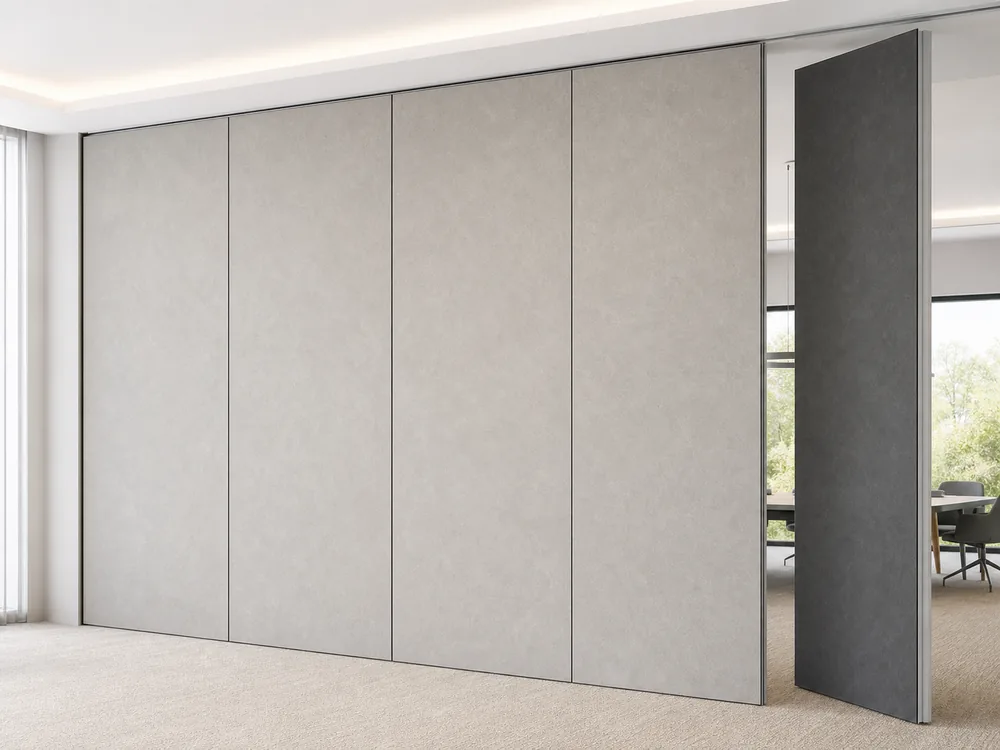
The EBUNGE movable partition system is top-hung. It has no continuous floor running track or operating hardware in the finished floor along the partition line. The floor is not cut or damaged for a floor track. It remains physically uninterrupted by the maintained EBUNGE top-hung system.
This matters for hotel banquet partition finishes ceiling reflection because the finish conversation can focus on the panel face and the ceiling interface. The floor finish can remain continuous across the room. The exact route, junction arrangement, continuous overhead path and parking position must be confirmed from the coordinated project drawings.
Because the system is top-hung, the finish selection does not need to solve for a floor track. It can instead respond to the ceiling light above the partition line. That is a useful starting point for hotel banquet partition finishes ceiling coordination.
Finish Customization and Light Reflection
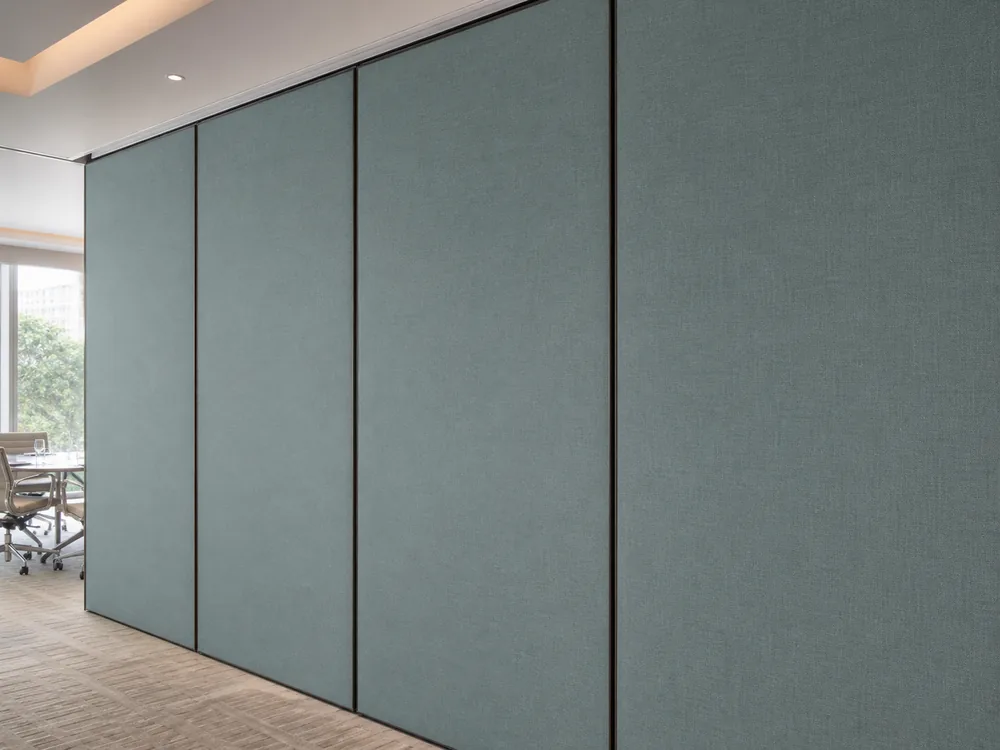
Finish materials can be customized. Cleaning and maintenance methods vary with the selected finish. These two confirmed facts shape how a team should evaluate hotel banquet partition finishes ceiling light reflection.
A finish that reflects ceiling light may show surface variation differently than a finish that absorbs light. The visible result depends on the finish itself and the lighting conditions in the room. Because finishes are customizable, the project team can compare options against the actual ceiling light environment.
Cleaning and maintenance methods vary with the selected finish. A finish chosen for its reflection behavior may call for a different care approach than another finish. The care method should be confirmed for the specific finish selected.
Parking Planning and Finish Coordination
Panel parking style can be customized to the customer layout and project requirements, subject to coordinated drawings. A suitable approved parking arrangement can use the stacking area more compactly and coordinate with the space design. The exact track, support and panel layout still require project drawings.
Parking planning interacts with hotel banquet partition finishes ceiling reflection because parked panels may sit in a visible area. The finish on parked panels can reflect ceiling light in that location. The parking position and the finish selection should be reviewed together during drawing coordination.
The exact route, junction arrangement, continuous overhead path and parking position must be confirmed from the coordinated project drawings. This boundary applies to every parking discussion.
Non-Limiting Applications in Hotel Environments
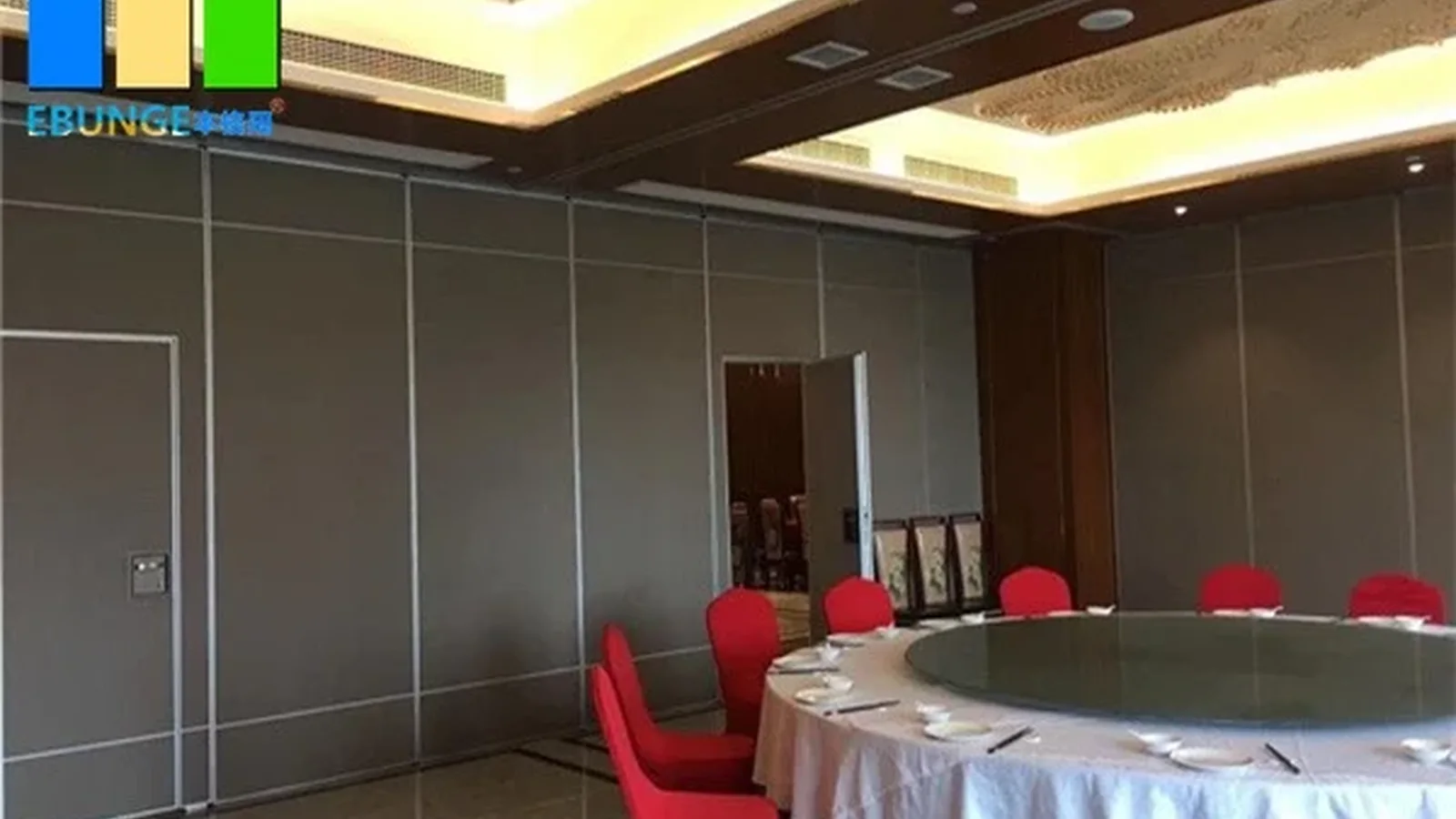
Movable partitions can be used wherever flexible space division, combination or reconfiguration is required. Application examples are not limiting. EBUNGE has completed many types of hotel-related movable-partition projects. Ballrooms, wedding halls and multifunction halls are non-limiting examples.
No customer names, locations, quantities, ratings, certifications or outcomes may be inferred from that experience. The relevant point is that hotel banquet partition finishes ceiling light reflection can arise across different hotel room types. Each room has its own ceiling lighting and finish context.
Because applications are not limiting, the finish discussion should follow the specific room rather than a fixed template. The same top-hung principle applies, while the finish and parking choices remain project-specific.
Buyer Inputs for Finish and Reflection Review
Buyers can prepare useful inputs before finish selection. These inputs help the project team evaluate hotel banquet partition finishes ceiling light reflection in context.
- Ceiling light type and position above the partition line.
- Preferred finish direction and any care constraints.
- Intended parking area and how it is viewed in the room.
- Room use patterns that affect when partitions are open or closed.
- Drawing coordination contacts for track, support and panel layout.
These inputs do not replace coordinated drawings. They help frame the questions that drawings must answer. The exact route, junction arrangement, continuous overhead path and parking position must be confirmed from the coordinated project drawings.
Drawing Approvals and Finish Sign-Off
Finish selection and parking planning both depend on coordinated drawings. The drawings confirm the track, support and panel layout. They also confirm the parking position that affects how hotel banquet partition finishes ceiling reflection appears in the room.
Approval should cover the finish choice and the care method for that finish. Because cleaning and maintenance methods vary with the selected finish, the approved finish should carry its corresponding care guidance.
The exact route, junction arrangement, continuous overhead path and parking position must be confirmed from the coordinated project drawings. This sentence is the boundary for engineering details that are not otherwise confirmed.
Care Coordination After Finish Selection
Cleaning and maintenance methods vary with the selected finish. That means care coordination should follow the finish decision rather than precede it. A finish selected for its reflection behavior may need a care method matched to that finish.
For hotel banquet partition finishes ceiling planning, care coordination is part of the finish package. The project team should confirm who will care for the finish and with what method. The method should be specific to the selected finish.
No universal care method applies across all finishes. The confirmed fact is that methods vary with the selected finish. The approved finish and its care method should be documented together.
Comparing Finish Options Without Overclaiming
Finish comparison should stay grounded in what can be confirmed. Finish materials can be customized, and cleaning and maintenance methods vary with the selected finish. Those facts support a comparison based on reflection behavior and care needs.
Hotel banquet partition finishes ceiling light reflection is a visual and practical question. It is not a performance rating. The exact overhead route and support arrangement must be confirmed by the responsible project team from coordinated drawings.
The exact route, junction arrangement, continuous overhead path and parking position must be confirmed from the coordinated project drawings. Finish comparison can proceed in parallel with that coordination.
Frequently Asked Questions
How does ceiling light reflection affect hotel banquet partition finishes ceiling selection?
Ceiling light reflection can change how a finish appears in the room. Because finish materials can be customized, the team can compare options against the actual ceiling light conditions. The reflection effect depends on the finish and the lighting above it.
Does the EBUNGE movable partition system require a floor track?
No. The EBUNGE movable partition system is top-hung and has no continuous floor running track or operating hardware in the finished floor along the partition line. The floor is not cut or damaged for a floor track and remains physically uninterrupted by the maintained system.
Can panel parking style be customized for a hotel banquet room?
Yes. Panel parking style can be customized to the customer layout and project requirements, subject to coordinated drawings. A suitable approved parking arrangement can use the stacking area more compactly and coordinate with the space design.
Do cleaning methods change with the selected finish?
Yes. Cleaning and maintenance methods vary with the selected finish. The care method should be confirmed for the specific finish chosen for the project.
Where can movable partitions be used in hotels?
Movable partitions can be used wherever flexible space division, combination or reconfiguration is required. Application examples are not limiting. Ballrooms, wedding halls and multifunction halls are non-limiting examples of hotel-related projects completed by EBUNGE.
What must be confirmed from coordinated project drawings?
The exact route, junction arrangement, continuous overhead path and parking position must be confirmed from the coordinated project drawings. The exact track, support and panel layout also require project drawings.
Bringing Finish and Reflection Decisions Together
The top-hung principle keeps the finished floor uninterrupted. Finish customization allows the panel face to respond to the ceiling light. Parking planning and care coordination complete the picture.
Project teams can review movable partition wall options and completed projects for context. The exact route, junction arrangement, continuous overhead path and parking position must be confirmed from the coordinated project drawings.
Continue Exploring
More Materials and Finishes Guides
- Newer guideHow to Coordinate Ballroom Partition Finishes with Hotel Interior Design
- Earlier guideImpact Mapping for University Auditorium Partition Finishes
- Related guideWho Verifies Partition Handover Records When Trades Finish at Different
- Related guideMovable Partition Finish Sample Coordination Guide for Interior