
Quick project answer
Restaurant partition seal grease interface planning affects how a function room is divided, combined and reconfigured. In food-service environments, the floor line and the parking area deserve early attention. The EBUNGE movable partition system is top-hung and has no continuous floor running track or operating hardware in the finished floor along the partition line. This article explains the implications for restaurant partition seal grease interface detailing without inventing performance claims.
Why the top-hung principle matters in restaurants
A top-hung system carries the panels from an overhead structure rather than from a floor guide. That principle shapes how the restaurant partition seal grease interface is considered at the floor. The floor is not cut or damaged for a floor track and remains physically uninterrupted by the maintained EBUNGE top-hung system.
The suitability of each route and parking arrangement depends on the approved layout, circulation, ceiling interfaces and operating sequence. The restaurant partition seal grease interface is therefore a planning topic rather than a product feature. The exact route, junction arrangement, continuous overhead path and parking position must be confirmed from the coordinated project drawings.
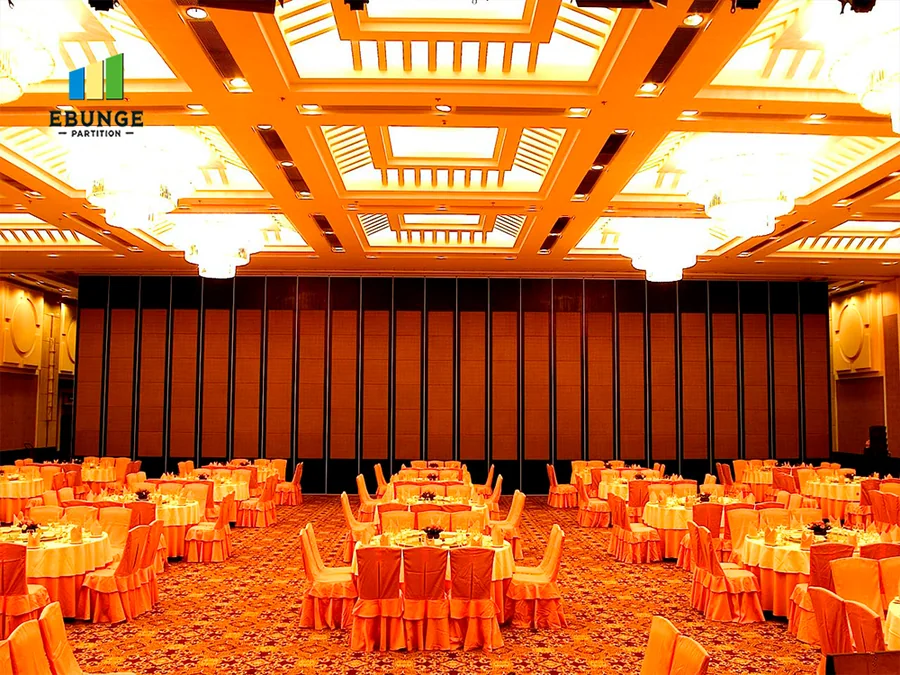
Physically uninterrupted floor and grease-zone planning
Grease and food residue are common in restaurant function rooms. Because the maintained EBUNGE top-hung system leaves the floor physically uninterrupted, the restaurant partition seal grease interface can be reviewed as part of the room’s cleaning and finish strategy. Cleaning and maintenance methods vary with the selected finish.
Finish materials can be customized. The restaurant partition seal grease interface should be discussed with the finish selection so that care routines match the chosen surface. No cleaning outcome is claimed here; the confirmed point is that care methods vary by finish.
Parking arrangements and compact stacking
Panel parking style can be customized to the customer layout and project requirements, subject to coordinated drawings. A suitable approved parking arrangement can use the stacking area more compactly and coordinate with the space design. The exact track, support and panel layout still require project drawings.
In a restaurant function room, the restaurant partition seal grease interface often relates to where panels rest when the room is open. Parking planning should account for service routes, table layouts and the physically uninterrupted floor. The exact route, junction arrangement, continuous overhead path and parking position must be confirmed from the coordinated project drawings.
Finish selection and care coordination
Finish materials can be customized, and cleaning and maintenance methods vary with the selected finish. For the restaurant partition seal grease interface, finish choice and care planning should be coordinated together. The physically uninterrupted floor remains a fixed condition of the maintained EBUNGE top-hung system.
Buyers should confirm which finish is appropriate for their restaurant environment and how that finish is cared for. The restaurant partition seal grease interface discussion should remain tied to the coordinated drawings and the selected finish, not to assumed performance.
Non-limiting applications for flexible space division
Movable partitions can be used wherever flexible space division, combination or reconfiguration is required; application examples are not limiting. EBUNGE has completed many types of hotel-related movable-partition projects. Ballrooms, wedding halls and multifunction halls are non-limiting examples.
Restaurant function rooms are another possible context for the restaurant partition seal grease interface. No customer names, locations, quantities, ratings, certifications or outcomes may be inferred from these examples. The restaurant partition seal grease interface remains a project-specific detailing topic.
Buyer inputs needed before drawings
Useful buyer inputs include the intended room uses, the desired parking style, the preferred finish direction and the way the floor is cleaned. These inputs help the restaurant partition seal grease interface discussion stay grounded in the actual layout. The exact route, junction arrangement, continuous overhead path and parking position must be confirmed from the coordinated project drawings.
Because the EBUNGE system is top-hung, the floor is not cut or damaged for a floor track and remains physically uninterrupted. That confirmed condition should be reflected in the restaurant partition seal grease interface brief from the start.
Drawing approvals and coordinated details
Panel parking style can be customized to the customer layout and project requirements, subject to coordinated drawings. A suitable approved parking arrangement can use the stacking area more compactly and coordinate with the space design. The exact track, support and panel layout still require project drawings.
For the restaurant partition seal grease interface, drawing approvals should confirm the overhead path, the parking position and the finish direction. The exact route, junction arrangement, continuous overhead path and parking position must be confirmed from the coordinated project drawings.
- Confirm the top-hung principle and the physically uninterrupted floor condition.
- Review parking style options against the restaurant layout and service routes.
- Select a finish and align care methods with that finish.
- Record buyer inputs for the restaurant partition seal grease interface brief.
- Use coordinated project drawings to confirm the exact route, junction arrangement, continuous overhead path and parking position.

Quick reference for project teams
| Topic | Confirmed point | Project action |
|---|---|---|
| System principle | EBUNGE movable partition system is top-hung | Confirm overhead path in drawings |
| Floor condition | No continuous floor running track or operating hardware in the finished floor along the partition line | Keep floor physically uninterrupted |
| Parking | Parking style can be customized, subject to coordinated drawings | Coordinate stacking area with space design |
| Finish and care | Finish materials can be customized; care methods vary by finish | Match care routine to selected finish |
The exact route, junction arrangement, continuous overhead path and parking position must be confirmed from the coordinated project drawings.
FAQ: restaurant partition seal grease interface
For further context, review related project guidance and additional planning resources before preparing the coordinated project brief.
Does the EBUNGE movable partition system use a floor track?
No. The EBUNGE movable partition system is top-hung and has no continuous floor running track or operating hardware in the finished floor along the partition line.
Is the floor cut or damaged for a floor track?
The floor is not cut or damaged for a floor track and remains physically uninterrupted by the maintained EBUNGE top-hung system.
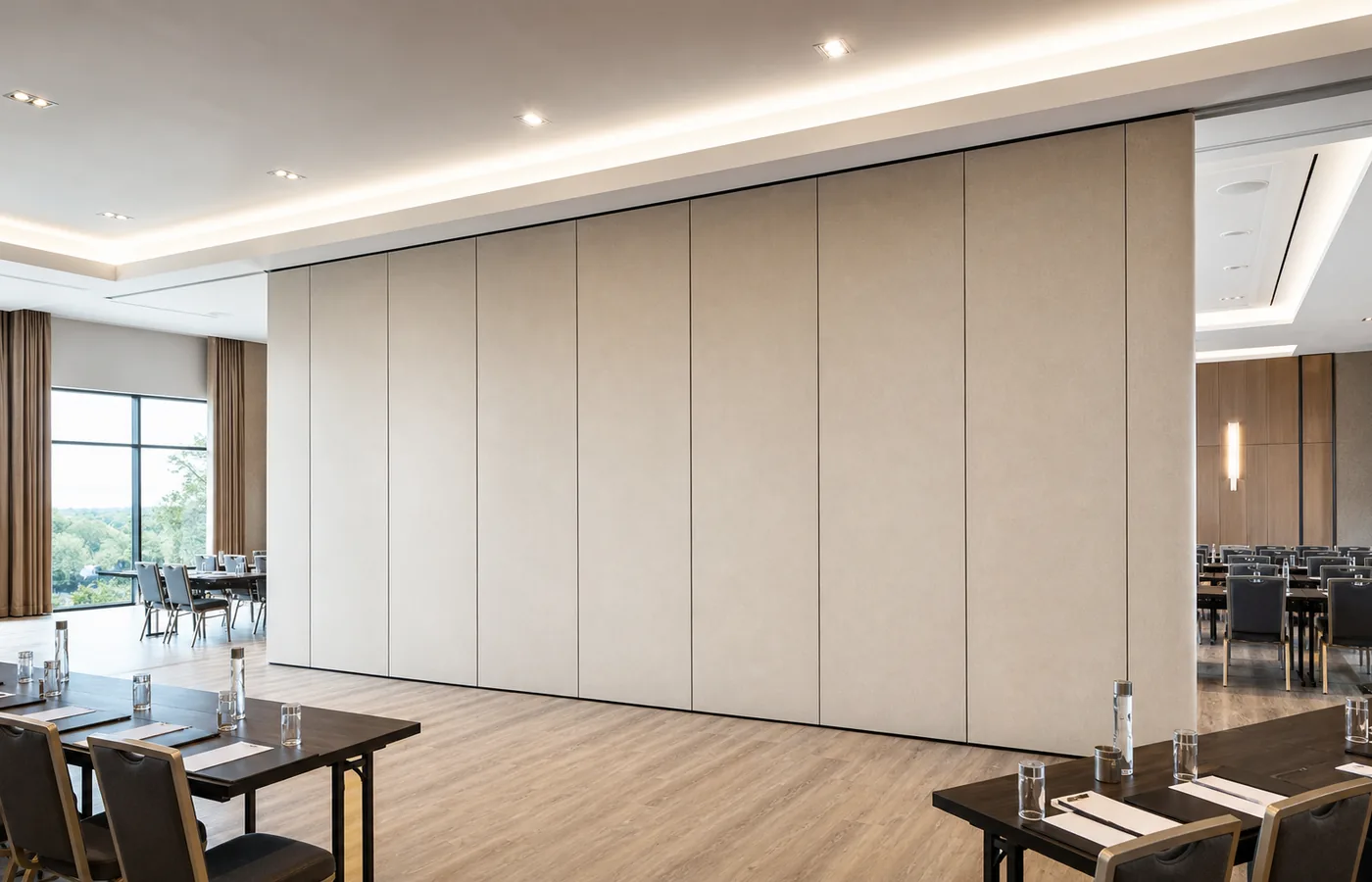
Can panel parking style be customized?
Yes. Panel parking style can be customized to the customer layout and project requirements, subject to coordinated drawings. A suitable approved parking arrangement can use the stacking area more compactly and coordinate with the space design.
Can finish materials be customized for a restaurant function room?
Yes. Finish materials can be customized, and cleaning and maintenance methods vary with the selected finish.
Where can movable partitions be used?
Movable partitions can be used wherever flexible space division, combination or reconfiguration is required; application examples are not limiting. EBUNGE has completed many types of hotel-related movable-partition projects, and ballrooms, wedding halls and multifunction halls are non-limiting examples.
What must be confirmed from coordinated project drawings?
The exact route, junction arrangement, continuous overhead path and parking position must be confirmed from the coordinated project drawings. The exact track, support and panel layout still require project drawings.
The exact overhead route and support arrangement must be confirmed by the responsible project team from coordinated drawings.. These links support the restaurant partition seal grease interface review without implying performance outcomes.
Continue Exploring
More Acoustic Partition Guides
- Newer guideRestaurant Partition Seals: Private Dining vs Open Kitchen Noise
- Earlier guideCoordinating Auditorium Partition Stacking with Wall Acoustic Panels
- Related guideAcoustic Partition Ceiling Interface Zone Confirmation
- Related guideWho Confirms Ceiling Grid Line Before Acoustic Partition Track