
Quick project answer
Restaurant function rooms often sit close to kitchens, service corridors and dining areas where cooking air moves through the building. When these rooms are divided for private dining, meetings or events, the partition line becomes part of the room planning. This article reviews how restaurant function room partition seals can be planned around grease air paths using a top-hung movable partition approach.
Why Grease Air Paths Matter at the Partition Line
Cooking areas produce airborne grease particles that can travel with make-up air, exhaust balance and general room pressure. In a restaurant function room, the partition line may sit between a dining zone and a service zone. That position makes the partition line a useful planning reference for air movement.
Grease particles are not a reason to assume a partition will stop or capture them. Instead, the topic belongs in the wider coordination of room use, cleaning routines and finish selection. Restaurant function room partition seals should be considered alongside the air path rather than treated as a separate item.
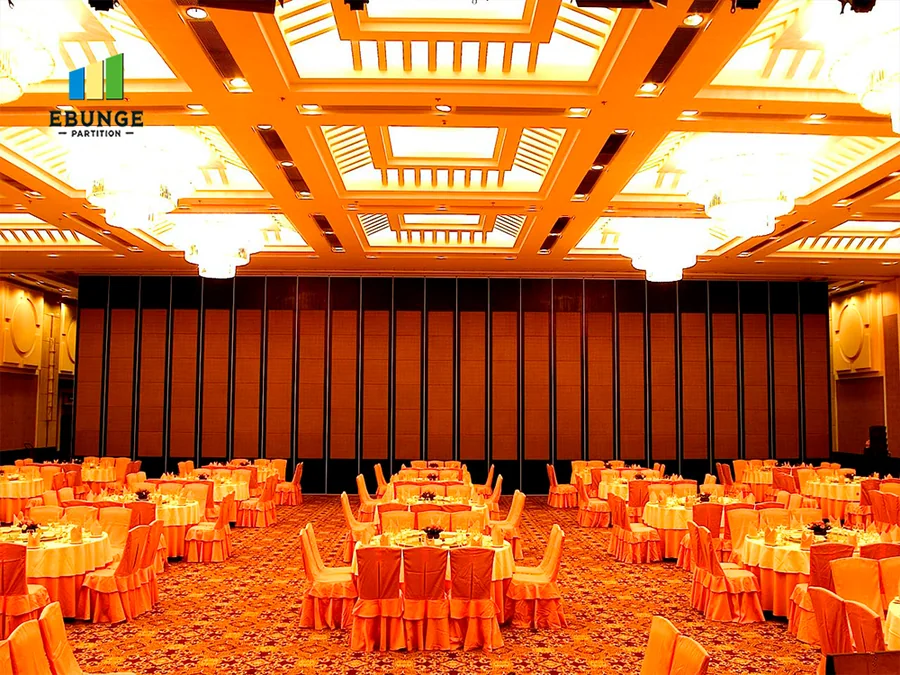
Where air moves from a kitchen toward a function room, the partition line may be one of several boundaries. The planning question is how the partition system interacts with the floor, the ceiling zone and the parking area. The suitability of each route and parking arrangement depends on the approved layout, circulation, ceiling interfaces and operating sequence.
The Top-Hung Principle and the Uninterrupted Floor
The EBUNGE movable partition system is top-hung. It has no continuous floor running track or operating hardware in the finished floor along the partition line. This means the floor is not cut or damaged for a floor track and remains physically uninterrupted by the maintained EBUNGE top-hung system.
For a restaurant function room, an uninterrupted floor can simplify how the room is cleaned and how guests move through the space. It also means the partition line does not introduce a floor slot that could collect debris or interfere with floor finishes. Restaurant function room partition seals can therefore be planned around the overhead support rather than a floor track.
The exact route, junction arrangement, continuous overhead path and parking position must be confirmed from the coordinated project drawings. This boundary applies to every project, including restaurant function rooms where grease air paths are part of the brief.
Planning Parking for Panels Near Service Zones
Panel parking style can be customized to the customer layout and project requirements, subject to coordinated drawings. A suitable approved parking arrangement can use the stacking area more compactly and coordinate with the space design. The exact track, support and panel layout still require project drawings.
In a restaurant function room, the parking area may sit near a service entrance, a storage alcove or a wall return. Planning that area early helps the design team check how the stacked panels relate to adjacent finishes and cleaning routes. Restaurant function room partition seals should be reviewed with the same drawing set.
Parking decisions are not universal. The project drawings define the approved arrangement, and the drawings also show how the overhead path connects to the parking position. Buyers should treat parking as a coordinated design item rather than a fixed default.
Finish Selection and Care Coordination
Finish materials can be customized, and cleaning and maintenance methods vary with the selected finish. This matters in restaurant function rooms, where food service, guest use and grease air paths can affect how surfaces are treated over time.
Because care methods vary by finish, the project team should align the chosen finish with the cleaning routine for the room. Restaurant function room partition seals are part of that conversation, but the finish itself determines the appropriate care approach. No single cleaning method applies to every finish.
Finish coordination also affects how the partition line reads within the room. A finish selected for a dining area may differ from one selected for a service-adjacent zone. The confirmed position is that finishes are customizable and that care follows the finish, not a universal rule.
Non-Limiting Applications for Movable Partitions
Movable partitions can be used wherever flexible space division, combination or reconfiguration is required. Application examples are not limiting. EBUNGE has completed many types of hotel-related movable-partition projects; ballrooms, wedding halls and multifunction halls are non-limiting examples.
Restaurant function rooms are another context where flexible division may be useful. A room may need to host a private dinner, a training session or a larger event on different days. Restaurant function room partition seals can be planned as part of that flexibility, provided the drawings confirm the overhead path and parking.
No customer names, locations, quantities, ratings, certifications or outcomes may be inferred from the completed project types. The confirmed point is the range of hotel-related experience, not a claim about any specific result.
Buyer Inputs and Drawing Approvals

Buyers can prepare useful inputs before drawings are developed. These inputs help the project team coordinate the partition line with the room layout, the parking area and the finish schedule. Restaurant function room partition seals should be listed among the items to confirm.
- Room layouts showing how the function room may be divided or combined.
- Parking area options and any adjacent storage or service zones.
- Finish preferences for the partition and surrounding surfaces.
- Cleaning routines that relate to the selected finish.
- Any air path notes from the wider building coordination.
The exact route, junction arrangement, continuous overhead path and parking position must be confirmed from the coordinated project drawings. Approval of those drawings is the point at which the project-specific arrangement becomes clear.
Reviewing the Partition Line Before Approval
A practical review can follow a simple order. The goal is to confirm that the top-hung principle, the uninterrupted floor and the parking plan are all reflected in the drawings. Restaurant function room partition seals should appear in the same review.
- Confirm the room division and combination scenarios.
- Confirm the parking area and its relationship to the layout.
- Confirm the finish selection and the care method that follows it.
- Confirm the overhead path and parking position from the coordinated drawings.
This order keeps the discussion on confirmed items. It does not prescribe an installation sequence or a universal operating procedure. It simply helps buyers and project teams check the drawing set before approval.
Frequently Asked Questions
For further context, review related project guidance and additional planning resources before preparing the coordinated project brief.
Do restaurant function room partition seals require a floor track?
No. The EBUNGE movable partition system is top-hung and has no continuous floor running track or operating hardware in the finished floor along the partition line. The floor is not cut or damaged for a floor track and remains physically uninterrupted by the maintained EBUNGE top-hung system.
Can the partition line be planned around grease air paths?
The partition line can be included in the wider coordination of room use, air movement and cleaning routines. The exact route, junction arrangement, continuous overhead path and parking position must be confirmed from the coordinated project drawings.
How is panel parking decided for a restaurant function room?
Panel parking style can be customized to the customer layout and project requirements, subject to coordinated drawings. A suitable approved parking arrangement can use the stacking area more compactly and coordinate with the space design. The exact track, support and panel layout still require project drawings.
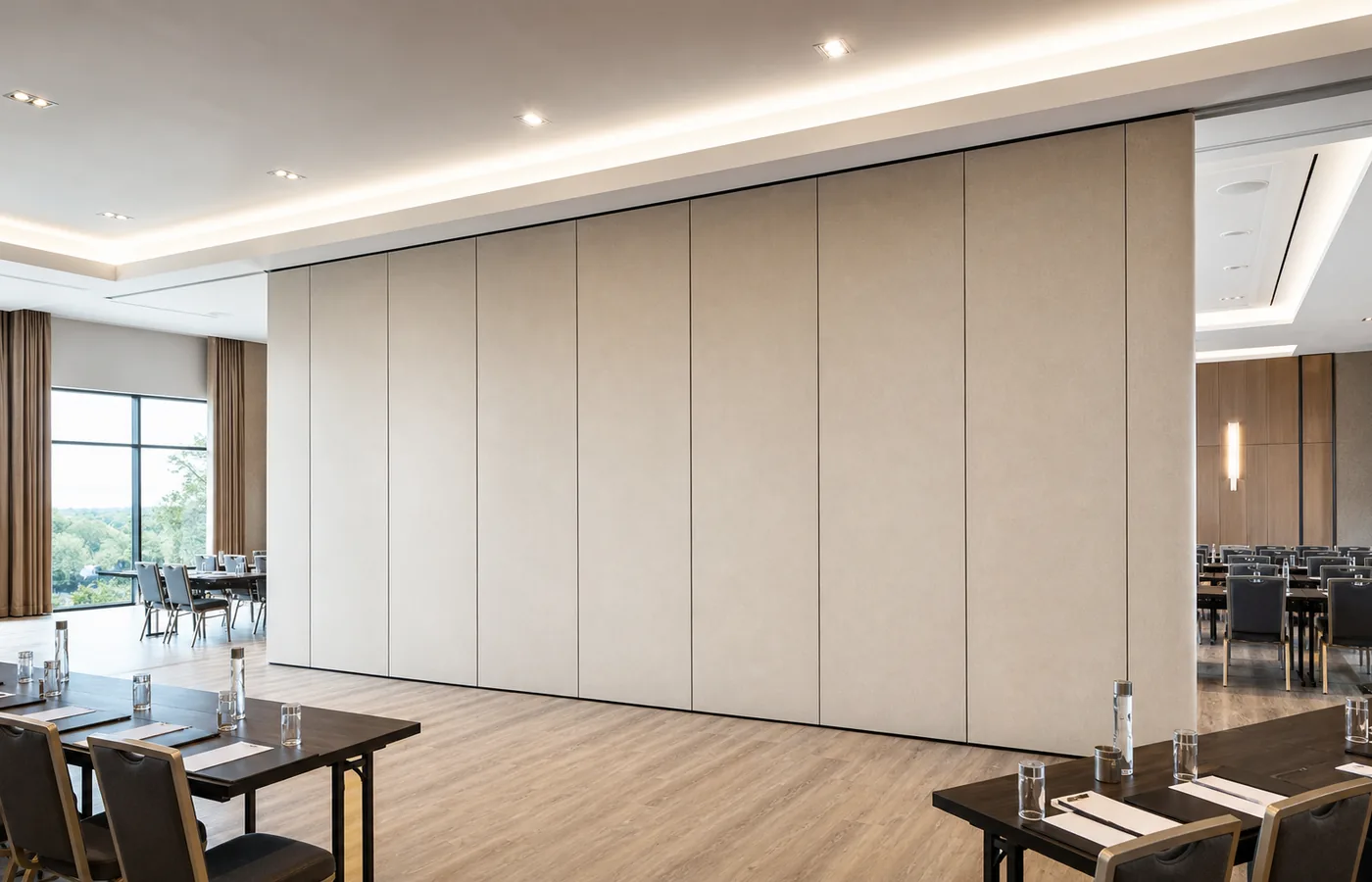
Are finishes and cleaning methods fixed for every project?
Finish materials can be customized, and cleaning and maintenance methods vary with the selected finish. The project team should align the chosen finish with the cleaning routine for the room rather than assume one method applies everywhere.
Where can movable partitions be used?
Movable partitions can be used wherever flexible space division, combination or reconfiguration is required. Application examples are not limiting. EBUNGE has completed many types of hotel-related movable-partition projects; ballrooms, wedding halls and multifunction halls are non-limiting examples.
What should buyers prepare before drawing approval?
Buyers can prepare room layouts, parking area options, finish preferences and cleaning routine notes. The exact route, junction arrangement, continuous overhead path and parking position must be confirmed from the coordinated project drawings.
The exact overhead route and support arrangement must be confirmed by the responsible project team from coordinated drawings..
Continue Exploring
More Acoustic Partition Guides
- Newer guideCeiling Grease Filter Edges for Restaurant Partition Seals
- Earlier guideSchool Auditorium Partition Stacking: Wall-Mounted Acoustic Panel Edges
- Related guideAcoustic Partition Ceiling Interface Zone Confirmation
- Related guideWho Confirms Ceiling Grid Line Before Acoustic Partition Track