
Top-Hung Principle for School Auditorium Partition Stacking Speaker Coordination
Quick project answer
The EBUNGE movable partition system is top-hung. It has no continuous floor running track or operating hardware in the finished floor along the partition line. This principle directly affects school auditorium partition stacking speaker planning because the floor remains physically uninterrupted. The exact route, junction arrangement, continuous overhead path and parking position must be confirmed from the coordinated project drawings.
Because the system is top-hung, the finished floor is not cut or damaged for a floor track. This helps preserve the auditorium floor surface for daily school use. It also means that school auditorium partition stacking speaker coordination must focus on overhead support and ceiling elements rather than floor-mounted guides.
Movable partitions can be used wherever flexible space division, combination or reconfiguration is required. Application examples are not limiting. For a school auditorium, this flexibility may support dividing a large hall into smaller activity zones or combining spaces for assemblies. The exact track, support and panel layout still require project drawings.
Physically Uninterrupted Floor and Its Planning Implications

The floor remains physically uninterrupted by the maintained EBUNGE top-hung system. No floor track means no continuous gap or hardware strip along the partition line. This is a key consideration when school auditorium partition stacking speaker planning includes floor finishes, seating layouts or access routes.
Because the floor is not cut or damaged for a floor track, the architect and school can plan floor patterns without a permanent line of hardware. However, the absence of a floor track does not remove the need for coordinated overhead support. The exact route, junction arrangement, continuous overhead path and parking position must be confirmed from the coordinated project drawings.
School auditorium partition stacking speaker coordination should therefore treat the floor as a clean, uninterrupted plane. Any ceiling speaker baffles, lighting or other overhead elements must be planned alongside the partition track and parking area. This is a drawing-based exercise, not a generic sequence.
Parking Planning for School Auditorium Partition Stacking Speaker Layouts
Panel parking style can be customized to the customer layout and project requirements, subject to coordinated drawings. A suitable approved parking arrangement can use the stacking area more compactly and coordinate with the space design. For school auditorium partition stacking speaker planning, the parking area must be considered early because it affects ceiling speaker baffle positions and sightlines.
When the partition is not in use, panels need a designated parking position. That position may be along a wall, in a recess or in another approved location. The exact track, support and panel layout still require project drawings. School auditorium partition stacking speaker coordination should show how parked panels relate to ceiling speakers and other overhead services.
A compact parking arrangement can help preserve usable floor area. However, no universal parking solution applies to every school auditorium. The exact route, junction arrangement, continuous overhead path and parking position must be confirmed from the coordinated project drawings.
Finish and Care Coordination with Ceiling Speaker Baffles
Finish materials can be customized, and cleaning and maintenance methods vary with the selected finish. This means school auditorium partition stacking speaker planning should include finish selection alongside ceiling speaker baffle choices. The finish affects appearance and care, while the baffle layout affects overhead coordination.
Because cleaning and maintenance methods vary with the selected finish, the school and design team should confirm care requirements for the chosen finish. This is not a universal procedure. The exact route, junction arrangement, continuous overhead path and parking position must be confirmed from the coordinated project drawings.
School auditorium partition stacking speaker coordination also benefits from early decisions about finish and baffle materials. These choices influence how the overhead plane is organized. They do not, however, change the top-hung principle or the uninterrupted floor condition.
Non-Limiting Applications for Movable Partitions in Schools
Movable partitions can be used wherever flexible space division, combination or reconfiguration is required. Application examples are not limiting. In a school context, this may include auditoriums, multipurpose halls, drama rooms or community spaces. School auditorium partition stacking speaker planning is one specific case within this broader range.
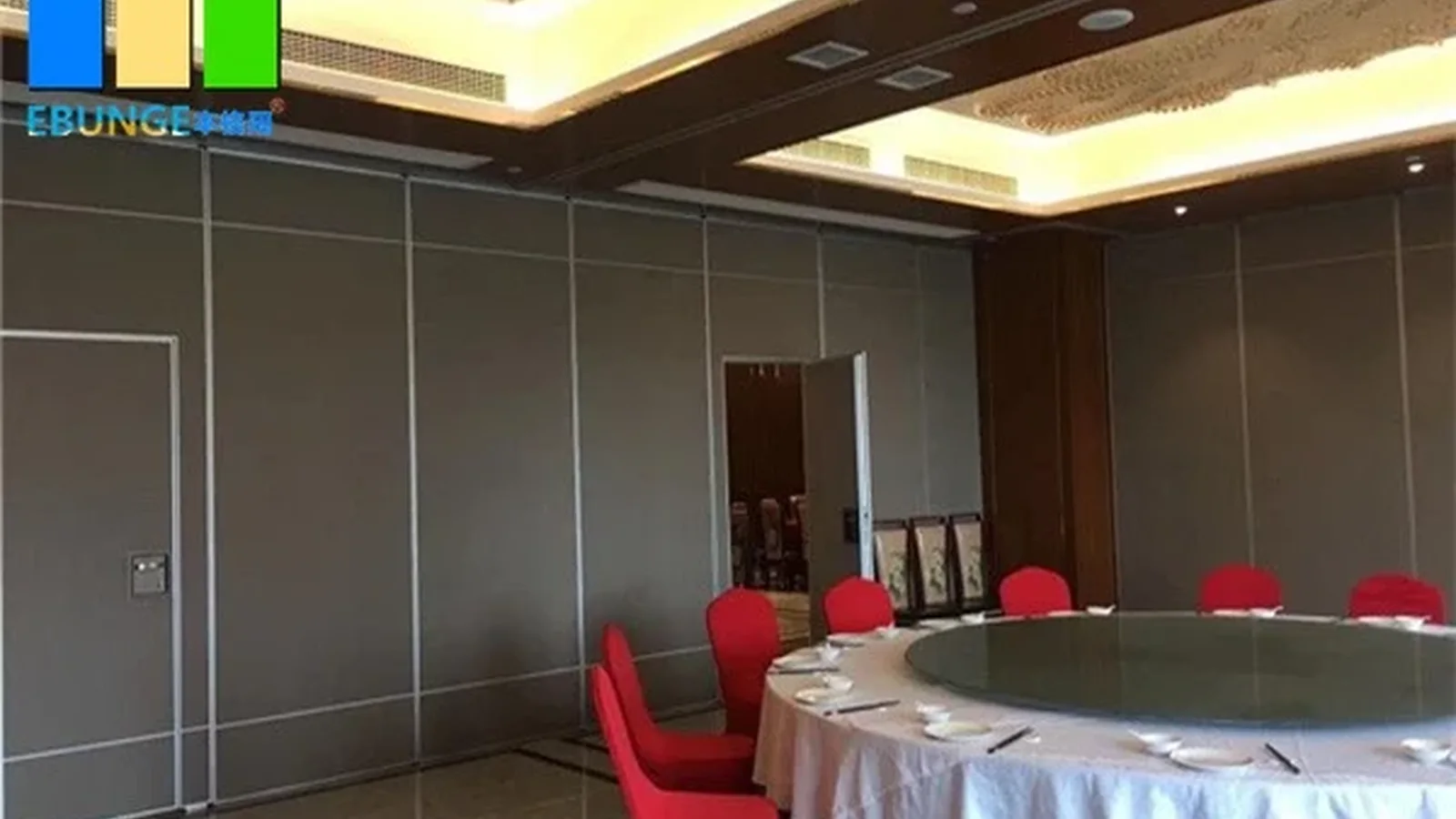
EBUNGE has completed many types of hotel-related movable-partition projects. Ballrooms, wedding halls and multifunction halls are non-limiting examples. No customer names, locations, quantities, ratings, certifications or outcomes may be inferred. The same top-hung principle applies across these project types.
For schools, the focus remains on flexible use and coordinated drawings. School auditorium partition stacking speaker coordination should not assume that a hotel example transfers directly. Each project requires its own approved layout.
Buyer Inputs and Drawing Approvals for School Auditorium Partition Stacking Speaker Projects
Buyers should provide clear information about the intended space division, parking preferences and ceiling speaker baffle locations. Panel parking style can be customized to the customer layout and project requirements, subject to coordinated drawings. This input helps the design team prepare accurate drawings.
The exact track, support and panel layout still require project drawings. School auditorium partition stacking speaker coordination depends on approved drawings that show the overhead path, parking position and baffle locations. Without these drawings, no reliable planning can proceed.
Finish materials can be customized, and cleaning and maintenance methods vary with the selected finish. Buyers should confirm finish preferences early so that care requirements can be reviewed. The exact route, junction arrangement, continuous overhead path and parking position must be confirmed from the coordinated project drawings.
Key Coordination Points for School Auditorium Partition Stacking Speaker Planning
- Confirm that the EBUNGE system is top-hung and has no continuous floor running track.
- Verify that the finished floor remains physically uninterrupted along the partition line.
- Plan the parking area with the approved stacking arrangement and ceiling speaker baffles.
- Select finish materials and review finish-specific cleaning and maintenance methods.
- Provide buyer inputs for layout, parking and overhead coordination.
- Obtain coordinated project drawings before finalizing any track, support or panel layout.
Drawing Approval Checklist
- Review the intended flexible space division and combination scenarios.
- Mark the proposed parking position and stacking area on the drawing.
- Show ceiling speaker baffle locations relative to the overhead path.
- Confirm finish selections and note finish-specific care requirements.
- Submit the coordinated drawings for approval before production planning.
Comparison of Planning Considerations
| Consideration | Top-Hung System | Planning Note |
|---|---|---|
| Floor track | No continuous floor running track | Floor remains physically uninterrupted |
| Parking | Customizable to layout | Subject to coordinated drawings |
| Finish | Customizable materials | Cleaning and maintenance vary by finish |
| Overhead | Top-hung support | Coordinate with ceiling speaker baffles |
The exact route, junction arrangement, continuous overhead path and parking position must be confirmed from the coordinated project drawings.
Frequently Asked Questions
Does the EBUNGE movable partition require a floor track?
No. The EBUNGE movable partition system is top-hung and has no continuous floor running track or operating hardware in the finished floor along the partition line. The floor is not cut or damaged for a floor track and remains physically uninterrupted by the maintained EBUNGE top-hung system.
Can panel parking be customized for a school auditorium?
Yes. Panel parking style can be customized to the customer layout and project requirements, subject to coordinated drawings. A suitable approved parking arrangement can use the stacking area more compactly and coordinate with the space design. The exact track, support and panel layout still require project drawings.
How do ceiling speaker baffles relate to school auditorium partition stacking speaker planning?
Ceiling speaker baffles are overhead elements that must be coordinated with the top-hung partition track and parking area. The exact route, junction arrangement, continuous overhead path and parking position must be confirmed from the coordinated project drawings. School auditorium partition stacking speaker planning should show baffle locations relative to the overhead path.
Are finish materials customizable, and how are they cleaned?
Finish materials can be customized, and cleaning and maintenance methods vary with the selected finish. The school and design team should confirm care requirements for the chosen finish. The exact route, junction arrangement, continuous overhead path and parking position must be confirmed from the coordinated project drawings.
What buyer inputs are needed for school auditorium partition stacking speaker projects?
Buyers should provide information about intended space division, parking preferences, ceiling speaker baffle locations and finish choices. Panel parking style can be customized to the customer layout and project requirements, subject to coordinated drawings. The exact track, support and panel layout still require project drawings.
Where can movable partitions be used in a school?
Movable partitions can be used wherever flexible space division, combination or reconfiguration is required. Application examples are not limiting. School auditorium partition stacking speaker coordination is one specific case. EBUNGE has completed many types of hotel-related movable-partition projects, but no customer names, locations, quantities, ratings, certifications or outcomes may be inferred.
For more information on movable partition systems, visit /movable-partition-wall/. To see project examples, visit /projects/.
Continue Exploring
More Operable Wall System Guides
- Newer guideRestaurant Room Partition Stacking: Ceiling Condenser Units
- Earlier guideOperable Wall Stacking Clearance Checks for School Auditorium Exits
- Related guideEvacuation Chair Routes Where Operable Walls Cross Accessible Paths
- Related guidePhase Operable Wall Work When a Renovation Adds a New Wing