
Understanding Healthcare Training Room Partition Seals and Simulator Interfaces
Quick project answer
Healthcare training rooms often need to switch between full-class instruction and small-group simulation. Movable partitions can divide or combine these spaces as schedules change. The EBUNGE system is top-hung, so the finished floor along the partition line stays physically uninterrupted. This matters when simulator interfaces, manikins, or mobile carts must roll across the room without a floor track in the way.
The suitability of each route and parking arrangement depends on the approved layout, circulation, ceiling interfaces and operating sequence. The floor is not cut or damaged for a floor track. That single principle shapes how simulator interfaces and training layouts can be coordinated.
The Top-Hung Principle for Training Rooms
In a top-hung movable partition, the panels hang from an overhead track. There is no continuous floor running track or operating hardware in the finished floor along the partition line. The floor remains physically uninterrupted by the maintained EBUNGE top-hung system.
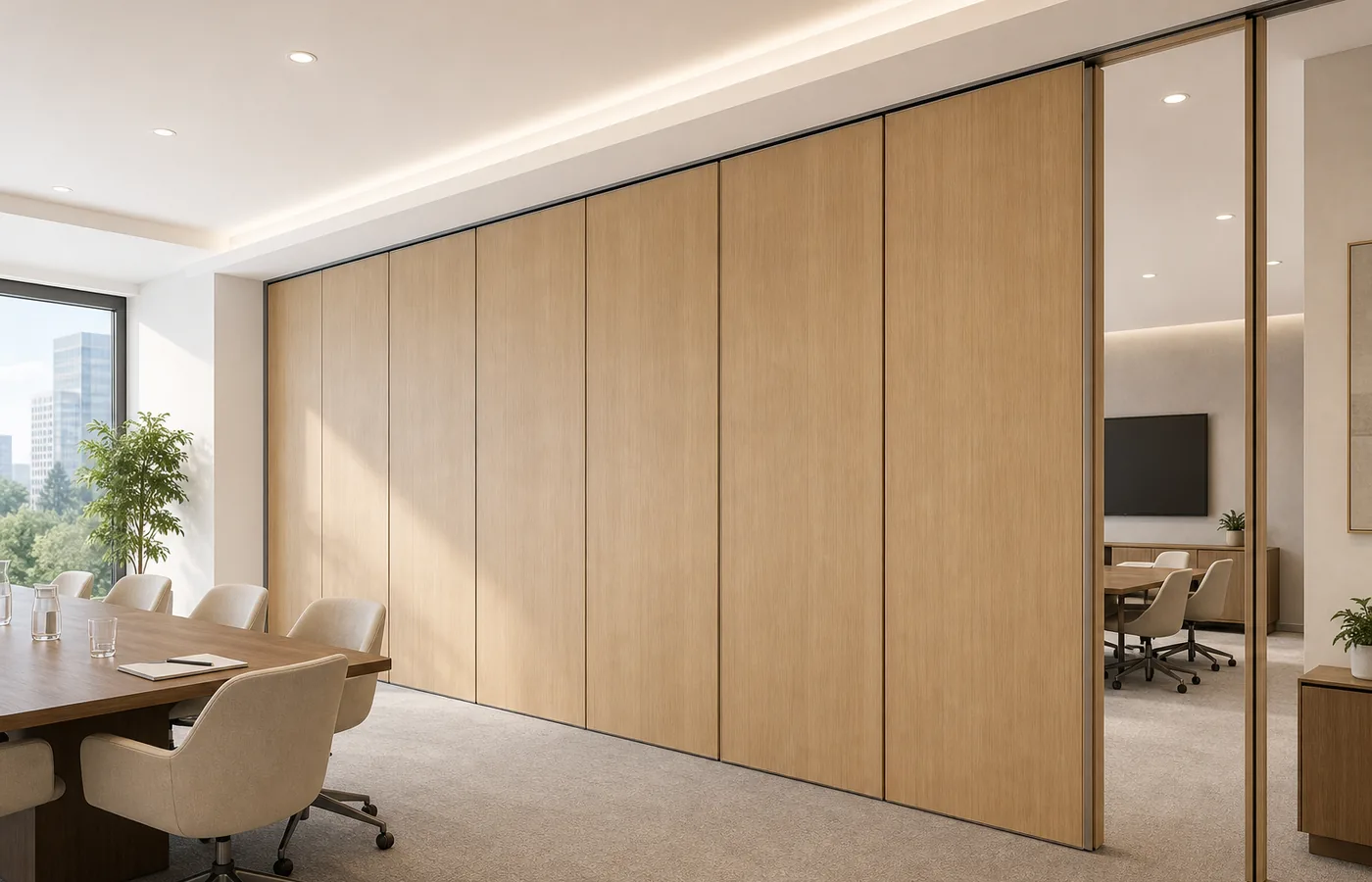
For healthcare training rooms, this means the floor surface can stay continuous where simulator interfaces, wheeled stretchers, or training carts are used. The partition line does not introduce a floor-mounted channel that would need to be crossed or cleaned around.
Healthcare training room partition seals are often discussed alongside simulator interfaces because both affect how a room is divided and used. The top-hung principle keeps the floor plane clear, which supports flexible reconfiguration without cutting the floor for a track.
Physically Uninterrupted Floor and Simulator Interfaces
A physically uninterrupted floor is a practical benefit in training environments. Simulator interfaces may include floor-standing equipment, cables, or mobile units that need a flat, continuous surface. Because the EBUNGE top-hung system does not require a floor track, the floor is not cut or damaged along the partition line.
Healthcare training room partition seals should be considered with the equipment plan. If a simulator interface sits near a partition line, the absence of a floor track can simplify layout coordination. The floor remains physically uninterrupted by the maintained system.
The exact route, junction arrangement, continuous overhead path and parking position must be confirmed from the coordinated project drawings.
Parking Planning for Movable Partitions
Panel parking style can be customized to the customer layout and project requirements, subject to coordinated drawings. A suitable approved parking arrangement can use the stacking area more compactly and coordinate with the space design.
In healthcare training rooms, parking location affects how simulator interfaces and teaching zones are arranged. The exact track, support and panel layout still require project drawings. Healthcare training room partition seals are part of that drawing review, not a standalone specification.
When parking is planned early, the stacking area can be coordinated with storage, circulation, and equipment positions. The goal is a workable layout that respects the confirmed top-hung principle and the project drawings.
Finish and Care Coordination
Finish materials can be customized, and cleaning and maintenance methods vary with the selected finish. This means the care approach for healthcare training room partition seals depends on the finish chosen for the project.
Different finishes may call for different cleaning products or methods. The project team should confirm finish-specific care instructions before the space is placed into service. No universal cleaning outcome should be assumed.
Cost and maintenance requirements depend on the selected configuration, finish and project conditions and require project-specific confirmation. The exact finish selection and care method remain project-specific.
Non-Limiting Applications in Healthcare Training
Movable partitions can be used wherever flexible space division, combination or reconfiguration is required. Application examples are not limiting. Healthcare training rooms are one possible use among many.
EBUNGE has completed many types of hotel-related movable-partition projects. Ballrooms, wedding halls and multifunction halls are non-limiting examples. No customer names, locations, quantities, ratings, certifications or outcomes may be inferred.
Healthcare training room partition seals and simulator interfaces are planning topics that sit within this broader flexibility. The confirmed facts about the top-hung system apply wherever the product is used.
Buyer Inputs and Drawing Approvals
Buyers should provide layout requirements, parking preferences, and finish direction early. Panel parking style can be customized to the customer layout and project requirements, subject to coordinated drawings.
The exact route, junction arrangement, continuous overhead path and parking position must be confirmed from the coordinated project drawings. This boundary sentence applies to all engineering details outside the confirmed facts.
Healthcare training room partition seals should be reviewed as part of the coordinated drawings. The floor remains physically uninterrupted by the maintained EBUNGE top-hung system, and the floor is not cut or damaged for a floor track.
Scannable Planning Checklist
- Confirm the top-hung principle: no continuous floor running track or operating hardware in the finished floor along the partition line.
- Verify that the floor is not cut or damaged for a floor track.
- Coordinate panel parking style with the customer layout and project requirements, subject to coordinated drawings.
- Select finish materials and confirm finish-specific cleaning and maintenance methods.
- Review healthcare training room partition seals within the coordinated project drawings.
Parking Options at a Glance
| Planning Item | Confirmed Status | Drawing Requirement |
|---|---|---|
| Panel parking style | Customizable to customer layout and project requirements | Subject to coordinated drawings |
| Stacking area use | Can be more compact with a suitable approved arrangement | Coordinate with space design |
| Track, support and panel layout | Not confirmed without drawings | Require project drawings |
The exact route, junction arrangement, continuous overhead path and parking position must be confirmed from the coordinated project drawings.
Frequently Asked Questions
What are healthcare training room partition seals?
Healthcare training room partition seals refer to the interface details around movable partitions in training rooms. The confirmed EBUNGE fact is that the system is top-hung and has no continuous floor running track or operating hardware in the finished floor along the partition line.
Does the EBUNGE partition require a floor track?
No. The EBUNGE movable partition system is top-hung and has no continuous floor running track or operating hardware in the finished floor along the partition line. The floor is not cut or damaged for a floor track.
Can panel parking be customized?
Yes. Panel parking style can be customized to the customer layout and project requirements, subject to coordinated drawings. A suitable approved parking arrangement can use the stacking area more compactly and coordinate with the space design.
Are finish materials customizable?
Yes. Finish materials can be customized, and cleaning and maintenance methods vary with the selected finish. The project team should confirm finish-specific care methods.
Where can movable partitions be used?
Movable partitions can be used wherever flexible space division, combination or reconfiguration is required. Application examples are not limiting. EBUNGE has completed many types of hotel-related movable-partition projects, with ballrooms, wedding halls and multifunction halls as non-limiting examples.

What must be confirmed from project drawings?
The exact route, junction arrangement, continuous overhead path and parking position must be confirmed from the coordinated project drawings. The exact track, support and panel layout also require project drawings.
Coordinating with Project Drawings
Healthcare training room partition seals and simulator interfaces should be resolved through coordinated drawings. The confirmed top-hung principle keeps the floor physically uninterrupted, but the exact route and parking position still require drawing confirmation.
Buyers can review products and projects for general information. Project-specific details must come from the coordinated drawings.
The exact route, junction arrangement, continuous overhead path and parking position must be confirmed from the coordinated project drawings. This boundary applies to every engineering detail outside the confirmed facts.
The floor remains physically uninterrupted by the maintained EBUNGE top-hung system, which supports flexible training room use.
Continue Exploring
More Acoustic Partition Guides
- Newer guideExhibition Hall Partition Seals: Ceiling Rigging Interface Zones
- Earlier guideSports Hall Partition Seals: Multi-Sport vs Event-Only Acoustics
- Related guideAcoustic Partition Ceiling Interface Zone Confirmation
- Related guideWho Confirms Ceiling Grid Line Before Acoustic Partition Track