
Quick project answer
A healthcare training room partition track is often planned where ceiling service columns already occupy the overhead zone. The partition line must respect those fixed elements while still dividing training rooms from adjacent areas. This article explains how a top-hung movable partition system works, why the finished floor stays physically uninterrupted, and which project inputs support coordinated drawings.
Why the Top-Hung Principle Matters in Healthcare Training Rooms
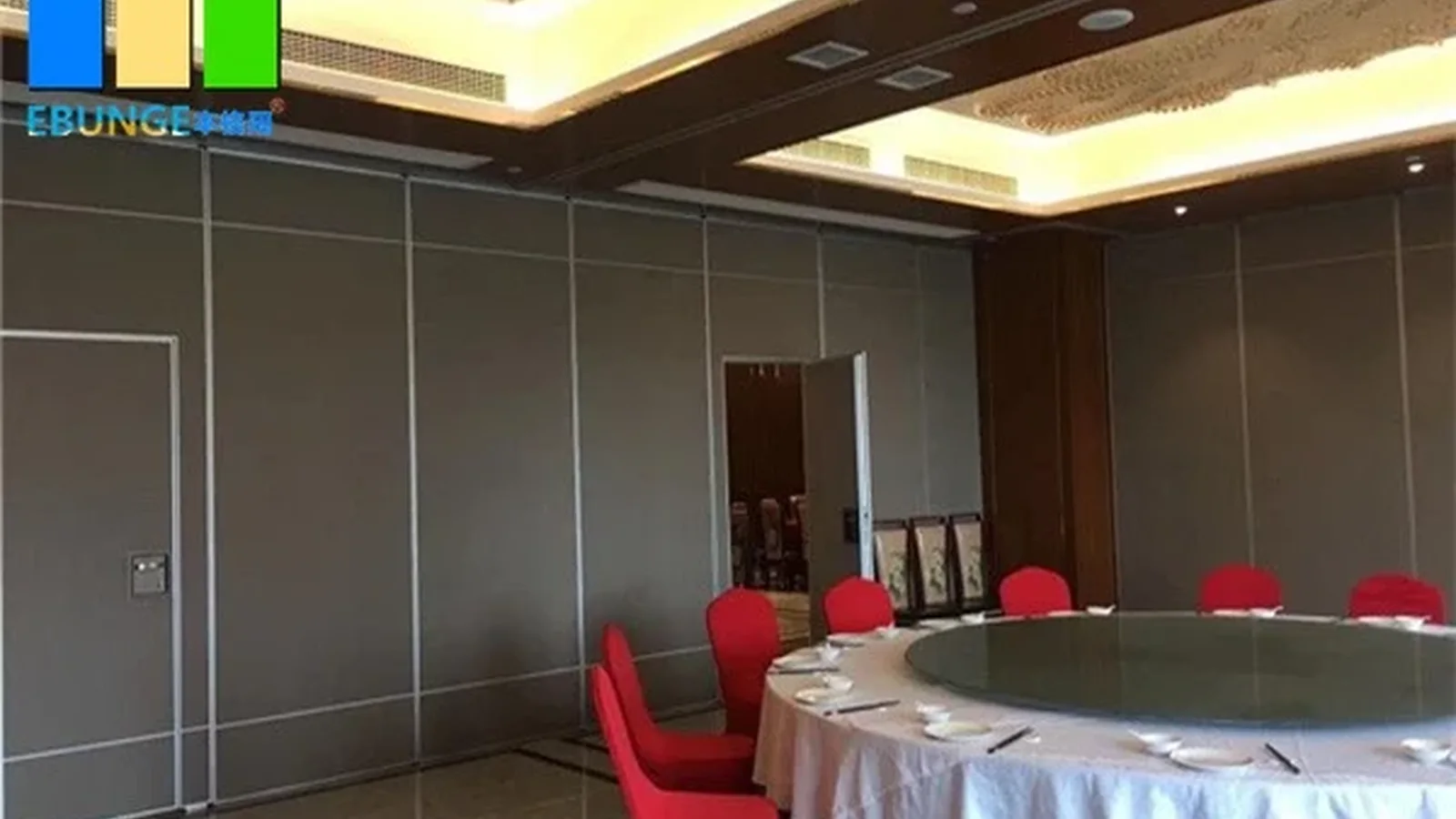
The EBUNGE movable partition system is top-hung. Panels hang from an overhead track rather than rolling on hardware set into the finished floor. This principle shapes early planning because the partition line is defined above the room, not across the walking surface.
In a healthcare training room, the floor may be shared with chairs, tables, training equipment and circulation routes. A top-hung arrangement keeps that floor free of a continuous running track along the partition line. The healthcare training room partition track therefore becomes an overhead coordination item rather than a floor construction item.
Ceiling service columns can interrupt the overhead zone. The exact route, junction arrangement, continuous overhead path and parking position must be confirmed from the coordinated project drawings.

Physically Uninterrupted Floor Along the Partition Line
With the maintained EBUNGE top-hung system, the floor is not cut or damaged for a floor track. The finished floor remains physically uninterrupted along the partition line. That matters when the training room floor is already finished or when floor continuity is part of the room layout.
No continuous floor running track or operating hardware sits in the finished floor along the partition line. This does not remove the need for coordination. It changes where coordination is focused: the overhead track, its supports and the parking area.
Healthcare training rooms may be reconfigured for different group sizes or session types. A healthcare training room partition track that stays overhead allows the floor to remain a single continuous surface between training layouts.
Parking Planning Around Ceiling Service Columns
Panel parking style can be customized to the customer layout and project requirements, subject to coordinated drawings. Parking is where panels rest when the room is open. A suitable approved parking arrangement can use the stacking area more compactly and coordinate with the space design.
Ceiling service columns may sit near a possible stacking zone. The parking position, track route and support layout must be confirmed from the coordinated project drawings. The exact route, junction arrangement, continuous overhead path and parking position must be confirmed from the coordinated project drawings.
Parking planning is not a product selection alone. It links the healthcare training room partition track to the room’s usable area, adjacent corridors and the way trainers set up the space.
Finish and Care Coordination for Training Environments
Finish materials can be customized, and cleaning and maintenance methods vary with the selected finish. Healthcare training rooms may have their own surface expectations, so finish selection should be coordinated with the project team.
Because care methods differ by finish, the project should record which finish is selected and how it is expected to be maintained. This is a finish-specific topic, not a universal cleaning claim.
The healthcare training room partition track itself is part of the overhead system. Finish coordination should include the visible panel faces and the surrounding room surfaces without assuming a single care routine for every project.
Non-Limiting Applications for Movable Partitions
Movable partitions can be used wherever flexible space division, combination or reconfiguration is required. Application examples are not limiting. A healthcare training room is one possible setting among many.
EBUNGE has completed many types of hotel-related movable-partition projects. Ballrooms, wedding halls and multifunction halls are non-limiting examples. No customer names, locations, quantities, ratings, certifications or outcomes may be inferred from those examples.
For a healthcare training room partition track, the same top-hung principle applies: the system divides space without a continuous floor track along the partition line. The project drawings define how that principle lands in the actual room.
Buyer Inputs That Support Coordinated Drawings
Useful buyer inputs include the room layout, the intended training configurations, the location of ceiling service columns and the preferred parking zone. These inputs help the project team develop coordinated drawings for the healthcare training room partition track.
Panel parking style can be customized to the customer layout and project requirements, subject to coordinated drawings. Finish materials can be customized. Both choices should be recorded before drawings are finalized.
The exact route, junction arrangement, continuous overhead path and parking position must be confirmed from the coordinated project drawings. This boundary sentence applies to every engineering detail outside the confirmed facts.
Drawing Approvals and Project Coordination
Coordinated drawings are the control point for the healthcare training room partition track. They show how the overhead path relates to ceiling service columns and where panels park when the room is open.
A suitable approved parking arrangement can use the stacking area more compactly and coordinate with the space design. Approval should confirm the parking position and the relationship between the track route and the room layout.
Finish selection and care expectations should also be coordinated. Cleaning and maintenance methods vary with the selected finish, so the approved drawings and finish schedule should align.
Scannable Planning Checklist
- Confirm the training room layout and the partition line.
- Identify ceiling service columns that affect the overhead zone.
- Record the preferred parking zone and stacking area.
- Select a finish and note its care method.
- Review coordinated drawings before finalizing the healthcare training room partition track.
Comparison of Coordination Topics
| Topic | What Is Confirmed | What Requires Drawings |
|---|---|---|
| Floor | No continuous floor track; floor not cut or damaged | Finished floor interface at the partition line |
| Overhead | Top-hung EBUNGE system | Exact route, junction arrangement and continuous overhead path |
| Parking | Parking style can be customized | Parking position and support layout |
| Finish | Finish materials can be customized | Care method for the selected finish |
For engineering details outside the confirmed facts, the project team should rely on the coordinated drawings rather than assumptions about the ceiling zone.
Frequently Asked Questions
Does a healthcare training room partition track require cutting the finished floor?
No. The EBUNGE movable partition system is top-hung and has no continuous floor running track or operating hardware in the finished floor along the partition line. The floor is not cut or damaged for a floor track and remains physically uninterrupted by the maintained EBUNGE top-hung system.
How do ceiling service columns affect the healthcare training room partition track?
Ceiling service columns occupy part of the overhead zone. The exact route, junction arrangement, continuous overhead path and parking position must be confirmed from the coordinated project drawings.
Can panel parking be customized for the room layout?
Yes. Panel parking style can be customized to the customer layout and project requirements, subject to coordinated drawings. A suitable approved parking arrangement can use the stacking area more compactly and coordinate with the space design.
Can finish materials be customized?
Finish materials can be customized, and cleaning and maintenance methods vary with the selected finish. The finish selection and its care method should be coordinated with the project team.
Where can movable partitions be used?
Movable partitions can be used wherever flexible space division, combination or reconfiguration is required. Application examples are not limiting. EBUNGE has completed many types of hotel-related movable-partition projects, with ballrooms, wedding halls and multifunction halls as non-limiting examples.
What should buyers provide for drawing coordination?
Buyers should provide the room layout, intended training configurations, ceiling service column locations and preferred parking zone. These inputs support coordinated drawings for the healthcare training room partition track.
For related products and project references, see /products/ and /projects/. The healthcare training room partition track should be planned with the same drawing discipline as any other movable partition application.
Continue Exploring
More Project Applications Guides
- Newer guideUniversity Training Partition Track: Ceiling Sprinkler Head Escutcheons
- Earlier guidePlanning Manual Restaurant Partition Use for Concurrent Dining
- Related guideOffice Glass Partition Selection Guide for Fit-Out Contractors
- Related guideOffice Meeting Suite Partition Tracks Need Clearance at Ceiling-Mounted