
Why the interface matters before drawings are issued
Quick project answer
The interface between an office meeting suite partition track and wall AV panels is a coordination point, not a product selection. The partition is top-hung, so the overhead path and the wall-mounted AV panel both occupy the same zone. Detailing this interface early keeps the drawing set consistent for the whole meeting suite.
This article explains the confirmed principles of the EBUNGE movable partition system and the inputs a buyer should prepare. It does not describe a universal operating sequence, and it does not replace project-specific engineering.
The top-hung principle and what it means for the wall
The EBUNGE movable partition system is top-hung. Panels are carried from an overhead track rather than from a floor guide. That single principle shapes how the office meeting suite partition track relates to the wall AV panel and to the surrounding ceiling zone.

Because the system is top-hung, the finished floor along the partition line has no continuous floor running track and no operating hardware. The floor is not cut or damaged for a floor track. It remains physically uninterrupted by the maintained EBUNGE top-hung system.
For a meeting suite, that uninterrupted floor is a planning fact. It affects how the room is furnished, how the AV wall is approached and how the office meeting suite partition track is shown on the reflected ceiling plan.
Physically uninterrupted floor and the AV wall zone
A wall AV panel is typically mounted on a finished wall surface. The partition line may meet that same wall, or it may run parallel to it. Either way, the office meeting suite partition track overhead and the AV panel on the wall are separate assemblies that must be shown together.
Because there is no floor track, the wall base and the floor finish can run continuously past the partition line. This is a confirmed property of the maintained EBUNGE top-hung system, not a claim about any other partition type.
The exact route, junction arrangement, continuous overhead path and parking position must be confirmed from the coordinated project drawings.
Parking planning and the office meeting suite partition track
Panel parking style can be customized to the customer layout and project requirements, subject to coordinated drawings. A suitable approved parking arrangement can use the stacking area more compactly and coordinate with the space design.
The exact track, support and panel layout still require project drawings. Parking is therefore a drawing decision, not a catalogue default. It should be resolved alongside the wall AV panel position so that the two do not compete for the same zone.
When the office meeting suite partition track and the parking area are drawn together, the meeting suite can be reviewed as one coordinated room rather than as separate packages.
Finish and care coordination at the AV wall
Finish materials can be customized, and cleaning and maintenance methods vary with the selected finish. That means the finish schedule for the partition and the finish schedule for the AV wall should be read together.
Care instructions follow the finish that is actually selected. They are not a fixed set that applies to every project. The buyer should confirm the finish direction before care documentation is finalised.
The exact route, junction arrangement, continuous overhead path and parking position must be confirmed from the coordinated project drawings.
Non-limiting applications across hospitality and workplace
Movable partitions can be used wherever flexible space division, combination or reconfiguration is required. Application examples are not limiting. The same top-hung principle applies whether the room is a workplace meeting suite or a hospitality venue.
EBUNGE has completed many types of hotel-related movable-partition projects. Ballrooms, wedding halls and multifunction halls are non-limiting examples. No customer names, locations, quantities, ratings, certifications or outcomes may be inferred from that statement.
For an office meeting suite partition track, the same coordination logic applies: overhead path, wall interface, parking and finish are resolved on drawings.
Buyer inputs that support clean detailing
Useful inputs include the room layout, the intended parking direction, the wall AV panel location and the finish direction. These inputs let the office meeting suite partition track be shown against the AV wall in one coordinated view.
- Room layout and the partition line on plan
- Intended parking zone and stacking direction
- Wall AV panel location and mounting surface
- Finish direction for partition and adjacent wall
- Drawing set references for the meeting suite
These inputs are not a substitute for coordinated drawings. They are the starting information that makes those drawings reviewable.
Drawing approvals and the interface boundary
Approval should be based on the coordinated project drawings, not on a generic detail. The office meeting suite partition track, the wall AV panel and the parking position are reviewed together before any interface is treated as fixed.
The exact route, junction arrangement, continuous overhead path and parking position must be confirmed from the coordinated project drawings.
Treat the partition track and the wall AV panel as one interface package during drawing review, and confirm every route and parking position from the coordinated project drawings.
Interface review checklist
| Review item | What to confirm |
|---|---|
| Overhead path | Route shown on coordinated drawings |
| Floor condition | No continuous floor track along the partition line |
| Parking position | Approved arrangement per project drawings |
| Wall AV panel | Location coordinated with the partition line |
| Finish direction | Customizable finish and finish-specific care |
This checklist supports review. It does not replace the coordinated project drawings for the office meeting suite partition track.
Related pages
For the wider product context, see movable partition wall. For project references, see projects.
Frequently asked questions
Does the office meeting suite partition track require a floor track?
No. The EBUNGE movable partition system is top-hung and has no continuous floor running track or operating hardware in the finished floor along the partition line.
Is the floor cut or damaged for a floor track?
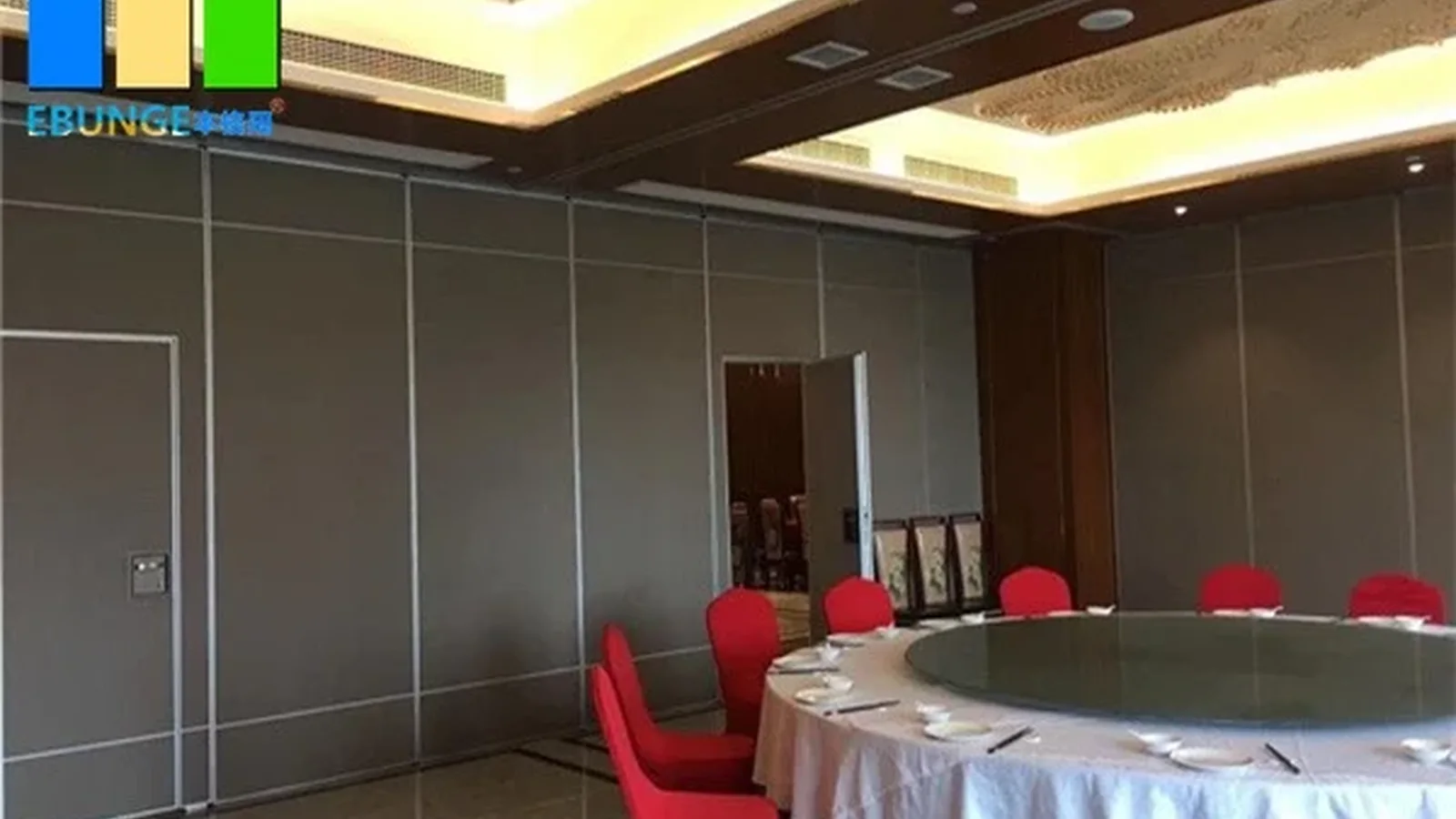
No. The floor is not cut or damaged for a floor track and remains physically uninterrupted by the maintained EBUNGE top-hung system.
How is parking decided for the office meeting suite partition track?
Panel parking style can be customized to the customer layout and project requirements, subject to coordinated drawings. The exact track, support and panel layout still require project drawings.
Can the finish be customized?
Finish materials can be customized, and cleaning and maintenance methods vary with the selected finish.
Where can movable partitions be used?
Movable partitions can be used wherever flexible space division, combination or reconfiguration is required. Application examples are not limiting.
What must be confirmed from the coordinated project drawings?
The exact route, junction arrangement, continuous overhead path and parking position must be confirmed from the coordinated project drawings.
Continue Exploring
More Project Applications Guides
- Newer guideSchool Auditorium Partition Track: Curved Wall Junctures Drawings
- Earlier guideOffice Suites Partition Track: Ceiling Data Projector Lifts
- Related guideOffice Glass Partition Selection Guide for Fit-Out Contractors
- Related guideOffice Meeting Suite Partition Tracks Need Clearance at Ceiling-Mounted