
When your office meeting suite design includes both thermostat zones and diffuser zones, the way you compare partition seals can change how the space performs for occupants and how easily it adapts to future layouts. This guide helps overseas contractors, architects, interior designers, and building owners evaluate office meeting suite partition seals thermostat vs diffuser zones without relying on unsupported performance claims. We focus on what can be confirmed through project-specific documentation and EBUNGE’s maintained product facts.
Understanding the Role of Partition Seals in Flexible Meeting Suites
Movable partitions are increasingly specified in meeting suites to allow rooms to be combined or subdivided. The seals along the partition edges help control air movement, light leakage, and sound flanking. However, the effectiveness of any seal depends on the surrounding building systems, especially HVAC components like thermostats and diffusers.
In a thermostat zone, the partition may need to isolate the space to maintain temperature setpoints. In a diffuser zone, the partition may interact with air supply or return paths. Comparing seals in these contexts requires a clear understanding of the partition’s movement, the ceiling interface, and the building’s mechanical design.
Key Differences Between Thermostat Zones and Diffuser Zones
Thermostat zones typically have a dedicated temperature sensor and control valve. When a movable partition divides a larger area, the thermostat may be located in one side, causing uneven heating or cooling. Seals that reduce air crossover help maintain temperature stability, but they cannot compensate for an undersized HVAC system.

Diffuser zones are areas where conditioned air is supplied through ceiling or wall diffusers. If a partition interrupts the airflow path, it can create pressure differences or dead spots. Seals that are too tight might cause air to bypass through other gaps, while seals that are too loose may allow drafts. The comparison should focus on how the partition’s sealing strategy aligns with the diffuser layout.
How EBUNGE Movable Partitions Support Flexible Zoning
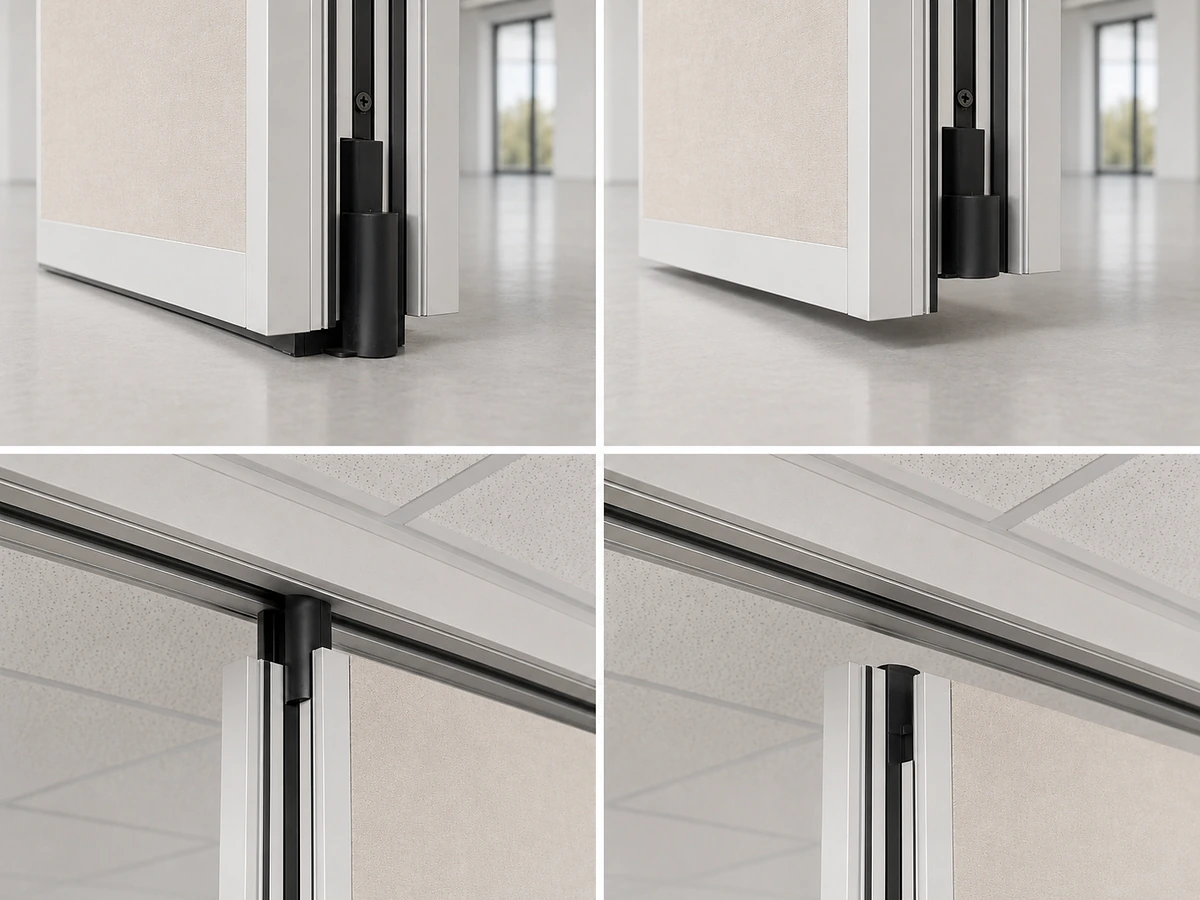
EBUNGE movable partition panels are individually movable and suspended from a top track. They cross the opening without a floor track, which means the floor remains clear and accessible. This design is particularly useful in meeting suites where you may want to reconfigure spaces frequently.
Panels park at a planned stacking position when not in use. The stacking configuration is customized to the customer layout and project requirements. For meeting suites, this could mean stacking panels against a wall or in a recessed pocket, allowing the full space to be opened up for larger events.
Share the opening dimensions, room layout and intended operating sequence for review.
The exact overhead route and support arrangement must be confirmed by the responsible project team from coordinated drawings. This is a critical coordination point with the HVAC design, especially when diffusers are located in the ceiling. The track route and stacking area must be reviewed in the layout to avoid conflicts with ductwork or diffuser placement.
Comparing Seals for Thermostat vs Diffuser Zones: A Project-Specific Approach
When comparing seals for these two zone types, you cannot rely on generic assumptions. The suitability of each route and parking arrangement depends on the approved layout, circulation, ceiling interfaces and operating sequence. Here is a framework to guide your comparison:
1. Identify the Zone Boundaries
Start by mapping out which areas are thermostat zones and which are diffuser zones. In a meeting suite, you might have a large room that can be divided into two smaller rooms. Each smaller room may have its own thermostat or share a diffuser system. Understanding these boundaries helps you determine where the partition seals will be most critical.
2. Review the Partition Movement Path
For EBUNGE partitions, the panels travel along a continuous overhead track. The route must be straight, turning, or stacking as reviewed from the layout. In a diffuser zone, the track may need to be routed around ceiling diffusers or integrated with the ceiling grid. This can affect the seal design at the top of the partition.
3. Consider Airflow and Pressure Differentials
In thermostat zones, the goal is often to minimize air exchange between the divided spaces to maintain temperature control. In diffuser zones, you may need to allow some airflow to ensure proper ventilation. Seals that are too effective at blocking air might create pressure imbalances if the HVAC system is not designed for closed-off rooms. Conversely, seals that are too leaky may reduce comfort.
4. Evaluate Acoustic Requirements
Seals play a role in reducing sound flanking through gaps. You should not assume that a particular seal will achieve a certain STC without project-specific testing or documentation.
5. Coordinate with HVAC Controls
If the partition divides a space with a single thermostat, you may need to consider how the thermostat will respond when the partition is closed. Some projects integrate sensors or bypass dampers, but these are not part of the partition system. Your HVAC engineer should review the control strategy to ensure comfort in both configurations.
Seal Types and Their Relevance to Zone Types
EBUNGE offers various finish options for panels, but the seals themselves are part of the partition system. While we cannot specify seal materials or performance, we can explain the general function of perimeter seals and how they relate to zone types.
Perimeter Seals
These are located at the top, bottom, and vertical edges of the partition. They help block air and sound from passing through gaps. In a thermostat zone, a tight perimeter seal may be desirable to prevent conditioned air from escaping. In a diffuser zone, you might need to coordinate the bottom seal with the floor to avoid interfering with underfloor air distribution, if present.
Vertical Seals Between Panels
When multiple panels are used to close an opening, the vertical joints between panels must be sealed. In a diffuser zone, if the diffuser is located near a vertical joint, the seal may need to be more robust to prevent air leakage.
Top Seals and Ceiling Interface
The top seal is critical because it interfaces with the ceiling. In a diffuser zone, the ceiling may have perforated tiles or linear diffusers. The top seal must accommodate these features without compromising the partition’s movement. EBUNGE partitions are top-hung, so the top track and seal must be coordinated with the ceiling system.
Project Documentation and Coordination
To compare seals effectively, you need accurate project documentation. EBUNGE provides technical documents that cover track routes, stacking, ceiling interfaces, finish selection, and room layout. These documents are essential for your project team to review.
When you contact EBUNGE, be prepared to share your floor plans, ceiling plans, and HVAC layouts. We can also review the project documentation to ensure that the partition system is compatible with your thermostat and diffuser zones.
Common Pitfalls to Avoid in Comparison
Here are some mistakes project teams often make when comparing partition seals for these zones:
- Assuming one seal type fits all zones: The optimal seal configuration may differ between a thermostat zone and a diffuser zone, even in the same room.
- Ignoring the ceiling plenum: Air can travel through the ceiling plenum, bypassing the partition entirely. Seals alone cannot address flanking paths through the plenum.
- Overlooking the stacking area: When panels are parked, the seals may be exposed or compressed. The stacking area should be designed to protect the seals and allow for easy operation.
Review the ceiling interface, panel route and stacking position together.
Case Example: Meeting Suite with Mixed Zones
Consider a large meeting suite that can be divided into two rooms. One room has a thermostat on the wall, and the other room is served by a ceiling diffuser. The partition is placed between the two rooms.
In this scenario, the thermostat zone may require a tighter seal to prevent the thermostat from reading the temperature of the other room. The diffuser zone may need a seal that allows some airflow to prevent pressure buildup. The project team must coordinate with the HVAC engineer to ensure that the partition seals do not create uncomfortable conditions.
EBUNGE can provide a movable partition with customized parking and sealing options, but the final configuration must be reviewed against the actual HVAC design. This is why project-specific support is essential.
How to Proceed with Your Project
To compare partition seals for your office meeting suite, start by gathering your architectural and mechanical drawings. Then, contact EBUNGE to discuss your project. We can review the layout, track routes, and stacking positions to ensure the partition system meets your spatial and functional needs.
For examples of how movable partitions have been used in various projects, visit our projects page. When you are ready to discuss your specific requirements, reach out through our contact page.
FAQ: Partition Seals in Thermostat vs Diffuser Zones
What is the main difference between thermostat and diffuser zones when selecting partition seals?
Thermostat zones require seals that minimize air crossover to maintain temperature control, while diffuser zones may need seals that accommodate airflow patterns to avoid pressure imbalances. The exact seal configuration depends on your HVAC design and partition layout.
Can EBUNGE partitions be used in rooms with ceiling diffusers?
Yes, EBUNGE movable partitions can be used in rooms with ceiling diffusers. However, the top track and seal must be coordinated with the diffuser placement to avoid conflicts. This requires a review of the ceiling plan and the partition’s movement path.
Do partition seals affect acoustic performance?
STC and Rw ratings are not simply decibel counts; they are measured under specific conditions.

What project information does EBUNGE need to recommend the right seals?
EBUNGE needs your floor plans, ceiling plans, HVAC layouts, and details about the partition’s intended use. This includes the size of the opening, stacking location, and any pass-door requirements. With this information, we can review the track route and sealing options.
Are there any limitations to using movable partitions in thermostat zones?
Movable partitions can be used in thermostat zones, but you must ensure that the HVAC system can handle the divided space. Coordination with your HVAC engineer is essential.
Can EBUNGE provide a partition with a pass door for meeting suites?
Yes, pass-door requirements can be discussed with EBUNGE. A pass door allows access through the partition without opening the entire wall. This is often useful in meeting suites where you need to move between rooms while the partition is closed.
Conclusion
Comparing office meeting suite partition seals for thermostat vs diffuser zones is a nuanced process that requires project-specific coordination.
Do not rely on generic assumptions or unsupported performance claims. Instead, work with EBUNGE to review your project documentation and confirm the appropriate sealing strategy. Contact us today to discuss your meeting suite project and ensure that your partition system performs as intended.
Contact EBUNGE for project-specific support.
Continue Exploring
More Acoustic Partition Guides
- Newer guideHow to Coordinate Office Meeting Suite Partition Seals with Ceiling-Mounted HVAC Diffuser Edges
- Earlier guideWhy Office Meeting Suite Partition Seals Need Detailing at Ceiling Diffuser Edges
- Related guideWhat Drawings Specify School Auditorium Partition Seals at Ceiling-Mounted Speaker Cluster Zones
- Related guideHow to Coordinate Office Meeting Suite Partition Seals with Wall-Mounted Video Bar Swing Paths