
Why Exhibition Partition Stacking Pockets Demand Early Coordination
When a flexible venue must combine a movable partition wall with wall-mounted rigging control panels, the exhibition partition stacking pockets become a critical planning focus. These pockets are the designated parking areas where panels rest when the partition is open. Their position, depth, and clearance directly affect how the rigging control panels can be accessed, operated, and maintained.
Unlike a simple straight run, an exhibition space often requires the partition to turn corners or stack in a compact zone. The wall-mounted rigging panels—used to manage lighting, sound, or other technical equipment—may occupy the same wall plane. Without early coordination, you risk conflicts between the stacking pocket’s required clear path and the control panel’s operational envelope.
This guide provides an evidence-bounded framework for project teams. It explains what information you need to gather, how to review the layout, and how to document decisions. The suitability of each route and parking arrangement depends on the approved layout, circulation, ceiling interfaces and operating sequence.
Understanding the Movable Partition System: Top-Hung and Floor-Free
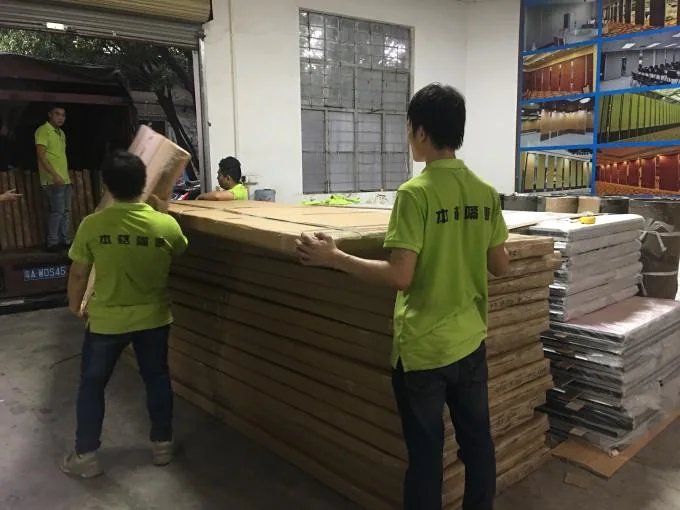
EBUNGE movable partition panels are individually movable and suspended from a top track. They cross the opening without a floor track, leaving the floor clear. This design offers flexibility but also imposes strict requirements on the overhead structure and the continuous route from the closed position to the stacking pocket.
The route must be continuous and connected—there can be no gaps where a panel would lose support. This is especially important when the stacking pocket is around a corner or in a recessed area.
However, it also means that the stacking pocket must be carefully designed to accept the panels without any floor-level guidance.
What Are Exhibition Partition Stacking Pockets?
Stacking pockets are the designated parking zones where movable partition panels are stored when not in use. They can be straight, turning, or a combination, depending on the layout. The pocket must be sized to accommodate the number of panels and their individual widths, and it must allow for the necessary clearances for the panels to enter and exit smoothly.
In an exhibition hall, the stacking pocket is often located along a wall that also houses technical control panels. This dual use of wall space requires careful planning to ensure that the partition’s operation does not interfere with the control panels’ accessibility.
Share the opening dimensions, room layout and intended operating sequence for review.
The configuration of the stacking pocket is customized to the project layout. EBUNGE reviews the proposed route—straight, turning, and stacking—from the layout drawings. This review ensures that the panels can travel from the closed position to the pocket without obstruction.
Wall-Mounted Rigging Control Panels: Operational Requirements
Wall-mounted rigging control panels are used to operate overhead rigging systems, such as lighting trusses or speaker clusters. These panels require clear access for operation and maintenance. They may have doors that swing open, touchscreen interfaces, or physical buttons that need a certain clearance.
When a movable partition stacks in front of or beside these panels, you must consider:
- Access: Can the panel be opened and operated when the partition is stacked?
- Clearance: Is there enough space for a technician to stand and work?
- Safety: Does the partition’s movement create any pinch points or obstructions?
The stacking pocket must be designed so that the control panel remains accessible, either by leaving a gap between the stacked panels and the panel, or by positioning the pocket away from the control panel.
Key Coordination Steps for Exhibition Partition Stacking Pockets
Coordinating these elements involves several steps that should happen early in the design process.
Step 1: Gather Project Information
Start by collecting all relevant architectural and MEP drawings. You need to know the exact location of the partition, the stacking pocket, and the rigging control panels. Also gather information about the overhead structure, ceiling height, and any obstructions like ductwork or lighting fixtures.
This information is essential for EBUNGE to review the proposed route and stacking configuration. Without accurate drawings, it is impossible to confirm that the partition will operate correctly.
Step 2: Review the Layout for Straight, Turning, and Stacking Routes
EBUNGE reviews the layout to ensure that the panels can travel from the closed position to the stacking pocket. This includes checking for any turns in the track and the space required for the panels to stack compactly.
The exact route, junction arrangement, continuous overhead path and parking position must be confirmed from the coordinated project drawings. If the pocket is in a straight line, the length must accommodate all panels. The review also considers the stacking sequence—how panels park one behind another.
Step 3: Identify Potential Conflicts with Wall-Mounted Equipment
Once the stacking pocket location is known, check for conflicts with the rigging control panels. Measure the depth of the stacked panels and compare it to the available wall depth. Ensure that the control panel’s door can open fully without hitting the stacked panels.
The exact overhead route and support arrangement must be confirmed by the responsible project team from coordinated drawings.
Step 4: Coordinate with Structural and MEP Engineers
The overhead track must be supported by the building structure. MEP systems, such as electrical conduits or HVAC ducts, must not interfere with the track or the panels’ movement.
Cost and maintenance requirements depend on the selected configuration, finish and project conditions and require project-specific confirmation.
Step 5: Document All Decisions
Every decision regarding the stacking pocket, track route, and control panel placement should be documented. This includes drawings, specifications, and meeting minutes. This documentation is essential for the contractor during installation and for future maintenance.
Design Considerations for Stacking Pockets Near Control Panels
When the stacking pocket must be near a rigging control panel, several design strategies can help.
Recessed Pockets to Maximize Clearance
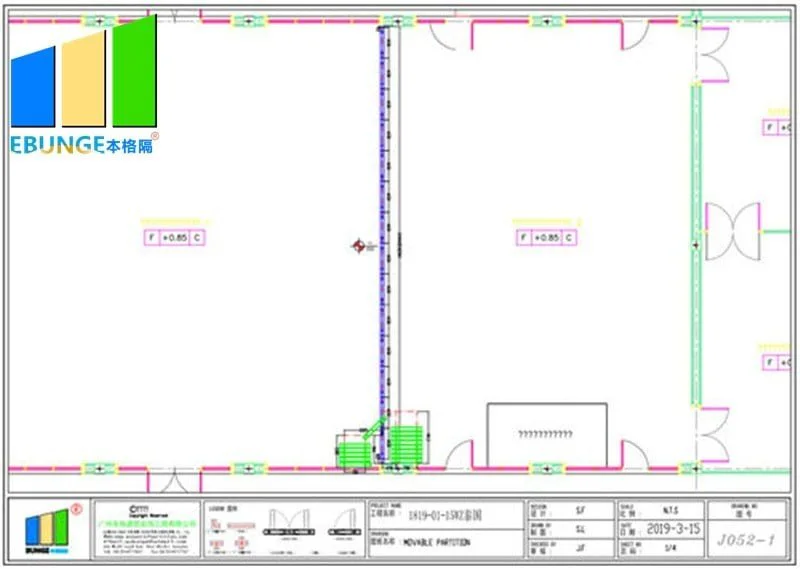
A recessed pocket allows the panels to tuck into a niche, reducing the projection into the room. This can leave more space in front of the control panel. However, the recess must be sized accurately to accommodate the panels and their movement.
Offset Stacking to Preserve Access
If the control panel is on the same wall as the pocket, you might offset the pocket so that the stacked panels stop short of the control panel. This leaves a gap for access. The gap must be wide enough for a person to stand and operate the panel.
Alternate Stacking Locations
This can avoid conflicts entirely and provide more flexibility for the rigging control panel placement.
Finish Options and Their Impact on Stacking Pockets
The finish of the partition panels can affect the stacking pocket design. EBUNGE offers laminate, melamine, fabric, leather, glass, and other approved surfaces. Each finish has different thickness and surface properties.
Review the ceiling interface, panel route and stacking position together.
Glass panels are heavier and may require different handling. The stacking pocket must be designed to accommodate the specific finish and its requirements.
Discuss finish options with EBUNGE early to ensure the stacking pocket is compatible.
Acoustic Considerations: Conceptual Overview
). These ratings indicate how much sound is reduced across the partition.
If the pocket is not properly sealed, sound can leak through gaps.
It is important to understand that STC/Rw is not a simple decibel count. It is a rating that considers various frequencies and construction details.
Pass-Door Requirements and Stacking Pockets
In some projects, a pass-door is required within the partition. This is a small door that allows people to pass through when the partition is closed. The location of the pass-door can affect the stacking pocket, as the door hardware may protrude.
If a pass-door is planned, its position must be coordinated with the stacking sequence. The door panel may need to be stacked in a specific order to avoid interference.
Project Documentation and Coordination
Thorough documentation is the backbone of successful coordination. This includes:
- Architectural drawings showing the partition and stacking pocket
- Structural drawings for the overhead support
- MEP drawings for any services that might conflict
- Product data sheets and installation guides
- Meeting minutes and RFIs
EBUNGE can discuss project documentation requirements and provide guidance on what is needed for your specific project.
Frequently Asked Questions
What is an exhibition partition stacking pocket?
A stacking pocket is a designated area where movable partition panels are stored when not in use. It is designed to accommodate the panels in a compact arrangement, often along a wall or in a recess.
How do I know if my stacking pocket location conflicts with a rigging control panel?
You need to compare the dimensions of the stacked panels with the location and clearance requirements of the control panel. Measure the depth and width of the stacked panels and ensure that the control panel can be accessed without obstruction. EBUNGE can review your layout to identify potential conflicts.
Can the stacking pocket be placed around a corner?
Yes, EBUNGE movable partition systems can accommodate turning routes. EBUNGE reviews the layout to confirm that the panels can navigate the turn and stack correctly.
What finishes are available for the partition panels?

EBUNGE offers laminate, melamine, fabric, leather, glass, and other approved surfaces. The finish can affect the stacking pocket design, so discuss your choice early.
How does the stacking pocket affect acoustic performance?
Visible references can support layout discussion but do not verify hidden construction or performance.
What project information does EBUNGE need to review stacking pocket coordination?
EBUNGE needs architectural drawings showing the partition location, stacking pocket, and any wall-mounted equipment. This information allows EBUNGE to review the route and stacking configuration.
Conclusion: Plan Early, Document Thoroughly
Coordinating exhibition partition stacking pockets with wall-mounted rigging control panels is a complex task that requires early planning and collaboration.
Remember that every project is unique.
For more information about movable partition walls and how they can be integrated into your project, explore our project examples. To discuss your specific requirements, contact our team today.
Continue Exploring
More Operable Wall System Guides
- Newer guideHow to Compare Airport Training Room Partition Track for Ceiling-Mounted Security Camera Zones
- Earlier guideWhy Movable Solid Partition Stacking Pockets Need Clearance for Wall-Mounted AV Swings
- Related guideWhy School Auditorium Partition Stacking Pockets Need Clearance for Wall-Mounted Choir Riser Dollies
- Related guideHow to Compare Office Meeting Suite Partition Manual Operation for Single vs Double Leaf Stacking