When planning an office meeting suite partition track clearance for ceiling-mounted cameras with pan-tilt swings, project teams must look beyond the visible wall panel. The track that supports a movable partition occupies ceiling space, and a camera that rotates or tilts can easily intersect that zone. This article explains why clearance is a coordination issue, not just a dimensional check, and how to manage it within an evidence-based framework.
Understanding the Movable Partition System
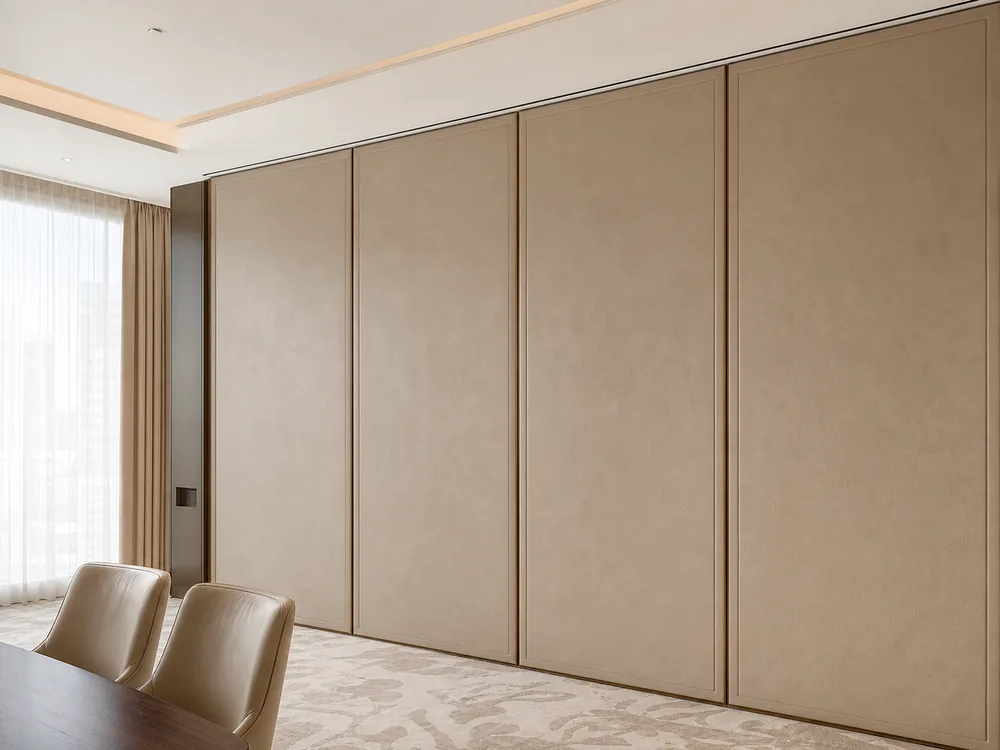
EBUNGE movable partition panels are individually movable and suspended from a top track. They cross the opening without a floor track, meaning the floor remains clear along the partition line. Panels park at a planned stacking position when not in use. This design offers flexibility, but it also means the overhead track is a permanent feature that must be integrated with other ceiling-mounted equipment.
Top-Hung Suspension and Ceiling Integration
The suitability of each route and parking arrangement depends on the approved layout, circulation, ceiling interfaces and operating sequence. The ceiling finish, lighting, sprinklers, and audiovisual equipment all share the same overhead zone. A camera mounted on the ceiling or on a bracket attached to the structure will swing through an arc as it pans and tilts. If that arc crosses the track envelope, the camera could hit the track or the moving panels.
Clear-Floor Advantage and Its Implications
The absence of a floor track simplifies floor finishes and accessibility, but it shifts all moving parts to the ceiling. This makes overhead coordination more critical. The exact route, junction arrangement, continuous overhead path and parking position must be confirmed from the coordinated project drawings. Any obstruction in that path can stop panel movement or cause damage.
Why Clearance Is a Coordination Issue
Clearance is not simply a matter of leaving a gap between the camera and the track. It involves understanding the full envelope of both the camera’s movement and the partition’s travel. A camera that pans 360 degrees sweeps a horizontal circle. A tilt adds a vertical arc. The track may be straight, curved, or include stacking areas. The intersection of these volumes must be analyzed in three dimensions.
Camera Pan-Tilt Swing Envelope
Ceiling-mounted cameras vary in size and movement range. A pan-tilt unit can rotate horizontally and tilt vertically, creating a sphere of possible positions. The camera body and lens extend outward from the mount. Even when the camera is parked, it may protrude into the track zone. During operation, the swing can be much larger.
Share the opening dimensions, room layout and intended operating sequence for review.
Track Envelope and Panel Stacking
The track itself has a physical profile, and the panels hang below it. When panels are stacked, they occupy a larger area. The stacking position is customized to the layout, so the envelope is not uniform. A camera near a stacking area may face a different clearance challenge than one along a straight run.
Project-Specific Drawing Review Is Essential
Every office meeting suite has a unique layout, ceiling height, and equipment list. The project team must review the proposed track routes, stacking positions, and camera locations together. This review should happen early in design, before installation.
What Information Is Required?
To assess clearance, the following project information is typically needed:
- Detailed ceiling plan showing the partition track route, including straight, turning, and stacking sections.
- Camera model specifications, including dimensions, mounting method, and pan/tilt ranges.
- Any other ceiling-mounted equipment that could interfere, such as lighting, speakers, or sensors.
This information allows the team to create a composite model or overlay to identify conflicts.
How to Coordinate Without Inferring Hidden Performance
Coordination should be based on visible geometry and documented specifications. Avoid assuming that a certain clearance distance is automatically safe. Instead, model the camera’s swing envelope and compare it with the track and panel envelope. If they intersect, adjust the camera position, the track route, or the camera’s movement limits.
Seals and Acoustic Considerations
These seals are located at the top, bottom, and vertical edges of the panels. They may compress against the ceiling or floor. If a camera is mounted too close to the track, it could interfere with the top seal’s operation.
Acoustic Performance Is Not a Simple Number
These ratings are determined through standardized tests and are not a direct count of decibels. They depend on the entire wall assembly, including seals, panel construction, and installation quality.
Common Conflict Scenarios
Several situations commonly arise in office meeting suites:
Camera Directly Above the Track
If a camera is mounted directly above the track, its pan swing may hit the track or the hanging rods. Even if the camera is offset, the tilt could bring the lens into the track zone.
Camera Near Stacking Area
Stacking areas concentrate multiple panels in a small space. The track may have switches or curves that increase the envelope. A camera placed near this area might be at risk when panels are being moved.

Camera on a Pole or Bracket
Sometimes cameras are mounted on poles that extend down from the ceiling. These poles can be positioned to avoid the track, but they still swing with the camera. The pole itself may also obstruct the track if not placed correctly.
Best Practices for Clearance Planning
To avoid costly rework, follow these practices:
Start Early in Design
Include the partition track and camera positions in the initial architectural and MEP coordination meetings.
Use 3D Modeling or Overlays
If possible, use BIM or simple 2D overlays to visualize the camera swing and track envelope. This helps all stakeholders see the issue clearly.
Communicate with the Partition Supplier
Review the ceiling interface, panel route and stacking position together.
Share your ceiling and camera plans with the partition supplier. They can review the track layout and advise on clearance requirements based on their system’s geometry. This is not a performance claim but a coordination service.
Plan for Maintenance Access
Even if the camera clears the track during operation, consider maintenance. A technician may need to access the track or the camera. Ensure there is enough space to reach both without moving the partition unnecessarily.
Finish Options and Their Role
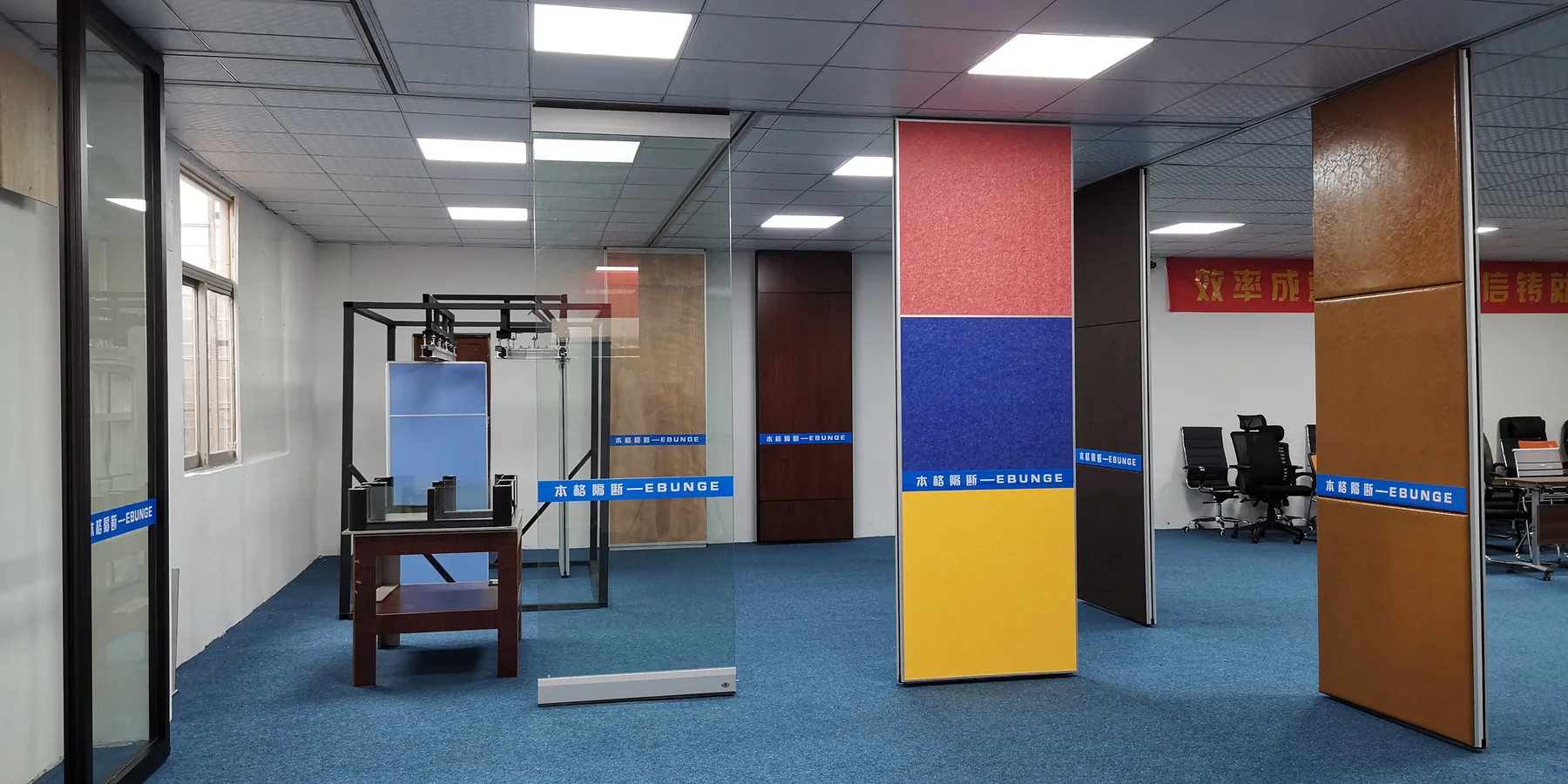
EBUNGE partitions offer a range of finishes, including laminate, melamine, fabric, leather, glass, and other approved surfaces. The finish does not directly affect track clearance, but it can influence the visual integration of the partition with the room. A camera mounted near a fabric panel might require special mounting to avoid damaging the surface. The finish also affects cleaning and maintenance, which should be considered when placing equipment nearby.
Pass Doors and Additional Openings
If the partition includes a pass door, the door swing adds another moving element. A camera near the door could be hit by the door when it opens. The door’s swing radius must be included in the clearance analysis.
Documentation and Approvals
All clearance decisions should be documented. This includes drawings showing the camera swing envelope, the track route, and any adjustments made. This documentation is useful for future renovations or equipment changes.
Frequently Asked Questions
What is the main reason for clearance between a partition track and a ceiling camera?
The main reason is to prevent physical interference. The camera’s pan-tilt swing can hit the track or the moving panels, causing damage or obstructing operation. Clearance ensures both systems function without conflict.
Can a camera be mounted directly above the track if it is small?
Even a small camera has a swing envelope. The size is not the only factor; the movement range and mounting position matter. A small camera that pans 360 degrees will still sweep a circle that could intersect the track.
Do I need to provide the camera specifications to the partition supplier?
Yes, providing camera specifications is helpful. The supplier can review the track layout against the camera’s dimensions and movement. This is part of project-specific coordination and does not guarantee a solution without proper analysis.
How does the track clearance affect acoustic performance?
Any obstruction can reduce effectiveness.
What should I do if a conflict is found after installation?
If a conflict is discovered after installation, you may need to relocate the camera or adjust its movement limits. In some cases, the track route can be modified, but that is more complex.
Conclusion
Office meeting suite partition track clearance for ceiling-mounted camera pan-tilt swings is a critical coordination task. It requires a clear understanding of the movable partition system’s overhead requirements and the camera’s movement envelope. The exact overhead route and support arrangement must be confirmed by the responsible project team from coordinated drawings.
If you are planning a flexible space with movable partitions and ceiling-mounted technology, contact EBUNGE to discuss your project. Our team can review your layout and provide guidance on track routing and clearance coordination. Visit our operable wall system page for more information, and see examples of completed projects in our project gallery.
Continue Exploring
More Operable Wall System Guides
- Newer guideWhy Office Meeting Suite Partition Track Needs Coordination with Ceiling-Mounted Projector Throw Paths
- Earlier guideHow to Compare Hotel Banquet Partition Manual Operation for Ceiling Light Rigging Zones
- Related guideWhy University Auditorium Partition Manual Operation Needs Coordination with Ceiling-Mounted Speaker Cluster Swings
- Related guideHow to Plan University Training Center Partition Stacking Around Wall-Mounted Fire Extinguisher Recesses