
Introduction: The Hidden Interface Between Partition Movement and Speaker Swings
When a university auditorium is designed to divide into smaller teaching or event spaces, the university auditorium partition manual operation speaker swings coordination becomes a critical planning issue. The operable wall system must move smoothly along its overhead track, while ceiling-mounted speaker clusters may need to swing or rotate to serve different room configurations. Without early coordination, these two systems can interfere physically or operationally.
The suitability of each route and parking arrangement depends on the approved layout, circulation, ceiling interfaces and operating sequence. We focus on what must be reviewed, what information is required, and how to avoid common pitfalls, without making unsupported performance claims.
Understanding the Operable Wall System in an Auditorium Context
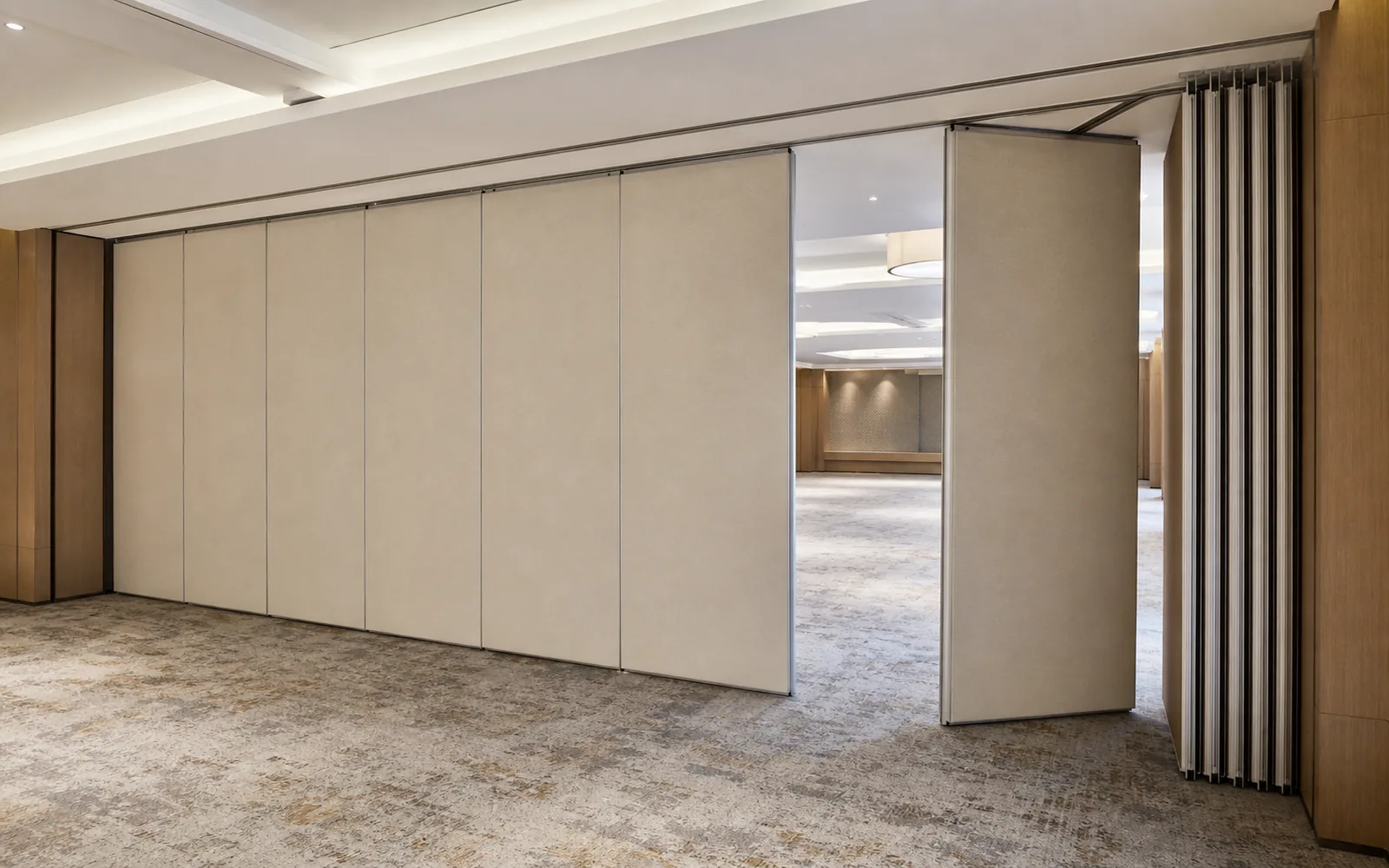
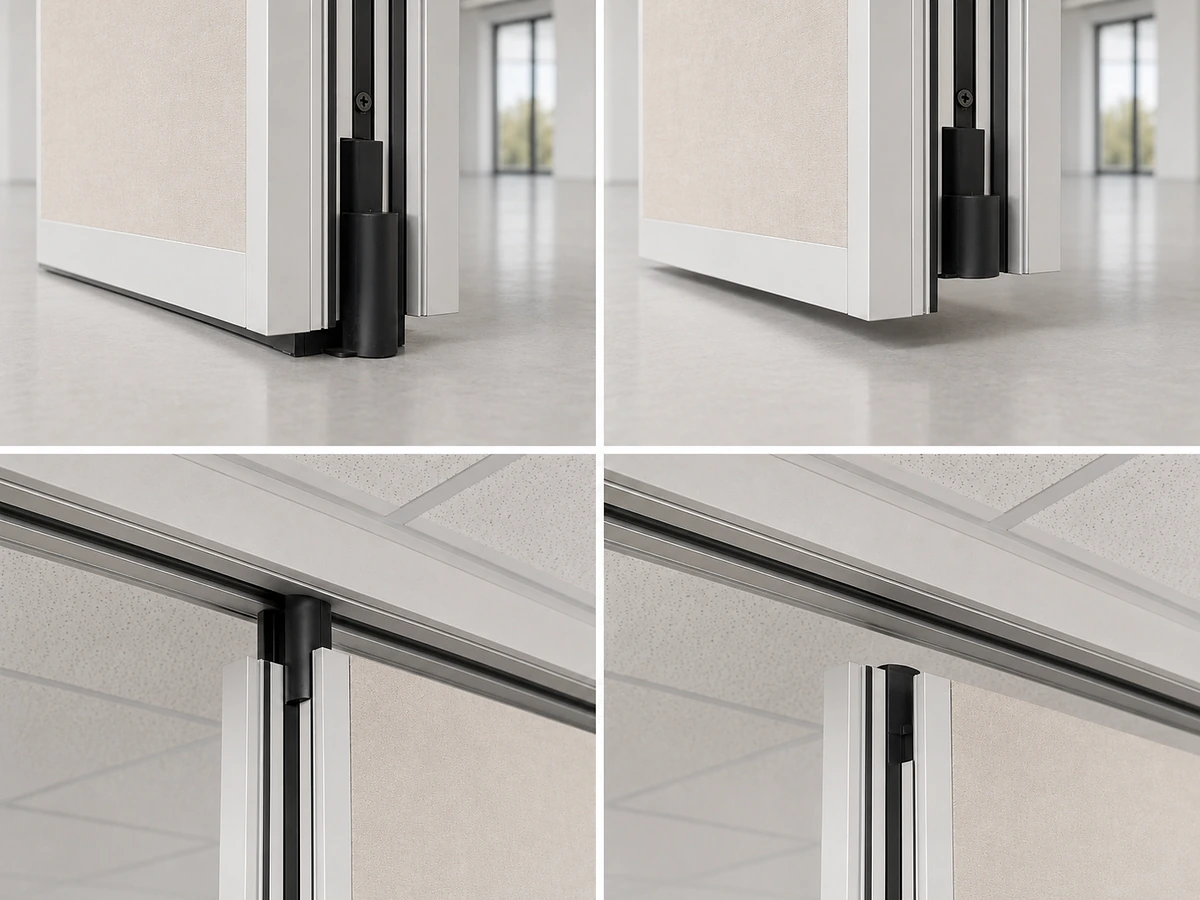
EBUNGE movable partition panels are individually movable and suspended from a top track. They cross the opening without a floor track, meaning the floor remains clear and unobstructed. Panels park at a planned stacking position when not in use. This design offers flexibility for spaces that need to be reconfigured frequently.
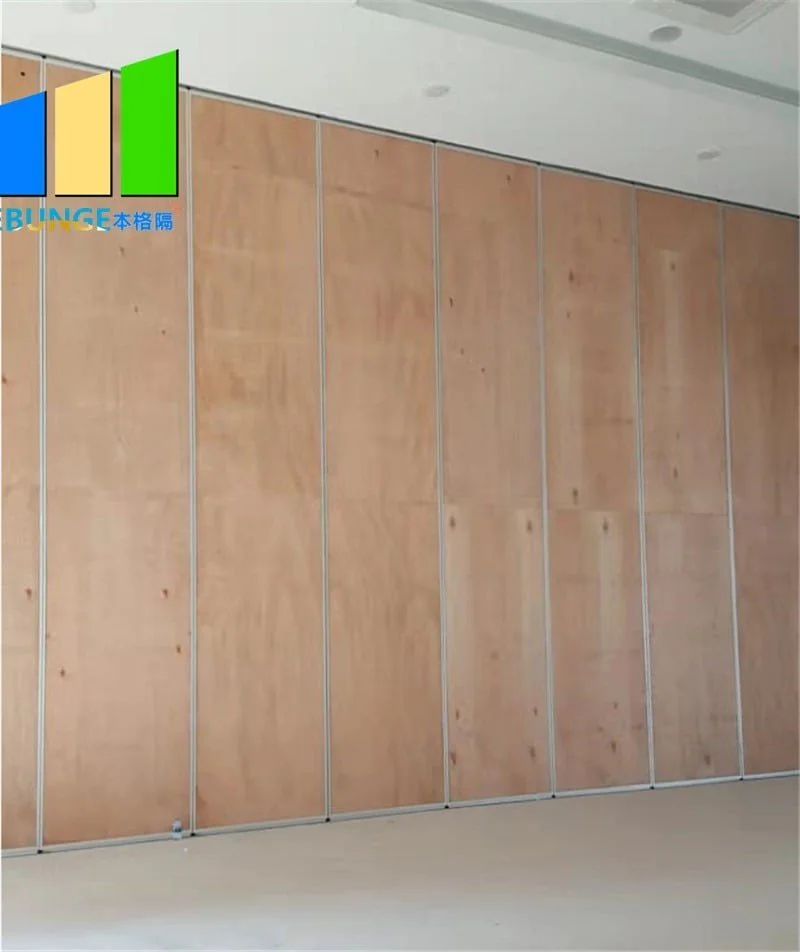
In a university auditorium, the operable wall may be used to split the room into two or more lecture halls, seminar rooms, or performance spaces. The movement of panels is manual, requiring coordination with other ceiling-mounted equipment, especially speaker clusters that may swing or rotate to direct sound to different zones.
Key Characteristics of the Partition System
- Top-hung panels: no floor track or floor hardware along the partition line.
- Individual panel movement: each panel can be moved independently.
- Customized parking: stacking configuration is tailored to the project layout.
- Continuous overhead route: panels require a connected track system for any movement path.
Why Speaker Cluster Swings Matter for Partition Operation
Ceiling-mounted speaker clusters in auditoriums are often designed to swing or tilt to optimize sound coverage for different room configurations. When a partition is installed, the speaker clusters may need to be repositioned to serve the divided spaces. This movement can conflict with the partition’s stacking area or its path of travel.
Share the opening dimensions, room layout and intended operating sequence for review.
For example, if a speaker cluster swings down into the space where panels are parked, it could obstruct the manual operation. Conversely, if the partition is moved without considering the speaker position, it could strike the cluster or its rigging.
Potential Interference Points
- Stacking area: where panels park when not in use.
- Travel path: the route panels follow from the open position to the stacking area.
- Speaker swing envelope: the space required for the cluster to rotate or tilt.
Coordination Requirements: What Project Information Is Needed?
To ensure successful coordination, project teams must provide detailed information to the partition supplier and other consultants. This includes architectural drawings, ceiling plans, and equipment specifications. The following are essential data points:
- Partition layout: the exact location of the partition line, stacking area, and any pass-doors.
- Speaker cluster details: the size, weight, swing radius, and mounting points of each cluster.
- Track route: the continuous overhead path that panels will follow, including any turns.
- Operational sequence: how the partition will be used and how speakers will be repositioned.
This information allows the design team to review the layout and identify potential conflicts. It is crucial to involve the partition supplier early in the design process to ensure that the track route and stacking area are compatible with the speaker swings.
Design Review: Straight, Turning, and Stacking Routes
EBUNGE reviews straight, turning, and stacking routes from the layout. This review ensures that the partition can move as intended without interference. For an auditorium with speaker clusters, the review must also consider the speaker swing envelope.
Straight Routes
However, even straight routes can be obstructed if a speaker cluster hangs low enough to intersect the panel’s path.
Turning Routes
The exact route, junction arrangement, continuous overhead path and parking position must be confirmed from the coordinated project drawings. Speaker clusters near the turn could be at risk if they are within the swing path of the panel. The review must ensure that the turning area is clear.
Stacking Routes
Stacking routes lead to the parking area. This area must be large enough to accommodate all panels in a compact stack. If speaker clusters are located above the stacking area, they must not interfere with the panels’ vertical clearance or the manual operation.
Acoustic Considerations: Conceptual Understanding
Operable partitions are often rated for sound transmission class (STC) or weighted sound reduction index (Rw). These metrics indicate how much sound is reduced when passing through the partition. However, it is important to understand that STC/Rw is not a direct count of decibels; it is a laboratory-derived rating that depends on many factors.
Seals and Gaps
Operable partitions typically have perimeter seals that compress against the floor, ceiling, and walls to minimize sound leakage. These seals must be compatible with the ceiling-mounted equipment. For example, if a speaker cluster is mounted in the ceiling, the partition’s top seal must accommodate any protrusions without leaving gaps.
They can recommend appropriate sealing strategies based on the specific project conditions.
Finish Options and Aesthetic Integration
Review the ceiling interface, panel route and stacking position together.
The partition’s finish can be selected to match the auditorium’s interior design. EBUNGE offers laminate, melamine, fabric, leather, glass, and other approved surfaces.
When coordinating with speaker clusters, the finish may influence how sound reflects or absorbs. Visible references can support layout discussion but do not verify hidden construction or performance.
Pass-Door Requirements and Operational Workflow
Pass-doors are often integrated into operable partitions to allow passage without moving the entire wall. In an auditorium, a pass-door can be useful for staff or performers to move between spaces. The location of pass-doors must be coordinated with speaker cluster swings to ensure they do not obstruct the door’s operation.
Additionally, the workflow for manual operation should be planned. For example, if the partition is to be moved while the speaker clusters are in a certain position, the sequence must be defined. This may involve moving speakers first, then panels, or vice versa. Clear operational guidelines can prevent accidents and damage.
Documentation and Project-Specific Confirmation
Every project is unique, and the coordination between partition and speaker systems requires project-specific documentation. EBUNGE can discuss pass-door requirements and project documentation with the design team. It is crucial to provide detailed drawings and specifications to the partition supplier for review.
Project teams should confirm the following with the supplier:
- Track route and stacking layout.
- Clearances for speaker swings.
- Acoustic sealing details.
- Finish selection.
- Pass-door integration.
The exact overhead route and support arrangement must be confirmed by the responsible project team from coordinated drawings.
Frequently Asked Questions
What is the main challenge when coordinating a movable partition with ceiling-mounted speaker clusters?
The primary challenge is ensuring that the speaker clusters’ swing or tilt movement does not interfere with the partition’s travel path, stacking area, or manual operation. This requires careful spatial coordination during design.
Do EBUNGE partitions require a floor track?
No, EBUNGE movable partition panels are top-hung and move without a continuous floor running track or floor hardware along the partition line. This leaves the floor clear, which is beneficial in auditoriums.
What project information is essential for the partition supplier to review?
Essential information includes architectural drawings, ceiling plans, speaker cluster specifications (size, swing radius, mounting points), partition layout, and the intended operational sequence.
Can the partition be moved manually while speaker clusters are in a certain position?
Yes, but the operational sequence must be defined. The design should ensure that when the partition is being moved, the speaker clusters are in a safe position that does not obstruct the panels. This may require moving speakers first or coordinating the movement.
How does the acoustic performance of the partition affect speaker cluster placement?
Speaker clusters or their mounts must not create gaps in the partition’s perimeter seals.
Conclusion: Early Coordination is Key
Coordinating a university auditorium partition manual operation with ceiling-mounted speaker cluster swings is a complex but manageable task. Cost and maintenance requirements depend on the selected configuration, finish and project conditions and require project-specific confirmation.
Remember that every project is unique. Our team is ready to review your layout and discuss how our operable wall system can be integrated with your auditorium’s audio systems. For more information or to discuss your project, please contact us. You can also view examples of our work in our projects section.
Continue Exploring
More Operable Wall System Guides
- Earlier guideHow to Plan University Training Center Partition Stacking Around Wall-Mounted Fire Extinguisher Recesses
- Related guideWhat Drawings Specify Airport Conference Partition Stacking Pockets at Wall-Mounted Security Panel Junctures
- Related guideWhy Convention Hall Partition Track Needs Clearance for Ceiling-Mounted Rigging Motor Swings
- Related guideHow to Coordinate Manual Operation for Healthcare Training Room Partition with Wall-Mounted Crash Cart Swings