
Quick project answer
Review the project drawings for sports hall partition seals.
The suitability of each route and parking arrangement depends on the approved layout, circulation, ceiling interfaces and operating sequence. It also includes the interfaces where panels meet the floor, ceiling, side walls, and any recessed services. Sports hall partition seals floor socket wells are a common example: the floor may contain sockets, power outlets, or data points that interrupt an otherwise continuous line.
This article explains why those details matter, what to check in drawings, and how to keep project-specific performance claims tied to confirmed evidence.
What a Floor-Mounted Socket Well Changes for a Movable Partition
Coordinate the current drawing set for sports hall partition seals.
A floor-mounted socket well is a recessed box or access point set into the floor. In a sports hall, such wells may serve power, scoring equipment, lighting, or other services. For a top-hung movable partition, the panels travel along an overhead track and do not need a continuous floor track. That clear-floor principle is a core benefit, but it does not mean the floor is irrelevant.
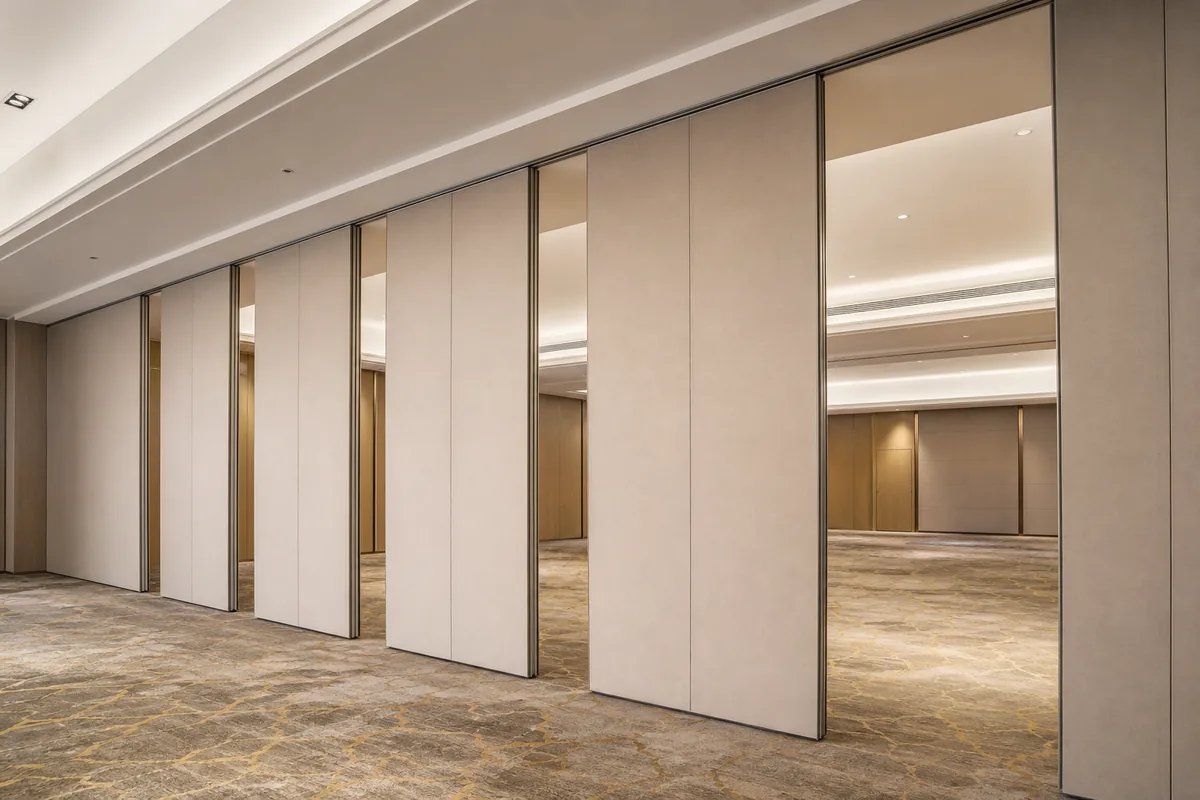
A gap, uneven cover, or open recess can create a flanking path. The exact effect depends on the well design, the seal detail, and the surrounding construction. These are project-specific conditions, not generic product claims.
Why the seal line is not just a floor detail
The bottom seal is part of a system that includes the panel edge, the floor surface, and the adjacent construction. If the socket well interrupts that system, the project team needs to decide how the seal will cross, bypass, or terminate at the well. That decision belongs in the coordinated drawings, not in a late site instruction.
How Top-Hung Movement and Socket Wells Interact
Record the drawing revision used for sports hall partition seals.
EBUNGE movable partition panels are individually movable and suspended from a top track. They cross the opening without a floor track and park at a planned stacking position. This movement principle means the floor can remain clear for sports use, but it also means the floor condition affects the seal interface rather than the travel mechanism.
A socket well does not stop the panels from moving, provided the overhead route is continuous and supported. However, the well can affect how the bottom seal lands when the partition is closed. If the well cover sits proud of the floor, the seal may not sit as intended. If the well is recessed, the seal may need a different interface detail. Both situations require review against the actual floor build-up and the partition layout.
Route review from the layout
Straight, turning, and stacking routes are reviewed from the layout. The exact overhead route and support arrangement must be confirmed by the responsible project team from coordinated drawings. The goal is to confirm that the overhead route remains continuous and that the seal line is addressed at every interface.
What to Check in the Coordinated Drawings
Keep project evidence attached to the sports hall partition seals review.
Early detailing is mostly a drawing exercise. The exact route, junction arrangement, continuous overhead path and parking position must be confirmed from the coordinated project drawings.
- Mark each socket well on the floor plan and note its cover type, level, and surrounding finish.
- Overlay the partition line and stacking position to see whether any well conflicts with the seal line or parked panels.
- Confirm the overhead track route is continuous and supported for the full travel path.
- Record how the bottom seal is intended to meet the floor at each well, including any transition detail.
- Check whether the well cover can be removed or serviced without disturbing the partition seal.
Evidence note
Visible references can support layout discussion but do not verify hidden construction or performance. Those claims require project-specific evidence and sign-off. The purpose of this checklist is to expose coordination points, not to certify an outcome.
Seals, Acoustic Concepts, and What STC/Rw Mean Here
Review the project drawings for sports hall partition seals.
Seals help close gaps at panel edges and interfaces. Their contribution depends on the full assembly, including the panel, the track interface, the floor condition, and the surrounding construction. A socket well can create a discontinuity if it is not detailed.
Common coordination questions
Ask whether the well can be relocated outside the partition line. If relocation is not possible, ask how the seal will transition across the well and whether the well cover can be made flush with the finished floor. These are design decisions that should be resolved before panels are ordered.
Finish and Interface Considerations
Confirmed finish options include laminate, melamine, fabric, leather, glass, and other approved surfaces. The seal interface at a socket well is a separate detail.
Pass-door requirements and project documentation can be discussed with the supplier. If a pass door is located near a socket well, the door threshold and seal line may need additional review. The same applies to any service penetration that crosses the partition line.

| Interface | What to confirm | Why it matters |
|---|---|---|
| Floor socket well | Position, cover level, and seal transition | Can interrupt the acoustic boundary |
| Overhead track | Continuous supported route | Panels cannot travel across an untracked gap |
| Stacking position | Clearance and floor condition | Parked panels must not conflict with services |
| Side wall | Seal termination and structural support | Completes the room boundary |
FAQ: Sports Hall Partition Seals and Floor Socket Wells
Do movable partitions need a floor track to cross a socket well?
No. EBUNGE movable partitions are top-hung and do not require a continuous floor track. The socket well affects the bottom seal interface, not the travel mechanism. The overhead route must still be continuous and supported.
Can a floor socket well reduce acoustic performance?
It can create a discontinuity if the seal line is not detailed.
Should the socket well be relocated outside the partition line?
That is a project decision. Relocation may simplify the seal detail, but it depends on services, floor construction, and layout. Review the options with the design team before finalizing the partition route.

What information should be shown on the drawings?
Show the socket well position, cover level, partition line, stacking position, overhead track route, and the intended seal transition. Also note any pass-door or service penetration near the well.
Can EBUNGE confirm acoustic performance for a specific sports hall?
Generic product information does not replace project-specific evidence.
Conclusion: Detail the Well, Protect the Boundary
A top-hung system keeps the floor clear, but the seal still needs a defined interface at every floor condition. By marking wells on the layout, checking the overhead route, and confirming the seal transition in the coordinated drawings, project teams can reduce late surprises.
Keep every performance statement tied to project-specific evidence. For project documentation and pass-door discussions, contact EBUNGE.
Continue Exploring
More Acoustic Partition Guides
- Newer guideCommunity Hall Partition Seal: Equipment Panel Junctions Maintenance
- Earlier guideRestaurant Partition Seal: Splash Zones Maintenance
- Related guideAcoustic Partition Ceiling Interface Zone Confirmation
- Related guideWho Confirms Ceiling Grid Line Before Acoustic Partition Track