
Quick project answer
Review the project drawings for banquet hall partition seal.
When a banquet hall must divide into smaller rooms, the hardest detail is often overhead. A banquet hall partition seal ceiling diffuser swing condition sits where the partition head, the ceiling plane and an air diffuser’s discharge pattern all meet. This comparison framework shows project teams what to check, what to document and which claims need project-specific confirmation before any seal approach is selected.
Why the Ceiling Diffuser Swing Zone Is a Seal Decision Point
Coordinate the current drawing set for banquet hall partition seal.
A diffuser does not simply sit in the ceiling; it throws air into the room. That discharge pattern is sometimes called the swing. Where a movable partition line passes near or under a diffuser, the head detail, the ceiling surface and the air path interact.
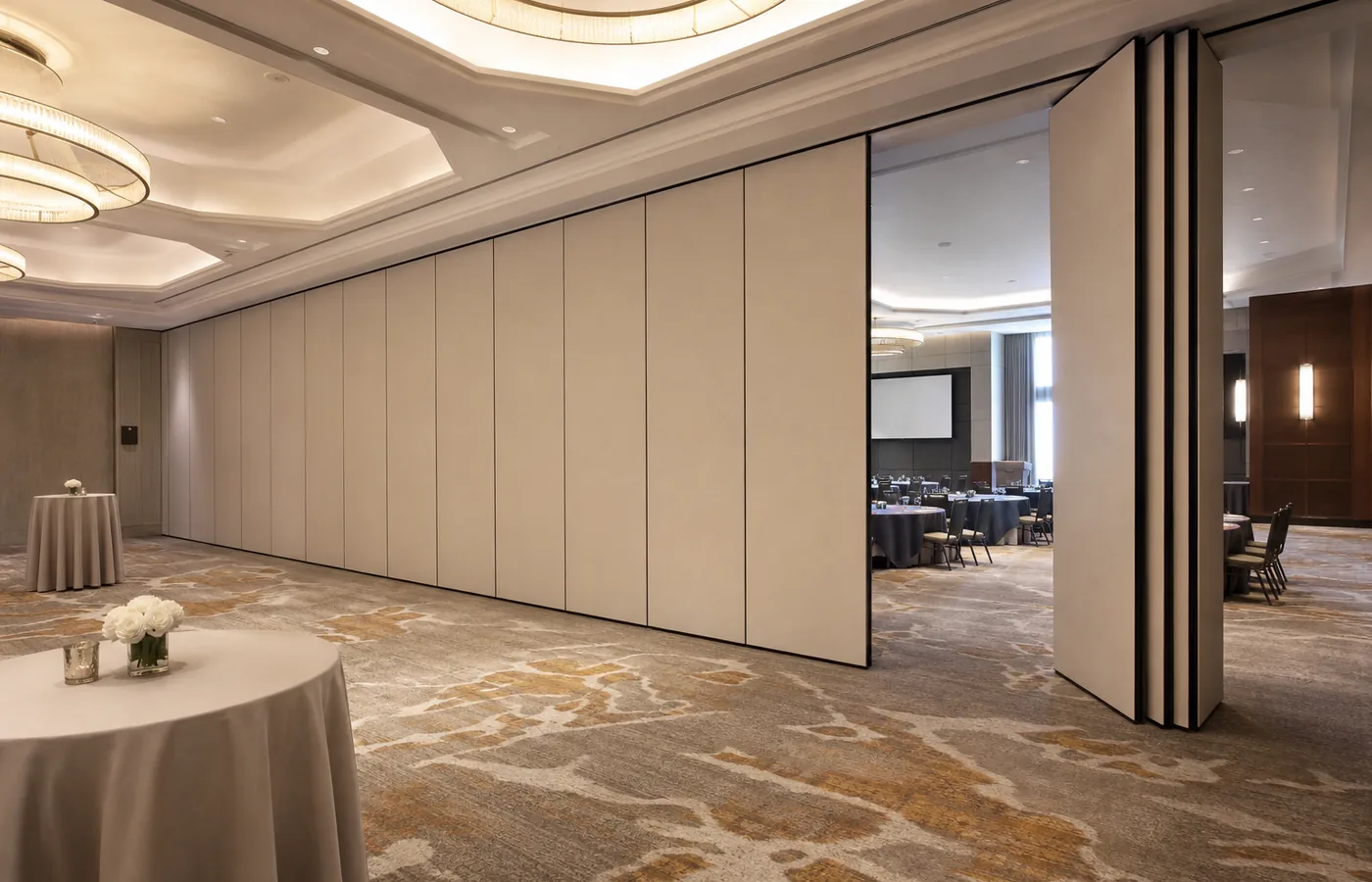
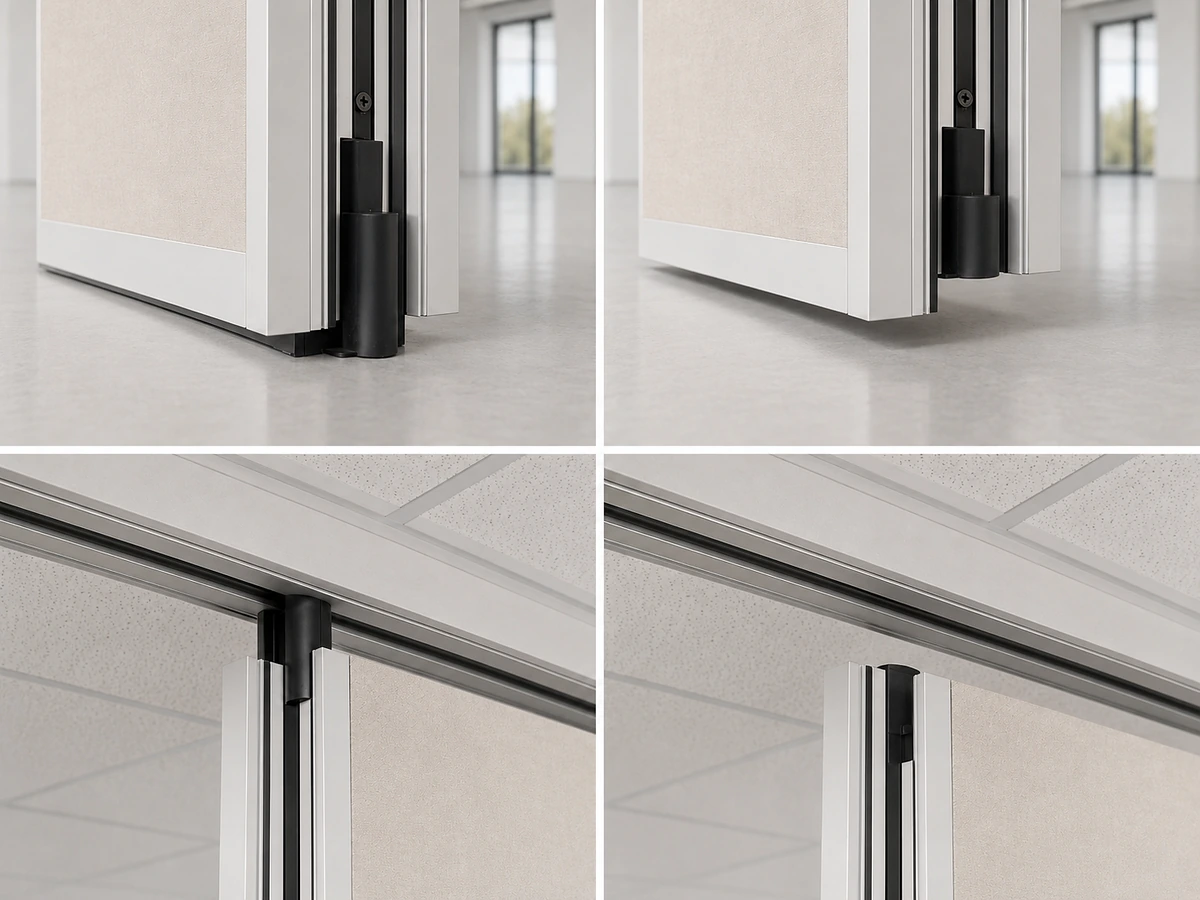
EBUNGE movable partition panels are individually movable and suspended from a top track. They cross the opening without a floor track and park at a planned stacking position. That clear-floor behaviour is a maintained fact, but it does not by itself resolve what happens at the ceiling interface.
What the Maintained Product Facts Actually Cover
Record the drawing revision used for banquet hall partition seal.
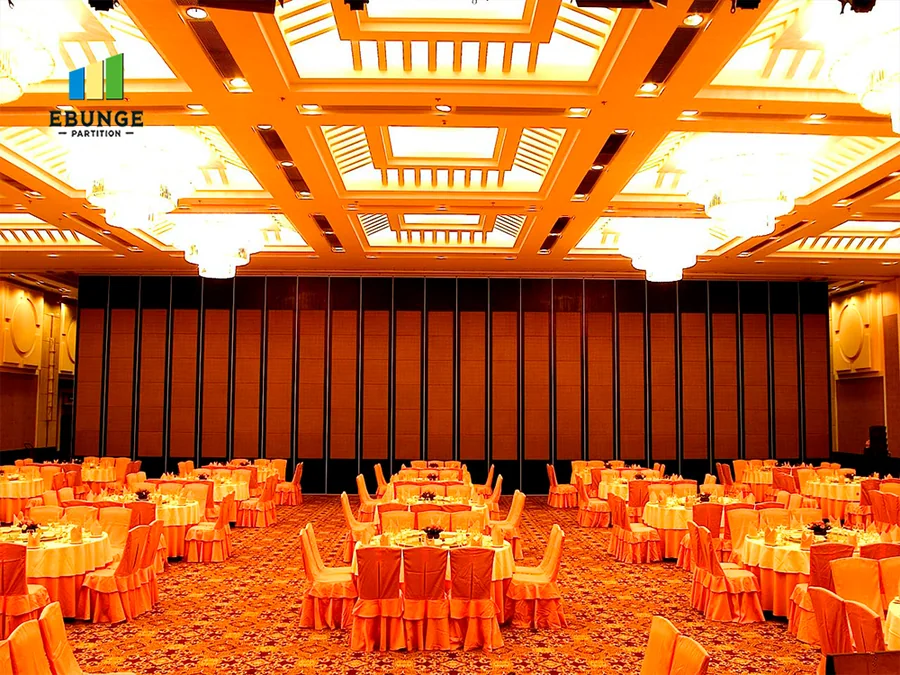
Confirmed EBUNGE facts are deliberately narrow. Panels are top-hung, individually movable and park at a planned stacking position. Straight, turning and stacking routes are reviewed from the layout. Finish options include laminate, melamine, fabric, leather, glass and other approved surfaces. Pass-door requirements and project documentation can be discussed.
Everything else must come from the project. The maintained facts do not state panel cores, seal materials, operating tools, manpower or tested performance. Treat any such detail as an open item until the project documentation supplies it.
Evidence note: a visible head detail in a photograph or drawing is not proof of acoustic, fire, durability or load performance. Those attributes require matching project evidence, not inference from shape.
Comparing Seal Approach Options at the Head Condition
Keep project evidence attached to the banquet hall partition seal review.
At concept stage, teams usually compare a small number of head-condition strategies. The comparison below is a review framework, not a product specification. The suitability of each route and parking arrangement depends on the approved layout, circulation, ceiling interfaces and operating sequence.
| Approach | What it affects | Evidence needed before selection |
|---|---|---|
| Continuous head interface along the full partition line | How the panel head meets the ceiling plane across the opening | Ceiling build-up, deflection limits, track support and coordinated drawings |
| Local treatment near the diffuser swing zone | How the head detail behaves where air discharge is closest | Diffuser position, throw direction, ceiling access and maintenance route |
| Relocated or adjusted diffuser position | Whether the air path can be moved away from the partition line | HVAC design intent, room-by-room airflow balance and coordination sign-off |
| Revised partition line or stacking position | Whether the head condition can avoid the tightest ceiling zone | Layout review of straight, turning and stacking routes |
None of these options can be ranked generically. The right choice depends on the ceiling, the services above it and the way the hall is expected to operate.
A Drawing Review Process for Project Teams
Review the project drawings for banquet hall partition seal.
Use a fixed sequence so that seal questions are answered by drawings rather than assumptions.
- Overlay the partition line on the reflected ceiling plan and mark every diffuser within the swing zone.
- Confirm the continuous overhead route for the top track, including straight, turning and stacking segments.
- Identify the ceiling build-up, support locations and access provisions above the partition head.
- Record the head-condition strategy chosen for each segment and the evidence behind it.
- Confirm pass-door positions and how they interact with the head detail.
- Issue the coordinated set for review before fabrication or site set-out.
This sequence keeps the seal discussion tied to the layout. It also prevents a late change to one diffuser from silently invalidating the head detail.
Acoustic Concepts Without Invented Ratings
STC and Rw are single-number descriptors used to compare how a construction assembly reduces airborne sound transmission under defined laboratory conditions. They are not a direct count of decibels in a real room, and they do not describe field performance on their own.
In a banquet hall, sound can travel over the partition head, through the ceiling void, around the stacking pocket and through service penetrations. These are flanking paths. A seal strategy is one part of controlling them, but the ceiling interface, the surrounding construction and the room layout all contribute.
Coordination Items That Often Decide the Outcome
Ceiling services and access
Diffusers, sprinklers, lighting and access panels all occupy the ceiling zone. The partition head must be coordinated with them, and maintenance access should remain possible after the partition is installed.
Structural support above the track
The top track needs a continuous, supported overhead route.
Stacking position and route
Panels park at a planned stacking position. The route to that position, including any turns, must be reviewed from the layout so that the head condition is consistent along the whole path.
Finish and interface appearance
Finish options include laminate, melamine, fabric, leather, glass and other approved surfaces. The chosen finish affects how the head junction reads visually, so it should be reviewed together with the ceiling detail.
Decision Checklist Before You Commit
- Is the full partition line shown on the reflected ceiling plan?
- Is every diffuser within the swing zone identified and its throw direction noted?
- Is the overhead track route continuous and supported for its entire length?
- Is the head-condition strategy recorded for each segment of the line?
- Are pass-door positions and stacking routes coordinated with the ceiling?
- Are acoustic requirements defined by the project’s acoustic consultant?
- Is the finish selection confirmed against the approved surface list?
- Has the coordinated drawing set been reviewed before site set-out?
If any item is unresolved, treat the seal comparison as incomplete rather than assuming a default answer.
How to Compare Options Fairly
Compare options on the same drawing set, with the same diffuser positions and the same operating assumptions. Ask what each option changes, what evidence supports it and what remains unverified. Where a supplier cannot provide project-specific evidence, record the item as open.
This approach keeps the comparison honest. It also gives the project team a clear record of why a particular head condition was chosen.
FAQ: Banquet Hall Partition Seal at Diffuser Swing Zones
What information is required to review this condition?
Provide the current layout, opening dimensions, ceiling information, intended room use, and relevant project drawings for review. The exact overhead route and support arrangement must be confirmed by the responsible project team from coordinated drawings.
Can a seal detail guarantee soundproofing?
No. Sealing is one part of controlling sound transmission, and flanking paths above the ceiling, around the stacking pocket and through services can still carry sound.
Do the panels need a floor track?
EBUNGE movable partition panels are top-hung and cross the opening without a floor track. The exact route, junction arrangement, continuous overhead path and parking position must be confirmed from the coordinated project drawings.
Can the diffuser simply be moved?
Sometimes the air path can be adjusted, but that is an HVAC design decision. It must be coordinated with the airflow balance for each room configuration and signed off by the responsible disciplines.
Which finish should be used near the head detail?
Confirmed options include laminate, melamine, fabric, leather, glass and other approved surfaces. The choice depends on the design intent, the ceiling junction and the approved surface list for the project.
When should this be reviewed?
Before fabrication and site set-out. Late changes to diffusers, ceiling build-up or the partition line can invalidate an earlier head-condition decision, so the coordinated set should be rechecked after any change.
Conclusion and Next Step
The banquet hall partition seal ceiling diffuser swing condition is a coordination problem before it is a product problem. Visible references can support layout discussion but do not verify hidden construction or performance.
To discuss pass-door requirements, finish selection or project documentation for your layout, contact the EBUNGE team with your drawings and ceiling plan.
Continue Exploring
More Acoustic Partition Guides
- Newer guideSchool Auditorium Partition Seal Coordination Guide for Wall Speaker
- Earlier guideBanquet Partition Seals Need Detailing at Ceiling-Mounted Projector Lift
- Related guideAcoustic Partition Ceiling Interface Zone Confirmation
- Related guideWho Confirms Ceiling Grid Line Before Acoustic Partition Track