
Quick project answer
The exact overhead route and support arrangement must be confirmed by the responsible project team from coordinated drawings. These documents help you compare stated performance with traceable evidence. This article explains what to ask for and how the top-hung EBUNGE system supports coordination.
Why acoustic partition test documents matter
Requesting these documents early supports informed decisions. It also helps you align the supplier’s evidence with your project requirements. The exact documents available depend on the supplier and the tested assembly.
What counts as acoustic partition test documents
Ask for the full report, not just a summary. The report should show the test date, the laboratory, and the specimen description. This detail helps you confirm that the tested assembly matches your intended specification.
How the top-hung principle affects documentation
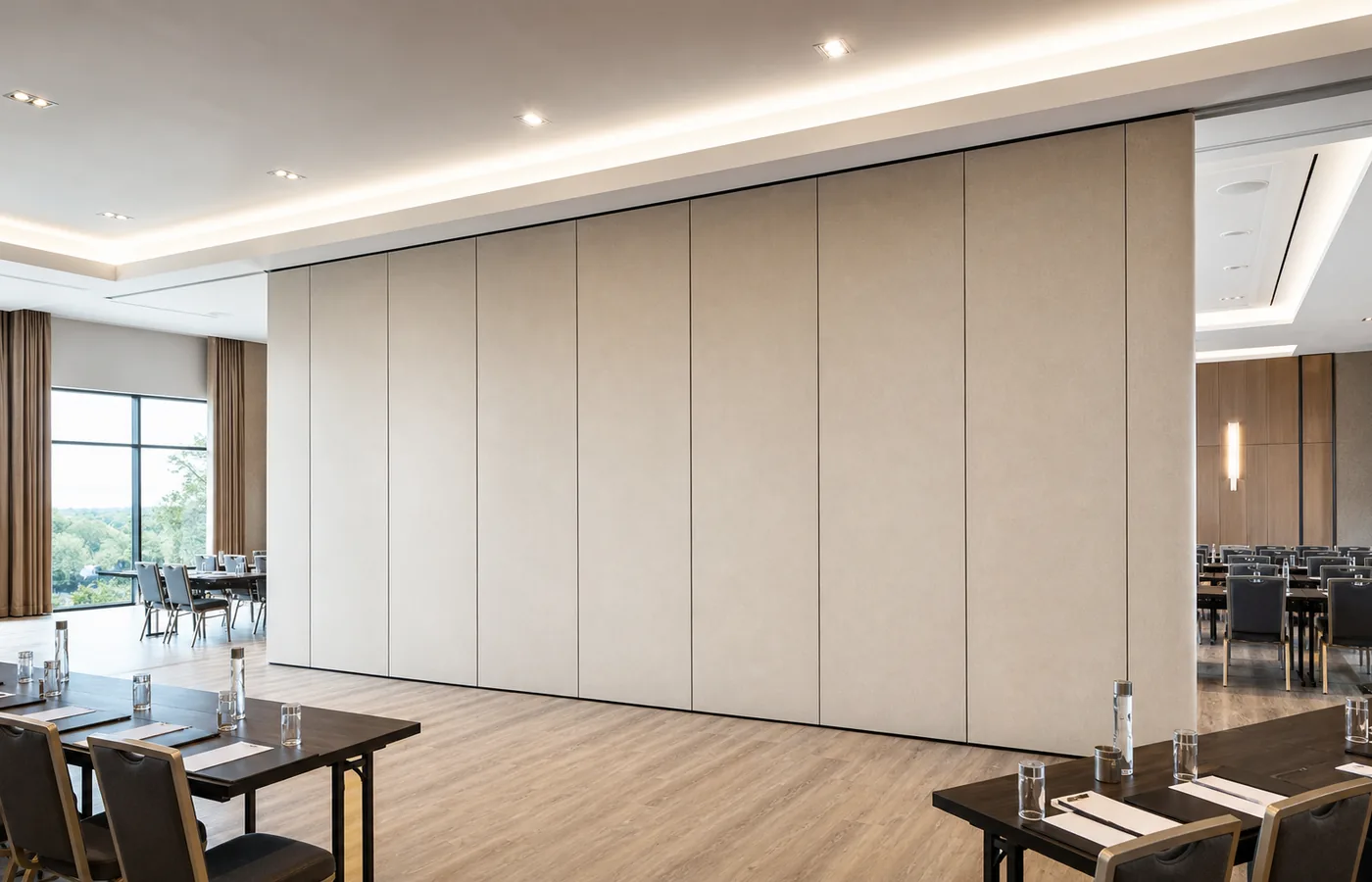
The EBUNGE movable partition system is top-hung. It has no continuous floor running track or operating hardware in the finished floor along the partition line. This design keeps the floor physically uninterrupted by the maintained system.
The exact route, junction arrangement, continuous overhead path and parking position must be confirmed from the coordinated project drawings.
This principle also means the floor remains intact for other uses. The absence of a floor track can simplify coordination with flooring finishes. However, the overhead structure and track layout still require project-specific drawings.
Parking planning and acoustic partition test documents
Panel parking style can be customized to the customer layout and project requirements, subject to coordinated drawings. A suitable approved parking arrangement can use the stacking area more compactly and coordinate with the space design.
The exact track, support and panel layout still require project drawings. The documents should not be assumed to cover every parking variation.
Parking planning affects the overall partition line and the space available for stacking. Early coordination helps avoid conflicts with other building elements.
Finish and care coordination
Finish materials can be customized, and cleaning and maintenance methods vary with the selected finish. The finish can influence the overall assembly behavior.
Ask the supplier how the finish interacts with the partition system. The documents should identify the finish used in the test, if applicable. This helps you compare like with like when reviewing multiple suppliers.
Cleaning and maintenance methods vary with the selected finish. Request guidance that matches your chosen finish.
Non-limiting applications and buyer inputs
Movable partitions can be used wherever flexible space division, combination or reconfiguration is required. Application examples are not limiting. EBUNGE has completed many types of hotel-related movable-partition projects; ballrooms, wedding halls and multifunction halls are non-limiting examples.
This helps them identify relevant test evidence. Buyer inputs such as layout, finish and parking preferences should be shared early.
No customer names, locations, quantities, ratings, certifications or outcomes may be inferred from these examples.
Drawing approvals and document review
The exact route, junction arrangement, continuous overhead path and parking position must be confirmed from the coordinated project drawings.
Approval of drawings and documents should be a coordinated step. The supplier can provide the test documents, while the project team confirms the layout. This separation helps ensure that the tested assembly aligns with the installed configuration.
Keep a record of the documents you receive and the drawings you approve. This record supports future reference.
Checklist for requesting acoustic partition test documents
- Ask for full laboratory test reports, not summaries.
- Confirm the tested assembly matches your intended specification.
- Request field test reports if available for similar projects.
- Verify that the test method and standards are stated.
- Check whether the finish used in the test matches your selection.
- Review the parking arrangement against the tested configuration.
- Store documents with the coordinated project drawings.
Frequently asked questions
What are acoustic partition test documents?
They are reports and certificates that record how a partition assembly performed under controlled test conditions. They help buyers verify supplier claims.
Do I need acoustic partition test documents for every project?
Requirements vary by project. The exact documents available depend on the supplier.
How do I know if the test documents apply to my layout?
Compare the tested assembly description with your coordinated project drawings. The exact route, junction arrangement, continuous overhead path and parking position must be confirmed from the coordinated project drawings.
Can finish choices affect the test documents?
Finish materials can be customized, and cleaning and maintenance methods vary with the selected finish. Confirm whether the tested assembly included a specific finish.
What should I ask for besides acoustic partition test documents?
Ask for coordinated drawings that show the top-hung track, parking arrangement and finish details. These drawings support the document review.
Are acoustic partition test documents the same as certifications?
No. Test documents report test results. Certifications are separate and may reference test documents. Request both if your project requires them.
Reviewing documents with the supplier
Ask questions about any unclear items. This helps you understand the scope of the evidence.
Use the review to confirm that the documents align with your project drawings. The exact route, junction arrangement, continuous overhead path and parking position must be confirmed from the coordinated project drawings.
Document the outcomes of the review. Share relevant findings with your project team. This supports a coordinated approach to specification.
Common pitfalls to avoid
One pitfall is accepting a summary instead of the full report. Another is assuming that a test on one assembly applies to all configurations. The suitability of each route and parking arrangement depends on the approved layout, circulation, ceiling interfaces and operating sequence.
A third pitfall is ignoring the parking arrangement. Confirm the parking layout separately.
Finally, avoid relying on verbal claims. Request written documents and keep them on file. This practice supports traceability.
Next steps for buyers
Then contact the supplier and request them. Review the documents alongside your coordinated drawings.
If you need more information about documentation practices, visit our documents page. For company background, see our about page.
Remember that the exact route, junction arrangement, continuous overhead path and parking position must be confirmed from the coordinated project drawings. This step ensures that the documents you receive match your project.
Continue Exploring
More Acoustic Partition Guides
- Newer guideAcoustic Movable Partition vs Fixed Acoustic Wall: How Their Roles
- Earlier guideHow to Prepare a Room Acoustic Brief for a Flexible Space
- Related guideAcoustic Partition Ceiling Interface Zone Confirmation
- Related guideWho Confirms Ceiling Grid Line Before Acoustic Partition Track