
html body.single-post main#content.site-main{box-sizing:border-box!important;width:calc(100% – 32px)!important;max-width:900px!important;margin-left:auto!important;margin-right:auto!important;padding-left:0!important;padding-right:0!important}
Quick answer: partition handover records
Review focus: partition handover records.
On most fit-out programmes, finishing trades do not close out on the same day. Ceiling works, floor finishes, electrical trim and movable partition installation can finish weeks apart. That gap is where partition handover records trade completion becomes a coordination problem rather than a filing problem. Someone must decide who signs, what evidence is attached and which items stay open until the responsible trade returns.
This article sets out an evidence-bounded framework for that decision. It applies to contractors, architects, interior designers, owners and renovation teams evaluating movable partition handover documentation. The suitability of each route and parking arrangement depends on the approved layout, circulation, ceiling interfaces and operating sequence.
Why Staggered Trade Completion Breaks Simple Handover Logic
Project review term: partition handover records.
A single handover date assumes every trade finishes together. In practice, the movable partition scope may be installed and aligned while adjacent finishes are still being corrected. If the handover record is signed only once, late defects can be attributed to the wrong party or left unverified.
Movable partitions add a specific dimension: panels are individually movable, suspended from a top track, cross the opening without a floor track and park at a planned stacking position. That means handover evidence should cover the opening, the track route and the parking zone, not just the panel faces.
What the record is actually verifying
Handover records are not a performance certificate. They confirm that defined installation and coordination items were inspected against approved drawings and specifications. They should state what was seen, when, by whom and under which drawing revision.
Who Should Verify Each Part of the Record
Coordination scope: partition handover records.
Verification is usually shared. The main contractor or construction manager typically owns the overall handover register. The partition specialist verifies the installed system against the coordinated layout. The architect or designer checks that visible finishes and interfaces match the approved specification. The owner or their representative accepts the completed scope.

Where trades finish at different times, each verifier should sign only for the portion they can actually inspect. A ceiling contractor should not sign for floor-level interfaces, and a partition installer should not sign for adjacent wall finishes.
A practical split of responsibility
- Partition specialist: panel movement along the reviewed route, parking position, visible finish condition and interface points within scope.
- Main contractor: sequencing, access, protection and closure of snag items across trades.
- Architect or designer: visible compliance with approved finish schedules and layout drawings.
- Owner or representative: acceptance of the completed scope and any agreed outstanding items.
A Staged Verification Process for Uneven Close-Outs
Checklist focus: partition handover records.
The most workable approach is staged sign-off. Instead of one final event, the team records completion in phases and keeps a live register of open items.
- Confirm the current approved layout drawing and finish schedule before any inspection.
- Verify that panels move individually along the reviewed straight, turning and stacking routes.
- Record the parking position and confirm it matches the planned stacking location.
- Check visible finish condition against the approved surface selection.
- List any interface items that depend on another trade, with a named owner and target date.
- Issue a partial sign-off that states exactly what was inspected and what remains open.
Why partial sign-off is safer than a delayed single sign-off
A partial record preserves evidence at the moment of inspection. If a later trade changes an adjacent condition, the earlier record still shows what was accepted. That traceability matters more than a tidy single date.
Evidence Boundaries: What Records Should Not Claim
Review focus: partition handover records.
Handover records should stay within what was observed. Visible references can support layout discussion but do not verify hidden construction or performance.
Similarly, a finish option such as laminate, melamine, fabric, leather or glass confirms a surface selection, not cleaning compatibility, impact resistance or acoustic outcome. Those require separate project-specific confirmation.
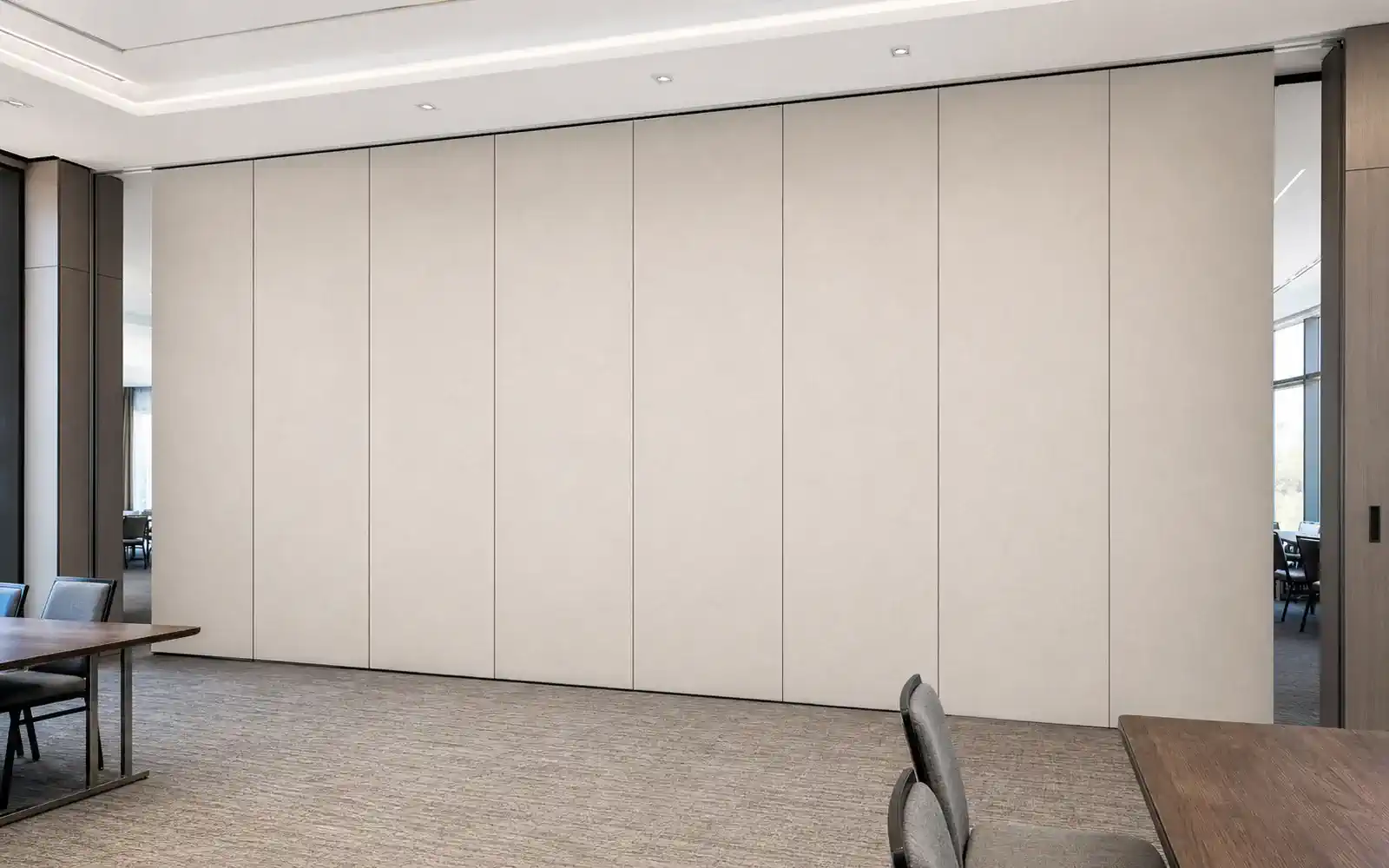
Evidence note: If a handover line cannot be tied to an approved drawing, a specification clause or a dated site observation, treat it as an open item rather than a verified one.
Coordinating Records When Trades Return Later
Late-returning trades can reopen previously signed items. The register should show which sign-offs are affected and who must re-verify. A simple status column — open, partially verified, verified, superseded — prevents old signatures from being treated as current.
For movable partitions, re-verification should focus on the opening, the overhead route and the parking zone. If adjacent works have changed the ceiling line or floor level near the stacking area, the coordinated layout should be reviewed again before the record is closed.
Documentation that supports the review
- Approved layout drawings showing straight, turning and stacking routes.
- Finish schedule confirming the selected surface for each panel.
- Pass-door requirements, if applicable, discussed and documented with the project team.
- Dated inspection notes with the name and role of each verifier.
- A live open-items list with owners and target dates.
Frequently Asked Questions
Who usually owns the partition handover record?
The main contractor or construction manager normally maintains the overall handover register, while the partition specialist verifies the installed system and the designer checks visible compliance. The owner or representative accepts the completed scope.

Can a partition be signed off before adjacent finishes are complete?
Yes, as a partial sign-off. The record should state exactly what was inspected, which interfaces remain dependent on other trades and who owns each open item.
What should be checked on the movable partition itself?
Confirm that panels are individually movable, suspended from the top track, cross the opening without a floor track and park at the planned stacking position. Also check visible finish condition against the approved schedule.
Do handover records confirm acoustic performance?
No.
How should late trade returns be handled?
Reopen the affected record lines, mark earlier sign-offs as superseded where necessary and re-verify the opening, overhead route and parking zone against the current approved layout.
What documentation should be attached?
Approved layout drawings, the finish schedule, any pass-door requirements discussed with the project team, dated inspection notes and a live open-items list with named owners.
Conclusion and Next Step
When trades finish at different times, the answer to who verifies partition handover records is not a single name. It is a staged process with named verifiers, dated observations and a clear boundary between what was seen and what still requires project-specific confirmation. Keep the register live, sign only for what was inspected and review the coordinated layout whenever adjacent works change.
To discuss pass-door requirements, finish options or project documentation for a specific layout, contact the EBUNGE team. You can also review the movable partition wall range and see related project references before your next coordination meeting.
Continue Exploring
More Materials and Finishes Guides
- Earlier guideMovable Partition Finish Sample Coordination Guide for Interior
- Related guideBanquet Partition Finishes at Ceiling Rigging Beam Obstructions
- Related guideSchool Auditorium Partition Finishes Selection Guide for Wall Control
- Related guideOffice Partition Finishes: Marker Board Trays