
Quick project answer
An auditorium gymnasium partition seal comparison usually begins with the floor. Planners want to know whether a movable wall leaves a track, a gap or a junction detail in the finished surface. The answer depends on the system type, and this article explains what a top-hung arrangement means for two common building types.
Why the Top-Hung Principle Changes the Comparison
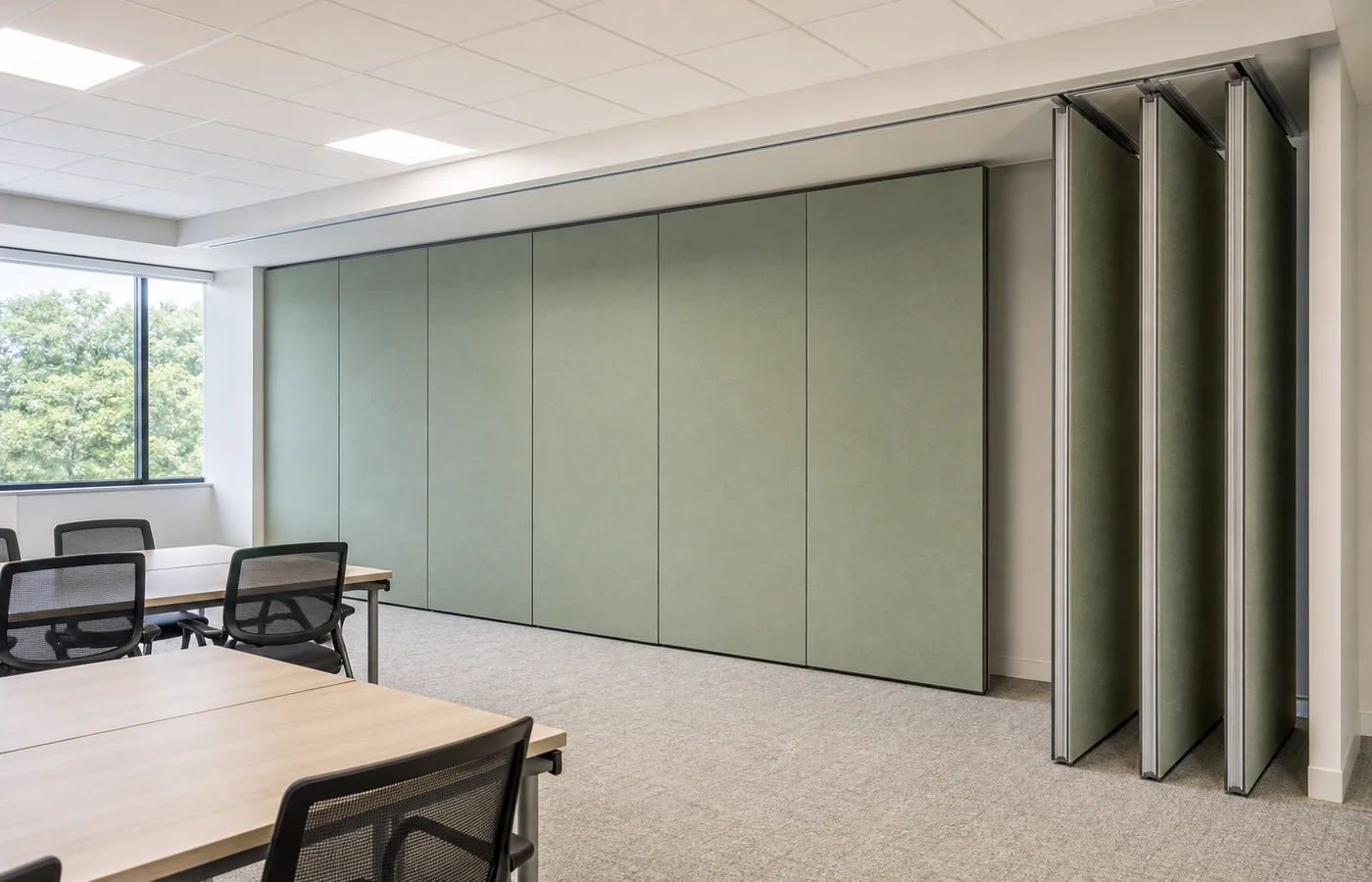
The EBUNGE movable partition system is top-hung. That single fact shapes how an auditorium gymnasium partition seal comparison should be read. The panels hang from an overhead structure rather than rolling along a track set into the floor.
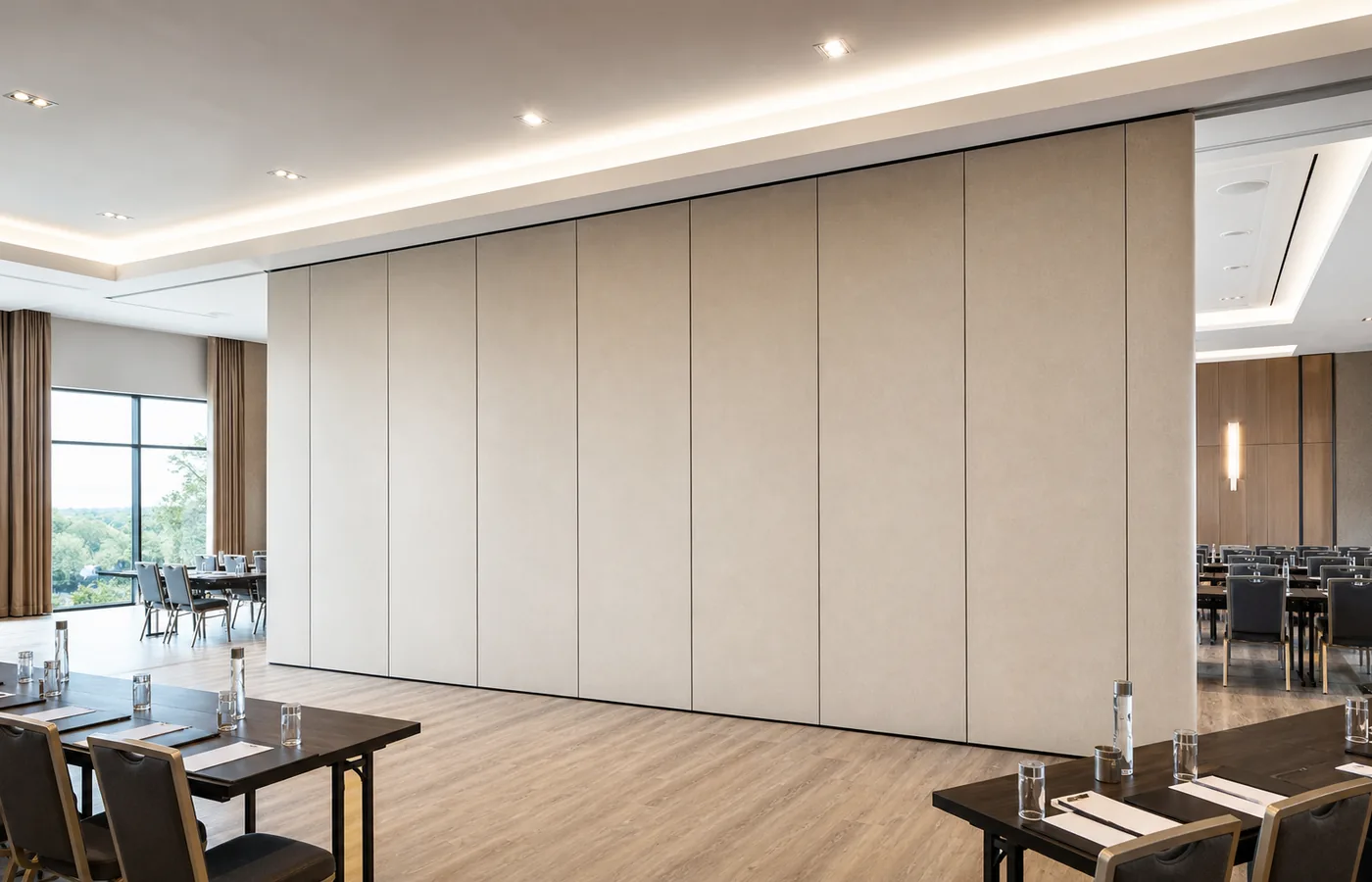
Because the system is top-hung, there is no continuous floor running track and no operating hardware in the finished floor along the partition line. The floor is not cut or damaged for a floor track. It remains physically uninterrupted by the maintained EBUNGE top-hung system.

For an auditorium, that matters when the room also hosts events, exhibitions or seated layouts. For a school gym, it matters when the same surface serves sports, assemblies and community use. The floor stays a single continuous plane in both cases.
What a Physically Uninterrupted Floor Means in Practice
A physically uninterrupted floor is a planning condition, not a performance claim. It means the finished floor along the partition line is not cut for a track and does not carry operating hardware for the maintained EBUNGE top-hung system.
In an auditorium, the floor may be shared with staging, seating or circulation. In a school gym, the floor may be shared with court markings and equipment movement. In both settings, the absence of a floor track keeps the surface continuous.
This is the core of the auditorium gymnasium partition seal comparison. One system type removes the floor track from the equation, while other arrangements may not. The comparison should therefore start with the operating principle, not with a product label.
Parking Planning for Auditorium and Gym Layouts
Panel parking style can be customized to the customer layout and project requirements, subject to coordinated drawings. A suitable approved parking arrangement can use the stacking area more compactly and coordinate with the space design.
In an auditorium, parking may sit near a side wall, a rear zone or a dedicated recess. In a school gym, parking may relate to a storage room, a corridor edge or a wall return. The right choice depends on the layout and the approved arrangement.
The exact track, support and panel layout still require project drawings. The exact route, junction arrangement, continuous overhead path and parking position must be confirmed from the coordinated project drawings.
Finish Selection and Care Coordination
Finish materials can be customized, and cleaning and maintenance methods vary with the selected finish. That is a coordination point for both building types, because an auditorium and a school gym may be cleaned on different schedules.
For an auditorium, the finish may need to suit event use and public circulation. For a school gym, the finish may need to suit daily sports activity and shared community use. The selected finish drives the care method.
Because care methods vary with the finish, the specification should record the chosen finish and the corresponding care approach. The suitability of each route and parking arrangement depends on the approved layout, circulation, ceiling interfaces and operating sequence.
Non-Limiting Applications Across Building Types
Movable partitions can be used wherever flexible space division, combination or reconfiguration is required. Application examples are not limiting. An auditorium and a school gym are two common contexts, but they do not define the full range.
EBUNGE has completed many types of hotel-related movable-partition projects. Ballrooms, wedding halls and multifunction halls are non-limiting examples. No customer names, locations, quantities, ratings, certifications or outcomes may be inferred from that statement.
This matters for the auditorium gymnasium partition seal comparison because it shows the same top-hung principle can be planned across different room types. The building use changes, but the floor condition and parking logic still need project-specific review.
Buyer Inputs That Shape the Comparison
A useful auditorium gymnasium partition seal comparison depends on inputs from the buyer and the design team. The more clearly those inputs are recorded, the more precisely the drawings can be coordinated.
- Room use and the way the space must divide, combine or reconfigure.
- Preferred parking zone and how it relates to the surrounding layout.
- Finish preference and the care method that matches that finish.
- Drawing set status and the parties responsible for coordination.
- Any approved parking arrangement already agreed for the project.
These inputs do not replace drawings. They inform them. The exact route, junction arrangement, continuous overhead path and parking position must be confirmed from the coordinated project drawings.
Drawing Approvals and Coordination Steps
Drawing approvals turn a concept into a buildable arrangement. For a top-hung system, the overhead path and parking position must be coordinated with the rest of the design.
- Confirm the room use and the required division or combination.
- Agree the parking style that suits the customer layout.
- Record the finish selection and its care method.
- Coordinate the overhead path and parking position on the drawings.
- Review the approved arrangement before production planning proceeds.
The exact route, junction arrangement, continuous overhead path and parking position must be confirmed from the coordinated project drawings. This step applies to an auditorium and a school gym alike.
How to Read an Auditorium Gymnasium Partition Seal Comparison
Read the comparison as a sequence of planning questions. First, does the system hang from above or run along the floor? Second, is the finished floor cut or left uninterrupted? Third, where do the panels park?
Fourth, what finish is selected and how is it cared for? Fifth, which drawings confirm the route and parking position? These questions keep the auditorium gymnasium partition seal comparison practical and traceable.
For a top-hung system, the floor condition and the parking plan are drawing-led decisions, not catalogue defaults.
That principle applies whether the project is an auditorium, a school gym or another flexible space. The confirmed facts stay the same, while the layout details come from the coordinated drawings.
Where to Go Next
The exact overhead route and support arrangement must be confirmed by the responsible project team from coordinated drawings. Project examples are available in the projects section.
Both resources support the same message: the auditorium gymnasium partition seal comparison should be resolved through confirmed system facts and coordinated drawings. The floor condition, parking style and finish care all follow from those inputs.
Frequently Asked Questions
For further context, review related project guidance before preparing the coordinated project brief.
Does a top-hung movable partition need a floor track?
The EBUNGE movable partition system is top-hung and has no continuous floor running track or operating hardware in the finished floor along the partition line.
Is the floor cut or damaged for a floor track?
The floor is not cut or damaged for a floor track and remains physically uninterrupted by the maintained EBUNGE top-hung system.
Can panel parking be customized for an auditorium or a school gym?
Panel parking style can be customized to the customer layout and project requirements, subject to coordinated drawings.
Can the finish materials be customized?
Finish materials can be customized, and cleaning and maintenance methods vary with the selected finish.
Where can movable partitions be used?
Movable partitions can be used wherever flexible space division, combination or reconfiguration is required, and application examples are not limiting.
What must be confirmed from the coordinated project drawings?
The exact route, junction arrangement, continuous overhead path and parking position must be confirmed from the coordinated project drawings.
Continue Exploring
More Acoustic Partition Guides
- Newer guideRestaurant Operable Wall Seal Maintenance: Grease-Resistant Scheduling
- Earlier guideAuditorium Operable Wall Track Alignment and Acoustic Seal Planning
- Related guideAcoustic Partition Ceiling Interface Zone Confirmation
- Related guideWho Confirms Ceiling Grid Line Before Acoustic Partition Track