
html body.single-post main#content.site-main{box-sizing:border-box!important;width:calc(100% – 32px)!important;max-width:900px!important;margin-left:auto!important;margin-right:auto!important;padding-left:0!important;padding-right:0!important}
Quick project answer
Review focus: ceiling void depth.
Before a top-hung acoustic movable partition can be set out, someone must confirm the ceiling void depth. This is not a single trade decision. The suitability of each route and parking arrangement depends on the approved layout, circulation, ceiling interfaces and operating sequence. The purpose of acoustic partition track ceiling void depth confirmation is to prove that the overhead route has enough continuous, supported space for the track and its fixing zone. Without that confirmation, setting-out becomes guesswork.
Why Ceiling Void Depth Matters Before Setting-Out
Project review term: ceiling void depth.
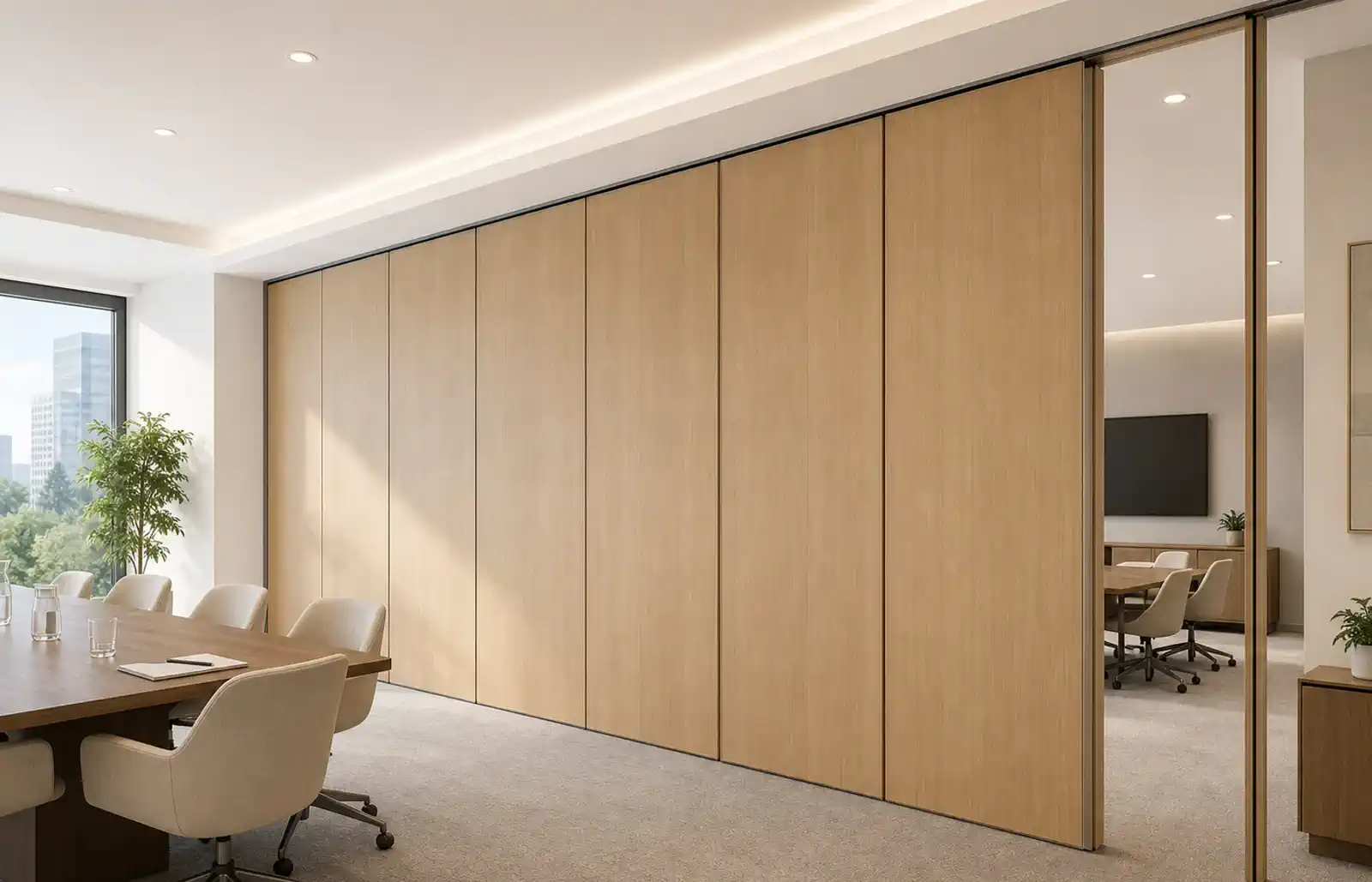
EBUNGE movable partition panels are individually movable, suspended from a top track, cross the opening without a floor track, and park at a planned stacking position. The track must follow a continuous connected overhead route. If the void is too shallow, or if services block the route, the track cannot be set out as drawn.
Setting-out transfers the design line to the floor and ceiling. If the void depth is unconfirmed, the setting-out team may mark a line that later has to move. That creates rework for the ceiling grid, MEP drops and partition parking zone. The confirmation is therefore a risk-control step, not a formality.
Who Is Responsible for Confirming the Void Depth?
Coordination scope: ceiling void depth.
Responsibility is shared, but one party should own the final sign-off. The table below shows typical roles. Confirm the actual responsibility matrix for your project.
| Role | Typical contribution | Confirmation boundary |
|---|---|---|
| Architect / interior designer | Reflected ceiling plan, partition layout, finish zone | Design intent and visible coordination |
| Structural engineer | Support location and overhead structure review | Project-specific support capacity |
| MEP coordinator | Duct, pipe and cable tray routes | Clash-free service zone |
| Ceiling contractor | Grid depth, hanger and access zone | Installed void dimensions |
| Partition supplier | Track profile and fixing interface information | Product-specific interface data |
| Main contractor | Setting-out and trade sequencing | Site readiness and hold points |
The main contractor usually chairs the sign-off, but the architect or lead designer should confirm that the void depth matches the coordinated ceiling zone. The partition supplier can only confirm the interface requirements for the track.
What Information Is Needed for Confirmation?
Confirmation needs more than a single dimension. The project team should assemble a coordinated set of drawings and schedules before setting-out. Missing information is a common cause of delay.
Essential drawing inputs
- Reflected ceiling plan showing the partition track line and ceiling void zone.
- MEP coordination drawings showing duct, pipe and cable tray routes.
- Partition layout showing straight, turning and stacking routes.
- Track interface details from the partition supplier.
Project-specific checks
Check that the void depth is consistent along the entire track route, including turning points and the parking zone. A deeper void at one end does not help if a service beam reduces the depth elsewhere. Also check that the support members are continuous where the track changes direction.
How to Run the Confirmation Process
A simple numbered process helps the project team avoid missed steps. Adapt it to your contract and site procedures.
- Issue the coordinated ceiling and MEP drawings to all responsible parties.
- Mark the proposed track route, including straight, turning and stacking sections.
- Measure or extract the available void depth along that route.
- Compare the available depth with the track interface requirements.
- Identify clashes and resolve them before setting-out.
- Record the confirmed depth and support locations in a signed coordination sheet.
- Release the setting-out hold point only after sign-off.
This process does not replace engineering review. It creates a clear evidence trail so that setting-out proceeds on confirmed information.
Evidence Boundaries and Common Misunderstandings
Several assumptions can mislead a project team. The first is that a visible ceiling void is automatically deep enough. The second is that the partition supplier can confirm the void depth. The supplier can provide track interface information, but the actual void is a site condition owned by the ceiling and MEP trades.
Confirm project-specific acoustic requirements with the responsible acoustic consultant.
Evidence note: Do not infer support capacity, acoustic performance or dimensional limits from a drawing or photograph. Each project requires its own confirmed support, acoustic and dimensional review.
Setting-Out Hold Points and Documentation
Setting-out should not begin until the void depth confirmation is documented. A hold point is a scheduled pause where the responsible parties verify that the overhead route is ready. The documentation should include the confirmed depth, the support locations, the track route and the sign-off date.
For projects with multiple partition lines, confirm each route separately. The exact route, junction arrangement, continuous overhead path and parking position must be confirmed from the coordinated project drawings. Parking style is customized to the customer layout and project requirements. The stacking position must be included in the void depth check because the track continues into that zone.
If pass-door requirements are part of the layout, confirm them during the same coordination stage. Pass-door positions can affect the track route and the setting-out line. Project documentation can be discussed with the EBUNGE team to align interface information.
Frequently Asked Questions
Who should sign off ceiling void depth before setting-out?
The partition supplier confirms track interface requirements. The final responsibility matrix should be agreed for each project.
Can the partition supplier confirm the void depth on site?
The supplier can provide track profile and fixing interface information. Site measurement and engineering review remain project-specific.
What happens if the void depth is too shallow?
The track route may need to be redesigned, or the ceiling and MEP services may need to be adjusted. Setting-out should stop until the responsible parties agree on a revised coordinated route. Do not proceed on an unconfirmed dimension.
Does a deeper ceiling void improve acoustic performance?
Not automatically. Confirm project-specific acoustic requirements with the responsible acoustic consultant.
Are straight, turning and stacking routes checked separately?
Yes. Each route section should be reviewed because support conditions, service clashes and void depth can change along the track. The stacking position is part of the overhead route and should be included in the confirmation.
What documentation should be kept?
Keep the coordinated ceiling plan, MEP drawings, track interface details, confirmed depth record and sign-off sheet. This evidence trail supports setting-out and helps resolve later coordination questions.
Conclusion and Next Steps
Ceiling void depth confirmation is a shared project responsibility. The main contractor should own the setting-out hold point and ensure that the confirmed depth is documented before work begins.
For top-hung acoustic movable partitions, the overhead route must be continuous and supported. Confirm project-specific support, acoustic and dimensional requirements with the responsible parties. Review the acoustic movable partition range for interface context, see project references for layout examples, and contact EBUNGE to discuss pass-door requirements and project documentation.
Continue Exploring
More Acoustic Partition Guides
- Newer guideWho Confirms Ceiling Grid Line Before Acoustic Partition Track
- Earlier guidePhase Acoustic Movable Partition Work Around a Building’s
- Related guideAcoustic Partition Ceiling Interface Zone Confirmation
- Related guideHandover Documentation for Acoustic Movable Partition Projects