
Why exhibition hall partition finishes trade show and conference uses differ
Document the review scope for exhibition hall partition finishes trade.
Quick project answer
Exhibition halls host events with different spatial demands. A trade show may need many small stands, while a conference may need one large room or several session rooms. Movable partitions can be used wherever flexible space division, combination or reconfiguration is required. The finish choice affects how the hall looks and how it is maintained between events.
When planners compare exhibition hall partition finishes trade show and conference requirements, they often focus on surface durability and visual consistency. The suitability of each route and parking arrangement depends on the approved layout, circulation, ceiling interfaces and operating sequence. This means the same partition system can be specified with different finishes for different event types.
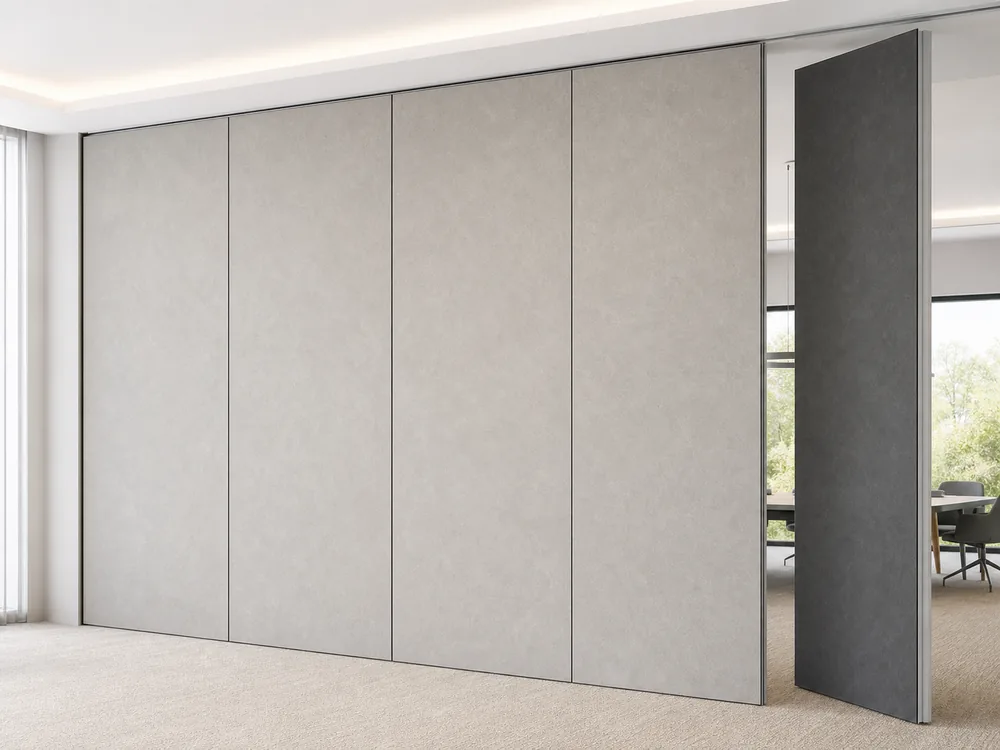
The EBUNGE movable partition system is top-hung and has no continuous floor running track or operating hardware in the finished floor along the partition line. This principle shapes how finishes are planned for both trade show and conference layouts.
The top-hung principle and its effect on finish planning
A top-hung system carries the partition panels from an overhead structure. Because there is no continuous floor running track, the finished floor along the partition line is not cut or damaged. The floor remains physically uninterrupted by the maintained EBUNGE top-hung system.
For exhibition hall partition finishes trade show applications, an uninterrupted floor can simplify the placement of stands and cable covers. For conference use, the same floor condition supports seating layouts and staging without a floor track crossing the room. The finish of the partition itself can be selected independently from the floor finish.
The exact route, junction arrangement, continuous overhead path and parking position must be confirmed from the coordinated project drawings. This boundary applies to every project, regardless of event type.
Physically uninterrupted floor and finish coordination
Because the floor is not cut or damaged for a floor track, the floor finish can run continuously beneath the partition line. This is relevant when the hall has a polished concrete, stone or resilient floor that would be difficult to repair after cutting.
For exhibition hall partition finishes trade show use, a continuous floor can help when heavy display materials are moved across the hall. For conference use, the same condition can support temporary stages and seating without a track to bridge. The partition finish and the floor finish can be coordinated as separate decisions.
Cleaning and maintenance methods vary with the selected finish. A finish that suits a trade show may need different care from one chosen for a conference. The project team should confirm the care method for each selected finish before the event cycle begins.
Parking planning for trade show and conference layouts
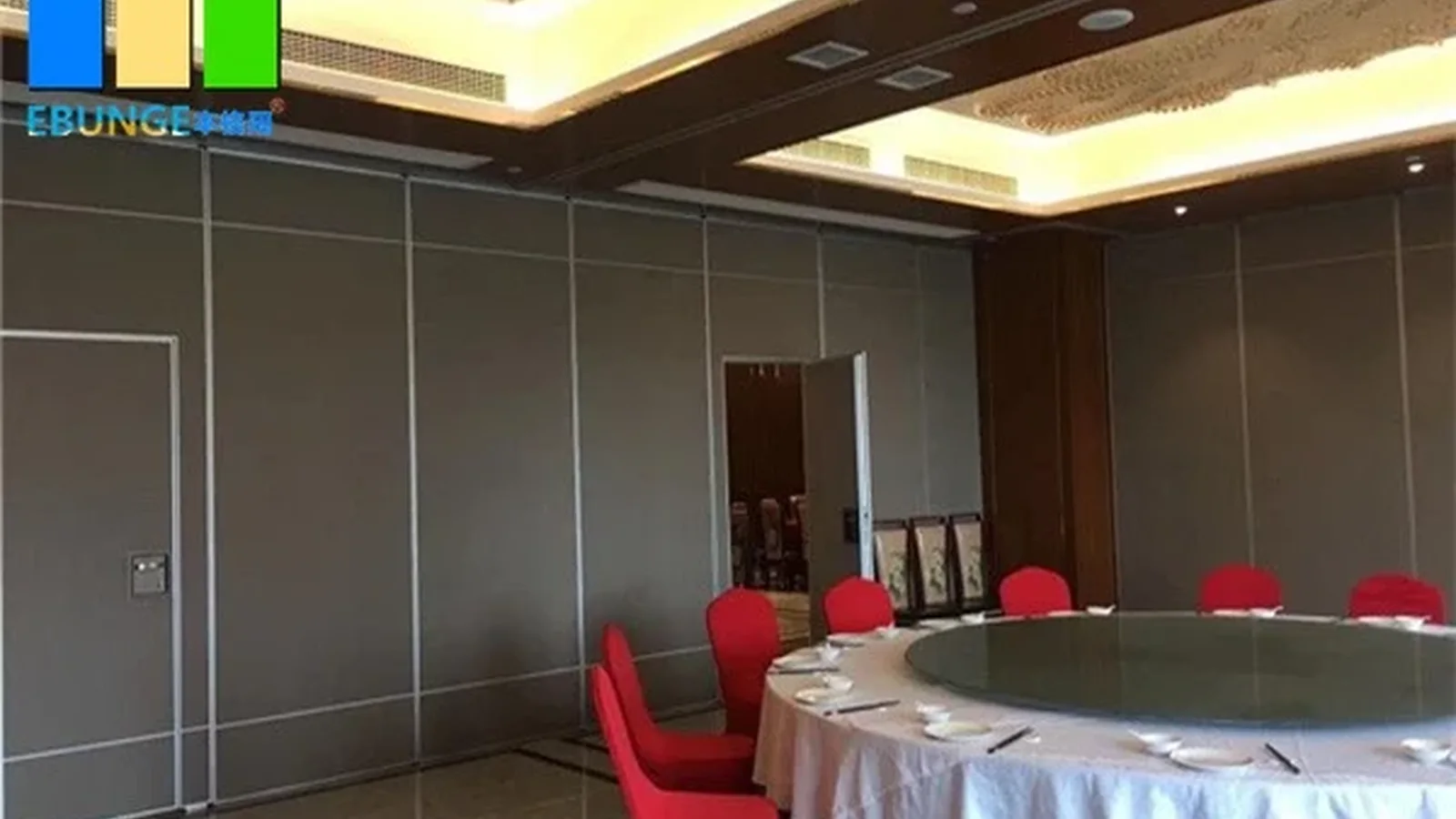
Panel parking style can be customized to the customer layout and project requirements, subject to coordinated drawings. A suitable approved parking arrangement can use the stacking area more compactly and coordinate with the space design.
For exhibition hall partition finishes trade show use, parking may need to stay clear of stand areas and service routes. For conference use, parking may be planned near a wall or service zone that is not used during sessions. The exact track, support and panel layout still require project drawings.
The following table compares typical planning inputs for the two event types. It is a general guide, not a project specification.
| Planning input | Trade show focus | Conference focus |
|---|---|---|
| Primary layout | Many small stands or zones | One large room or session rooms |
| Floor condition | Continuous floor for stand movement | Continuous floor for seating and staging |
| Parking area | Clear of stand and service routes | Near wall or service zone |
| Finish care | Confirmed for event cycle | Confirmed for event cycle |
These inputs must be reviewed against the coordinated project drawings. The exact route, junction arrangement, continuous overhead path and parking position must be confirmed from the coordinated project drawings.
Finish selection and care coordination
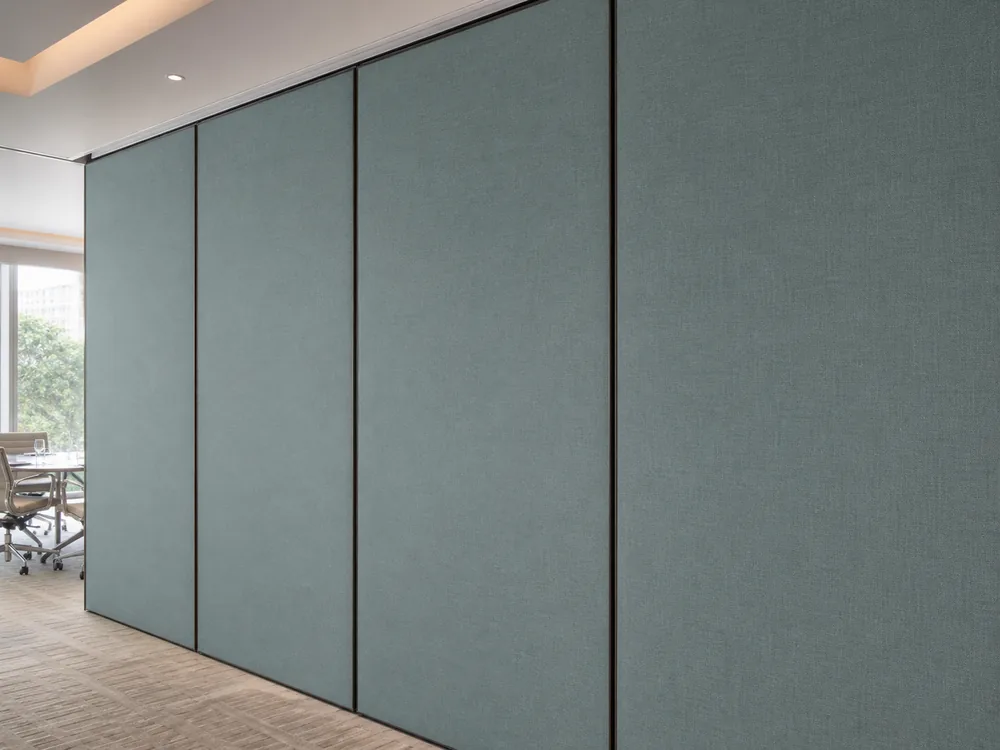
Finish materials can be customized, and cleaning and maintenance methods vary with the selected finish. For exhibition hall partition finishes trade show use, the finish may be chosen to suit frequent reconfiguration and visual variety. For conference use, the finish may be chosen for a consistent appearance across session rooms.
The care method should be confirmed for each finish before the hall opens. A finish that is easy to clean in one setting may need a different approach in another. The project team should record the confirmed care method for each partition finish.
Because the EBUNGE system is top-hung, the floor finish and the partition finish can be maintained as separate items. The floor remains physically uninterrupted by the maintained EBUNGE top-hung system. This separation can help when the floor and partition finishes have different care cycles.
Non-limiting applications and project context
Movable partitions can be used wherever flexible space division, combination or reconfiguration is required; application examples are not limiting. EBUNGE has completed many types of hotel-related movable-partition projects. Ballrooms, wedding halls and multifunction halls are non-limiting examples.
Exhibition halls and conference centers are also non-limiting examples. The same top-hung principle applies when a hall must change between trade show and conference layouts. The finish and parking decisions follow the event program and the coordinated drawings.
For related project context, see completed projects. For product information, see the movable partition wall page.
Buyer inputs and drawing approvals
Buyers should provide the event program, the required room sizes and the parking expectations for each layout. They should also confirm the preferred finish direction and the care method that can be supported between events.
The project team should then review the coordinated drawings for the track, support and panel layout. The exact route, junction arrangement, continuous overhead path and parking position must be confirmed from the coordinated project drawings.
Approval should cover the finish selection, the parking arrangement and the care method. Any change to the event program may require a new review of the coordinated drawings.
Frequently asked questions
Can the same partition system serve both trade show and conference layouts?
Yes. Movable partitions can be used wherever flexible space division, combination or reconfiguration is required. The finish and parking arrangement can be customized to the customer layout and project requirements, subject to coordinated drawings.
Does a top-hung partition require a floor track?
No. The EBUNGE movable partition system is top-hung and has no continuous floor running track or operating hardware in the finished floor along the partition line. The floor is not cut or damaged for a floor track.
How is parking planned for each event type?
Panel parking style can be customized to the customer layout and project requirements, subject to coordinated drawings. A suitable approved parking arrangement can use the stacking area more compactly and coordinate with the space design.
Can partition finishes be customized for exhibition halls?
Yes. Finish materials can be customized, and cleaning and maintenance methods vary with the selected finish. The project team should confirm the care method for each selected finish.
What must be confirmed from the coordinated drawings?
The exact route, junction arrangement, continuous overhead path and parking position must be confirmed from the coordinated project drawings. The exact track, support and panel layout also require project drawings.
Are exhibition halls the only application for movable partitions?
No. Movable partitions can be used wherever flexible space division, combination or reconfiguration is required; application examples are not limiting. EBUNGE has completed many types of hotel-related movable-partition projects, with ballrooms, wedding halls and multifunction halls as non-limiting examples.
Continue Exploring
More Materials and Finishes Guides
- Newer guideAirport Partition Finish: Luggage Cart Impact vs Passenger Traffic
- Earlier guideExhibition Hall Partition Finish Impact: Mobile Display Walls
- Related guideWho Verifies Partition Handover Records When Trades Finish at Different
- Related guideMovable Partition Finish Sample Coordination Guide for Interior