
Quick project answer
Exhibition hall partition seals hvac coordination is a planning topic that brings together movable walls, ceiling air devices, and the finished floor. When a hall must change from one large event to several smaller rooms, the partition system and the HVAC layout both influence how the space performs. This article explains the top-hung principle, the physically uninterrupted floor, parking planning, finish care, and the drawing approvals that keep exhibition hall partition seals hvac details aligned with the building.
Top-Hung Principle for Movable Partitions
The EBUNGE movable partition system is top-hung. That means the panels hang from an overhead track rather than rolling on a floor-mounted rail. The finished floor along the partition line is not cut or damaged for a floor track. The floor remains physically uninterrupted by the maintained EBUNGE top-hung system.
Because there is no continuous floor running track or operating hardware in the finished floor along the partition line, the floor finish can continue across the hall without a break. This characteristic supports flexible space division, combination, or reconfiguration. It also means that exhibition hall partition seals hvac planning can focus on the ceiling zone and the parking area rather than on floor trenches.

The exact route, junction arrangement, continuous overhead path and parking position must be confirmed from the coordinated project drawings. Those drawings define how the top-hung system relates to the ceiling structure and to the HVAC diffusers that serve the hall.
Physically Uninterrupted Floor and HVAC Layout
A physically uninterrupted floor is useful in exhibition halls where booths, displays, and visitor routes change from event to event. With a top-hung system, the floor is not cut for a track. The floor finish can run continuously under the partition line when the panels are parked away.
Ceiling HVAC diffusers, however, still need to deliver air to the occupied zones on both sides of a closed partition. Exhibition hall partition seals hvac coordination therefore involves checking diffuser positions against the partition line. The goal is to confirm that air distribution remains appropriate when the hall is divided.
This coordination does not require a universal installation sequence. It requires project-specific review. The exact route, junction arrangement, continuous overhead path and parking position must be confirmed from the coordinated project drawings.
Parking Planning and Stacking Area
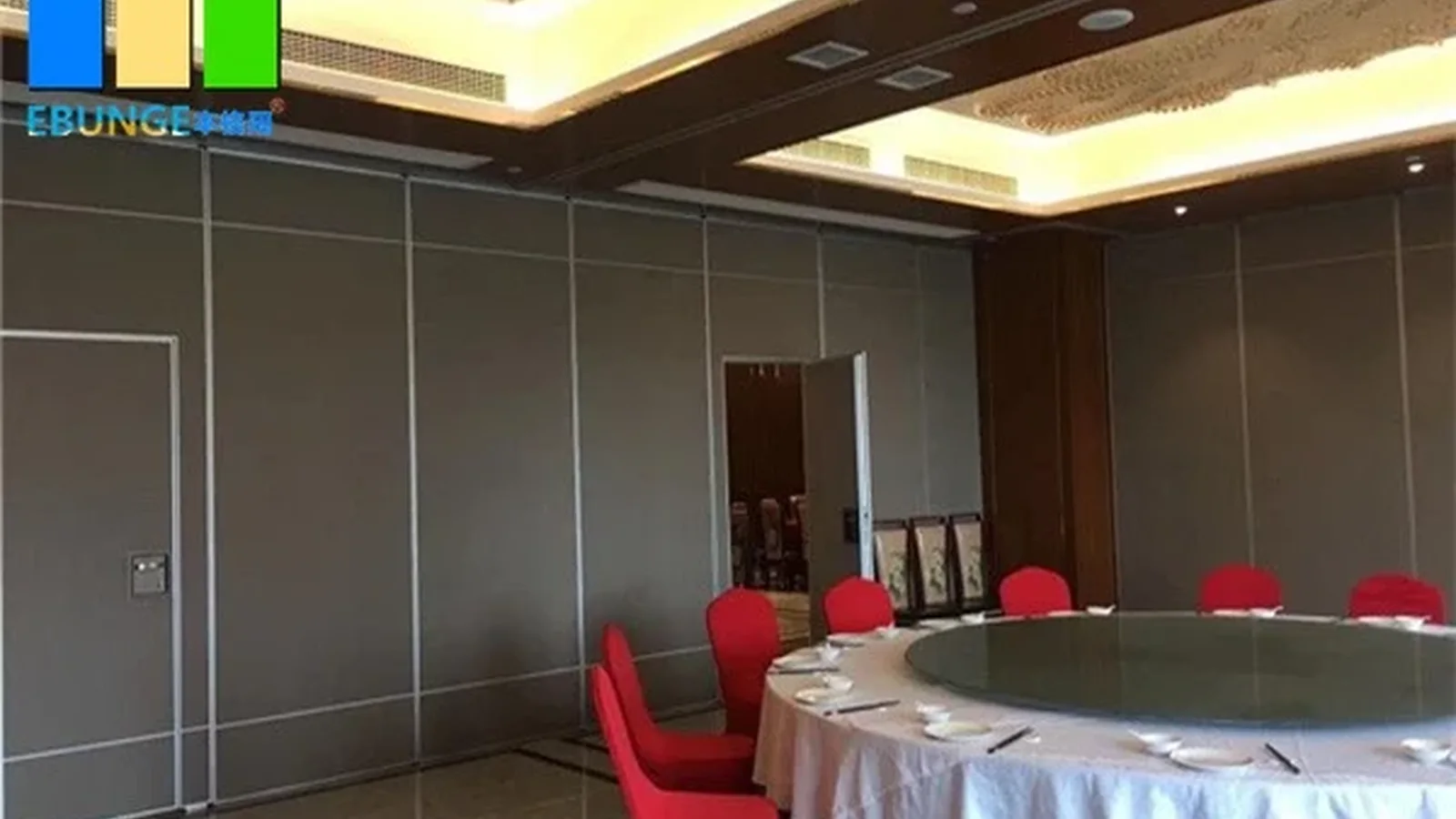
Panel parking style can be customized to the customer layout and project requirements, subject to coordinated drawings. A suitable approved parking arrangement can use the stacking area more compactly and coordinate with the space design. The exact track, support and panel layout still require project drawings.
Panel handling and the operating sequence must be confirmed for the selected layout and project conditions. It also affects where ceiling diffusers can be placed without interfering with the parked panels. Exhibition hall partition seals hvac planning should therefore treat the stacking area as part of the overall ceiling and floor plan.
Buyers should provide the expected hall layouts, the desired parking location, and any fixed ceiling features. These inputs help the project team prepare coordinated drawings for review.
Finish and Care Coordination
Finish materials can be customized, and cleaning and maintenance methods vary with the selected finish. This means the care routine for a movable partition depends on the finish chosen for the project. There is no single cleaning method that applies to every finish.
For exhibition halls, the finish may need to suit a busy event environment. The project team can discuss finish options during the drawing stage. Exhibition hall partition seals hvac coordination should also consider how the finish interacts with the ceiling diffuser layout and the parking area.
Because cleaning and maintenance methods vary with the selected finish, the project documents should record the approved finish and the corresponding care guidance. This record helps the facility team maintain the partition after handover.
Non-Limiting Applications for Flexible Space
Movable partitions can be used wherever flexible space division, combination or reconfiguration is required. Application examples are not limiting. EBUNGE has completed many types of hotel-related movable-partition projects. Ballrooms, wedding halls and multifunction halls are non-limiting examples.
Exhibition halls share the same need for flexible division, but they also have specific ceiling and floor conditions. Exhibition hall partition seals hvac coordination is one example of how a project can plan for both the partition system and the air distribution.
No customer names, locations, quantities, ratings, certifications or outcomes may be inferred from the examples above. Each project is planned from its own coordinated drawings.
Buyer Inputs and Drawing Approvals
Successful coordination depends on clear buyer inputs. The project team needs the hall dimensions, the intended partition lines, the parking location, and the ceiling features that may affect the overhead path. These inputs feed into the coordinated drawings.
The exact route, junction arrangement, continuous overhead path and parking position must be confirmed from the coordinated project drawings. Approval of those drawings is a key step before any project-specific production or installation planning.
Buyers should also confirm the finish selection and the care requirements that follow from it. Exhibition hall partition seals hvac details should be reviewed alongside the finish and parking decisions so that the final layout works as a whole.
Key Coordination Points
- Top-hung EBUNGE system with no continuous floor running track along the partition line.
- Physically uninterrupted floor that is not cut or damaged for a floor track.
- Parking style customized to the customer layout, subject to coordinated drawings.
- Finish materials customizable, with cleaning and maintenance methods varying by finish.
- Exhibition hall partition seals hvac details confirmed from coordinated project drawings.
Drawing Review Checklist
- Confirm the partition lines and the desired parking position.
- Identify ceiling HVAC diffusers that may sit near the partition line.
- Review the overhead path and junction arrangement on the coordinated drawings.
- Select the finish and record the corresponding care guidance.
- Approve the coordinated drawings before project-specific planning proceeds.
Comparison of Coordination Topics
| Topic | What to Confirm |
|---|---|
| Top-hung system | Overhead track and panel layout from coordinated drawings. |
| Floor condition | No floor track; floor remains physically uninterrupted. |
| Parking area | Customized parking style and stacking area from drawings. |
| HVAC diffusers | Diffuser positions relative to the partition line. |
| Finish and care | Customizable finish and finish-specific cleaning methods. |
The exact route, junction arrangement, continuous overhead path and parking position must be confirmed from the coordinated project drawings.
Frequently Asked Questions
For further context, review related project guidance and additional planning resources before preparing the coordinated project brief.
What does exhibition hall partition seals hvac coordination involve?
It involves planning the movable partition system alongside the ceiling HVAC diffusers and the floor condition. The goal is to confirm that the partition line, parking area, and air distribution work together in the coordinated project drawings.
Does a top-hung movable partition require a floor track?
No. The EBUNGE movable partition system is top-hung and has no continuous floor running track or operating hardware in the finished floor along the partition line. The floor is not cut or damaged for a floor track.
Can the parking style be customized for an exhibition hall?
Yes. Panel parking style can be customized to the customer layout and project requirements, subject to coordinated drawings. A suitable approved parking arrangement can use the stacking area more compactly and coordinate with the space design.
Are finish materials customizable, and how are they cleaned?
Finish materials can be customized, and cleaning and maintenance methods vary with the selected finish. The project documents should record the approved finish and the corresponding care guidance.
Where can movable partitions be used?
Movable partitions can be used wherever flexible space division, combination or reconfiguration is required. Application examples are not limiting. EBUNGE has completed many types of hotel-related movable-partition projects, including ballrooms, wedding halls and multifunction halls as non-limiting examples.
What should buyers provide for coordination?
Buyers should provide the hall dimensions, intended partition lines, parking location, and ceiling features that may affect the overhead path. These inputs help the project team prepare coordinated drawings for review and approval.
The exact overhead route and support arrangement must be confirmed by the responsible project team from coordinated drawings.. Exhibition hall partition seals hvac planning benefits from early coordination between the partition system, the ceiling diffusers, and the finished floor.
Continue Exploring
More Acoustic Partition Guides
- Newer guideHandover Docs: Movable Partition Seal Adjustment Points
- Earlier guideWhich Drawings Specify Exhibition Hall Partition Seals at Wall Displays
- Related guideAcoustic Partition Ceiling Interface Zone Confirmation
- Related guideWho Confirms Ceiling Grid Line Before Acoustic Partition Track