
Quick project answer
Selecting a factory direct movable partition supplier involves more than comparing product lists. Buyers need to verify how the system interacts with the building, how panels will be parked, and how finishes will be maintained. This article outlines practical checks for a factory direct movable partition supplier, based on confirmed system facts and coordinated project drawings.
Why the Top-Hung Principle Matters
The EBUNGE movable partition system is top-hung. That means the panels are supported from an overhead track rather than from a floor-mounted track. This principle affects how the floor is treated and how the partition line is planned.
For buyers, the top-hung approach is a key verification point. A factory direct movable partition supplier should be able to explain how the overhead track integrates with the building structure. The exact route, junction arrangement, continuous overhead path and parking position must be confirmed from the coordinated project drawings.
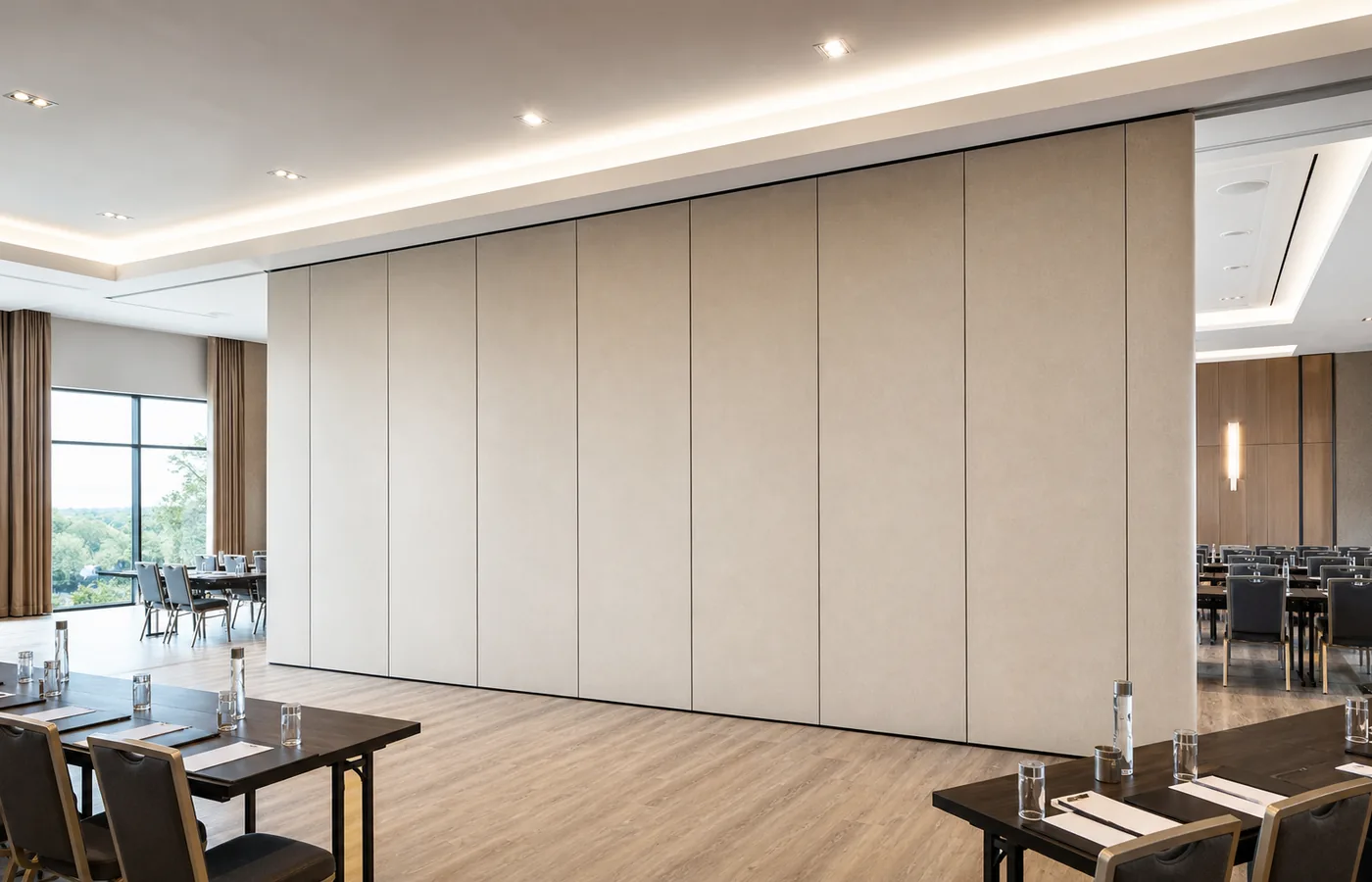
Because the system is top-hung, there is no continuous floor running track or operating hardware in the finished floor along the partition line. This is a confirmed fact that buyers can use to distinguish the EBUNGE system from floor-track alternatives.
Physically Uninterrupted Floor
The floor is not cut or damaged for a floor track and remains physically uninterrupted by the maintained EBUNGE top-hung system. This means the finished floor can remain continuous along the partition line. Buyers should verify that the proposed system does not require cutting or embedding hardware in the floor.
An uninterrupted floor can be important for spaces where floor finishes are continuous or where cutting would be undesirable. However, buyers should not assume that every top-hung system automatically avoids all floor work. The confirmed fact applies to the EBUNGE top-hung system as described.
When evaluating a factory direct movable partition supplier, ask for drawings that show the partition line and confirm that no floor track is required. The exact route, junction arrangement, continuous overhead path and parking position must be confirmed from the coordinated project drawings.
Parking Planning and Stacking Area
Panel parking style can be customized to the customer layout and project requirements, subject to coordinated drawings. A suitable approved parking arrangement can use the stacking area more compactly and coordinate with the space design. The exact track, support and panel layout still require project drawings.
Buyers should discuss parking early with a factory direct movable partition supplier. The parking position affects how panels are stored when the space is open. It also influences the layout of adjacent areas.
Parking style is not a universal default. It depends on the room geometry, the desired opening, and the available stacking area. The exact route, junction arrangement, continuous overhead path and parking position must be confirmed from the coordinated project drawings.
Finish Selection and Care Coordination
Finish materials can be customized, and cleaning and maintenance methods vary with the selected finish. Buyers should verify that the factory direct movable partition supplier can provide finish samples and care guidance for each proposed finish.
Different finishes may require different cleaning methods. A finish that is easy to clean in one setting may need different care in another. Buyers should ask how each finish should be maintained and whether the care method suits the project’s operations.
Finish coordination also affects the visual integration of the partition with the surrounding space. The factory direct movable partition supplier should confirm that finish choices are compatible with the project’s design intent and maintenance capabilities.
Non-Limiting Application Examples
Movable partitions can be used wherever flexible space division, combination or reconfiguration is required. Application examples are not limiting. EBUNGE has completed many types of hotel-related movable-partition projects; ballrooms, wedding halls and multifunction halls are non-limiting examples.
Buyers should not infer customer names, locations, quantities, ratings, certifications or outcomes from these examples. The confirmed facts only state that EBUNGE has completed many types of hotel-related movable-partition projects. Other applications are possible wherever flexible space division is needed.
When speaking with a factory direct movable partition supplier, buyers can describe their own space and requirements. The supplier can then confirm whether the top-hung system and customizable parking and finishes suit the project.
Buyer Inputs and Drawing Approvals
Buyers should prepare key inputs before requesting drawings from a factory direct movable partition supplier. These inputs help the supplier coordinate the top-hung track, parking arrangement, and finish selection.
- Room dimensions and the desired partition line.
- Preferred parking location and available stacking area.
- Finish preferences and cleaning considerations.
- Any building constraints that affect the overhead path.
After receiving drawings, buyers should review the track route, parking position, and finish details. The exact route, junction arrangement, continuous overhead path and parking position must be confirmed from the coordinated project drawings.
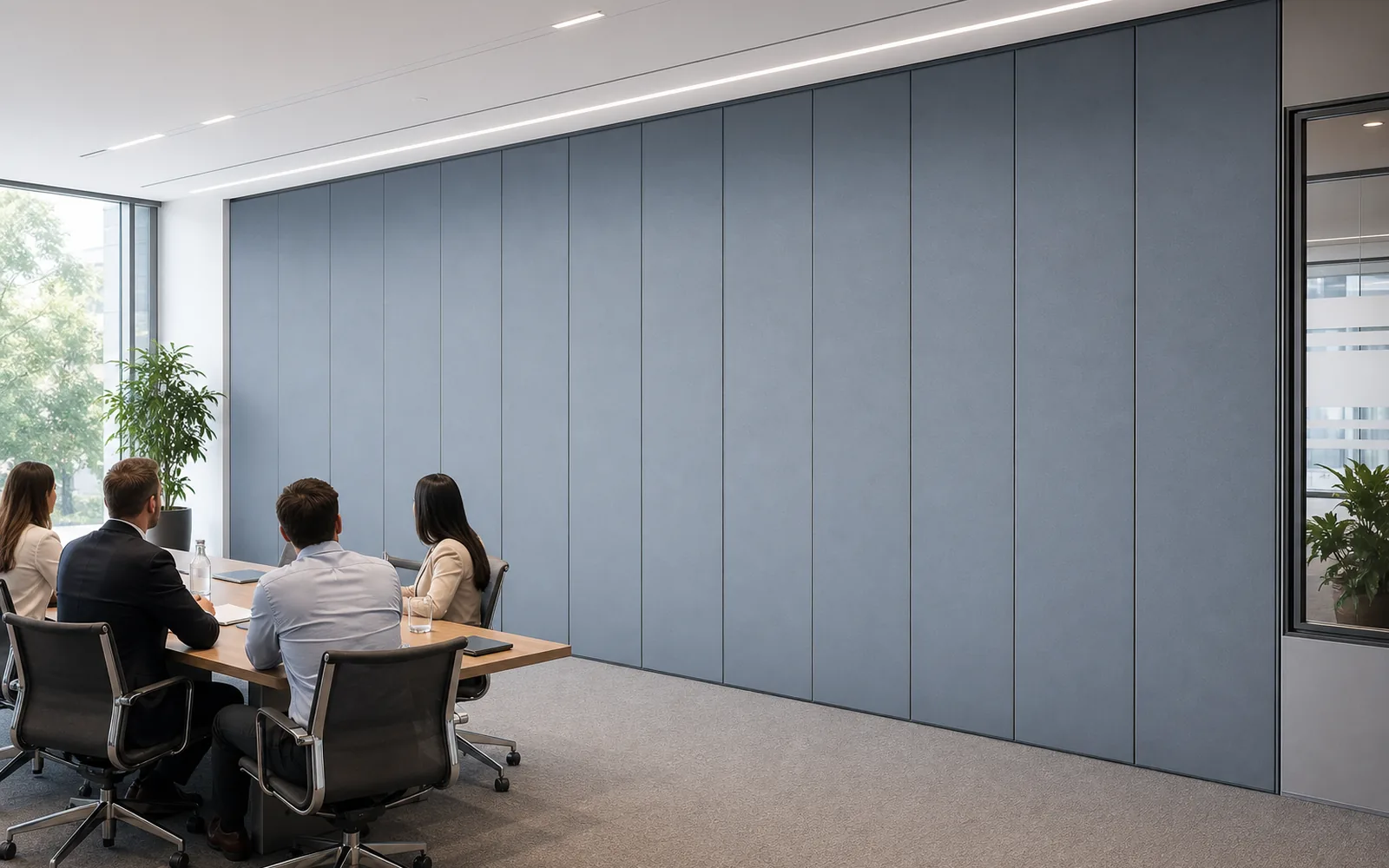
Approval of coordinated drawings is a critical step. Buyers should not assume that a generic layout applies to their project. Each project requires its own coordinated drawings.
Verification Checklist for a Factory Direct Movable Partition Supplier
Use the following checklist to structure your verification. It focuses on confirmed system facts and drawing coordination.
| Verification Item | What to Confirm |
|---|---|
| Top-hung principle | System is top-hung with no continuous floor track. |
| Floor continuity | Floor is not cut or damaged for a floor track. |
| Parking planning | Parking style is customized to layout and project requirements, subject to coordinated drawings. |
| Finish and care | Finishes are customizable; cleaning and maintenance vary with the selected finish. |
| Drawing approvals | Track route, parking position, and finishes are confirmed from coordinated project drawings. |
This table is not exhaustive. Buyers should adapt it to their project and ask the factory direct movable partition supplier for clarification where needed.
Common Questions Buyers Ask
What does top-hung mean for my floor?
With the EBUNGE top-hung system, there is no continuous floor running track or operating hardware in the finished floor along the partition line. The floor is not cut or damaged for a floor track and remains physically uninterrupted by the maintained system.
Can parking style be customized?
Yes, panel parking style can be customized to the customer layout and project requirements, subject to coordinated drawings. A suitable approved parking arrangement can use the stacking area more compactly and coordinate with the space design.
Are finishes customizable?
Finish materials can be customized, and cleaning and maintenance methods vary with the selected finish. Buyers should confirm care methods for each chosen finish.
Where can movable partitions be used?
Movable partitions can be used wherever flexible space division, combination or reconfiguration is required. Application examples are not limiting. EBUNGE has completed many types of hotel-related movable-partition projects; ballrooms, wedding halls and multifunction halls are non-limiting examples.
What drawings are needed?
The exact route, junction arrangement, continuous overhead path and parking position must be confirmed from the coordinated project drawings. Buyers should review and approve these drawings before finalizing the project.
How do I verify a factory direct movable partition supplier?
Ask for confirmation of the top-hung principle, floor continuity, parking customization, finish care, and coordinated drawings. A factory direct movable partition supplier should provide project-specific drawings rather than generic layouts.
For more information about EBUNGE, visit /about/. Project documents can be reviewed at /documents/.
Continue Exploring
More Movable Partition Guide Guides
- Newer guideSchool Auditorium Partition Track: Ceiling Light Grids vs Rigging
- Earlier guide10 Questions to Ask Before Ordering a Movable Wall System
- Related guideHow Architects Run a Partition Coordination Workflow Across Consultant
- Related guideRoom Scheduling Rules That Decide When Movable Partitions Stay Open