
Understanding the comparison
Quick project answer
Choosing between glass vs solid movable partitions for offices involves more than appearance. The decision affects how the floor is used, how panels are parked and how finishes are maintained. This comparison focuses on practical planning inputs rather than generic product claims.
The EBUNGE movable partition system is top-hung and has no continuous floor running track or operating hardware in the finished floor along the partition line. That single fact changes how the floor is treated and how the two visual options are evaluated.
Glass vs solid movable partitions can both be considered within a top-hung approach. The difference lies in finish selection, care routines and how each option coordinates with the surrounding office layout.
The top-hung principle
In a top-hung system, the panels are supported from above rather than from a floor track. The floor is not cut or damaged for a floor track and remains physically uninterrupted by the maintained EBUNGE top-hung system. This principle applies whether the panel finish is glass or solid.
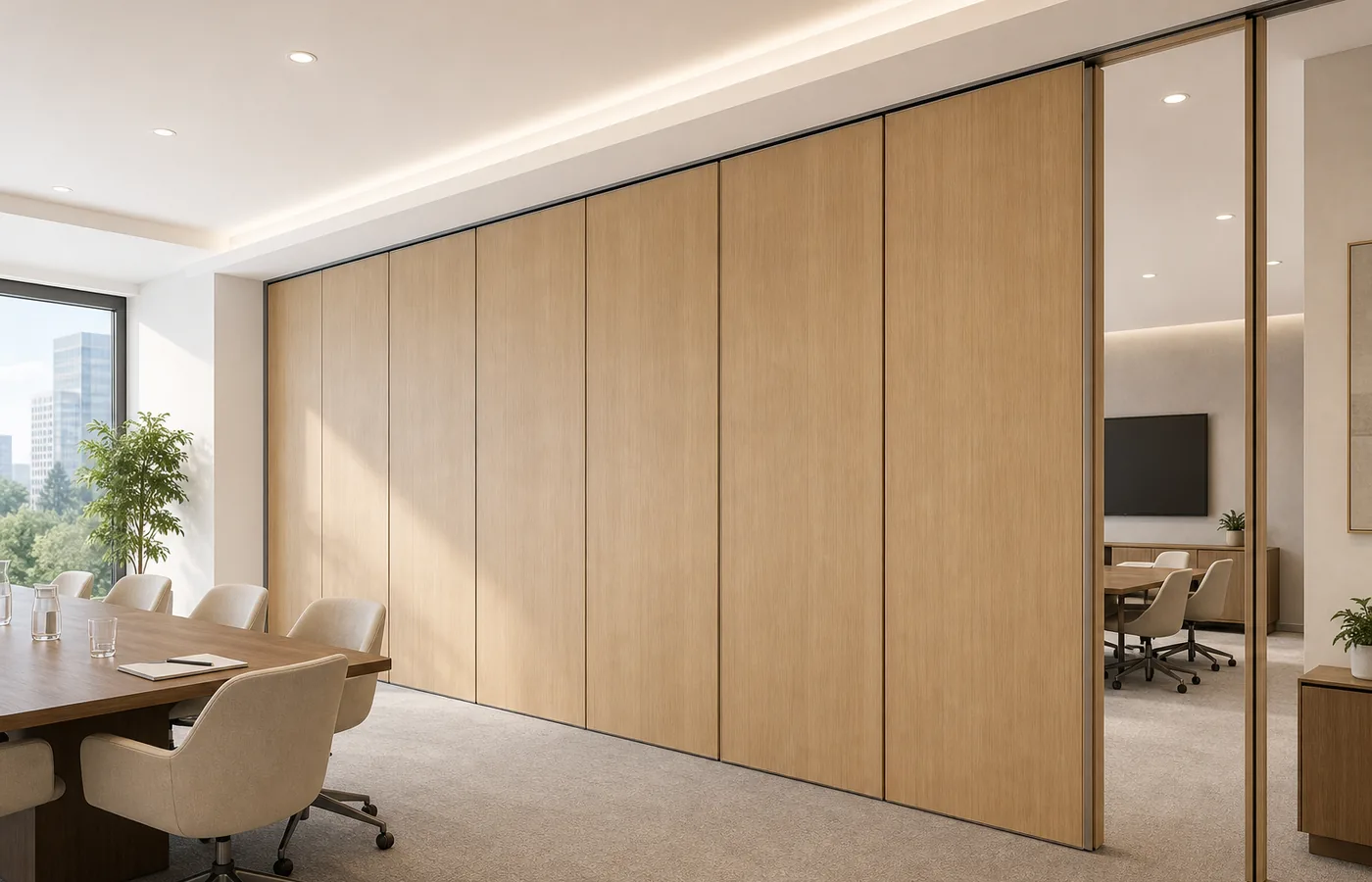
Because there is no continuous floor running track, the finished floor along the partition line can remain intact. That condition supports office layouts where floor finishes continue across the room without a permanent break.
The exact route, junction arrangement, continuous overhead path and parking position must be confirmed from the coordinated project drawings. Those items are project-specific and cannot be assumed from a general comparison.
Physically uninterrupted floor
A physically uninterrupted floor is a practical benefit when comparing glass vs solid movable partitions. With no continuous floor track, the floor surface does not need a cut line along the partition route. The suitability of each route and parking arrangement depends on the approved layout, circulation, ceiling interfaces and operating sequence.
The floor remains physically uninterrupted by the maintained EBUNGE top-hung system. That statement applies to the partition line and does not describe every possible floor condition in a project. Site conditions and coordinated drawings still govern the final arrangement.
When evaluating glass vs solid movable partitions, the floor condition is a shared characteristic of the top-hung approach. The choice of panel finish does not change the principle that no continuous floor track is required.
Parking planning and layout
Panel parking style can be customized to the customer layout and project requirements, subject to coordinated drawings. A suitable approved parking arrangement can use the stacking area more compactly and coordinate with the space design.
The exact track, support and panel layout still require project drawings. Parking is therefore a planning item rather than a fixed feature of either glass or solid panels.
When comparing glass vs solid movable partitions, consider how parked panels will relate to adjacent rooms, corridors and furniture zones. The stacking area should be reviewed alongside the overall space plan.
Parking decisions are separate from the finish choice. A well-coordinated parking position supports the way the office uses flexible space division, combination or reconfiguration.
Finish and care coordination
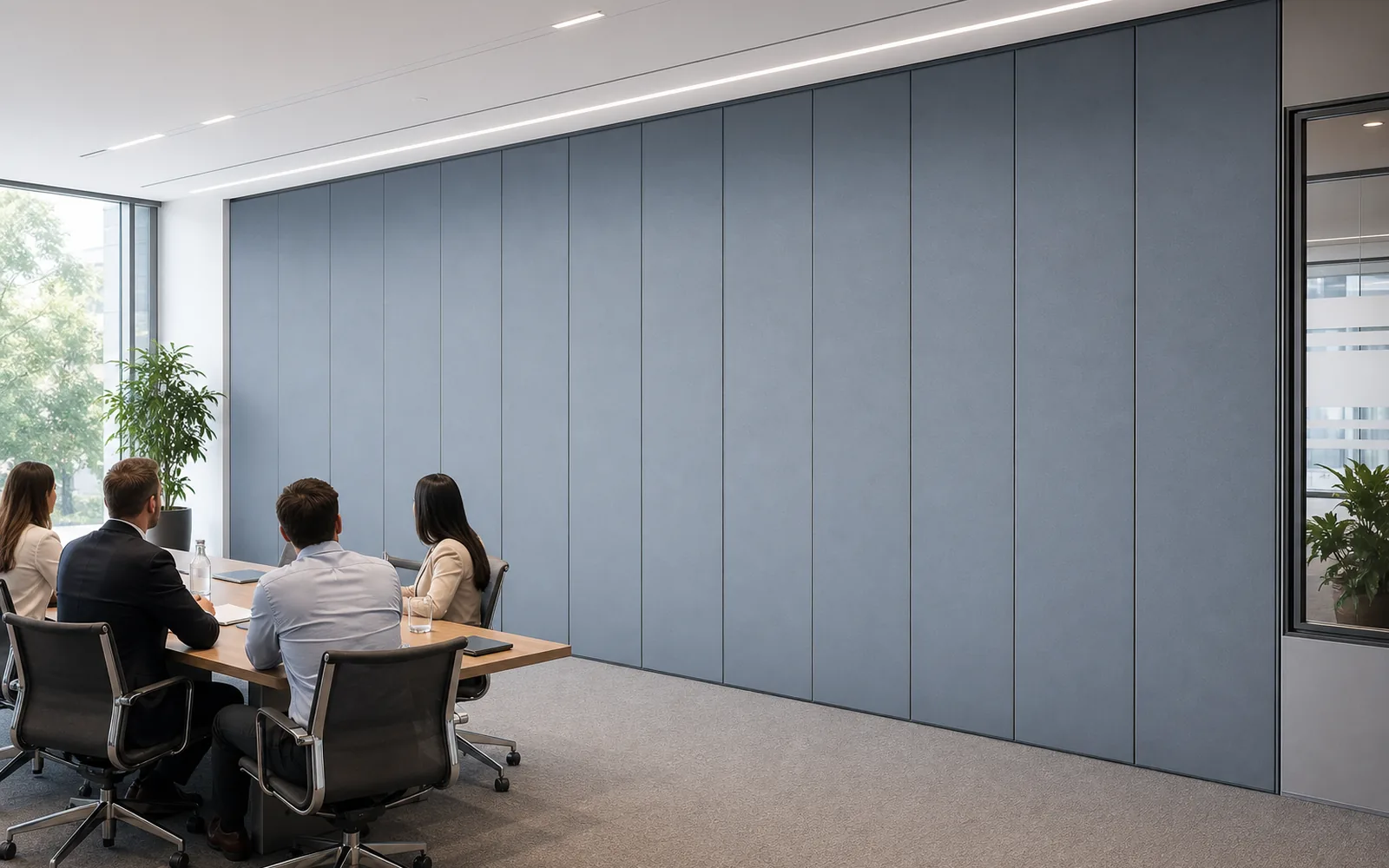
Finish materials can be customized, and cleaning and maintenance methods vary with the selected finish. This applies to glass vs solid movable partitions because each finish type has its own care considerations.
For any finish, the care method should be confirmed with the finish supplier or project team. A generic cleaning routine is not appropriate for every surface.
When planning glass vs solid movable partitions, match the finish to the office environment and the expected care routine. The confirmed point is that finishes are customizable and care methods differ by finish.
Non-limiting applications
Movable partitions can be used wherever flexible space division, combination or reconfiguration is required. Application examples are not limiting, so the comparison between glass vs solid movable partitions can apply to many office settings.
EBUNGE has completed many types of hotel-related movable-partition projects. Ballrooms, wedding halls and multifunction halls are non-limiting examples. No customer names, locations, quantities, ratings, certifications or outcomes may be inferred.
Office projects can follow the same planning logic. The choice between glass vs solid movable partitions depends on the space plan, finish preference and parking coordination rather than a fixed rule.
Buyer inputs and drawing approvals
Buyers should provide layout requirements, finish preferences and parking expectations early. These inputs help the project team coordinate the top-hung system with the surrounding space.
Panel parking style can be customized to the customer layout and project requirements, subject to coordinated drawings. Finish materials can be customized, and cleaning and maintenance methods vary with the selected finish.
For engineering details outside confirmed facts, use only this boundary sentence: The exact route, junction arrangement, continuous overhead path and parking position must be confirmed from the coordinated project drawings.
Reviewing glass vs solid movable partitions at drawing stage helps align finish, parking and floor continuity. Approval of coordinated drawings is a normal part of project planning.
Quick comparison module
| Consideration | Glass panels | Solid panels |
|---|---|---|
| Top-hung principle | Applies | Applies |
| Continuous floor track | Not required | Not required |
| Floor cut for track | Not required | Not required |
| Finish customization | Available | Available |
| Care method | Finish-specific | Finish-specific |
| Parking style | Customizable | Customizable |
Checklist for office projects
- Confirm the partition line and how the floor will remain uninterrupted.
- Review parking style against the customer layout and project requirements.
- Select finish materials and confirm the matching care method.
- Coordinate the overhead path and parking position through project drawings.
- Compare glass vs solid movable partitions against the space plan, not a default assumption.
Frequently asked questions
Does a top-hung movable partition require a floor track?
No continuous floor running track or operating hardware is required in the finished floor along the partition line. The floor is not cut or damaged for a floor track and remains physically uninterrupted by the maintained EBUNGE top-hung system.
Can glass vs solid movable partitions both use the same top-hung principle?
Yes. The top-hung principle applies regardless of whether the panel finish is glass or solid. The finish choice affects care and appearance, while the floor continuity principle remains the same.
How is parking planned for movable partitions?
Panel parking style can be customized to the customer layout and project requirements, subject to coordinated drawings. A suitable approved parking arrangement can use the stacking area more compactly and coordinate with the space design.
Are finish materials customizable?
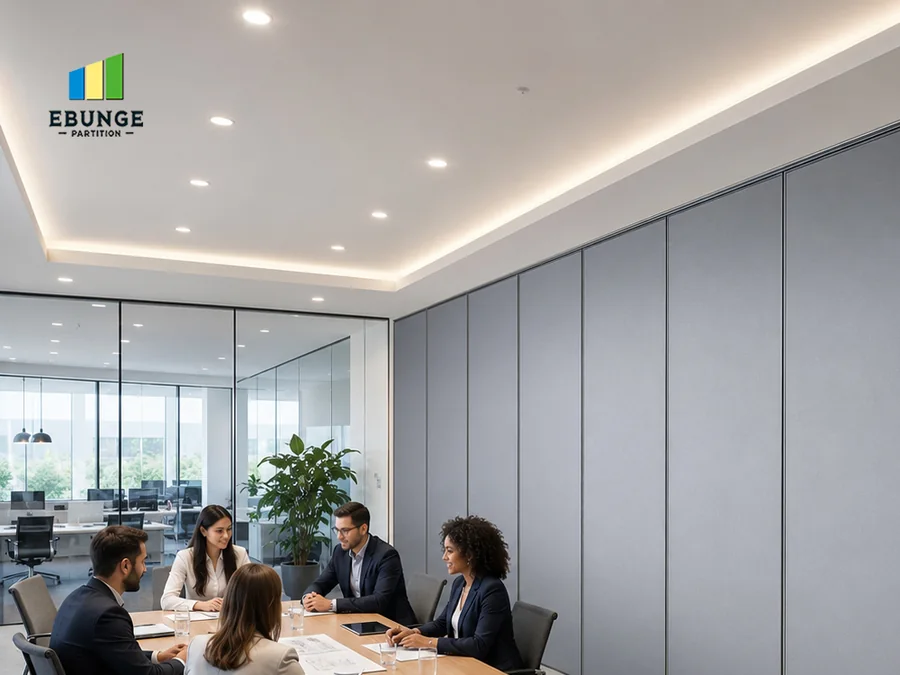
Yes. Finish materials can be customized, and cleaning and maintenance methods vary with the selected finish. The care method should be confirmed for the chosen finish.
Where can movable partitions be used?
Movable partitions can be used wherever flexible space division, combination or reconfiguration is required. Application examples are not limiting, and office layouts are among the possible uses.
What must be confirmed from project drawings?
The exact route, junction arrangement, continuous overhead path and parking position must be confirmed from the coordinated project drawings. These items are project-specific and should be reviewed before final planning.
Related reading
For more on top-hung systems, see glass movable partition guidance. For general office applications, review office movable partition information.
Comparing glass vs solid movable partitions is ultimately a project-specific exercise. Use the confirmed facts, coordinate the drawings and select finishes that match the care routine.
Continue Exploring
More Project Applications Guides
- Newer guideTraining Room Divider Wall Planning for Flexible Learning Areas
- Earlier guideConference Room Partition Planning: From Meeting Use to Panel Stacking
- Related guideOffice Glass Partition Selection Guide for Fit-Out Contractors
- Related guideOffice Meeting Suite Partition Tracks Need Clearance at Ceiling-Mounted