
Quick project answer
Use this guide to compare finish samples before ordering a healthcare training-room partition. The decision is which sample and care documentation to approve, rather than how to run the later cleaning programme.
Build a finish sample approval record
- Assign a sample reference to each candidate surface and record the panel face, edge treatment and intended room. Keep the reference tied to the current finish schedule.
- Ask the facilities team to list the cleaning products and methods it intends to use. Obtain written compatibility instructions from the finish supplier; a visual sample does not establish disinfectant resistance.
- Record the approved sample, reviewer, unresolved compatibility questions and supporting document revision. Keep approval conditional where care evidence is missing.
After the sample is selected, use the healthcare partition care handover checklist to transfer those limits to the operating team. Review available movable partition finish directions before requesting project samples.
Why healthcare training room partition finishes matter
Training rooms in healthcare settings may host repeated sessions with different groups. The partition surface is part of the room environment. Finish choices influence how staff clean and maintain the partition over time.
Because cleaning methods vary with the selected finish, the finish decision should be made with the care team. A finish that suits one training room may not suit another. The goal is a coordinated choice, not a default specification.
Healthcare training room partition finishes also affect visual consistency across a department. When several rooms share a finish language, wayfinding and room identity can feel more coherent. The finish should be selected with the wider interior plan.
The top-hung principle and the floor
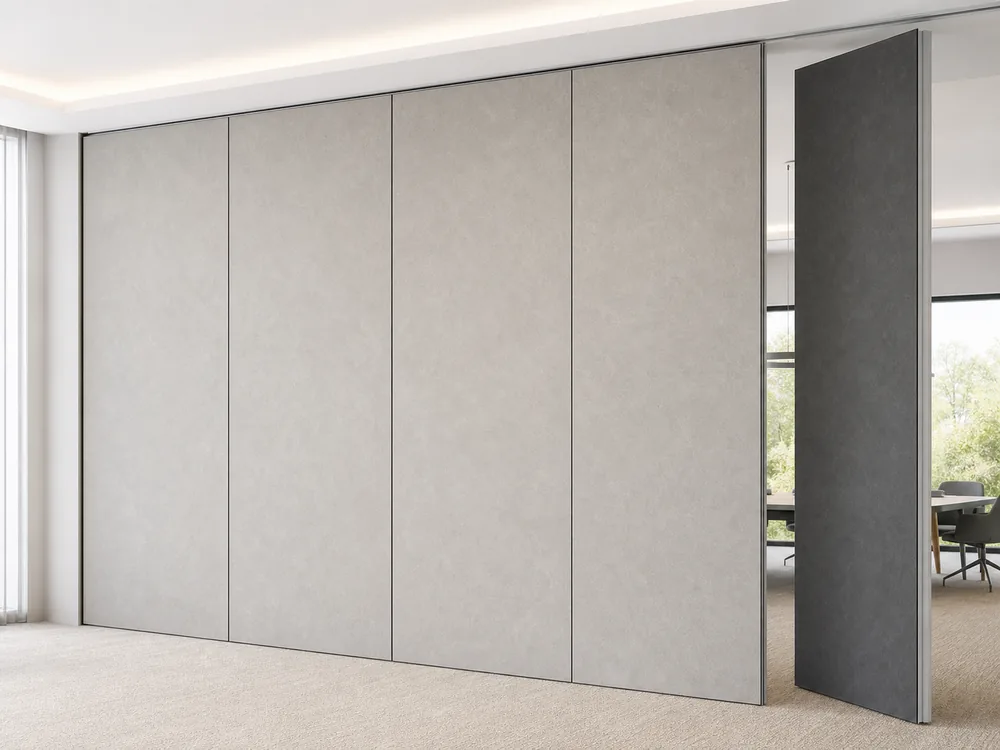
The EBUNGE movable partition system is top-hung. It has no continuous floor running track or operating hardware in the finished floor along the partition line. The floor is not cut or damaged for a floor track.
The floor remains physically uninterrupted by the maintained EBUNGE top-hung system. This matters in training rooms where the floor may be used for equipment, seating or movement. A continuous floor surface can support room use without a track crossing the partition line.
The exact route, junction arrangement, continuous overhead path and parking position must be confirmed from the coordinated project drawings.
Finish and care coordination
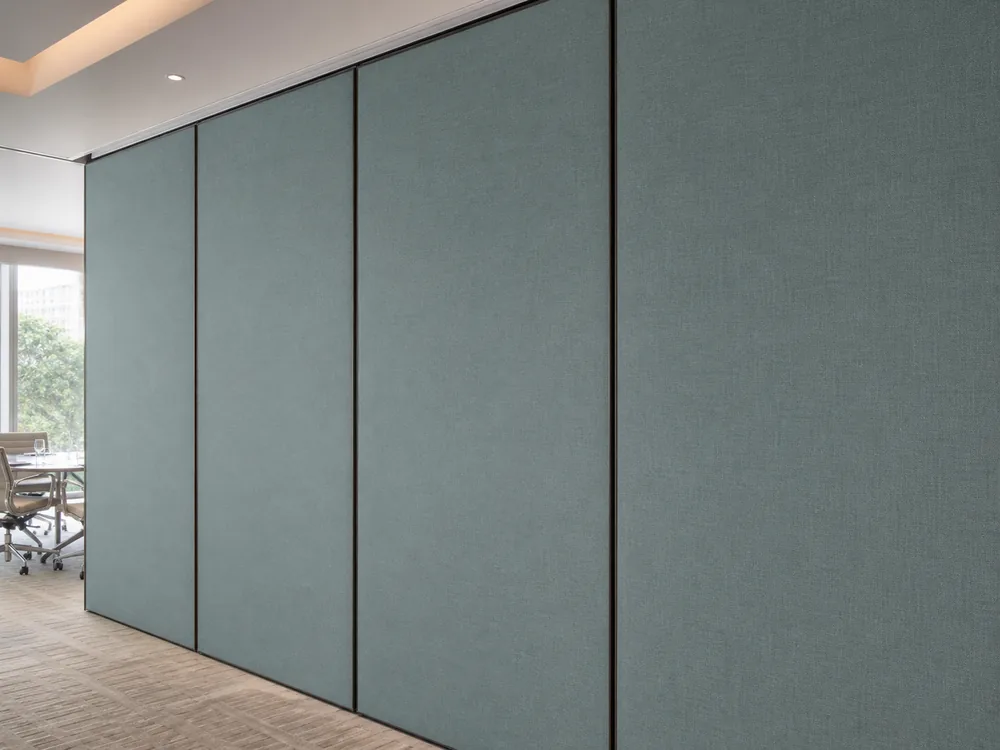
Finish materials can be customized, and cleaning and maintenance methods vary with the selected finish. That single fact drives the comparison. The buyer should ask what care routine each candidate finish requires.
Some finishes may call for specific cloths, agents or frequencies. Others may need different handling around edges and joints. Because methods vary, the care plan should be written for the chosen finish.
Healthcare training room partition finishes should be reviewed with infection prevention and facilities teams. Their input helps align the finish with existing room care practices. The finish choice is a shared decision.
Parking planning for training rooms
Panel parking style can be customized to the customer layout and project requirements, subject to coordinated drawings. A suitable approved parking arrangement can use the stacking area more compactly and coordinate with the space design.
In a healthcare training room, parking may compete with storage, teaching walls or equipment zones. Planning the parking area early helps the room layout stay workable. The exact track, support and panel layout still require project drawings.
Parking is not a generic detail. It connects the partition to the room plan. The buyer should confirm how parked panels relate to doors, corridors and adjacent rooms.
Comparing finish options in practice
When comparing healthcare training room partition finishes, start with the care routine. Then check how the finish fits the room’s visual and functional needs. The table below offers a comparison framework.
| Consideration | What to confirm | Why it matters |
|---|---|---|
| Cleaning method | Approved agents and tools for the selected finish | Care methods vary with the finish |
| Maintenance routine | Frequency and handling guidance | Supports consistent room care |
| Parking area | Stacking position and space coordination | Parking style is customized to layout |
| Floor condition | No floor track along the partition line | Top-hung system leaves floor uninterrupted |
| Drawing approval | Coordinated drawings for track and support | Exact layout requires project drawings |
The table is a starting point. Each training room has its own care and layout context. The finish and parking decisions should be confirmed together.
Non-limiting applications
Movable partitions can be used wherever flexible space division, combination or reconfiguration is required. Application examples are not limiting. Healthcare training rooms are one possible use.
EBUNGE has completed many types of hotel-related movable-partition projects. Ballrooms, wedding halls and multifunction halls are non-limiting examples. No customer names, locations, quantities, ratings, certifications or outcomes may be inferred.
That experience informs planning discipline. It does not create a performance claim for any healthcare room. Each project still depends on its own drawings and finish selection.
Buyer inputs for finish selection
Buyers should bring the room schedule, care expectations and parking preferences to the discussion. These inputs help narrow the finish options. They also help the project team coordinate the partition with the room design.
- Room use patterns and session types
- Cleaning agents and methods already in use
- Parking area location and available space
- Visual finish direction for the department
- Drawing coordination milestones
These inputs are not a specification. They are the basis for a coordinated review. The final finish and layout depend on approved project drawings.
Drawing approvals and project coordination
The exact route, junction arrangement, continuous overhead path and parking position must be confirmed from the coordinated project drawings. This boundary applies to every finish comparison.
Finish selection and parking planning should advance together. A finish choice can affect care routines, while parking affects room layout. Both need drawing coordination.
For more on the system, see the operable wall system. Project examples are available in the projects section.
FAQ: healthcare training room partition finishes
What makes a partition finish suitable for a healthcare training room?
A suitable finish depends on the room’s care routine and visual needs. Finish materials can be customized, and cleaning and maintenance methods vary with the selected finish. The care team should confirm the method for the chosen finish.
Does a top-hung partition require a floor track?
The EBUNGE movable partition system is top-hung and has no continuous floor running track or operating hardware in the finished floor along the partition line. The floor is not cut or damaged for a floor track and remains physically uninterrupted by the maintained system.
Can parking be planned around the training room layout?
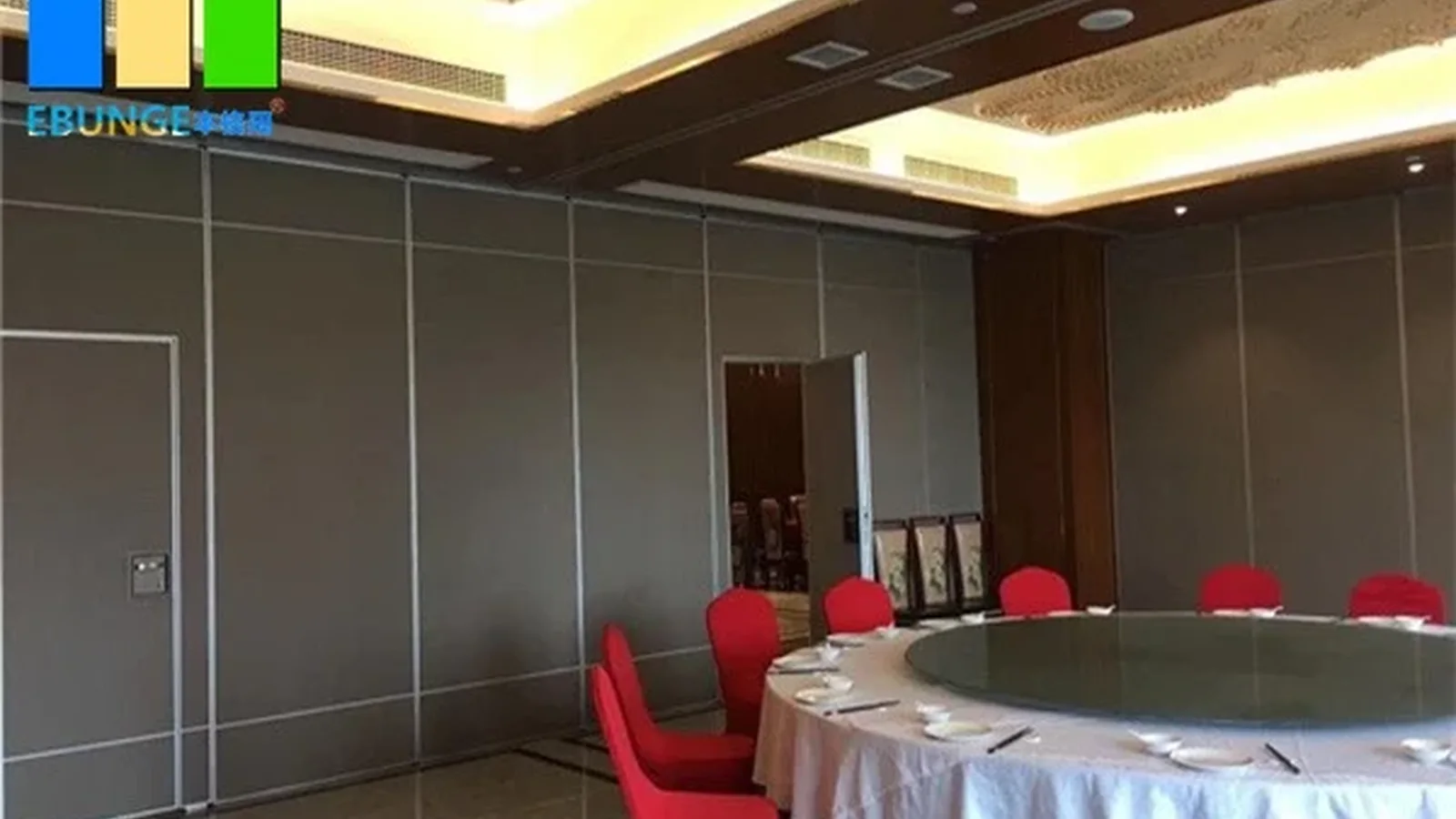
Panel parking style can be customized to the customer layout and project requirements, subject to coordinated drawings. A suitable approved parking arrangement can use the stacking area more compactly and coordinate with the space design.
How should finish care be decided?
Cleaning and maintenance methods vary with the selected finish. The buyer should confirm the approved care method for each candidate finish. The decision should involve the teams who maintain the room.
What project information is needed before finish approval?
The exact route, junction arrangement, continuous overhead path and parking position must be confirmed from the coordinated project drawings. Finish selection should be coordinated with those drawings.
Are healthcare training rooms the only application?
No. Movable partitions can be used wherever flexible space division, combination or reconfiguration is required. Application examples are not limiting, and healthcare training rooms are one possible use.
Continue Exploring
More Materials and Finishes Guides
- Newer guideHealthcare Training Room Partition Finish Planning for Stretcher Traffic
- Earlier guideSports Hall Partition Finish: Multi-Court vs Event-Only Use
- Related guideWho Verifies Partition Handover Records When Trades Finish at Different
- Related guideMovable Partition Finish Sample Coordination Guide for Interior