
Quick project answer
Healthcare training rooms often need to shift between classroom layouts, simulation setups, and debriefing zones. The choice of healthcare training room partition seals affects how well those changes work. This article examines the top-hung principle, floor continuity, parking planning, finish coordination, and the inputs that shape a coordinated drawing set.
Why healthcare training room partition seals matter in code and simulation
Training rooms in healthcare settings may serve both instructional and simulation functions. When a room divides, the partition line and its seals influence how the space reads for code reviews and how sound behaves during scenarios. The healthcare training room partition seals are part of that boundary.
Code officials look at how a space is classified and how walls or partitions define it. The exact overhead route and support arrangement must be confirmed by the responsible project team from coordinated drawings. The same partition line can be discussed from both angles, and the healthcare training room partition seals sit at the center of that discussion.
Those depend on project-specific evidence. Instead, it explains how a top-hung movable partition system works and what to coordinate before drawings are approved.
The top-hung principle and the physically uninterrupted floor
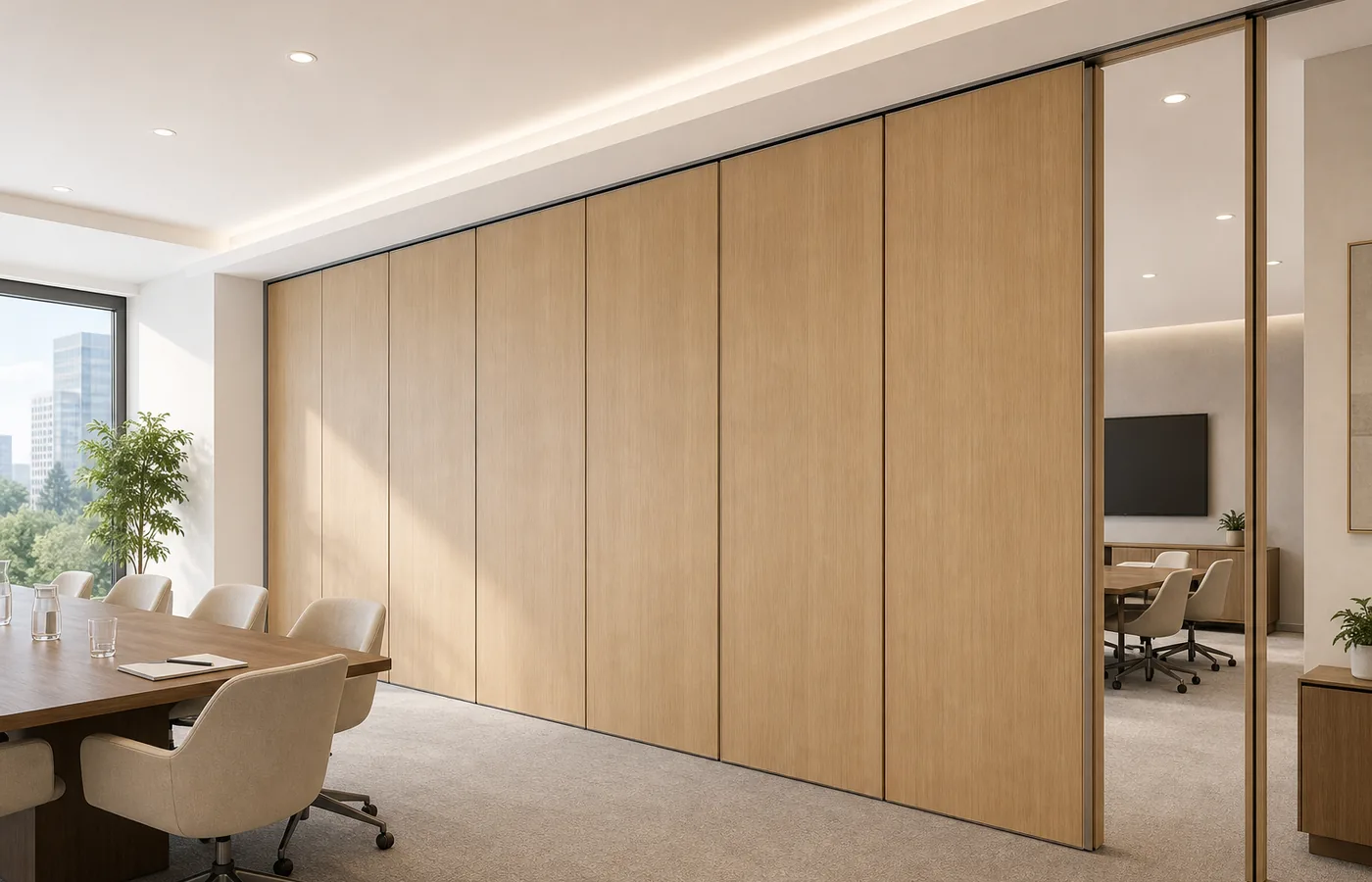
The EBUNGE movable partition system is top-hung. It has no continuous floor running track or operating hardware in the finished floor along the partition line. The floor is not cut or damaged for a floor track and remains physically uninterrupted by the maintained EBUNGE top-hung system.
That matters in healthcare training rooms because the floor often carries equipment, simulators, and wheeled carts. A floor that stays intact can support those uses without a track crossing the path. The healthcare training room partition seals are therefore part of an overhead-supported approach rather than a floor-based one.
Because the system is top-hung, the partition line does not require a continuous floor track. The exact route, junction arrangement, continuous overhead path and parking position must be confirmed from the coordinated project drawings.
Parking planning for healthcare training room partition seals
Panel parking style can be customized to the customer layout and project requirements, subject to coordinated drawings. A suitable approved parking arrangement can use the stacking area more compactly and coordinate with the space design. The exact track, support and panel layout still require project drawings.
Panel handling and the operating sequence must be confirmed for the selected layout and project conditions. It also affects where equipment can be stored. The healthcare training room partition seals interact with parking because the stacked panels must sit somewhere that does not block egress or equipment zones.
Parking is not a universal solution. It depends on the room geometry and the approved layout. The exact route, junction arrangement, continuous overhead path and parking position must be confirmed from the coordinated project drawings.
Finish and care coordination for healthcare training room partition seals
Finish materials can be customized, and cleaning and maintenance methods vary with the selected finish. That means the healthcare training room partition seals should be discussed alongside the finish selection, because care routines differ by material.
Healthcare training rooms may have infection-control protocols that shape which finishes are acceptable. The project team should confirm that the chosen finish aligns with those protocols. The healthcare training room partition seals themselves are part of the assembly, and their care depends on the finish chosen.
No cleaning outcome is claimed here. Cleaning and maintenance methods vary with the selected finish, and the project team should verify that the chosen finish fits the facility’s routines.
Non-limiting applications for movable partitions
Movable partitions can be used wherever flexible space division, combination or reconfiguration is required; application examples are not limiting. EBUNGE has completed many types of hotel-related movable-partition projects; ballrooms, wedding halls and multifunction halls are non-limiting examples.
Healthcare training rooms are another possible application, but they are not the only one. The same top-hung principle applies wherever a flexible division is needed. The healthcare training room partition seals are one part of that broader use case.
No customer names, locations, quantities, ratings, certifications or outcomes may be inferred from these examples. They simply show the range of spaces where movable partitions can be considered.
Buyer inputs and drawing approvals
Before drawings are approved, the project team should gather room dimensions, ceiling conditions, and intended uses. These inputs shape the parking plan and the partition layout. The healthcare training room partition seals should be reviewed as part of that package.
Finish selection is another input. Because finish materials can be customized, the team should confirm which finish suits the training environment. Cleaning and maintenance methods vary with the selected finish, so that choice should be made with care.
The exact route, junction arrangement, continuous overhead path and parking position must be confirmed from the coordinated project drawings.
Scannable planning checklist
- Confirm the room’s training and simulation functions.
- Review the top-hung principle and floor continuity.
- Identify a parking area that fits the layout.
- Select a finish and align care methods.
- Coordinate the overhead path and junction arrangement.
- Approve drawings before production.
Comparison of code and simulation considerations
| Consideration | Code review focus | Simulation focus |
|---|---|---|
| Partition line | Defines the space boundary | Separates scenario zones |
| Floor condition | Keeps egress paths clear | Supports equipment movement |
| Parking location | Must not block exits | Should not disrupt debriefing |
| Finish choice | Must meet facility protocols | Affects care routines |
Frequently asked questions
For further context, review related project guidance and additional planning resources before preparing the coordinated project brief.

What are healthcare training room partition seals?
They are the sealing elements along a movable partition line in a healthcare training room. Their performance depends on the selected system and the coordinated project drawings.
Does a top-hung partition require a floor track?
No. The EBUNGE movable partition system is top-hung and has no continuous floor running track or operating hardware in the finished floor along the partition line.
Can the floor remain uninterrupted?
Yes. The floor is not cut or damaged for a floor track and remains physically uninterrupted by the maintained EBUNGE top-hung system.
How is parking planned?
Panel parking style can be customized to the customer layout and project requirements, subject to coordinated drawings. The exact track, support and panel layout still require project drawings.
Can finishes be customized?
Finish materials can be customized, and cleaning and maintenance methods vary with the selected finish. The project team should confirm that the chosen finish fits the facility’s routines.
The healthcare training room partition seals should be reviewed with the full drawing set before approval.
Continue Exploring
More Acoustic Partition Guides
- Newer guideHealthcare Training Partition Seals: Ceiling Exhaust Grille Interface
- Earlier guidePlanning Healthcare Training Room Partition Seals for Split-Simulation
- Related guideAcoustic Partition Ceiling Interface Zone Confirmation
- Related guideWho Confirms Ceiling Grid Line Before Acoustic Partition Track