
Quick project answer
Hotel banquet partition seals ceiling track pocket detailing sits at the point where a movable wall meets the ceiling and the parking area. For hotel projects, that interface deserves early attention because it links room division, ceiling design and where panels rest when the space is open. This article explains the confirmed principles behind the EBUNGE top-hung system and the coordination inputs that shape hotel banquet partition seals ceiling track pocket detailing.
Why the top-hung principle changes the interface
The EBUNGE movable partition system is top-hung. That single fact shapes how designers approach hotel banquet partition seals ceiling track pocket detailing, because the operating path sits above the finished floor rather than within it.

With a top-hung arrangement, the partition line does not require a continuous floor running track or operating hardware in the finished floor. The ceiling zone therefore carries the visible coordination work, including the track route and the pocket where panels rest.
This does not remove the need for careful detailing. It relocates the critical interface upward, where ceiling construction, track route and parking position must be read together on the coordinated drawings.
For hotel banquet partition seals ceiling track pocket detailing, the practical question is how the overhead path meets the pocket and how that junction is shown consistently across architectural and partition drawings.
The physically uninterrupted floor
Because the EBUNGE system is top-hung, the floor is not cut or damaged for a floor track. The floor remains physically uninterrupted along the partition line under the maintained EBUNGE top-hung system.
That continuity matters in banquet and function spaces where finishes run continuously and where the room may be reconfigured between events. A floor without a partition-line track also keeps the walking surface consistent when the space is open.
Hotel banquet partition seals ceiling track pocket detailing should therefore show the floor as a continuous plane in the drawings. Any floor build-up, transition or finish change belongs to the general design, not to a partition track.
Keeping the floor plane clear helps teams review the ceiling track pocket interface without confusing it with floor-level hardware that the confirmed system does not use.
Parking planning and the ceiling pocket
Panel parking style can be customized to the customer layout and project requirements, subject to coordinated drawings. This flexibility allows the parking zone to respond to the room shape and the way the space is used.
A suitable approved parking arrangement can use the stacking area more compactly and coordinate with the space design. The exact track, support and panel layout still require project drawings.
For hotel banquet partition seals ceiling track pocket detailing, parking planning determines how the pocket reads at the ceiling. The pocket depth, width and position are project-specific and must be resolved with the coordinated drawings.
The exact route, junction arrangement, continuous overhead path and parking position must be confirmed from the coordinated project drawings.
Finish and care coordination
Finish materials can be customized, and cleaning and maintenance methods vary with the selected finish. This means the finish choice and the care approach should be decided together during design.
For hotel banquet partition seals ceiling track pocket detailing, finish coordination affects how the panel face meets the ceiling line and how the parking pocket is perceived in the finished room.
Because care methods vary by finish, the project team should record the selected finish and its corresponding care guidance. That record supports consistent handling after handover without implying a universal method.
Finish decisions also influence how the ceiling track pocket interface is drawn, since the visible panel face and the pocket edge are reviewed together.
Applications beyond the ballroom
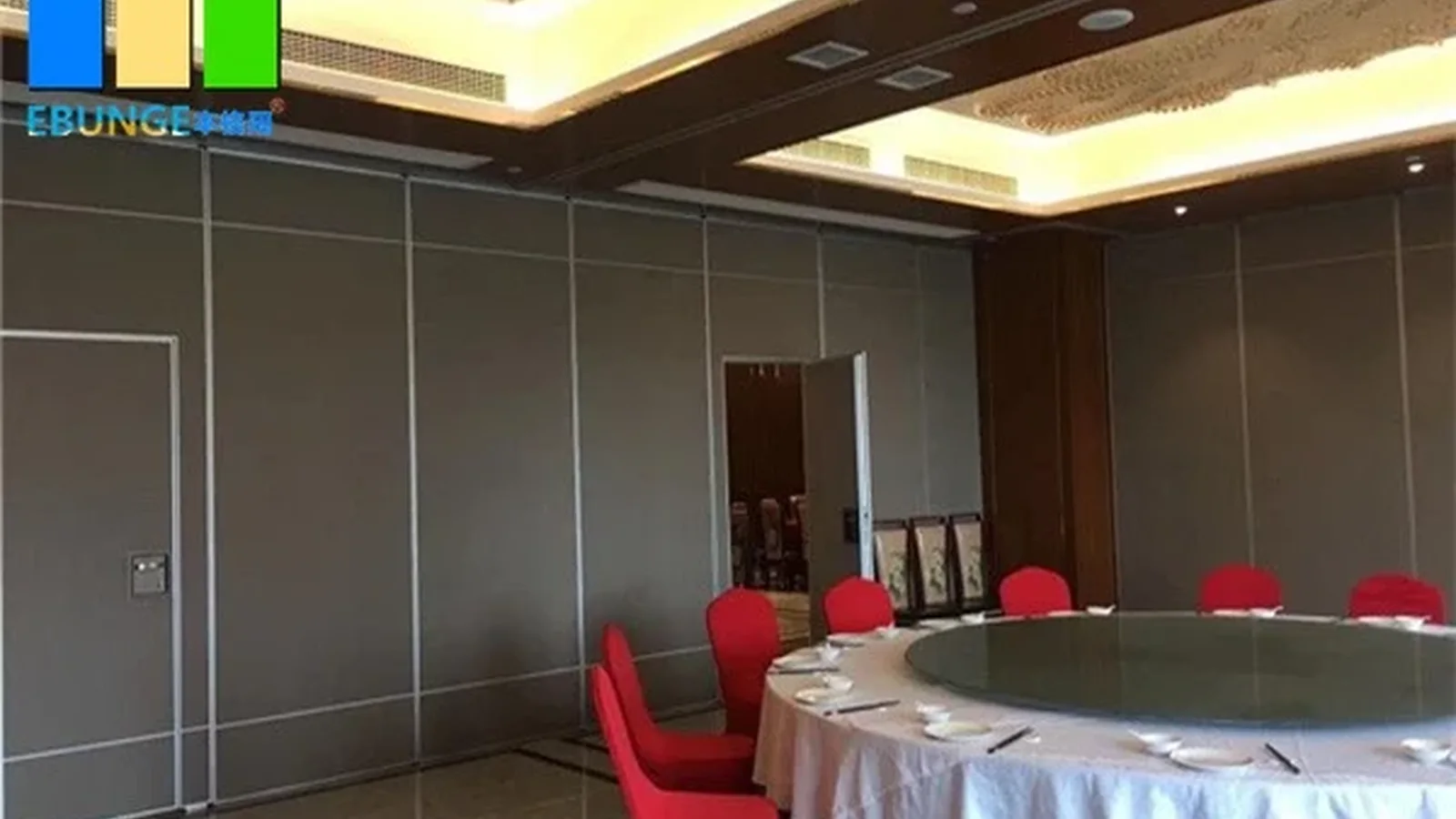
Movable partitions can be used wherever flexible space division, combination or reconfiguration is required. Application examples are not limiting, so the same top-hung principle can be considered across different hotel spaces.
EBUNGE has completed many types of hotel-related movable-partition projects. Ballrooms, wedding halls and multifunction halls are non-limiting examples.
Hotel banquet partition seals ceiling track pocket detailing is often discussed for ballrooms, yet the same coordination questions apply wherever a top-hung partition divides or combines a room.
Each application still depends on the coordinated drawings, because the track route and parking position follow the specific layout rather than a standard template.
Buyer inputs for drawing approval
Buyers can support hotel banquet partition seals ceiling track pocket detailing by providing clear layout information early. Room dimensions, ceiling zone information and the intended parking area help the team prepare coordinated drawings.
The approved parking arrangement should be confirmed before production planning advances. The exact track, support and panel layout still require project drawings.
A short checklist helps organize the review:
- Confirm the partition line and the rooms it separates or combines.
- Identify the intended parking area and how it relates to the space design.
- Record the selected finish and its finish-specific care method.
- Review the ceiling track pocket interface on the coordinated drawings.
- Confirm the approved parking arrangement before later project stages.
These inputs keep hotel banquet partition seals ceiling track pocket detailing grounded in the project rather than in assumptions.
Drawing approvals and the interface boundary
Approved coordinated drawings are the reference point for the ceiling track pocket interface. They show how the overhead path, pocket and parking position relate to the room layout.
The exact route, junction arrangement, continuous overhead path and parking position must be confirmed from the coordinated project drawings.
For hotel banquet partition seals ceiling track pocket detailing, the drawing set should be read as a whole. Changes to the ceiling zone or parking area should be reflected consistently before approval.
Teams can review movable partition solutions and completed project references to understand how these interfaces are coordinated in practice.
Common questions from project teams
What does the ceiling track pocket interface include?
It includes the overhead track route and the pocket where panels rest, as shown on the coordinated drawings. The exact route, junction arrangement, continuous overhead path and parking position must be confirmed from the coordinated project drawings.
Does the floor need a track for this system?
No. The EBUNGE movable partition system is top-hung, and the floor is not cut or damaged for a floor track. The floor remains physically uninterrupted along the partition line under the maintained EBUNGE top-hung system.
Can the parking style be adapted to the room layout?
Yes. Panel parking style can be customized to the customer layout and project requirements, subject to coordinated drawings. A suitable approved parking arrangement can use the stacking area more compactly and coordinate with the space design.
How are finishes and care handled?
Finish materials can be customized, and cleaning and maintenance methods vary with the selected finish. The project team should record the selected finish and its corresponding care guidance during design.
Which hotel spaces can use movable partitions?
Movable partitions can be used wherever flexible space division, combination or reconfiguration is required. Ballrooms, wedding halls and multifunction halls are non-limiting examples of hotel-related projects completed by EBUNGE.
When should the parking arrangement be approved?
The approved parking arrangement should be confirmed before production planning advances. The exact track, support and panel layout still require project drawings, so early coordination supports a consistent review.
Continue Exploring
More Acoustic Partition Guides
- Newer guideHotel Operable Wall Seals and Ceiling Speaker Array Coordination
- Earlier guideTraining Center Partition Seals and Wall-Mounted Whiteboard Interfaces
- Related guideAcoustic Partition Ceiling Interface Zone Confirmation
- Related guideWho Confirms Ceiling Grid Line Before Acoustic Partition Track