Why Partition Finish Choice Matters in Meeting Suites
When planning an office meeting suite, the partition finish is not just a cosmetic decision. It directly affects how the space functions, how it is perceived, and how flexible it truly is. The choice between a marker board surface and a projection screen surface is a classic comparison that many design and procurement teams face. This guide focuses on office meeting suite partition finishes marker board projection considerations, helping you weigh the practical and experiential differences.
Movable partitions from EBUNGE are designed to be individually movable, suspended from a top track, and they cross the opening without a floor track. They park at a planned stacking position when not in use. This inherent flexibility means the finish you choose will travel with the panel, affecting every configuration of the room. Therefore, the finish must be evaluated not only for its surface properties but also for how it behaves over time and under different usage patterns.
Understanding the Two Primary Surface Types
Marker Board Surfaces
Marker board finishes are designed for dry-erase markers, allowing users to write, draw, and brainstorm directly on the panel. They are typically light-colored to provide contrast for markers, and they must be easy to clean to avoid ghosting or staining. In a meeting suite, this surface encourages interactive sessions, collaborative planning, and visual thinking.
Projection Screen Surfaces
Projection screen finishes are optimized for displaying projected images, whether from a data projector, a video conference system, or a simple slide presentation. They are usually white or light gray and have a matte or slightly textured surface to reduce glare and hot spots. The goal is to provide a clear, bright image that is visible from multiple angles in the room.
Key Comparison Factors
Functionality and Usage Patterns
The primary question is: how will the meeting suite be used? If the space is primarily for brainstorming, training, or collaborative workshops, a marker board finish is often more valuable. It allows spontaneous note-taking and diagramming without the need for separate flip charts or mobile whiteboards. If the space is mainly for presentations, client pitches, or video conferences, a projection screen finish is more appropriate, ensuring that visuals are crisp and professional.
Share elevations, finish references and cleaning requirements.
However, many meeting suites serve both purposes. In such cases, you might consider a hybrid approach: some panels with marker board finish, others with projection screen finish. This way, you can have both capabilities within the same room, but you must carefully plan the layout so that the projection surface is positioned where it will be most effective, and the marker board is accessible for writing.
Lighting and Glare
Lighting plays a crucial role in the performance of both finishes. Marker board surfaces should not have excessive glare, as this can make writing difficult to read. Projection screen surfaces must be viewed in controlled lighting conditions; ambient light can wash out the image. When comparing finishes, consider the room’s lighting design, including natural light sources, ceiling fixtures, and dimming capabilities. A projection screen finish may require blackout shades or adjustable lighting to perform optimally.
Durability and Maintenance
Both finishes must withstand frequent use. Marker board surfaces need to resist staining from markers and be easy to clean with appropriate erasers and cleaners. Projection screen surfaces should be durable enough to handle occasional cleaning without scratching or degrading the optical properties. The material and coating of the finish affect its lifespan, but we do not provide specific performance guarantees. It is essential to discuss your maintenance expectations with your EBUNGE representative to choose a finish that aligns with your cleaning protocols.
Aesthetic and Branding
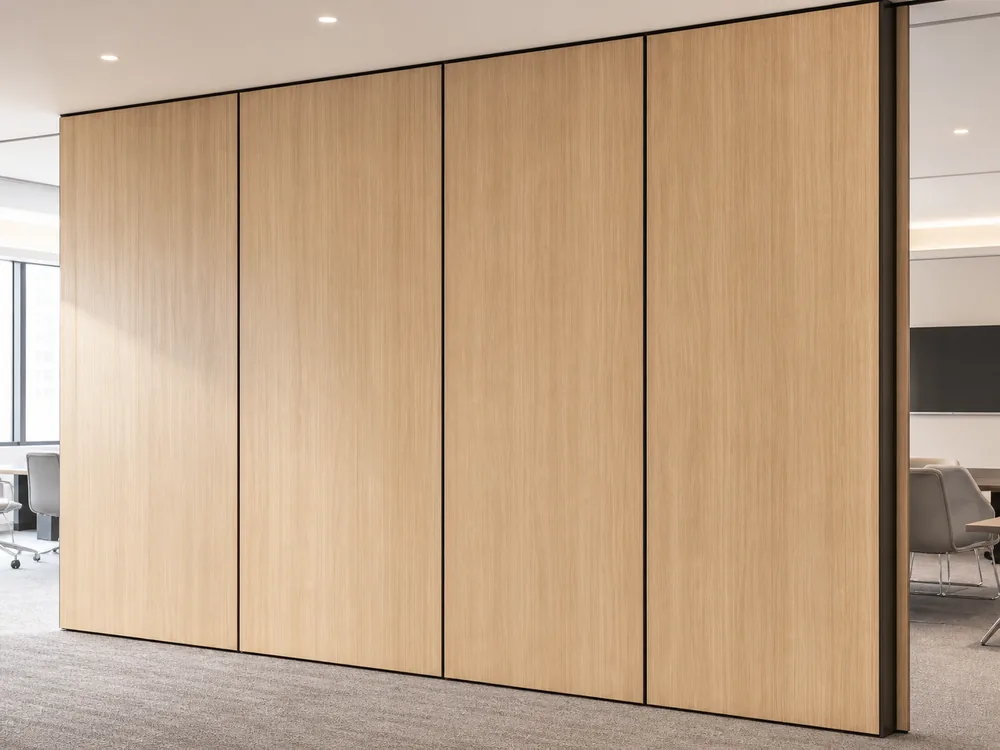
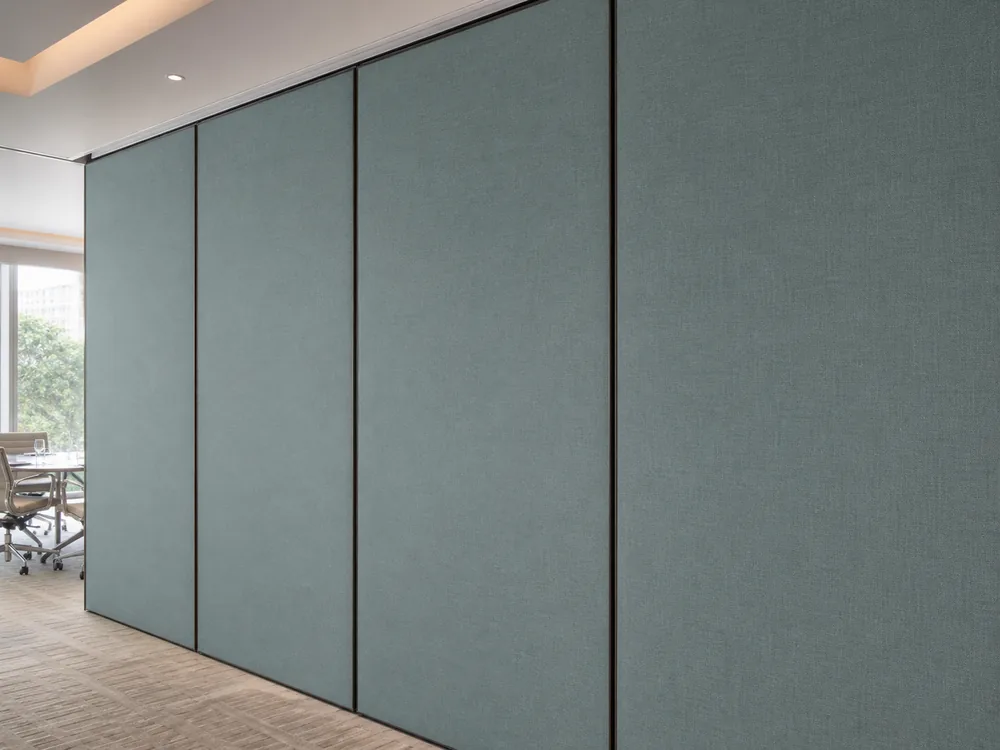
The finish also contributes to the overall aesthetic of the meeting suite. Marker board finishes are typically available in white or light gray, but some options may include other colors or patterns. Projection screen finishes are usually white, but the exact shade and texture can vary. Consider how the finish complements the furniture, flooring, and other design elements. In some cases, a fabric or leather finish might be used on some panels for acoustic purposes, while the writing or projection surface is on a specific panel. EBUNGE offers a range of finish options, including laminate, melamine, fabric, leather, glass, and other approved surfaces. You can combine different finishes to achieve both function and style.
Acoustic Considerations in Meeting Suites
In a meeting suite, acoustics are critical for privacy and clarity. Movable partitions can provide some sound isolation, but the level of soundproofing depends on many factors, including the panel construction, seals, and the surrounding structure. It is important to understand that no partition can guarantee complete soundproofing. Acoustic performance is often rated using metrics like STC (Sound Transmission Class) or Rw (Weighted Sound Reduction Index). These ratings give an indication of how much sound is reduced when passing through the partition, but they do not translate directly to a specific decibel reduction in a real room. The actual performance depends on installation, flanking paths, and room acoustics.
When comparing finishes, note that the surface itself may have a minor effect on acoustics. For example, a fabric finish can absorb sound, reducing echo, while a glass or laminate finish may reflect sound. However, the primary acoustic performance is determined by the panel core and seals, which are not part of the finish selection. If acoustic privacy is a priority, you should discuss your requirements with EBUNGE, and we can advise on the appropriate panel configuration and seals. But remember, we cannot promise a specific level of soundproofing without a site assessment.
Integration with Technology
Modern meeting suites often require integrated technology, such as displays, cameras, and audio systems. The partition finish can affect how these technologies are installed and used. For projection screen surfaces, you might need to mount a projector on the ceiling or on an adjacent wall, ensuring the image aligns with the screen. For marker board surfaces, you might want to install a camera that can capture the writing for remote participants, which requires a clear view of the board.
EBUNGE partitions can be designed to accommodate pass-door requirements, which may be useful for accessing technology or for egress. You can discuss your specific technology needs with our team, and we can help you plan the partition layout to integrate seamlessly with your audiovisual equipment.
Compare approved samples and panel-route clearances.
Planning the Partition Layout
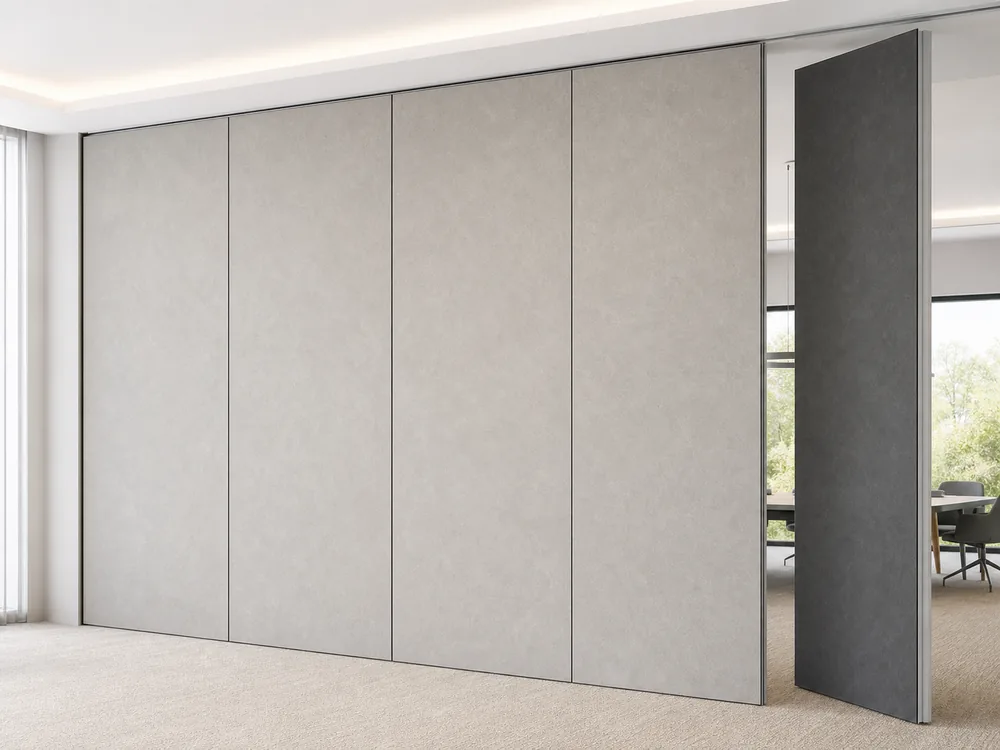
The layout of the movable partition system is crucial for both marker board and projection screen use. Straight, turning, and stacking routes must be reviewed from the layout to ensure that the panels can move smoothly and park efficiently. When you have a mix of finishes, you need to plan which panels will have which finish, and how they will be arranged when the partition is open or closed. For example, if you want a large continuous marker board surface, you might place several marker board panels adjacent to each other in the closed position. If you need a projection screen, you might designate a specific panel that aligns with the projector when the partition is closed.
EBUNGE’s movable partitions are individually movable, which gives you maximum flexibility in configuring the space. You can move panels to create different room sizes, and the finish on each panel can be chosen to suit the intended use of that particular configuration. However, this flexibility requires careful planning to ensure that the right surface is available where and when you need it.
Project Documentation and Support
When selecting finishes, it is essential to have proper project documentation. This includes detailed drawings, specifications, and installation guidelines. EBUNGE can provide project documentation to support your design and construction process. We encourage you to contact us early in your project to discuss your requirements, including finish options, pass-door needs, and acoustic considerations. Our team can help you review the layout and ensure that the partition system meets your expectations.
We also recommend that you confirm project-specific support, acoustic, and dimensional requirements with our team. Every project is unique, and we want to ensure that you get the right solution for your office meeting suite.
FAQ
Can I have both marker board and projection screen finishes on the same movable partition system?
Yes, you can mix finishes on different panels. For example, you could have several panels with a marker board finish and one panel with a projection screen finish. This allows you to have both functions within the same room, but you need to plan the layout so that the projection screen is positioned correctly for viewing and the marker board is accessible for writing.
Does the finish affect the acoustic performance of the partition?
The finish can have a minor effect on sound absorption or reflection, but the primary acoustic performance is determined by the panel’s construction and seals. For example, a fabric finish may absorb some sound, while a glass finish may reflect it. However, the STC/Rw rating is not directly tied to the finish. If acoustics are critical, discuss your requirements with EBUNGE, and we can recommend appropriate panel configurations.
What are the maintenance requirements for marker board and projection screen finishes?
Marker board finishes should be cleaned with appropriate dry-erase cleaners to prevent ghosting. Projection screen finishes should be gently wiped with a soft cloth to remove dust. Avoid abrasive cleaners on both. Specific care instructions depend on the finish material, so confirm with EBUNGE for your chosen finish.
Can the projection screen finish be used with any projector?
Most projectors work with a standard white projection screen surface, but the image quality depends on projector brightness, resolution, and ambient lighting. It is important to test the combination in the actual room conditions. EBUNGE can provide samples, but we do not guarantee compatibility with specific projectors.
How do I choose between marker board and projection screen for a multi-purpose meeting suite?
Assess the primary usage. If the room will be used for both presentations and brainstorming, consider a mix of finishes. Alternatively, you could use a mobile whiteboard or a separate projection screen that can be moved into place when needed. The movable nature of EBUNGE partitions allows you to reconfigure the room, but you must plan which panels have which finish.
Conclusion and Next Steps
Choosing between marker board and projection screen finishes for your office meeting suite partition is a decision that impacts functionality, aesthetics, and user experience. By understanding the key differences and considering factors like usage patterns, lighting, maintenance, and acoustics, you can make an informed choice. Remember that EBUNGE movable partitions offer flexibility in layout and finish, allowing you to create a space that adapts to your needs.
To ensure your partition system meets your specific requirements, we encourage you to contact EBUNGE. Our team can discuss your project, review the layout, and provide guidance on finish selection, acoustic considerations, and project documentation. Visit our movable partition wall page for more information, and explore our recent projects to see how we have helped other clients. We look forward to assisting you with your office meeting suite.
Continue Exploring
More Materials and Finishes Guides
- Newer guideHow to Compare Community Hall Partition Finishes for Wall-Mounted Trophy Case Glare vs Daylight
- Earlier guideWhat Drawings Specify Community Hall Partition Finishes at Wall-Mounted Art Display Rails
- Related guideComparing Healthcare Training Room Partition Finishes for Wall-Mounted Whiteboard vs Tackable Zones
- Related guideWhy Sports Hall Partition Finishes Need Abrasion Mapping for Wall-Mounted Hurdle Storage Racks