
html body.single-post main#content.site-main{box-sizing:border-box!important;width:calc(100% – 32px)!important;max-width:900px!important;margin-left:auto!important;margin-right:auto!important;padding-left:0!important;padding-right:0!important}
Quick project answer
Review focus: ceiling interface tolerance.
Partition ceiling interface tolerance resolution is the coordination work that happens before anyone fixes a top track to a ceiling structure. It asks a simple question: who confirms that the ceiling plane, the structural support zone and the partition route agree closely enough for anchorage to proceed? On many projects the answer is assumed rather than assigned. That assumption is where rework begins.
This article sets out an evidence-bounded framework for overseas project teams. The suitability of each route and parking arrangement depends on the approved layout, circulation, ceiling interfaces and operating sequence. It explains which decisions belong to which party, what drawings should show, and where a project-specific review must replace generic guidance.
Why Ceiling Interface Tolerance Resolution Is a Coordination Problem
Project review term: ceiling interface tolerance.
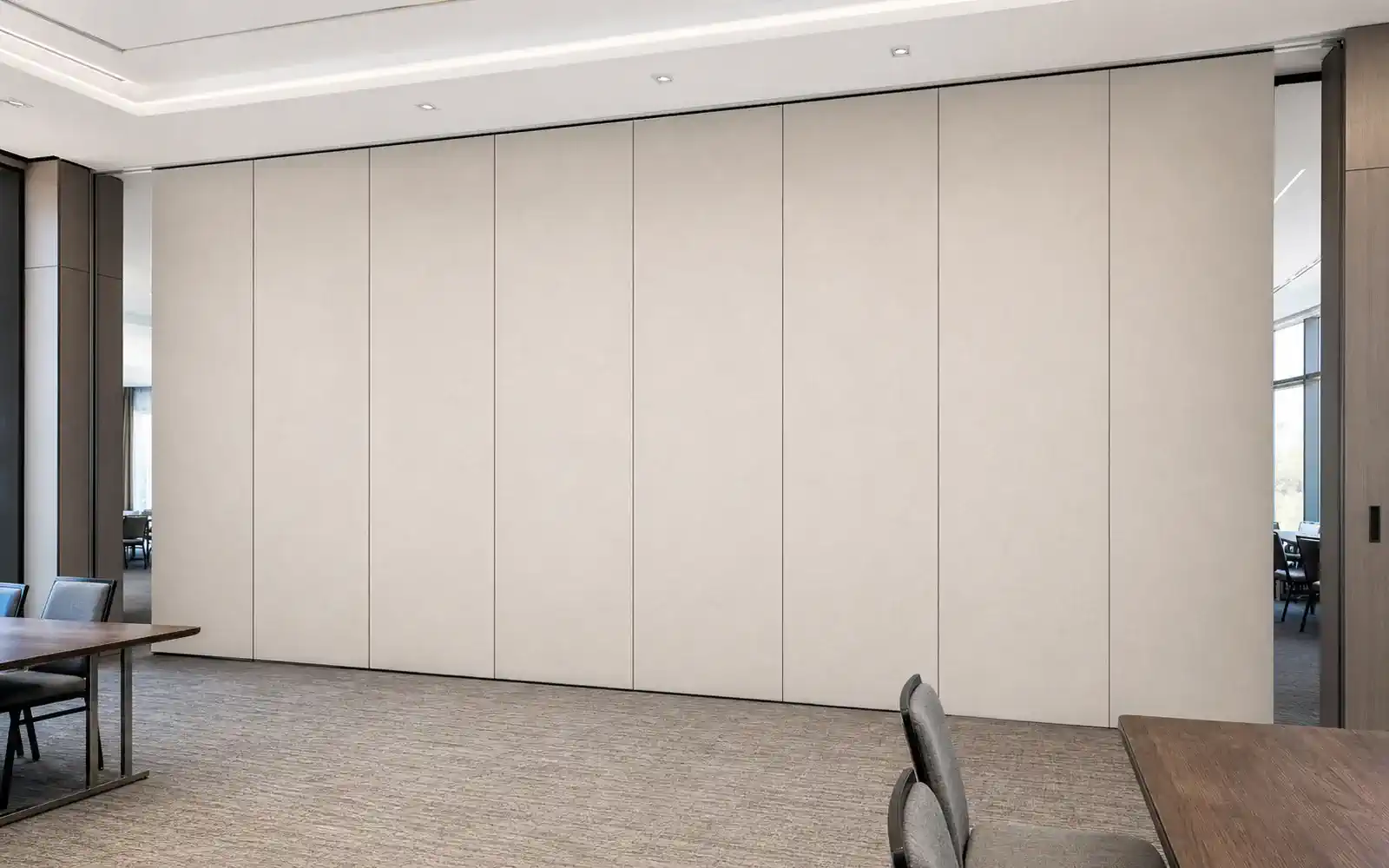
A movable partition is top-hung. Panels are individually movable, suspended from a top track, cross the opening without a floor track, and park at a planned stacking position. The ceiling interface therefore carries the visual, dimensional and support consequences of the whole system.
Tolerance resolution is not the same as tolerance measurement. Measurement tells you what exists. Resolution decides what will be done about it, who accepts the outcome, and whether the partition route can still work.
What the interface actually contains
Each layer can introduce deviation. None of these layers should be inferred from a photograph or a single section drawing.
What remains project-specific
Support arrangements, allowable deviations, fixing positions and acoustic expectations must be confirmed for the application reference. Generic statements about ceiling types or track profiles are not evidence of capacity or fit.
Who Owns Which Decision Before Anchorage
Responsibility is often split across contracts. The table below is a coordination prompt, not a contractual allocation. Project teams should confirm roles in their own agreements.

| Decision area | Typical lead | Input needed |
|---|---|---|
| Ceiling level and finish tolerance | Ceiling contractor | Setting-out drawings, survey data |
| Structural support zone | Structural or base-build party | As-built structure, load path review |
| Partition route and stacking position | Design team with supplier | Layout drawings, opening dimensions |
| Track anchorage coordination | Partition supplier with installer | Confirmed interface condition |
| Final acceptance of interface | Principal or owner representative | Signed coordination record |
Where no single party owns the interface, the risk is that each trade works to its own tolerance and the partition track becomes the place where those tolerances meet. A named coordinator, even if that role is temporary, prevents that outcome.
Drawings and Information Needed for Tolerance Resolution
Before anchorage is fixed, the project team should be able to point to a coordinated drawing set. The following checklist is a practical starting point.
- Reflected ceiling plan showing the partition route and any ceiling features that cross it.
- Plan showing straight, turning and stacking routes, including the parking position.
- Confirmed opening dimensions and any pass-door requirements.
- Record of agreed tolerances and who accepts them.
If any item is missing, tolerance resolution is incomplete.
How to Run a Ceiling Interface Coordination Review
A short, structured review is more useful than a long discussion. The sequence below keeps the focus on decisions rather than opinions.
- Confirm the partition route, turning points and stacking position from the layout.
- Identify every ceiling feature that intersects or runs parallel to the route.
- Compare the as-built ceiling condition with the coordinated drawing.
- List deviations that affect the track anchorage zone.
- Assign each deviation to a responsible party and a resolution action.
- Record agreed tolerances and acceptance before anchorage proceeds.
This process does not require new performance claims. It requires visible evidence and a clear record. Where the evidence is incomplete, the correct action is to pause anchorage, not to assume the interface will work.
Acoustic and Sealing Concepts at the Ceiling Interface
Acoustic separation is often discussed at the ceiling interface because sound can travel through gaps and flanking paths.
Seals and closing details are part of the interface design, but their materials and performance must be confirmed for the project. Do not infer acoustic results from a finish sample, a drawing or a generic description.
What not to assume
Do not assume that a ceiling type, a track profile or a visible seal detail delivers a particular acoustic outcome. Those are project-specific questions for the design and acoustic team.
Common Coordination Gaps and How to Close Them
Most interface problems are predictable. They appear when information is missing, when responsibility is unclear, or when a trade proceeds on an assumption.
- No coordinated section through the anchorage zone.
- Ceiling installed before the partition route is confirmed.
- Stacking position not coordinated with ceiling features.
- No record of who accepted the interface tolerance.
Each gap can be closed with a drawing, a survey or a written confirmation. None requires a performance promise. The goal is a documented interface that the partition track can be anchored to without unresolved conflict.
Evidence Boundaries for Specification and Procurement
Specification language should describe what is required, not what is assumed. For partition ceiling interface tolerance resolution, the specification should call for coordinated drawings, confirmed support conditions and an agreed tolerance record.

Buyers and distributors should ask for the same discipline. A finish option such as laminate, melamine, fabric, leather or glass describes a surface, not a performance result. A layout describes a route, not a guarantee that the route is buildable without support review.
FAQ: Ceiling Interface Tolerance and Track Anchorage
Who is responsible for ceiling interface tolerance resolution?
Responsibility depends on the project’s contract structure. The project should name a coordinator and record who accepts the final interface condition.
When should tolerance resolution happen?
It should happen before track anchorage is fixed and ideally before the ceiling is closed. Early review reduces the chance that the partition route conflicts with ceiling features or support zones.
Can the partition supplier resolve ceiling tolerances alone?
No. The exact route, junction arrangement, continuous overhead path and parking position must be confirmed from the coordinated project drawings.
What drawings are needed for a coordination review?
Pass-door requirements should also be confirmed.
Does a ceiling interface detail guarantee acoustic performance?
No.
What should happen if the interface condition is unresolved?
Anchorage should not proceed on assumption. The project team should record the deviation, assign a resolution action and confirm the interface before fixing the track.
Conclusion: Resolve the Interface Before the Track
Partition ceiling interface tolerance resolution is a shared coordination duty. It requires a named coordinator, coordinated drawings, confirmed support information and a written record of accepted tolerances. The partition system itself is top-hung and moves without a floor track, but that does not remove the need to resolve the ceiling interface before anchorage.
Project teams should confirm support, acoustic and dimensional requirements for their specific project. Where evidence is missing, the correct step is to request it, not to infer it.
To discuss layout review, finish options or project documentation for your next flexible-space project, contact EBUNGE. You can also review the movable partition wall range or see how coordination is handled in project documentation.
Continue Exploring
More Installation and Maintenance Guides
- Newer guideContractor Pre-Mobilization Walk for Movable Partition Installations
- Earlier guideWho Verifies Ceiling Grid Flatness Before Partition Track Anchorage?
- Related guideMovable Partition Wall Handover Commissioning Records
- Related guideWho Sets the Ceiling Interface Datum When Partition Tracks Meet Curved