
html body.single-post main#content.site-main{box-sizing:border-box!important;width:calc(100% – 32px)!important;max-width:900px!important;margin-left:auto!important;margin-right:auto!important;padding-left:0!important;padding-right:0!important}
Quick answer: partition interface decision
Review focus: partition interface decision.
Partition interface decision visibility architect reviews is not a documentation ritual. It is the discipline of keeping every interface choice traceable from one design meeting to the next. When a movable partition is top-hung and crosses an opening without a floor track, the decisions that matter most sit at the head condition, the parking zone and the route between them. If those decisions live only in someone’s memory or a marked-up PDF, they disappear between reviews. This article offers an evidence-bounded framework for keeping them visible.
Why Interface Decisions Slip Between Reviews
Project review term: partition interface decision.
Design reviews are episodic. Between them, drawing sets evolve, consultant comments accumulate and site conditions change. The suitability of each route and parking arrangement depends on the approved layout, circulation, ceiling interfaces and operating sequence. The risk is not that teams forget; it is that they remember differently.
For movable partitions, the interface set includes the overhead support route, the stacking or parking position, the finish selection and any pass-door requirement. Each of these touches other trades. When one changes without a visible record, the others can drift out of alignment.
What Counts as a Visible Interface Decision
Coordination scope: partition interface decision.
A visible decision is one that a new team member could find, read and act on without asking the original author. It states what is fixed, what is still open and who must confirm it. For partition interfaces, that means separating maintained product facts from project-specific requirements.
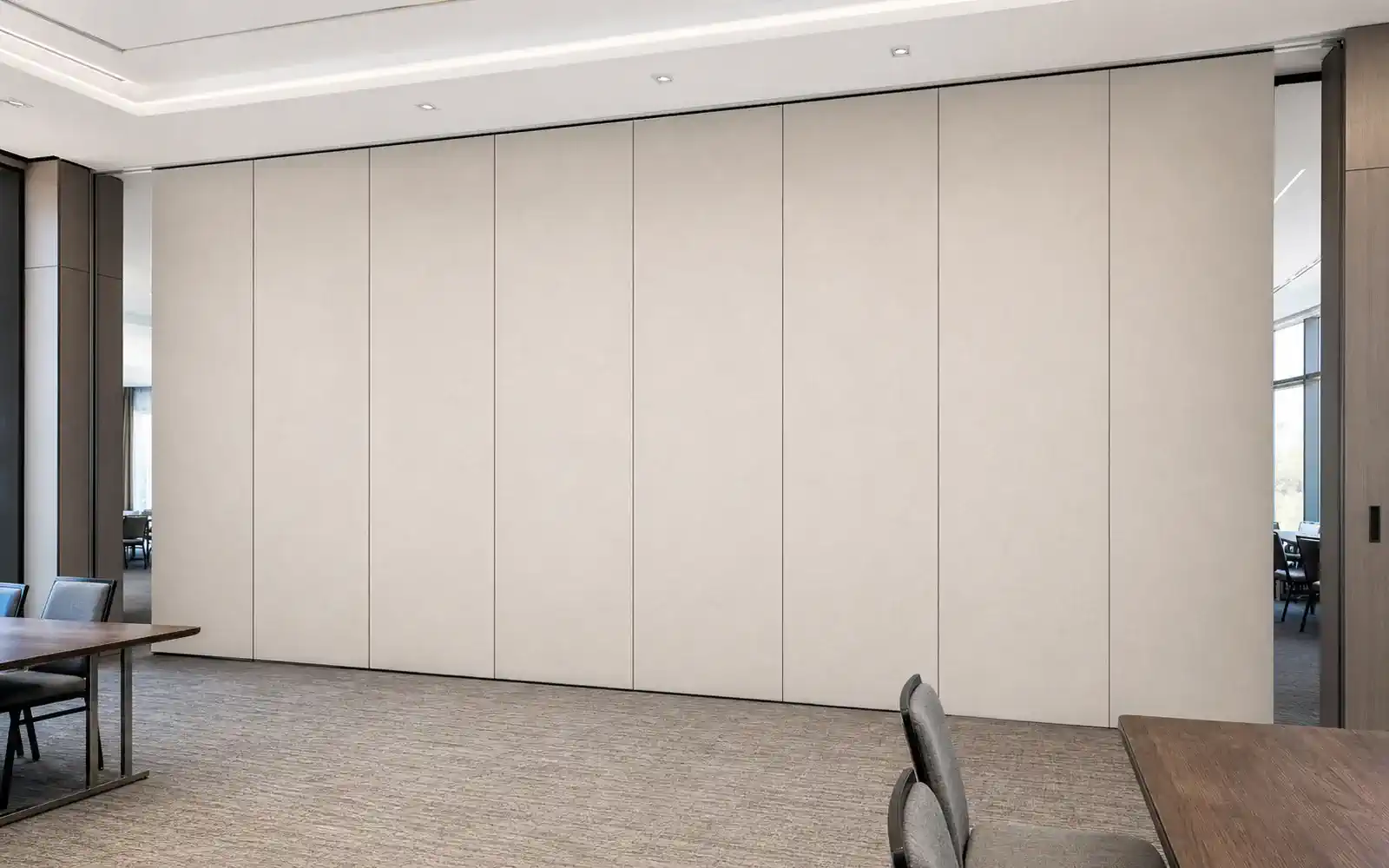
Maintained facts describe how the system works: panels are individually movable, suspended from a top track, cross the opening without a floor track and park at a planned stacking position. Project-specific requirements describe how that system must perform in a particular building. The first can be documented once; the second must be confirmed for every project.
Evidence note: a drawing or finish sample does not prove acoustic, structural or fire performance. Those require project-specific confirmation and matching documentation.
A Review-to-Review Visibility Routine

Checklist focus: partition interface decision.
The following numbered process is a coordination habit, not a performance claim. It helps teams keep interface decisions in view without inventing conclusions the evidence does not support.
- Log the decision. Record each interface choice in a dated register with an owner and a status: proposed, confirmed or pending.
- Mark the drawing. Show the overhead route, parking zone and any pass-door location on the current plan set.
- Flag the boundary. Note which items still need project-specific support, acoustic or dimensional confirmation.
- Close the loop. At the next review, read the register aloud and confirm changes before updating drawings.
This routine keeps the conversation anchored to documents rather than recollection. It also makes it obvious when a decision has been assumed rather than confirmed.
Drawing Checks That Keep Interfaces Honest
Not every interface can be resolved in a single review. The goal is to make the unresolved parts visible so they are not mistaken for finished design. The checklist below focuses on what can be seen and what still needs confirmation.
- Is the overhead support route shown as continuous across the opening and into the parking zone?
- Is the stacking position dimensioned and coordinated with adjacent services?
- Is the finish selection recorded against an approved option such as laminate, melamine, fabric, leather or glass?
- Is any pass-door requirement noted with its own confirmation status?
- Are acoustic and structural requirements marked as project-specific items rather than assumed values?
These checks do not replace engineering review. They simply keep the interface visible so the right specialist can confirm it.
Separating Product Facts from Project Requirements
One of the most common sources of confusion is treating a product fact as a project conclusion. For example, the fact that panels are top-hung and cross an opening without a floor track does not by itself confirm that a specific opening can accept that system. The exact route, junction arrangement, continuous overhead path and parking position must be confirmed from the coordinated project drawings.
Similarly, finish options such as laminate, melamine, fabric, leather and glass describe available surfaces. They do not confirm cleaning compatibility, durability or acoustic behavior in a given room. Those questions belong to the project evidence set.
Using STC and Rw Conceptually
If acoustic separation matters for a project, the requirement should be stated as a project-specific target and confirmed against the relevant evidence. The partition interface decision is then about how the system is specified, installed and sealed, not about a generic label.
Keeping the Register Useful, Not Bureaucratic
A register fails when it becomes a dumping ground. Keep it short, dated and tied to drawing sheets. Each entry should answer three questions: what was decided, what remains open and who owns the next step. When an item is confirmed, move it to a closed section rather than deleting it, so the history remains visible.
This approach also helps contractors and distributors. When they receive a clear interface register, they can price and plan against defined requirements instead of assumptions. When they receive ambiguity, they should ask for confirmation rather than infer a solution.
Coordinating Across Trades and Reviews
Partition interfaces rarely belong to one trade. The overhead route may interact with structure, ceilings, sprinklers or lighting. The parking zone may compete with circulation or storage. Keeping these relationships visible means inviting the relevant disciplines to the same review or sharing the register before decisions are finalized.
For overseas projects, time zones and language differences can widen the gap between reviews. A written register with clear status labels reduces that gap. It also gives remote team members a single source to check before issuing comments.
FAQ

What does partition interface decision visibility mean in practice?
It means every interface choice is recorded in a controlled document with an owner and a status, so it can be found and acted on between reviews.
Which partition facts can be documented without project-specific evidence?
Maintained product facts such as top-hung movement, no continuous floor track and planned parking positions can be documented generally. The exact overhead route and support arrangement must be confirmed by the responsible project team from coordinated drawings.
How should acoustic requirements be recorded?
As project-specific targets with a clear confirmation boundary.
What should a review register include for movable partitions?
The overhead route, parking zone, finish selection, pass-door requirements and any open confirmation items, each with a date and owner.
When should a contractor or distributor ask for clarification?
Provide the current layout, opening dimensions, ceiling information, intended room use, and relevant project drawings for review. The exact overhead route and support arrangement must be confirmed by the responsible project team from coordinated drawings.
Conclusion and Next Step
Keeping partition interface decisions visible between reviews is a documentation habit, not a performance promise. By separating maintained product facts from project-specific requirements, teams can reduce ambiguity without inventing conclusions. The result is a clearer path from design intent to coordinated installation.
To discuss pass-door requirements, finish options or project documentation for your next review, contact EBUNGE. You can also review the movable partition wall overview or browse project references for coordination context.
Continue Exploring
More Movable Partition Guide Guides
- Newer guidePhasing Movable Partition Work When Renovation Zones Flip Mid-Project
- Earlier guidePhasing Movable Partition Work Around a Building’s Seasonal Shutdowns
- Related guideHow Architects Log Partition Coordination Assumptions Before Design
- Related guideHow Architects Run a Partition Coordination Workflow When the Design