
When planning a sports hall that will use wall-mounted hurdle storage racks, the choice of sports hall partition finishes for hurdle storage racks is not a purely aesthetic decision. It is a coordination exercise that affects how the space can be used, how the partition is maintained, and how the room layout is documented. EBUNGE movable partitions are individually movable panels suspended from a top track, crossing the opening without a floor track, and parking at a planned stacking position. This design gives project teams flexibility, but it also means that every surface near the partition—including storage racks—must be reviewed in relation to the partition’s movement path and finish durability.
This article provides an evidence-bounded framework for architects, contractors, and facility managers. It explains why abrasion mapping is essential, what project information is required, and how to coordinate finish selection without relying on unsupported performance claims.
Understanding the Role of Movable Partitions in Sports Halls
Sports halls are multi-purpose venues. They host training sessions, competitions, community events, and examinations. Movable partitions allow the hall to be divided into smaller zones or opened into one large space. EBUNGE partitions are top-hung and operate without a continuous floor track, which simplifies floor maintenance and reduces trip hazards. Panels move along an overhead route and park in a designated stacking area when not in use.
The suitability of each route and parking arrangement depends on the approved layout, circulation, ceiling interfaces and operating sequence. In a sports hall, that environment includes impact from balls, equipment, and—critically—storage racks mounted on the walls. If hurdle racks are placed near the partition’s parking or movement zone, the finish must be selected with that contact in mind.

Why Floor Tracks Are Not the Only Concern
Many project teams focus on the absence of a floor track, which is a clear benefit. However, the top-hung design means that the bottom of the panels is free, but the panels themselves still occupy space when parked or moving. The finish on the panels is the first line of defense against abrasion from stored equipment. Abrasion mapping is the process of identifying where and how the partition surface might come into contact with other objects, such as hurdle racks, trolleys, or cleaning equipment.
What Is Abrasion Mapping and Why Does It Matter?
Abrasion mapping is a planning technique that identifies potential contact points between a movable partition and its surroundings. It involves reviewing the layout of the room, the location of storage racks, the movement path of the partition, and the stacking position. The goal is to select a finish that can withstand the expected level of rubbing, scraping, or impact without requiring frequent replacement.
If a partition panel is parked next to such a rack, or if the partition must be moved past it, the finish could be scratched or dented.
Share the opening dimensions, room layout and intended operating sequence for review.
Mapping the Movement Path
EBUNGE partitions are designed to move along straight, turning, and stacking routes, but every route must be reviewed from the layout. The project team must confirm that the overhead track is continuous and that the panels can travel without obstruction. Abrasion mapping adds a layer to this review: it checks whether the panels, when moving or parked, are likely to touch any wall-mounted equipment.
Mapping the Parking Zone
The stacking position is where panels are stored when the partition is open. This area is often against a wall, and it is a common location for storage racks. If hurdle racks are placed in or near the stacking zone, the finish on the parked panels is at risk. Abrasion mapping should include a clear dimensioned drawing showing the clearance between the parked panels and any racks.
Finish Options and Their Role in Abrasion Resistance
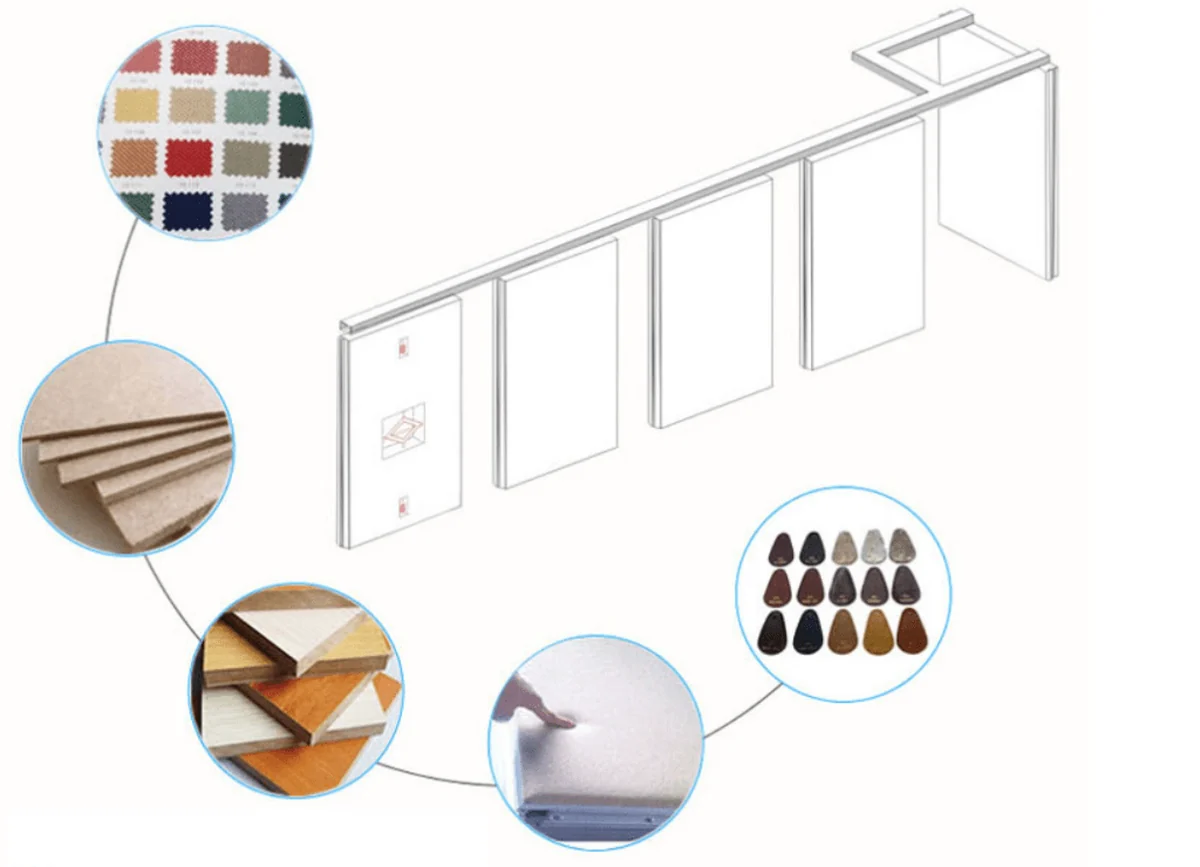
EBUNGE offers a range of finish options, including laminate, melamine, fabric, leather, glass, and other approved surfaces. Each finish has different characteristics in terms of appearance, cleanability, and resistance to abrasion. However, it is important to note that no finish is indestructible. The selection must be based on the specific conditions of the project.
Panel handling and the operating sequence must be confirmed for the selected layout and project conditions. The key is to match the finish to the expected level of contact.
Laminate and Melamine: Practical Choices
Laminate and melamine surfaces are commonly used in high-traffic areas. They are available in many colors and patterns, and they are generally resistant to scratches from light contact. However, if a hurdle rack is pushed directly against the panel, even a laminate finish could be damaged. Abrasion mapping should identify such risk areas and recommend protective measures, such as adding a buffer strip or relocating the rack.
Fabric and Leather: Aesthetic and Acoustic Considerations
Leather finishes add a tactile quality. But these finishes are more vulnerable to abrasion than hard surfaces.
Glass: Visual Openness with Care
Glass panels can make a space feel larger and allow natural light to pass through. They are easy to clean but can be scratched or chipped if struck by equipment. In a sports hall, glass is often used in upper sections or in areas away from impact. Abrasion mapping will help determine if glass is appropriate near hurdle storage.
Acoustic Performance: A Conceptual Note
). These ratings indicate how much sound is reduced when passing through the partition. The overall performance depends on the panel construction, seals, and installation quality.
Project Documentation and Coordination
Successful integration of sports hall partition finishes for hurdle storage racks requires thorough project documentation. This includes architectural drawings, partition layout plans, and specifications for finishes and storage racks. EBUNGE can discuss project documentation requirements, but the project team must provide accurate information about the room layout, including the location of all fixed elements.
Information Required from the Project Team
To assess the suitability of finishes and to plan the partition system, the following information is typically needed:
- Detailed floor plans showing the partition location, stacking area, and any wall-mounted equipment.
- Elevations showing the height of the partition and the position of storage racks.
- Information about the type of activities that will occur in the space, such as sports, events, or classes.
Without this information, it is impossible to recommend a specific finish or to confirm that the partition will operate correctly. EBUNGE’s role is to provide a movable partition system that is configured to the project’s needs, but the project team must define those needs clearly.
Reviewing the Layout for Movement and Stacking
Review the ceiling interface, panel route and stacking position together.
EBUNGE reviews straight, turning, and stacking routes from the layout to ensure that the partition can operate as intended. This review includes checking that the overhead track is continuous and that there are no obstructions in the movement path. Abrasion mapping should be part of this review, with particular attention to areas where the partition is likely to be parked for long periods.
Pass Doors and Accessibility
In many sports halls, a pass door is integrated into the partition to allow people to move between zones without opening the entire partition. Pass doors are useful for athletes, staff, and maintenance personnel. The location of the pass door should be coordinated with the storage rack layout to avoid conflicts. For example, a pass door should not open directly into a hurdle rack.
EBUNGE can discuss pass-door requirements, but the project team must decide where the door is needed and how it will be used. This decision affects the partition layout and the finish selection, as the door area may be subject to more frequent contact.
Practical Steps for Abrasion Mapping
To implement abrasion mapping for sports hall partition finishes for hurdle storage racks, follow these steps:
- Create a detailed layout drawing that shows the partition in both open and closed positions, including the stacking area.
- Identify all wall-mounted elements within 1 meter of the partition’s movement path or parking zone. This includes hurdle racks, whiteboards, and electrical outlets.
- Assess the risk of contact by considering the size and shape of the racks, the frequency of partition movement, and the likelihood of accidental impact.
- Select a finish that matches the risk level. For high-risk areas, choose a more durable finish or add protective measures.
- Document the decisions in the project specifications and share them with all stakeholders.
Case Example: A Typical Sports Hall Scenario
Consider a sports hall that will be divided into two courts for training. The partition is to be parked against the side wall when not in use. The facility manager plans to install hurdle racks on that same wall. Without abrasion mapping, the racks might be placed too close to the stacking area, causing the panels to rub against the hurdles every time the partition is opened or closed. With proper mapping, the racks can be relocated to a different wall, or the finish on the partition can be upgraded to a more impact-resistant laminate.
This example illustrates the importance of early coordination. The finish selection should not be an afterthought; it should be part of the initial design discussions.
Frequently Asked Questions
What is abrasion mapping for movable partitions?
Abrasion mapping is a planning process that identifies where a movable partition’s surface might come into contact with other objects, such as storage racks, and helps select a finish that can withstand that contact.
Why are sports hall partition finishes for hurdle storage racks a special concern?
Hurdle racks are often wall-mounted and protrude into the room. If they are placed near the partition’s movement or parking area, the finish can be scratched or damaged. Abrasion mapping helps avoid this.
Can EBUNGE partitions be used in sports halls with wall-mounted equipment?
Yes, EBUNGE partitions can be used in such spaces, but the layout must be reviewed to ensure that the partition can move and stack without obstruction. The finish should be selected based on the expected contact.
What finish options are available for EBUNGE partitions?
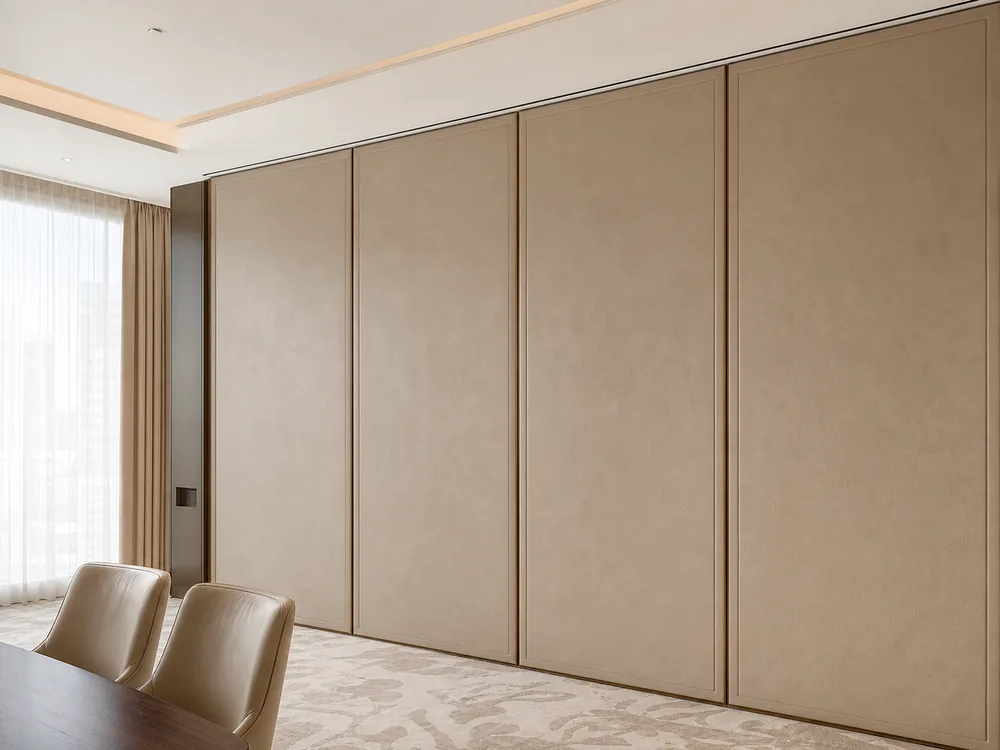
EBUNGE offers laminate, melamine, fabric, leather, glass, and other approved surfaces.
Do I need to provide project drawings to EBUNGE?
Yes, project drawings are essential for reviewing the partition layout, movement routes, and stacking positions. EBUNGE can discuss documentation requirements, but the project team must supply accurate plans.
Can a pass door be added to the partition?
Yes, pass doors can be incorporated. The location of the pass door should be coordinated with the storage rack layout to ensure safe operation.
Conclusion and Next Steps
Selecting sports hall partition finishes for hurdle storage racks is a task that requires careful planning and coordination. By reviewing the layout, understanding the movement and stacking of the partition, and choosing a finish that matches the risk, you can ensure that the partition performs well for years.
EBUNGE movable partitions offer flexibility and a range of finish options, but every project is unique. To confirm that your sports hall partition meets your specific requirements, contact EBUNGE for a detailed discussion. Our team can review your layout, discuss finish options, and help you plan a partition system that works for your space.
Explore EBUNGE movable partition products to see the available configurations and finishes. For more information on how to coordinate your project, visit our project examples or contact us directly.
Continue Exploring
More Materials and Finishes Guides
- Newer guideComparing Healthcare Training Room Partition Finishes for Wall-Mounted Whiteboard vs Tackable Zones
- Earlier guideWhy Hotel Banquet Partition Finishes Need Coordination with Ceiling Light Rigging Abrasion
- Related guideHow to Compare University Multipurpose Room Partition Finishes for Tackable vs Marker Board Surfaces
- Related guideWhy University Lecture Hall Partition Finishes Need Abrasion Mapping for Mobile Lectern Traffic