
Quick answer: university classroom partition seal options
Review the project drawings for university classroom partition seal options.
When a university classroom divides into two teaching rooms, the partition line often meets a wall-mounted clock recess. That recess interrupts the head, jamb or pocket condition, so university classroom partition seal options must be compared against the actual drawing rather than a generic detail. This article sets out an evidence-bounded framework for that comparison.
EBUNGE movable partitions are top-hung and travel without a continuous floor track along the partition line. Panels park at a planned stacking position. The suitability of each route and parking arrangement depends on the approved layout, circulation, ceiling interfaces and operating sequence.
Why the Clock Recess Changes the Seal Comparison
Coordinate the current drawing set for university classroom partition seal options.
A wall-mounted clock recess is a fixed obstruction on the wall plane. Where the partition meets that wall, the junction is no longer a simple vertical line. The recess may sit above, beside or across the intended meeting point, and each position changes how the partition edge, the wall and the surrounding ceiling interface relate to one another.
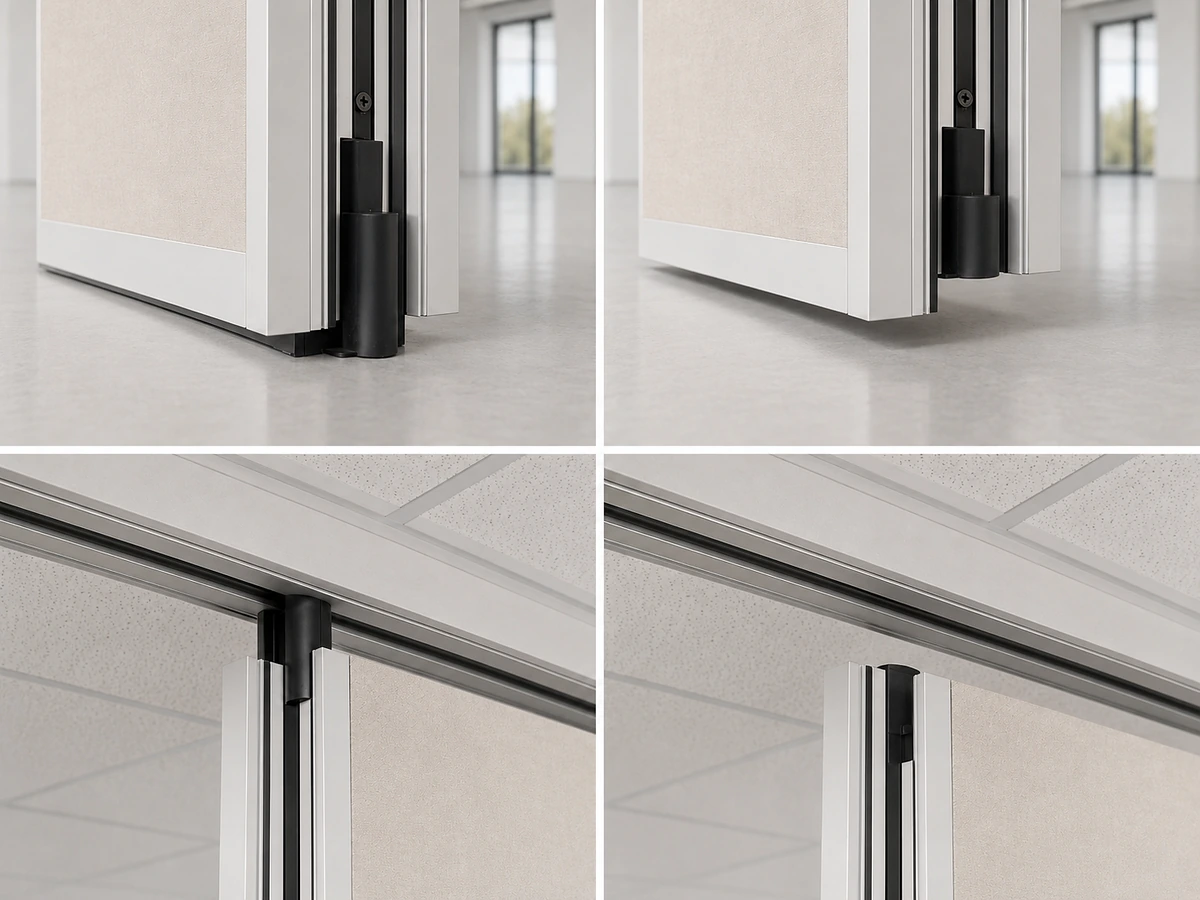
Seals are the interface elements that close the gap between panel edges and adjacent building surfaces. Their purpose is to limit air movement and flanking paths around the partition. How well any arrangement performs depends on the whole assembly, not on the seal alone, so a comparison should begin with geometry and coordination rather than with a product label.
What the recess can affect
- The vertical line where the partition meets the wall.
- The head condition where the partition meets the ceiling or soffit.
- The stacking position if the recess sits near the intended park.
- The route review if the recess narrows a turning or travel path.
Start With the Route, Not the Seal
Record the drawing revision used for university classroom partition seal options.
Before comparing seal options, confirm that the partition can reach the junction. Every proposed movement path requires a continuous connected overhead route and project-specific support review. A recess that appears harmless on a plan can still sit close to a turning point or a stacking zone.
The exact route, junction arrangement, continuous overhead path and parking position must be confirmed from the coordinated project drawings. If the recess is near the park, the stacking arrangement may need to be coordinated with the wall condition. Parking style is customized to the customer layout and project requirements, and compact stacking may be possible when the coordinated design permits it.
Route review checklist
- Mark the partition line and the clock recess on the same drawing.
- Trace the full travel path from closed position to stacking position.
- Identify any turning point near the recess.
- Confirm the overhead route is continuous and supported.
- Note where the partition edge meets the wall and ceiling.
- Flag every point that needs project-specific confirmation.
Comparing Seal Conditions at the Recess
Keep project evidence attached to the university classroom partition seal options review.
At a clock recess, the seal comparison usually involves three conditions: the vertical junction at the wall, the head junction at the ceiling or soffit, and the intermediate junction where the recess interrupts the wall plane. Each condition has its own tolerance and coordination needs.
A useful comparison table should record what is known and what still needs confirmation. The table below is a framework, not a performance ranking. The exact overhead route and support arrangement must be confirmed by the responsible project team from coordinated drawings.
| Junction condition | What to compare | Evidence needed |
|---|---|---|
| Vertical wall junction | How the partition edge meets the wall beside the recess | Dimensioned wall section and confirmed interface detail |
| Head junction | How the partition meets the ceiling or soffit above the recess | Ceiling interface drawing and support review |
| Recess interruption | How the wall plane changes at the clock recess | Elevation showing the recess and partition line |
| Stacking zone | Whether the park position is clear of the recess | Layout showing stacking position and clearance |
Drawing Coordination for the Recess Juncture
Seal comparisons become reliable only when the drawings agree. The architectural plan, reflected ceiling plan, wall elevations and partition layout should show the same recess position and the same partition line. If they differ, the comparison is built on an unresolved condition.
Project teams should also confirm who is responsible for the wall opening, the recess surround and any blocking behind the finished surface. These items sit outside the partition scope but directly affect the junction. Documenting them early prevents a seal detail from being selected against an unconfirmed substrate.
Evidence note
Do not infer acoustic, fire, durability, load or maintenance performance from a visible shape, finish, photograph or drawing. Comparative and absolute statements require corresponding evidence; otherwise state the exact project-specific confirmation boundary.
Finish Choices and the Recess Interface
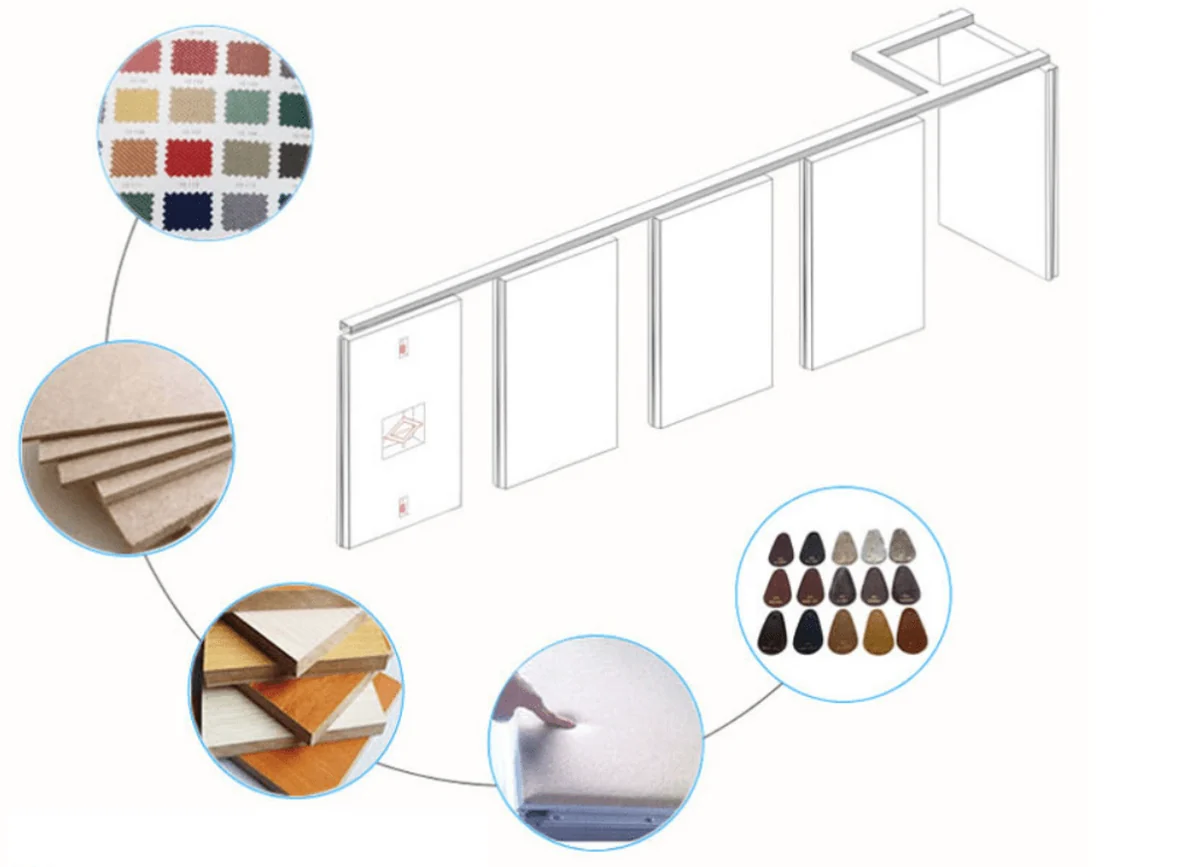
Confirmed finish options include laminate, melamine, fabric, leather, glass and other approved surfaces. A finish shown near a recess in a photograph is not evidence of a application reference or of a tested junction.
Where a recess creates a visible edge, the finish return and the seal interface should be reviewed together. The goal is a coordinated appearance and a defined junction, not an assumed performance outcome. Any cleaning or maintenance expectation should be confirmed for the specific finish and project condition.
Pass Doors, Documentation and Project Confirmation
Some classroom layouts include a pass door within the partition. Pass-door requirements can be discussed as part of the layout, and the door position may interact with the recess if both sit on the same wall. Project documentation can also be discussed so that the seal comparison is tied to the actual drawings.
Those items depend on the ceiling structure, the wall build-up, the partition layout and the intended use. Confirm them with the project team before selecting a seal arrangement.
Frequently Asked Questions
Can a clock recess be ignored when comparing seal options?
No. The recess changes the wall plane at the junction, so it should appear on the same drawing as the partition line and be reviewed as part of the interface.
Does a seal option guarantee soundproofing?
No. Seals are interface elements within a larger assembly.
Can STC or Rw be expressed as a simple decibel count?
No. STC and Rw are rating concepts for assemblies. They should not be reduced to a direct count of decibels or applied to a project without matching evidence.
What if the recess sits near the stacking position?
Review the stacking route and park position with the layout. Parking is customized to project requirements, and the recess should be checked against the coordinated design.
Which finishes can be considered near a recess?
Confirmed options include laminate, melamine, fabric, leather, glass and other approved surfaces. Selection should be coordinated with the junction detail and project requirements.
What information should be ready before a seal comparison?
Prepare the partition layout, wall elevations showing the recess, ceiling interface information, route and stacking plans, and any pass-door requirements for discussion.
Conclusion and Next Step
Comparing university classroom partition seal options at a wall-mounted clock recess is a drawing-led exercise. Start with the route and support review, map the junction conditions, record what evidence exists, and leave performance conclusions to project-specific confirmation.
To discuss a specific classroom layout, share the drawings and requirements through the contact page.
Continue Exploring
More Acoustic Partition Guides
- Newer guideSchool Auditorium Partition Seal: Speaker Recess Junctions Maintenance
- Earlier guideUniversity Lecture Hall Partition Seal: Speaker Junctions Maintenance
- Related guideAcoustic Partition Ceiling Interface Zone Confirmation
- Related guideWho Confirms Ceiling Grid Line Before Acoustic Partition Track