
Why university movable partition seal maintenance planning starts with the top-hung principle
Quick project answer
University movable partition seal maintenance planning begins with the operating principle of the system. The EBUNGE movable partition system is top-hung. That single fact changes how a facilities team thinks about the floor, the parking area and the finish schedule.
Because the system is top-hung, there is no continuous floor running track or operating hardware in the finished floor along the partition line. The floor is not cut or damaged for a floor track. It remains physically uninterrupted by the maintained EBUNGE top-hung system.
For a university, that matters when a room must change between teaching, examination, seminar and event use. The floor surface stays intact, so the planning conversation can focus on the overhead path, the parking position and the finish care routine.
What a physically uninterrupted floor means for daily use
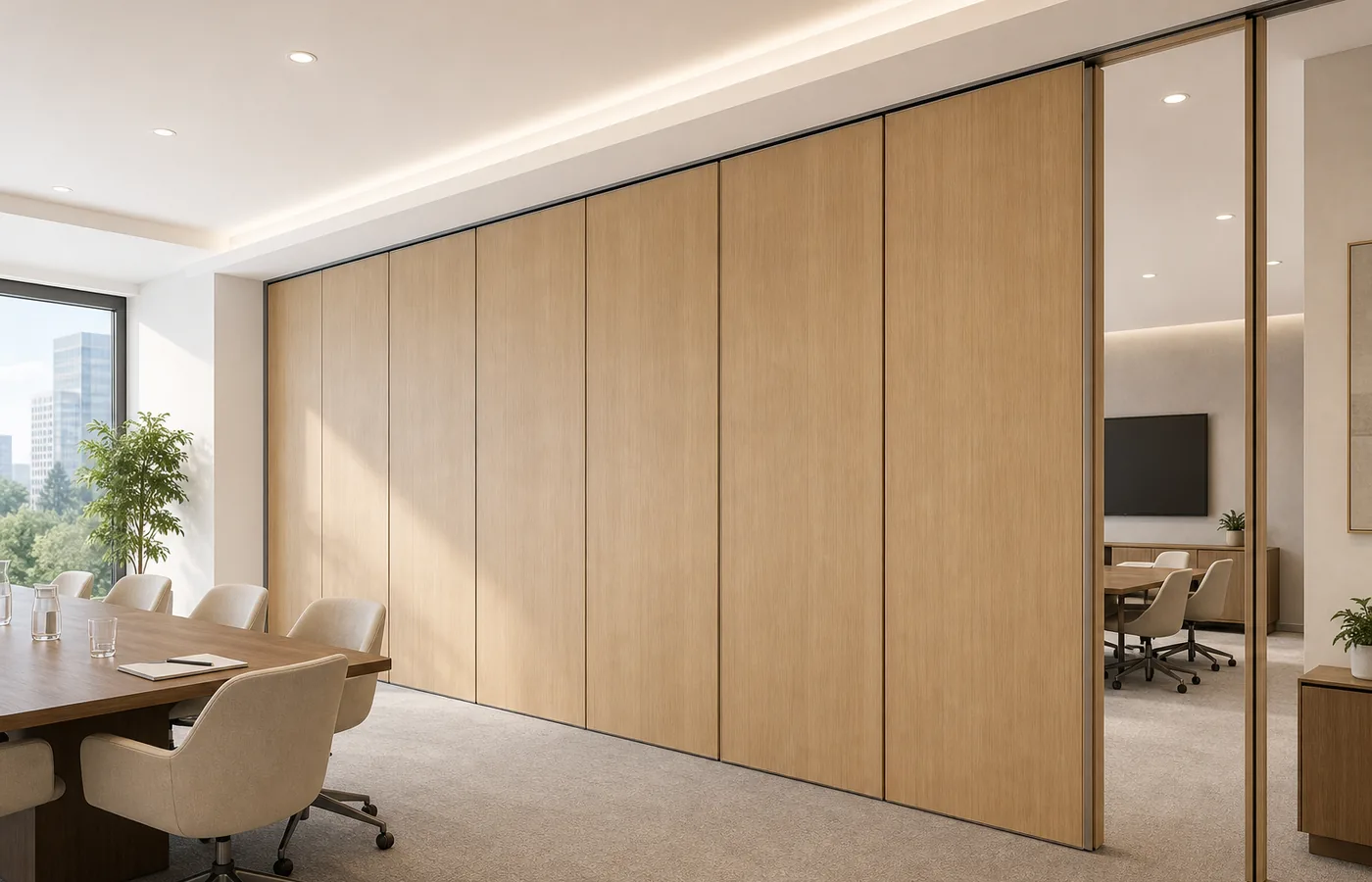
A physically uninterrupted floor is a planning condition, not a performance claim. It means the finished floor along the partition line is not cut for a floor track. Cleaning crews and building users meet one continuous floor surface.
This condition can simplify how a space is scheduled. A lecture room can be divided for two seminars, then returned to a single hall. The floor does not carry a track that must be crossed or cleaned around.
University movable partition seal maintenance planning should still respect the finish. Cleaning and maintenance methods vary with the selected finish. The floor and the panel finish may need different care products and different routines.
Parking planning for university movable partition seal maintenance
Panel parking style can be customized to the customer layout and project requirements, subject to coordinated drawings. A suitable approved parking arrangement can use the stacking area more compactly and coordinate with the space design.
The exact track, support and panel layout still require project drawings. That boundary applies to every university movable partition seal maintenance plan. The parking position is a drawing decision, not a generic rule.
When the parking area is coordinated early, the university can review how the stacked panels relate to adjacent circulation, furniture zones and teaching equipment. The review is a drawing review, not a performance promise.
Finish and care coordination for university movable partition seal maintenance
Finish materials can be customized, and cleaning and maintenance methods vary with the selected finish. A university may choose different finishes for different halls, so the care routine should follow the finish schedule rather than a single generic method.
University movable partition seal maintenance planning should record which finish is used in each location. The record helps the facilities team match the correct cleaning method to the correct surface.
Because the system is top-hung, the floor care routine does not need to account for a floor track along the partition line. The floor remains physically uninterrupted by the maintained EBUNGE top-hung system.
Non-limiting applications across a university estate
Movable partitions can be used wherever flexible space division, combination or reconfiguration is required. Application examples are not limiting. A university may apply the same planning logic to several room types.
Typical settings include lecture rooms, seminar rooms, multipurpose halls and event spaces. Each setting may have a different finish, a different parking position and a different care routine.
EBUNGE has completed many types of hotel-related movable-partition projects. Ballrooms, wedding halls and multifunction halls are non-limiting examples. No customer names, locations, quantities, ratings, certifications or outcomes may be inferred from those examples.
Buyer inputs for university movable partition seal maintenance
A useful planning file starts with the room schedule. The university should list each space, its intended uses and the way the space must combine or divide. That list supports the drawing review.
The file should also note the selected finish for each location and the cleaning method that finish requires. Finish materials can be customized, and cleaning and maintenance methods vary with the selected finish.
The parking preference should be stated as a planning input. Panel parking style can be customized to the customer layout and project requirements, subject to coordinated drawings.
Drawing approvals and the project boundary
University movable partition seal maintenance planning depends on coordinated drawings. The exact route, junction arrangement, continuous overhead path and parking position must be confirmed from the coordinated project drawings.
Approval should cover the parking area, the finish schedule and the care method for each finish. The review should also confirm that the floor remains physically uninterrupted by the maintained EBUNGE top-hung system.
Because the system is top-hung, there is no continuous floor running track or operating hardware in the finished floor along the partition line. That confirmed fact should appear in the planning file.
Scannable planning checklist
- List each room and its flexible-use requirement.
- Confirm the top-hung principle in the project file.
- Record that the floor is not cut for a floor track.
- State the parking preference for drawing review.
- Match each finish to its cleaning method.
- Review the coordinated drawings before approval.
Comparison of planning inputs
| Planning input | What to confirm | Source |
|---|---|---|
| Operating principle | Top-hung system | Confirmed system fact |
| Floor condition | No floor track along the partition line | Confirmed system fact |
| Parking style | Customized to layout and requirements | Coordinated drawings |
| Finish care | Method varies with selected finish | Finish schedule |
| Route and junction | Exact arrangement | Coordinated drawings |
Frequently asked questions
For further context, review related project guidance before preparing the coordinated project brief.
Does university movable partition seal maintenance require a floor track?
No. The EBUNGE movable partition system is top-hung and has no continuous floor running track or operating hardware in the finished floor along the partition line.
Is the floor cut or damaged for a track?
The floor is not cut or damaged for a floor track and remains physically uninterrupted by the maintained EBUNGE top-hung system.
Can the parking style be customized?
Panel parking style can be customized to the customer layout and project requirements, subject to coordinated drawings.

Do cleaning methods change with the finish?
Yes. Finish materials can be customized, and cleaning and maintenance methods vary with the selected finish.
Where can movable partitions be used?
Movable partitions can be used wherever flexible space division, combination or reconfiguration is required. Application examples are not limiting.
What must be confirmed from drawings?
The exact route, junction arrangement, continuous overhead path and parking position must be confirmed from the coordinated project drawings.
Related planning pages
The exact overhead route and support arrangement must be confirmed by the responsible project team from coordinated drawings. The projects page shows completed work for general reference.
University movable partition seal maintenance planning should stay tied to confirmed facts, the finish schedule and the coordinated drawings. That approach keeps the planning file clear for the university team.
Continue Exploring
More Acoustic Partition Guides
- Newer guideComparing Hotel Banquet Partition Seal Planning for Ceiling-Mounted AV
- Earlier guideConvention Center Operable Wall Seal and Plenum Coordination
- Related guideAcoustic Partition Ceiling Interface Zone Confirmation
- Related guideWho Confirms Ceiling Grid Line Before Acoustic Partition Track