
Why healthcare training room finish edge planning matters
Quick project answer
Healthcare training rooms often need to shift between classroom layouts, simulation setups and small-group discussion. The healthcare training room finish edge is where the movable partition meets adjacent finishes, and it deserves early attention. A poorly coordinated edge can affect cleaning routines, visual continuity and how the room reads during training sessions. Planning the healthcare training room finish edge before procurement helps align the wall system with the room’s daily use.
This article focuses on top-hung operable walls and the finish edge decisions that surround them. It does not prescribe a universal installation sequence or a fixed operating procedure. Instead, it outlines the planning inputs that help design and construction teams coordinate the healthcare training room finish edge with the wider room design.
The top-hung principle and the physically uninterrupted floor
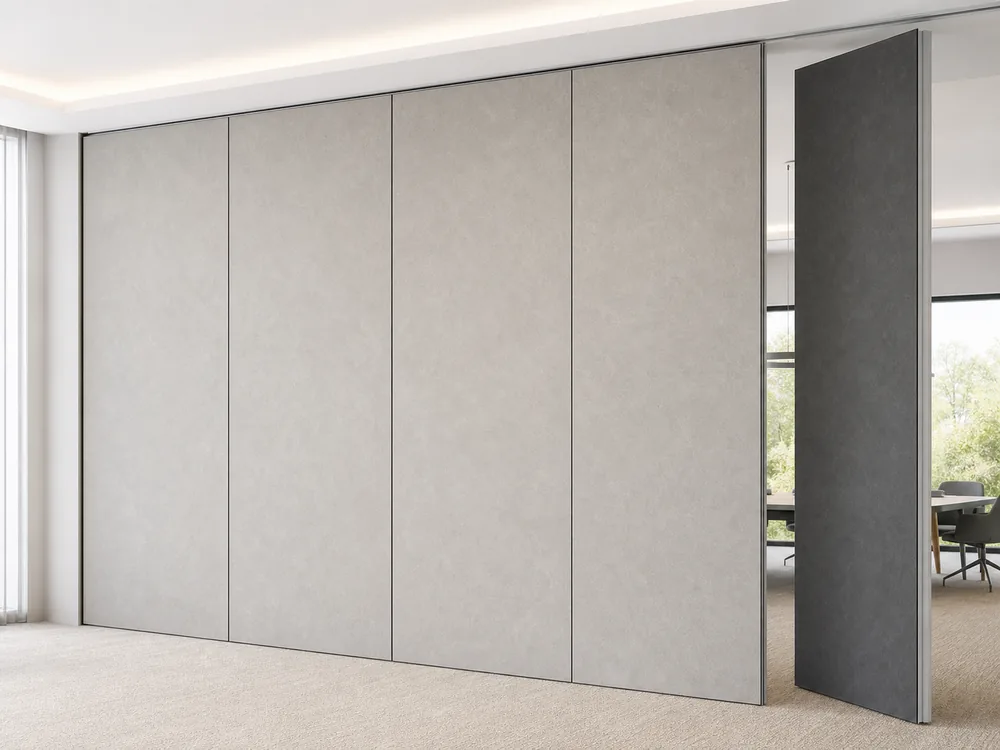
The EBUNGE movable partition system is top-hung. It has no continuous floor running track or operating hardware in the finished floor along the partition line. This means the floor is not cut or damaged for a floor track. The floor remains physically uninterrupted by the maintained EBUNGE top-hung system.
The suitability of each route and parking arrangement depends on the approved layout, circulation, ceiling interfaces and operating sequence. It also changes how the healthcare training room finish edge is treated at floor level. Because there is no floor track, the edge condition is resolved at the panel face and adjacent wall or floor finish rather than around a recessed track.
The exact route, junction arrangement, continuous overhead path and parking position must be confirmed from the coordinated project drawings. This boundary applies to every healthcare training room finish edge decision described here.
Finish edge coordination with adjacent surfaces
Finish materials can be customized, and cleaning and maintenance methods vary with the selected finish. That variability matters when the healthcare training room finish edge meets vinyl flooring, hygienic wall cladding or painted surfaces. The selected finish influences how the edge is cleaned and maintained over time.
Design teams should confirm the finish schedule for both the partition and the surrounding room. The healthcare training room finish edge should be reviewed alongside door frames, corner guards and wall protection where these are part of the room design. This is a coordination exercise, not a performance claim.
Because cleaning methods vary by finish, the facilities team should receive finish-specific care information for the selected materials. The healthcare training room finish edge may need a consistent cleaning approach across adjacent surfaces, and that approach depends on the finishes chosen.
Parking planning for healthcare training rooms
Panel parking style can be customized to the customer layout and project requirements, subject to coordinated drawings. A suitable approved parking arrangement can use the stacking area more compactly and coordinate with the space design. The exact track, support and panel layout still require project drawings.
In a healthcare training room, parking location affects how the room is used when the partition is open. The healthcare training room finish edge near the parking zone should be considered together with the stacking area. This helps the design team check that the parked panels do not conflict with training equipment, seating or circulation.
Parking decisions are project-specific. The healthcare training room finish edge and parking zone should be shown on coordinated drawings so that the design intent is clear before construction.
Non-limiting application examples
Movable partitions can be used wherever flexible space division, combination or reconfiguration is required. Application examples are not limiting. EBUNGE has completed many types of hotel-related movable-partition projects; ballrooms, wedding halls and multifunction halls are non-limiting examples.
Healthcare training rooms are another context where flexible division may be useful. The healthcare training room finish edge planning approach described here can be adapted to other training, education and clinical support spaces. No customer names, locations, quantities, ratings, certifications or outcomes may be inferred from these examples.
When considering a healthcare training room finish edge, the project team should treat each room as its own coordination task. The confirmed top-hung principle and customizable finish remain the stable points of reference.
Buyer inputs and drawing approvals
Buyers and design teams can prepare several inputs before drawings are finalized. These inputs help the healthcare training room finish edge and parking strategy align with the room layout. The list below is a planning aid, not a fixed sequence.
- Room layout options showing open, closed and partially divided configurations.
- Finish schedule for the partition and adjacent surfaces.
- Preferred parking location and stacking area dimensions.
- Cleaning and maintenance expectations for the selected finishes.
- Coordination points with doors, glazing where applicable and wall protection.
These inputs should feed into coordinated drawings. The exact route, junction arrangement, continuous overhead path and parking position must be confirmed from the coordinated project drawings. The healthcare training room finish edge should be reviewed at each drawing stage.
Reviewing the healthcare training room finish edge in drawings
Drawing review is where the healthcare training room finish edge becomes concrete. The team can check that the top-hung system aligns with the ceiling structure and that the floor remains uninterrupted. They can also verify that the parking area matches the intended room use.
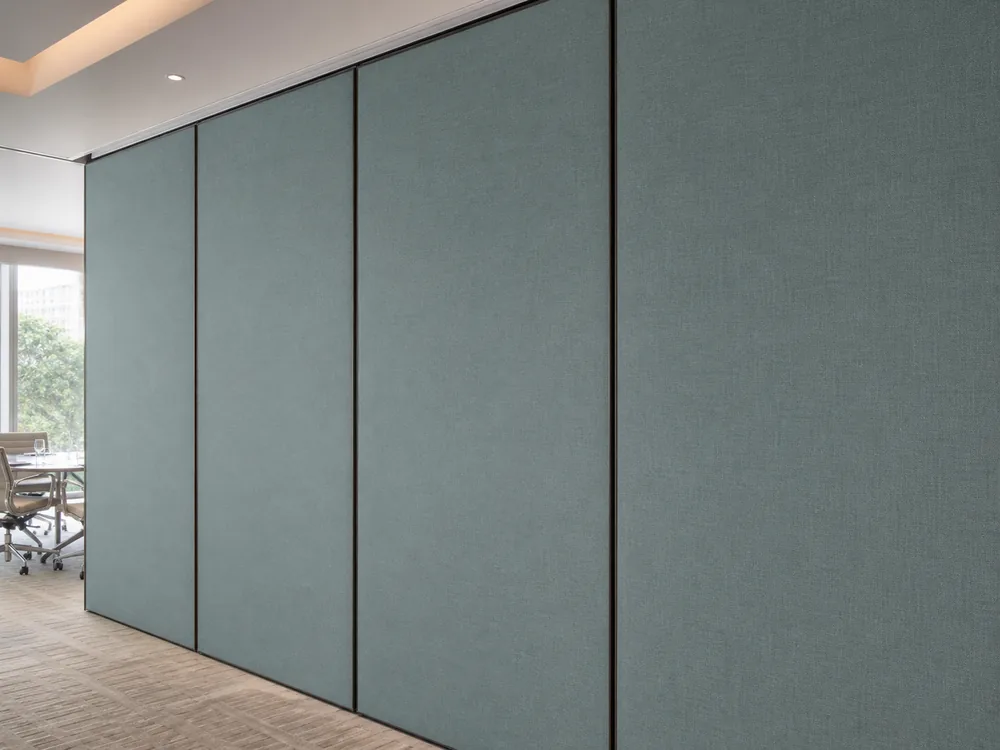
The table below summarizes typical review points. It is a coordination checklist, not a performance specification.
| Review point | What to confirm |
|---|---|
| Overhead path | Continuous overhead path shown on coordinated drawings. |
| Floor condition | No floor track; floor remains physically uninterrupted. |
| Finish edge | Selected finish and adjacent surface transitions. |
| Parking zone | Approved parking arrangement and stacking area. |
| Cleaning | Finish-specific care information for selected materials. |
After review, the healthcare training room finish edge should be reflected in the coordinated drawings. Any changes to finish or parking should be re-checked against those drawings.
Frequently asked questions
Does a top-hung operable wall require a floor track in a healthcare training room?
No. The EBUNGE movable partition system is top-hung and has no continuous floor running track or operating hardware in the finished floor along the partition line. The floor is not cut or damaged for a floor track and remains physically uninterrupted by the maintained EBUNGE top-hung system.
Can the healthcare training room finish edge be customized?
Finish materials can be customized, and cleaning and maintenance methods vary with the selected finish. The healthcare training room finish edge should be coordinated with adjacent surfaces and confirmed in the project drawings.
How is panel parking planned for a healthcare training room?
Panel parking style can be customized to the customer layout and project requirements, subject to coordinated drawings. A suitable approved parking arrangement can use the stacking area more compactly and coordinate with the space design. The exact track, support and panel layout still require project drawings.
Are movable partitions only for hotels and ballrooms?
No. Movable partitions can be used wherever flexible space division, combination or reconfiguration is required. Application examples are not limiting. EBUNGE has completed many types of hotel-related movable-partition projects, but healthcare training rooms are another possible context.
What information should buyers provide for the healthcare training room finish edge?
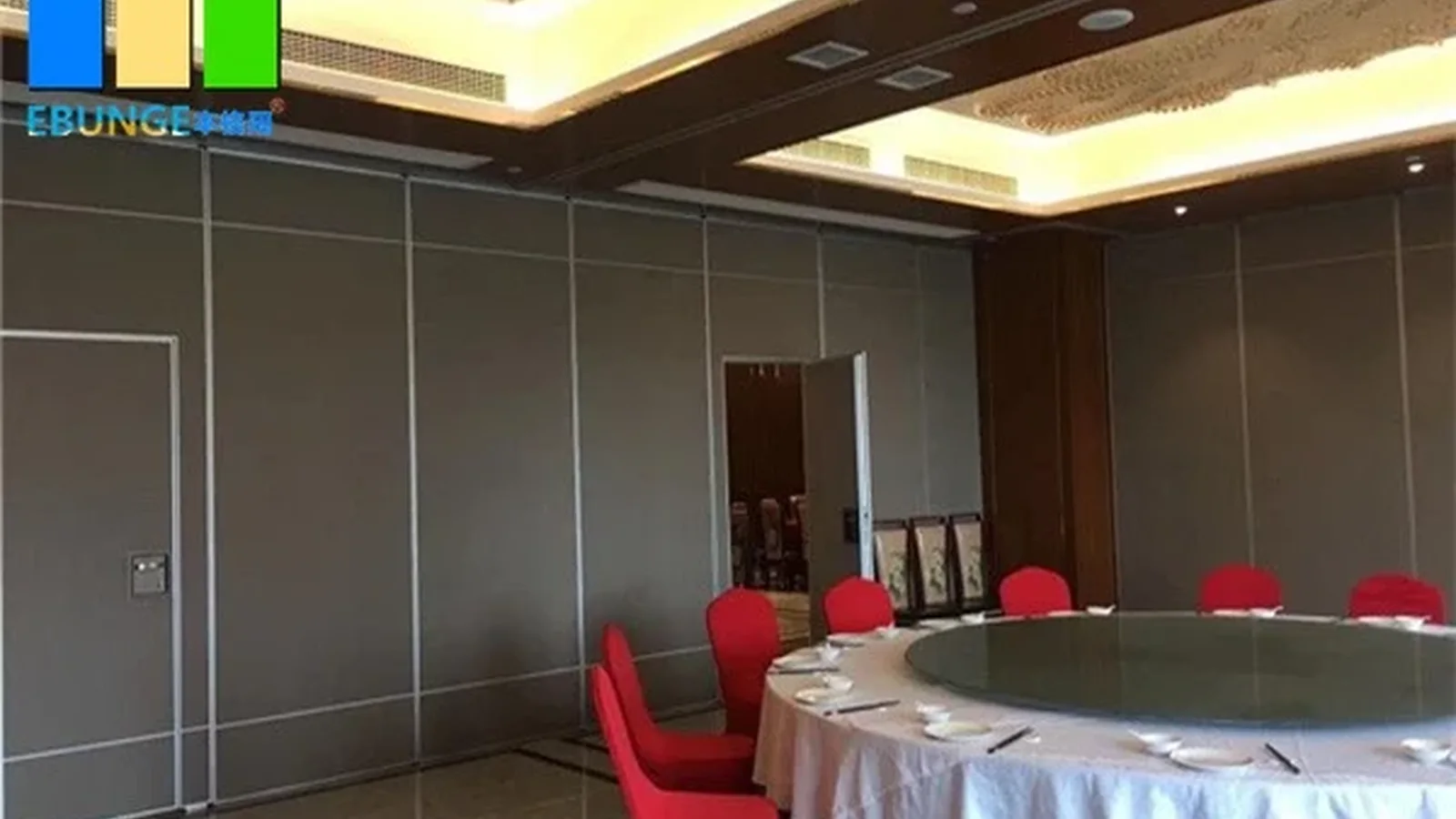
Visible references can support layout discussion but do not verify hidden construction or performance. These inputs help the design team coordinate the healthcare training room finish edge and prepare drawings for review.
Where can I see related movable partition projects?
You can review completed projects and learn more about the movable partition wall system. The exact route, junction arrangement, continuous overhead path and parking position must be confirmed from the coordinated project drawings.
Key takeaways for healthcare training room finish edge planning
The healthcare training room finish edge is a coordination topic that benefits from early attention. The top-hung principle keeps the floor physically uninterrupted, while finish and parking decisions remain project-specific. Buyers and designers should align on layouts, finishes and parking before drawings are approved.
Every healthcare training room finish edge decision should be checked against coordinated drawings. The exact route, junction arrangement, continuous overhead path and parking position must be confirmed from the coordinated project drawings. With those confirmations in place, the healthcare training room finish edge can support flexible training use without overstating performance.
Continue Exploring
More Materials and Finishes Guides
- Newer guideCompare Hotel Movable Partition Finishes for Ceiling Height
- Earlier guideComparing Movable Partition Finishes for Clinical Skills Labs
- Related guideWho Verifies Partition Handover Records When Trades Finish at Different
- Related guideMovable Partition Finish Sample Coordination Guide for Interior