
Why maintenance planning differs for an office meeting suite operable wall
Quick project answer
An office meeting suite operable wall divides larger meeting areas into smaller rooms. Huddle room dividers often sit in the same suite, so maintenance planning must cover both. The EBUNGE movable partition system is top-hung and has no continuous floor running track or operating hardware in the finished floor along the partition line.
That single fact changes how a facility team thinks about daily care. The floor is not cut or damaged for a floor track and remains physically uninterrupted by the maintained EBUNGE top-hung system. Maintenance attention therefore moves to the overhead path, the panel faces and the parking zone.
This article explains how to plan care for an office meeting suite operable wall without inventing performance claims. It uses only confirmed product facts and separates confirmed points from items that require project drawings.
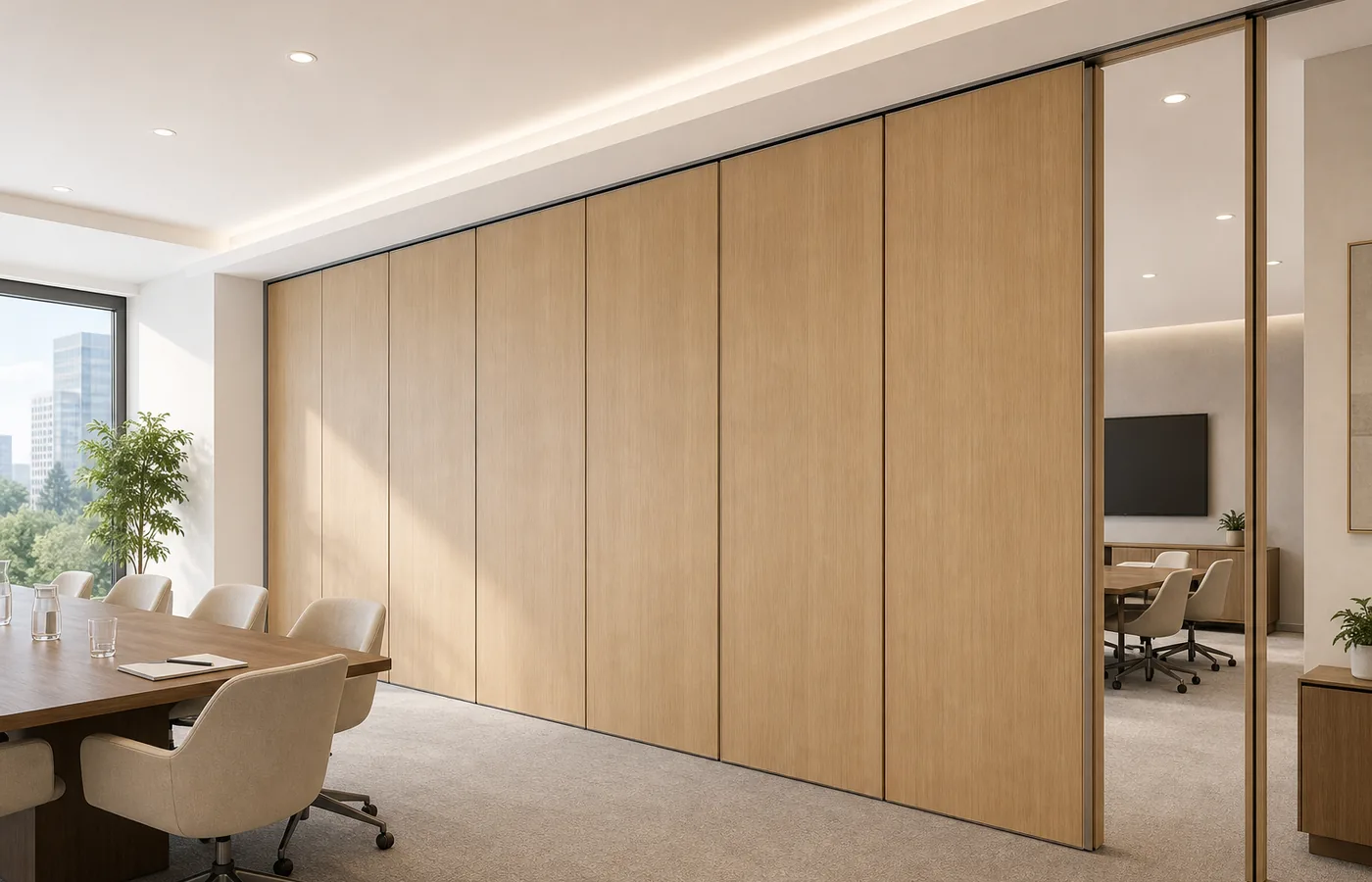
The top-hung principle and what it means for care
A top-hung system carries the panels from above. Because the EBUNGE movable partition system is top-hung, the finished floor along the partition line stays free of a continuous running track and operating hardware. That is a confirmed design fact, not a performance rating.
For maintenance teams, the practical consequence is that floor cleaning along the partition line does not need to work around a recessed track. The floor remains physically uninterrupted by the maintained EBUNGE top-hung system. Care routines can treat that floor area as ordinary finished floor.
Overhead components still require attention, but the exact route, junction arrangement, continuous overhead path and parking position must be confirmed from the coordinated project drawings. Do not assume a generic overhead layout applies to every office meeting suite operable wall.
Physically uninterrupted floors in meeting suites and huddle rooms
Huddle room dividers and larger meeting suite partitions often share a floor finish. When the partition line has no floor track, the floor finish can run continuously through the opening. This is a confirmed benefit of the top-hung arrangement.
Maintenance teams should still protect the floor during any panel handling. The absence of a floor track does not remove the need for care around panel edges. Finish materials can be customized, and cleaning and maintenance methods vary with the selected finish.
For an office meeting suite operable wall, confirm the finish type before choosing cleaners or tools. A method that suits one finish may not suit another. The exact route, junction arrangement, continuous overhead path and parking position must be confirmed from the coordinated project drawings.
Parking planning for huddle room dividers and meeting suites
Panel parking style can be customized to the customer layout and project requirements, subject to coordinated drawings. A suitable approved parking arrangement can use the stacking area more compactly and coordinate with the space design.
Parking planning matters because huddle room dividers and meeting suite panels may rest in a shared zone. The exact track, support and panel layout still require project drawings. Maintenance planning should begin with the approved parking position rather than an assumed location.
When the parking zone is confirmed, the facility team can plan access for cleaning and visual checks. The exact route, junction arrangement, continuous overhead path and parking position must be confirmed from the coordinated project drawings.
Finish and care coordination for an office meeting suite operable wall
Finish materials can be customized, and cleaning and maintenance methods vary with the selected finish. This is the central care rule for any office meeting suite operable wall. There is no single cleaning method that applies to every finish.
Buyers should record the selected finish for each partition and share that record with the cleaning team. The record should describe the finish and the approved care method. It should not assume hidden performance or universal cleaning outcomes.
For huddle room dividers, the same finish may appear on both sides of a panel. Care instructions should cover both faces. The exact route, junction arrangement, continuous overhead path and parking position must be confirmed from the coordinated project drawings.
Non-limiting applications across workplace and hospitality spaces
Movable partitions can be used wherever flexible space division, combination or reconfiguration is required. Application examples are not limiting. An office meeting suite operable wall is one example among many.
EBUNGE has completed many types of hotel-related movable-partition projects. Ballrooms, wedding halls and multifunction halls are non-limiting examples. No customer names, locations, quantities, ratings, certifications or outcomes may be inferred from that statement.
Huddle room dividers may appear in workplace settings, while larger meeting suite partitions may appear in conference areas. The maintenance approach still depends on the confirmed finish and the approved parking arrangement.
Buyer inputs and drawing approvals before maintenance planning
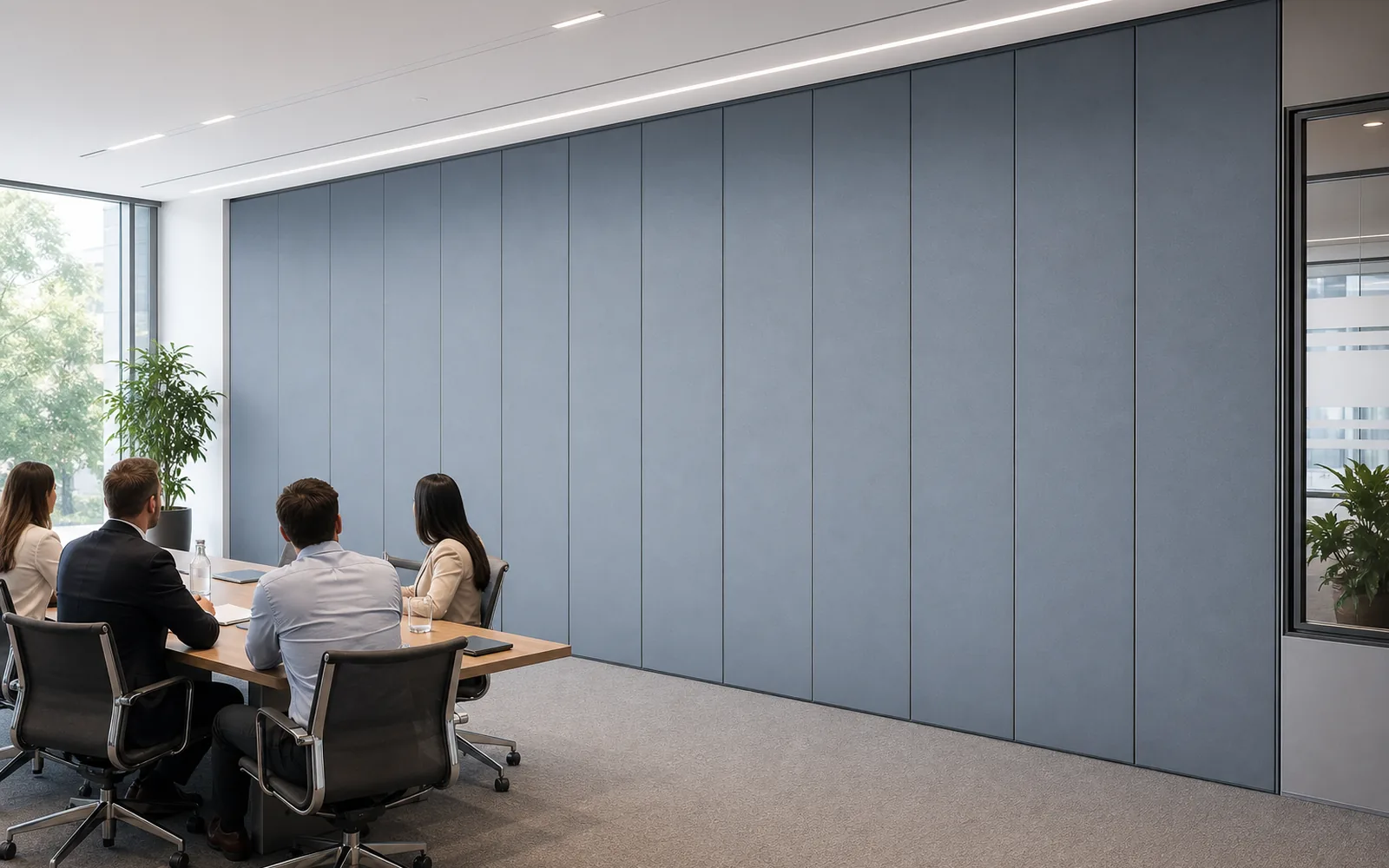
Maintenance planning should follow drawing approvals, not precede them. Buyers can provide layout priorities, parking preferences and finish selections. These inputs support the coordinated drawings that define the installation.
Panel parking style can be customized to the customer layout and project requirements, subject to coordinated drawings. A suitable approved parking arrangement can use the stacking area more compactly and coordinate with the space design.
The exact track, support and panel layout still require project drawings. For any engineering detail outside confirmed facts, use this boundary: The exact route, junction arrangement, continuous overhead path and parking position must be confirmed from the coordinated project drawings.
Maintenance checklist for an office meeting suite operable wall
- Confirm the approved parking position from the coordinated project drawings.
- Record the selected finish for each partition and huddle room divider.
- Match cleaning methods to the selected finish, because methods vary with finish.
- Keep the finished floor along the partition line free of a continuous floor track, as confirmed for the EBUNGE top-hung system.
- Review the overhead path only within the approved drawing scope.
Questions buyers ask about office meeting suite operable wall care
Does an office meeting suite operable wall need a floor track?
No continuous floor running track or operating hardware is present in the finished floor along the partition line for the EBUNGE top-hung system. The floor is not cut or damaged for a floor track and remains physically uninterrupted by the maintained system.
Can huddle room dividers share the same parking area as meeting suite panels?
Panel parking style can be customized to the customer layout and project requirements, subject to coordinated drawings. A suitable approved parking arrangement can use the stacking area more compactly and coordinate with the space design.
How should cleaning methods be chosen for an office meeting suite operable wall?
Finish materials can be customized, and cleaning and maintenance methods vary with the selected finish. Record the selected finish and use the care method approved for that finish.
Are movable partitions limited to office meeting suites?
No. Movable partitions can be used wherever flexible space division, combination or reconfiguration is required. Application examples are not limiting, and huddle room dividers are only one example.
What must be confirmed before maintenance planning is finalized?
The exact route, junction arrangement, continuous overhead path and parking position must be confirmed from the coordinated project drawings. The exact track, support and panel layout still require project drawings.
Coordinating suppliers, drawings and facility teams
An office meeting suite operable wall sits between the supplier, the project drawings and the facility team. Each group needs the same confirmed facts. The supplier confirms the top-hung principle and the absence of a floor track along the partition line.
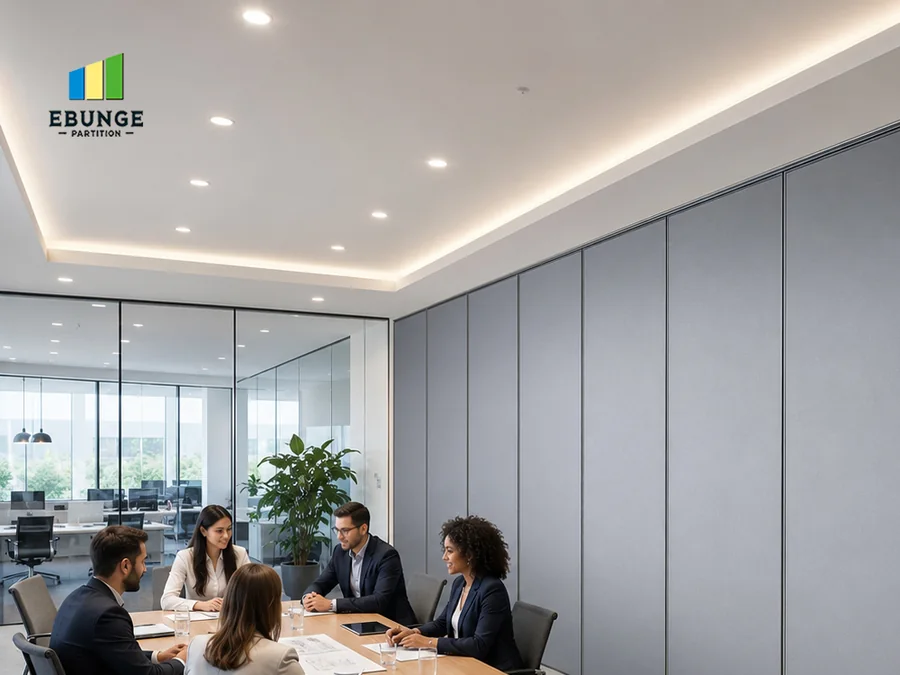
The project drawings confirm the route, junction arrangement, continuous overhead path and parking position. The facility team confirms the selected finish and the care method for that finish. This division keeps maintenance planning grounded in confirmed information.
For product context, see /products/. For project context, see /projects/. These links support general review and do not replace coordinated project drawings.
Summary for office meeting suite operable wall maintenance
Maintenance planning for an office meeting suite operable wall starts with the top-hung principle. The EBUNGE movable partition system has no continuous floor running track or operating hardware in the finished floor along the partition line. The floor remains physically uninterrupted by the maintained system.
Huddle room dividers follow the same care logic. Finish materials can be customized, and cleaning and maintenance methods vary with the selected finish. Parking style can be customized, subject to coordinated drawings.
For every engineering detail outside confirmed facts, return to the boundary sentence: The exact route, junction arrangement, continuous overhead path and parking position must be confirmed from the coordinated project drawings.
Continue Exploring
More Maintenance Guides
- Newer guideCommunity Hall Operable Wall Maintenance: School Gymnasium Dividers
- Earlier guideRestaurant Movable Partition Maintenance Inspection Planning
- Related guidePlan Service Access to Operable Wall Tracks When Ceiling Hatches
- Related guideAcoustic Movable Partition Track Servicing Access