
Quick project answer
A university auditorium manual operation split allows one large hall to serve two lecture schedules without cutting the finished floor. The EBUNGE movable partition system is top-hung and has no continuous floor running track or operating hardware in the finished floor along the partition line. This article explains how that principle supports split-lecture use, what to plan for parking and finishes, and which inputs and drawings a project team should confirm.
Why a university auditorium manual operation split starts with the top-hung principle
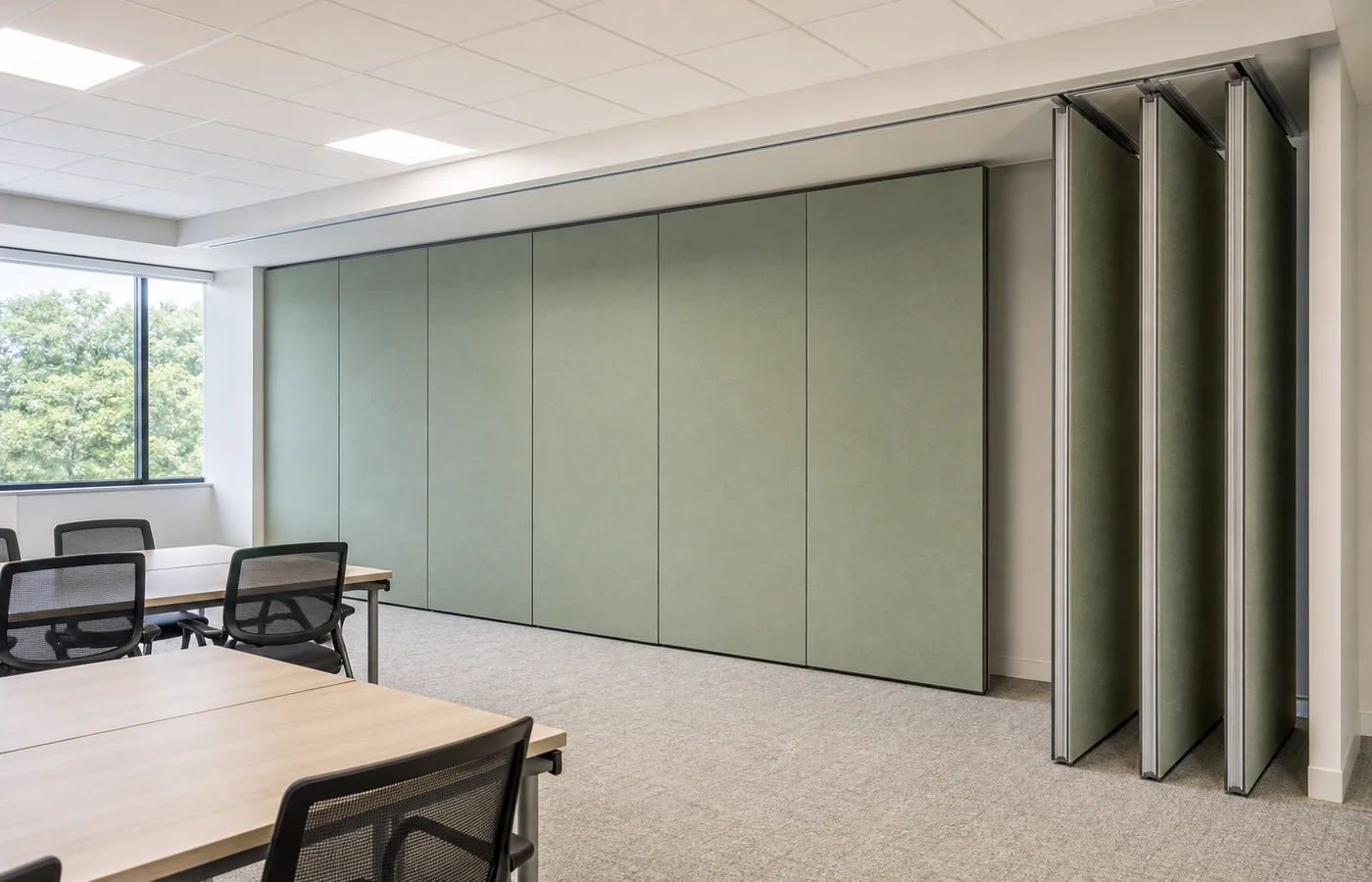
A university auditorium manual operation split begins with how the partition is supported. In a top-hung system, the panels hang from an overhead track rather than running on a floor guide. The floor is not cut or damaged for a floor track and remains physically uninterrupted by the maintained EBUNGE top-hung system.
That arrangement matters in auditoriums where the floor may be raked, finished or used for circulation. Because there is no continuous floor track along the partition line, the floor surface can remain as designed. The exact route, junction arrangement, continuous overhead path and parking position must be confirmed from the coordinated project drawings.

Manual operation refers to the way staff reconfigure the room between schedules. The confirmed system is top-hung and does not rely on floor-mounted operating hardware. Any operating sequence depends on the approved layout, so this article does not prescribe a universal procedure.
What a physically uninterrupted floor means for split-lecture schedules
When a university auditorium manual operation split is planned, the floor often carries multiple roles. It may support fixed seating, temporary chairs, accessible routes or equipment movement. A top-hung partition keeps the finished floor free of a continuous track along the partition line.
The confirmed fact is specific: the floor is not cut or damaged for a floor track and remains physically uninterrupted by the maintained EBUNGE top-hung system. This does not describe every possible partition product, and it does not remove the need for coordinated drawings.
The exact overhead route and support arrangement must be confirmed by the responsible project team from coordinated drawings. The room can be divided or combined where flexible space division is required. Application examples are not limiting, so the same principle can apply beyond a single auditorium type.
Parking and stacking planning for a university auditorium manual operation split
Parking is a central planning topic for a university auditorium manual operation split. Panel parking style can be customized to the customer layout and project requirements, subject to coordinated drawings. That means the stacking location should be discussed early with the design team.
A suitable approved parking arrangement can use the stacking area more compactly and coordinate with the space design. The exact track, support and panel layout still require project drawings. No single parking method applies to every auditorium.
Use the following checklist to organize parking questions before drawings are finalized.
- Identify where panels will rest when the auditorium is open.
- Confirm whether that area conflicts with seating, circulation or stage use.
- Review how the parking zone relates to the overhead path shown on drawings.
- Record any finish or trim expectations around the parking area.
- Confirm the approved parking style against the coordinated layout.
The exact route, junction arrangement, continuous overhead path and parking position must be confirmed from the coordinated project drawings.
Finish selection and care coordination
Finish materials can be customized, and cleaning and maintenance methods vary with the selected finish. For a university auditorium manual operation split, finish choices should be coordinated with the room’s visual language and with the care routine that staff can follow.
Because care methods vary by finish, the project team should confirm the selected material and the corresponding cleaning approach. This article does not claim a cleaning outcome or a universal maintenance method. The confirmed point is that finish and care are linked.
Finish coordination also affects how the partition reads when the auditorium is open or divided. The exact route, junction arrangement, continuous overhead path and parking position must be confirmed from the coordinated project drawings.
Non-limiting applications for flexible space division
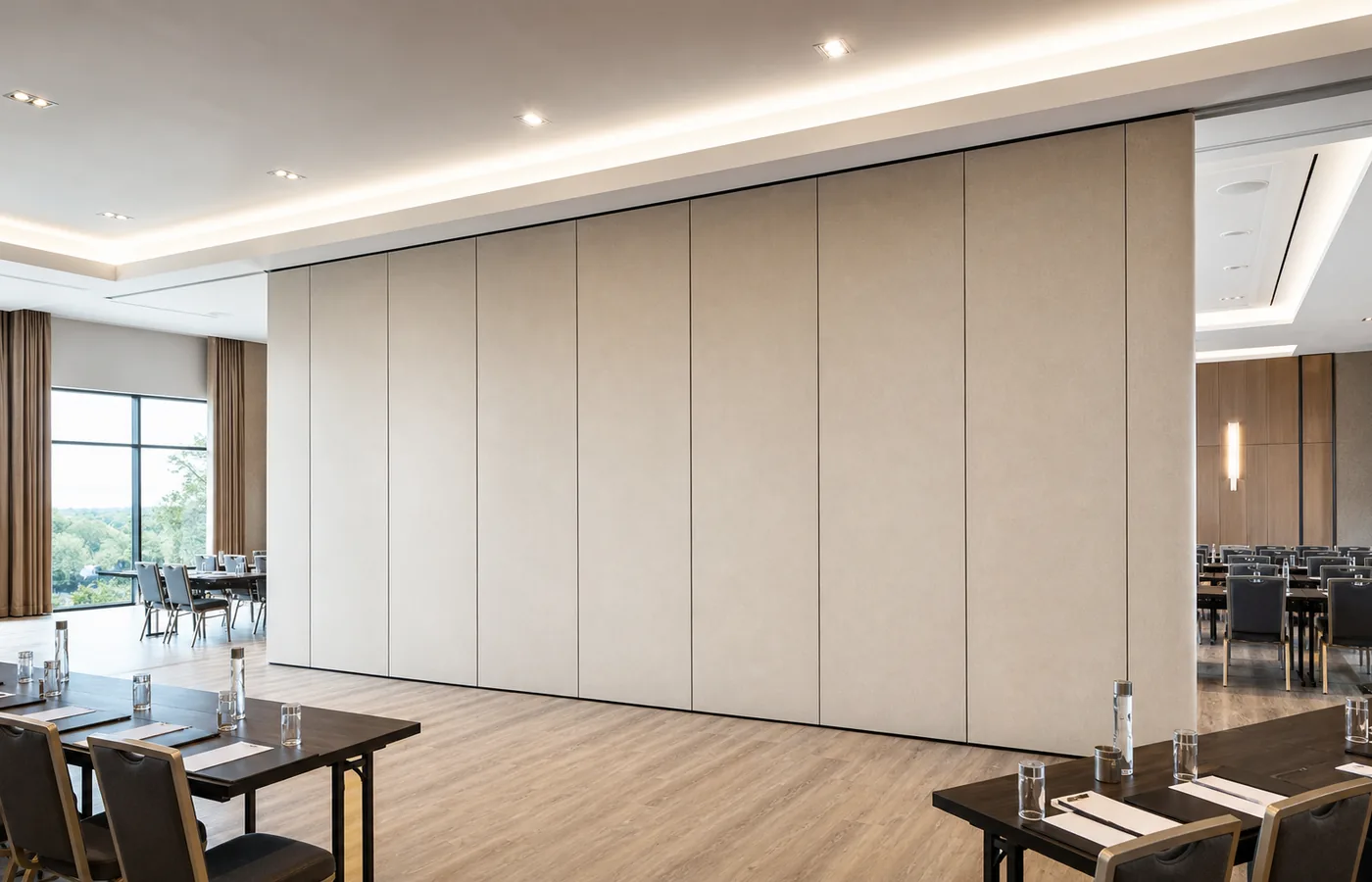
Movable partitions can be used wherever flexible space division, combination or reconfiguration is required; application examples are not limiting. A university auditorium manual operation split is one example among many.
EBUNGE has completed many types of hotel-related movable-partition projects. Ballrooms, wedding halls and multifunction halls are non-limiting examples. No customer names, locations, quantities, ratings, certifications or outcomes may be inferred from that statement.
For education projects, the same top-hung principle can be considered when a room needs to change between schedules. The exact route, junction arrangement, continuous overhead path and parking position must be confirmed from the coordinated project drawings.
Buyer inputs and drawing approvals
A university auditorium manual operation split depends on coordinated information. The project team should gather room layout, intended division lines, parking expectations and finish direction before drawings are approved.
Panel parking style can be customized to the customer layout and project requirements, subject to coordinated drawings. Finish materials can be customized, and cleaning and maintenance methods vary with the selected finish. These are the confirmed customization points.
The following table summarizes inputs and the drawing items they inform.
| Buyer input | Drawing item to confirm |
|---|---|
| Intended division line | Overhead path and junction arrangement |
| Parking preference | Parking position and stacking area coordination |
| Finish direction | Finish selection and care method |
| Room layout | Track, support and panel layout |
The exact route, junction arrangement, continuous overhead path and parking position must be confirmed from the coordinated project drawings.
How to review a university auditorium manual operation split proposal
Review the proposal against the confirmed top-hung principle. Check that the floor is not cut or damaged for a floor track and remains physically uninterrupted by the maintained EBUNGE top-hung system. Then review parking, finish and care items.
Ask for coordinated drawings that show the overhead path and parking position. Confirm that panel parking style matches the customer layout and project requirements. Confirm that finish materials and care methods are stated for the selected finish.
For engineering details outside confirmed facts, use only this boundary: The exact route, junction arrangement, continuous overhead path and parking position must be confirmed from the coordinated project drawings.
Useful internal references include movable partition wall information and project examples for general context.
FAQ: university auditorium manual operation split
Does a university auditorium manual operation split require a floor track?
No continuous floor running track is required for the confirmed EBUNGE top-hung system. The floor is not cut or damaged for a floor track and remains physically uninterrupted by the maintained EBUNGE top-hung system. The exact route, junction arrangement, continuous overhead path and parking position must be confirmed from the coordinated project drawings.
Can panel parking be customized for an auditorium?
Panel parking style can be customized to the customer layout and project requirements, subject to coordinated drawings. A suitable approved parking arrangement can use the stacking area more compactly and coordinate with the space design. The exact track, support and panel layout still require project drawings.
Are finish materials customizable?
Finish materials can be customized, and cleaning and maintenance methods vary with the selected finish. The project team should confirm the chosen finish and the corresponding care method. This article does not claim a cleaning outcome or a universal maintenance method.
Where can movable partitions be used?
Movable partitions can be used wherever flexible space division, combination or reconfiguration is required; application examples are not limiting. EBUNGE has completed many types of hotel-related movable-partition projects, with ballrooms, wedding halls and multifunction halls as non-limiting examples. No customer names, locations, quantities, ratings, certifications or outcomes may be inferred.
What must be confirmed from project drawings?
The exact route, junction arrangement, continuous overhead path and parking position must be confirmed from the coordinated project drawings. The exact track, support and panel layout also require project drawings. This article does not prescribe a universal installation sequence or operating procedure.
Planning summary
A university auditorium manual operation split is a planning exercise in top-hung support, uninterrupted floor use, parking coordination and finish care. The confirmed facts support a top-hung EBUNGE system with no continuous floor running track or operating hardware in the finished floor along the partition line.
For each project, confirm the overhead path, parking position and finish direction through coordinated drawings. Use the allowed internal links for general product and project context, and treat all application examples as non-limiting.
Continue Exploring
More Operable Wall System Guides
- Newer guideUniversity Training Partition Stacking Pocket Door Swing Check
- Earlier guideUniversity Training Operable Wall Track: Ceiling Simulators Coordination
- Related guidePhase Operable Wall Work When a Renovation Adds a New Wing
- Related guideRoom Scheduling Rules That Decide When an Operable Wall Stays Open