
Quick project answer
Restaurant layouts often need to shift between intimate private dining and a lively open kitchen atmosphere. Movable partitions can support that flexibility, but the choice of system affects how the floor performs and how the space is planned. This article examines top-hung operation, floor continuity, parking strategy and finish coordination for restaurant partition seals private dining and open kitchen noise separation.
Why Restaurant Partition Seals Private Dining and Open Kitchen Zones Differently
Private dining areas usually require a defined boundary that can be closed for events and opened for daily service. Open kitchen zones bring activity, movement and equipment noise into the guest area. A movable partition can help manage these conditions by dividing or combining spaces as needed.
The term restaurant partition seals private dining often refers to the interface between panels and adjacent building elements. In practice, the performance of that interface depends on the selected system, the finish and the coordinated design. EBUNGE movable partitions are top-hung and do not require a continuous floor track along the partition line.
Because the floor is not cut or damaged for a floor track, the finished floor remains physically uninterrupted. This characteristic can be relevant when a restaurant wants to preserve flooring materials or maintain a clean transition between dining and kitchen zones.
The Top-Hung Principle and Its Effect on the Floor
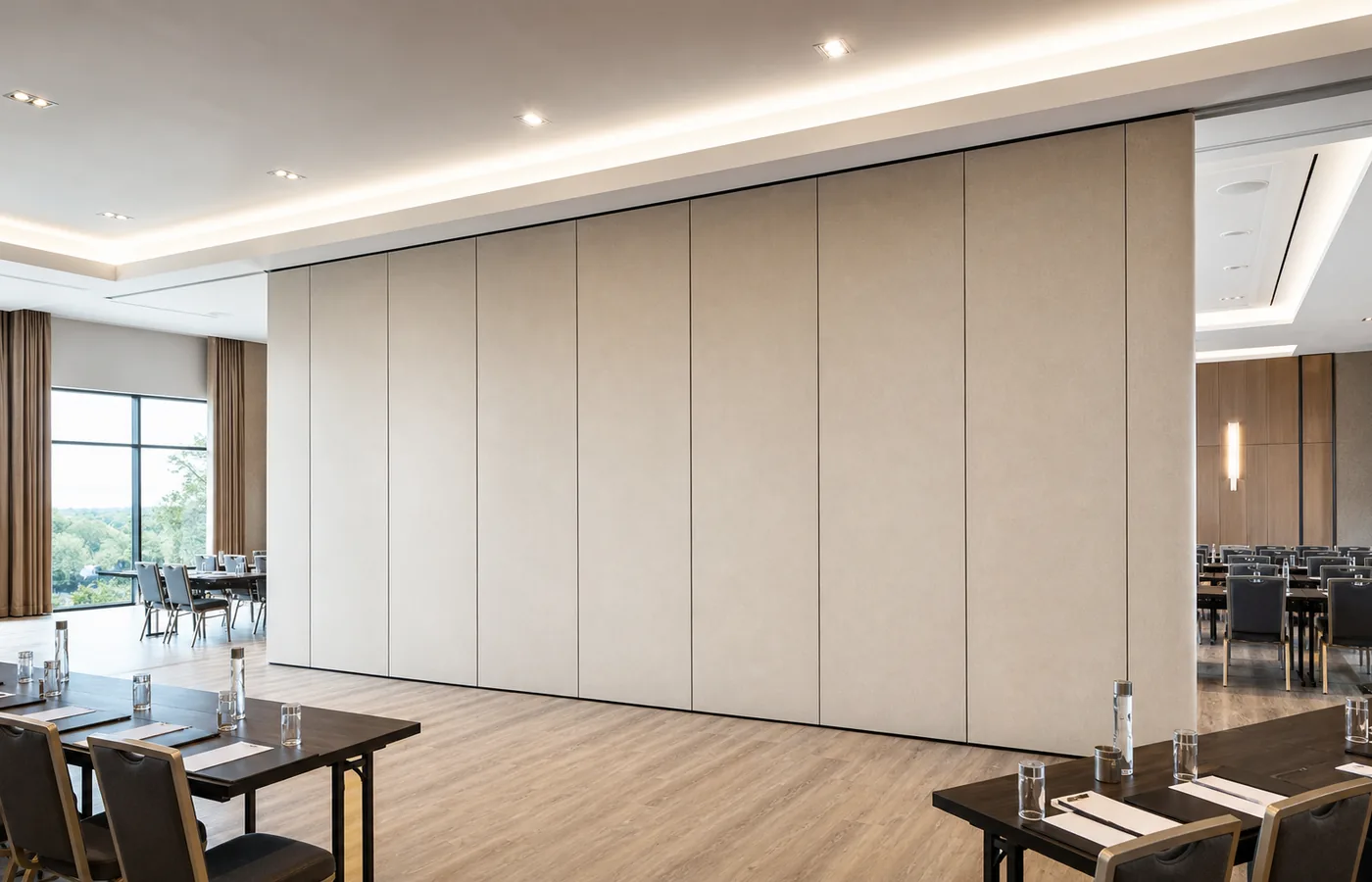
In a top-hung system, the panels are supported from an overhead track rather than from a floor-mounted track. EBUNGE movable partitions follow this principle. The absence of a continuous floor running track means there is no operating hardware embedded in the finished floor along the partition line.
The suitability of each route and parking arrangement depends on the approved layout, circulation, ceiling interfaces and operating sequence. The floor remains physically uninterrupted by the maintained EBUNGE top-hung system. This does not mean the floor is never touched during installation, but the maintained system does not rely on a floor track.
When specifying restaurant partition seals private dining, designers should confirm how the top-hung panels meet adjacent walls, columns or other building elements. The exact route, junction arrangement, continuous overhead path and parking position must be confirmed from the coordinated project drawings.
Planning Parking for Movable Partitions in Restaurants
Panel parking style can be customized to the customer layout and project requirements, subject to coordinated drawings. A suitable approved parking arrangement can use the stacking area more compactly and coordinate with the space design. The exact track, support and panel layout still require project drawings.
In a restaurant, parking location affects circulation, service routes and the visual openness of the dining room. Planners may consider whether panels stack near a wall, in a dedicated recess or in another coordinated area. The goal is to keep the parking arrangement consistent with the overall space plan.
Because restaurant partition seals private dining and open kitchen noise separation often involve multiple zones, parking should be reviewed alongside the partition layout. The exact route, junction arrangement, continuous overhead path and parking position must be confirmed from the coordinated project drawings.
Finish and Care Coordination for Restaurant Environments
Finish materials can be customized, and cleaning and maintenance methods vary with the selected finish. Restaurants may choose finishes that align with interior design, durability expectations and cleaning routines. The appropriate care method depends on the finish selected for each project.
When planning restaurant partition seals private dining, the finish choice can influence how the partition integrates with the surrounding decor. It can also affect how staff approach routine cleaning. Because methods vary by finish, the project team should confirm care instructions for the specific materials selected.
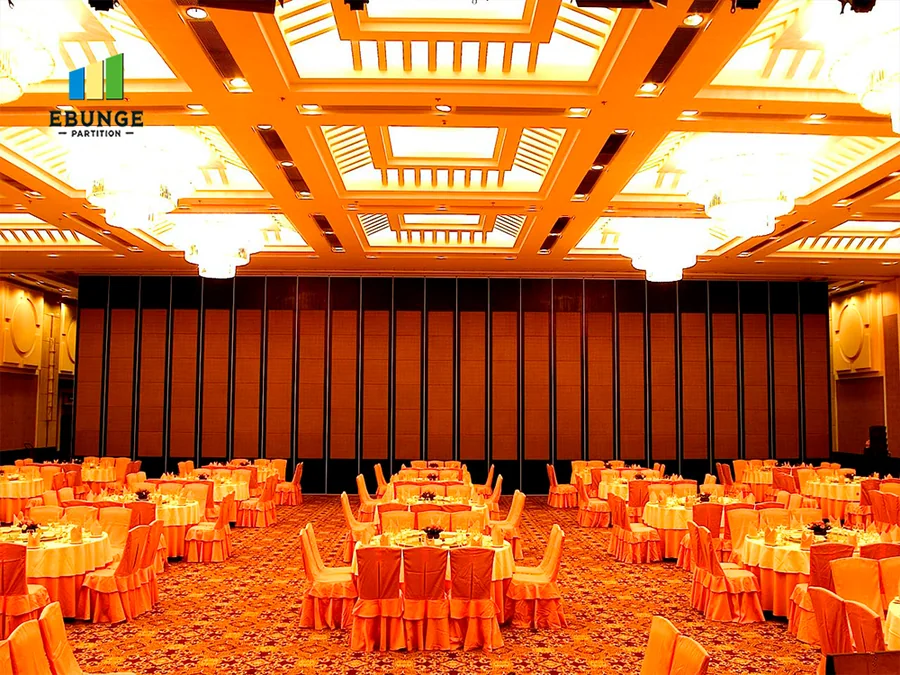
EBUNGE has completed many types of hotel-related movable-partition projects. Ballrooms, wedding halls and multifunction halls are non-limiting examples. These project types show that movable partitions can be used wherever flexible space division, combination or reconfiguration is required.
Non-Limiting Applications for Movable Partitions
Movable partitions can be used wherever flexible space division, combination or reconfiguration is required. Application examples are not limiting. In a restaurant context, this might include separating a private dining room from the main floor or creating a flexible event area adjacent to an open kitchen.
The same top-hung principle applies across these uses. The floor remains physically uninterrupted by the maintained EBUNGE top-hung system. This can be an advantage when the flooring is continuous or when a floor track would interfere with the design intent.
For projects that involve restaurant partition seals private dining, the partition layout should be developed with the overall operational flow in mind. The exact route, junction arrangement, continuous overhead path and parking position must be confirmed from the coordinated project drawings.
Buyer Inputs and Drawing Approvals
Successful partition projects depend on clear buyer inputs and coordinated drawings. The project team should provide information about the space, the desired division, the parking area and the finish direction. These inputs help define the system configuration.
Panel parking style can be customized to the customer layout and project requirements, subject to coordinated drawings. A suitable approved parking arrangement can use the stacking area more compactly and coordinate with the space design. The exact track, support and panel layout still require project drawings.
Finish materials can be customized, and cleaning and maintenance methods vary with the selected finish. Buyers should confirm finish selections and care expectations during the drawing review stage. This helps align the partition with restaurant operations.
For restaurant partition seals private dining and open kitchen noise separation, the drawing approval process is where the overhead path, parking position and junction details are resolved. The exact route, junction arrangement, continuous overhead path and parking position must be confirmed from the coordinated project drawings.
Comparing Private Dining and Open Kitchen Considerations

| Consideration | Private Dining Focus | Open Kitchen Focus |
|---|---|---|
| Primary need | Defined, closable room | Flexible separation from activity |
| Floor impact | Uninterrupted floor preferred | Uninterrupted floor preferred |
| Parking | Coordinated with dining layout | Coordinated with service routes |
| Finish | Customizable to interior | Customizable to environment |
| Care | Varies with selected finish | Varies with selected finish |
This comparison is illustrative and not a specification. Each restaurant project requires its own coordinated drawings. The exact route, junction arrangement, continuous overhead path and parking position must be confirmed from the coordinated project drawings.
Key Planning Steps for Restaurant Partition Projects
- Define the zones that need flexible division, such as private dining and open kitchen areas.
- Confirm that a top-hung system is suitable for the overhead conditions, subject to project drawings.
- Review parking options with the project team and coordinate the stacking area with the layout.
- Select finish materials and confirm the corresponding cleaning and maintenance methods.
- Approve coordinated drawings that show the route, junction arrangement, overhead path and parking position.
These steps are general and do not replace project-specific engineering. The exact route, junction arrangement, continuous overhead path and parking position must be confirmed from the coordinated project drawings.
Frequently Asked Questions
For further context, review related project guidance before preparing the coordinated project brief.
What does restaurant partition seals private dining mean in practice?
It refers to the interface between movable partition panels and adjacent building elements in a restaurant setting. The exact details depend on the selected system and the coordinated project drawings.
Do EBUNGE movable partitions require a floor track?
No. The EBUNGE movable partition system is top-hung and has no continuous floor running track or operating hardware in the finished floor along the partition line. The floor is not cut or damaged for a floor track.
Can the floor remain uninterrupted with a top-hung partition?
Yes. The floor remains physically uninterrupted by the maintained EBUNGE top-hung system. This can help preserve the finished floor in dining and kitchen areas.
How is panel parking planned for a restaurant?
Panel parking style can be customized to the customer layout and project requirements, subject to coordinated drawings. A suitable approved parking arrangement can use the stacking area more compactly and coordinate with the space design.
Can finishes be customized for restaurant interiors?
Yes. Finish materials can be customized, and cleaning and maintenance methods vary with the selected finish. The project team should confirm care instructions for the chosen finish.
Where can I see examples of movable partition projects?
EBUNGE has completed many types of hotel-related movable-partition projects. Ballrooms, wedding halls and multifunction halls are non-limiting examples. You can review projects for general context.
Coordinating Restaurant Partition Seals Private Dining with Project Drawings
Every restaurant has unique spatial conditions, operational priorities and design goals. A top-hung movable partition can support flexible division while keeping the floor physically uninterrupted. The exact route, junction arrangement, continuous overhead path and parking position must be confirmed from the coordinated project drawings.
The exact overhead route and support arrangement must be confirmed by the responsible project team from coordinated drawings.. Project-specific questions should be directed to the EBUNGE team during the drawing review process.
Continue Exploring
More Acoustic Partition Guides
- Newer guideRestaurant Operable Wall Seals: Walk-In Cooler Vibration
- Earlier guideRestaurant Function Room Partition Seals: Grease Interface Detailing
- Related guideAcoustic Partition Ceiling Interface Zone Confirmation
- Related guideWho Confirms Ceiling Grid Line Before Acoustic Partition Track