
Quick project answer
Contractor tender documents manual partition clauses set the basis on which every bidder prices the same scope. When the requirement is a movable partition, the tender text should describe how the system is supported, how the finished floor is treated and how panels are parked. Clear wording at tender stage reduces the number of clarifications raised later. This article outlines the points that belong in contractor tender documents manual partition sections.
Why the top-hung principle belongs in the tender
The EBUNGE movable partition system is top-hung. That single fact shapes much of the tender wording, because it determines where the operating load is carried and what happens at floor level. Bidders need to know that the partition is suspended from an overhead structure rather than supported from the floor.
Stating the top-hung principle early in contractor tender documents manual partition sections prevents assumptions about floor-mounted alternatives. It also tells bidders which interfaces to price, such as the overhead support and the panel parking zone, rather than a floor track that will not exist.
The exact route, junction arrangement, continuous overhead path and parking position must be confirmed from the coordinated project drawings.
Describing the physically uninterrupted floor
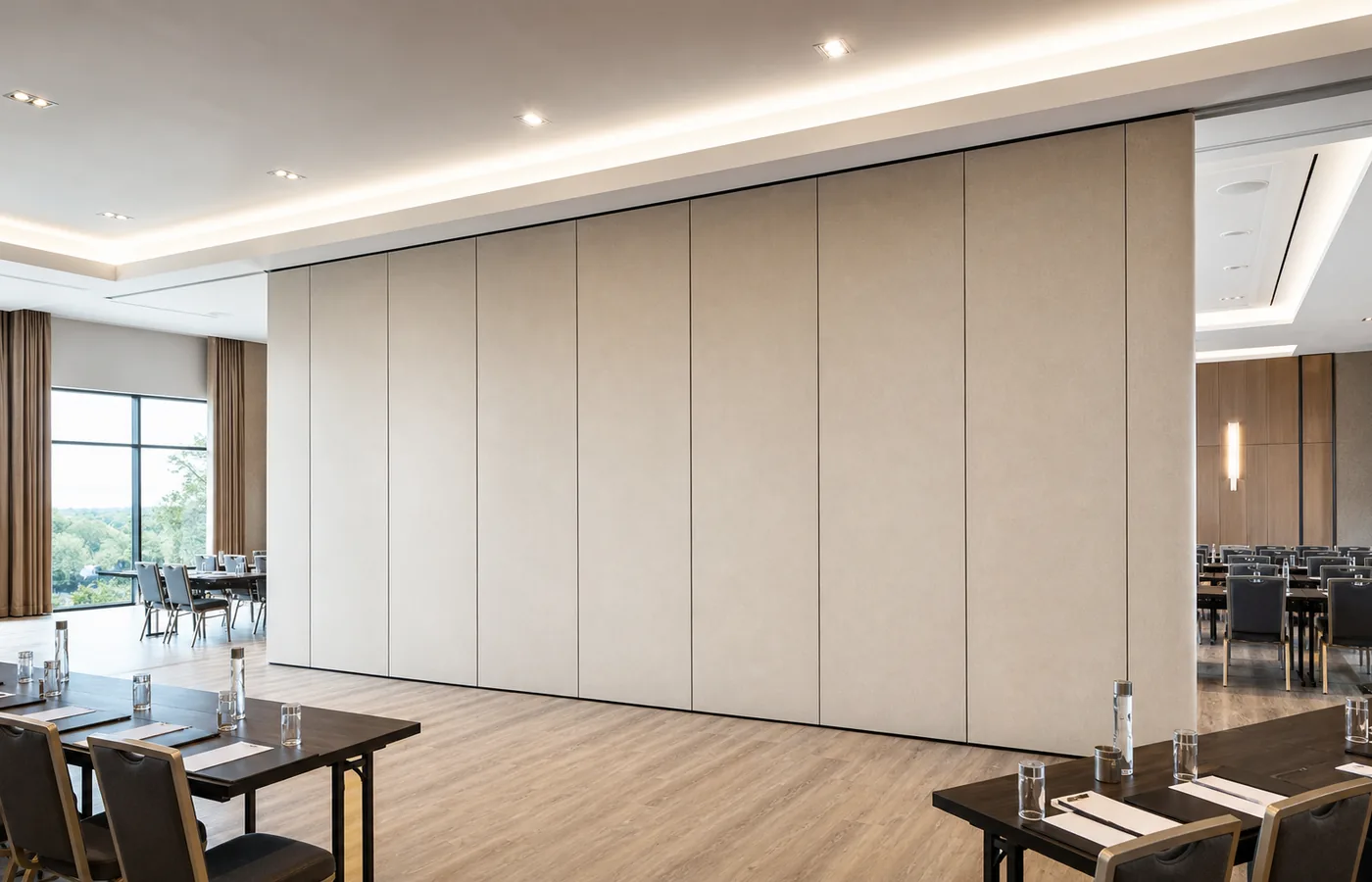
With the EBUNGE top-hung system there is no continuous floor running track and no operating hardware in the finished floor along the partition line. The floor is not cut or damaged for a floor track and remains physically uninterrupted by the maintained system.
This matters in contractor tender documents manual partition text because flooring finishes, underfloor services and handover cleaning are all affected. A tender that leaves the floor condition open may attract allowances that are not required, or omit protection measures that are.
Bidders should be asked to confirm that their proposal keeps the finished floor along the partition line free of a continuous running track. Any local floor interface should be described only where the coordinated drawings show it.
Parking planning and stacking area coordination
Panel parking style can be customized to the customer layout and project requirements, subject to coordinated drawings. A suitable approved parking arrangement can use the stacking area more compactly and coordinate with the space design.
Contractor tender documents manual partition sections should therefore identify the intended parking zone and note that the arrangement is subject to approval. The exact track, support and panel layout still require project drawings.
Parking decisions interact with adjacent finishes, door positions and furniture layouts. Raising them at tender stage lets bidders price the stacking area consistently instead of assuming a default arrangement.
Finish selection and care coordination
Finish materials can be customized, and cleaning and maintenance methods vary with the selected finish. Tender documents should record that finishes are a project-specific choice rather than a fixed catalogue item.
Because care methods follow the finish, the tender can require the successful bidder to align cleaning instructions with the finish finally selected. The suitability of each route and parking arrangement depends on the approved layout, circulation, ceiling interfaces and operating sequence.
Where finishes are still being chosen, the tender can note that the partition scope proceeds once selections are confirmed. That keeps contractor tender documents manual partition wording accurate while design continues.
Applications that are not limiting
Movable partitions can be used wherever flexible space division, combination or reconfiguration is required. Application examples are not limiting, so tender text should avoid narrowing the scope to a single room type.
EBUNGE has completed many types of hotel-related movable-partition projects. Ballrooms, wedding halls and multifunction halls are non-limiting examples, and no customer names, locations, quantities, ratings, certifications or outcomes may be inferred from them.
For contractor tender documents manual partition clauses, the useful point is that the requirement is defined by function and layout, not by a fixed list of room names.
Buyer inputs to request before pricing
A tender pack is stronger when it asks bidders for defined inputs rather than open assumptions. The list below covers the items that most often change how a top-hung partition is priced and coordinated.
- Confirmation that the proposal is top-hung with no continuous floor running track along the partition line.
- A description of the proposed parking arrangement and the stacking area it occupies.
- The finish direction under consideration and any care requirements that follow from it.
- Reference to the coordinated drawings that fix the overhead path and parking position.
- Any interfaces with adjacent finishes, openings or furniture that affect the stacking zone.
These inputs keep bids comparable and give the evaluation team a consistent basis for review.
Drawing approvals and information flow
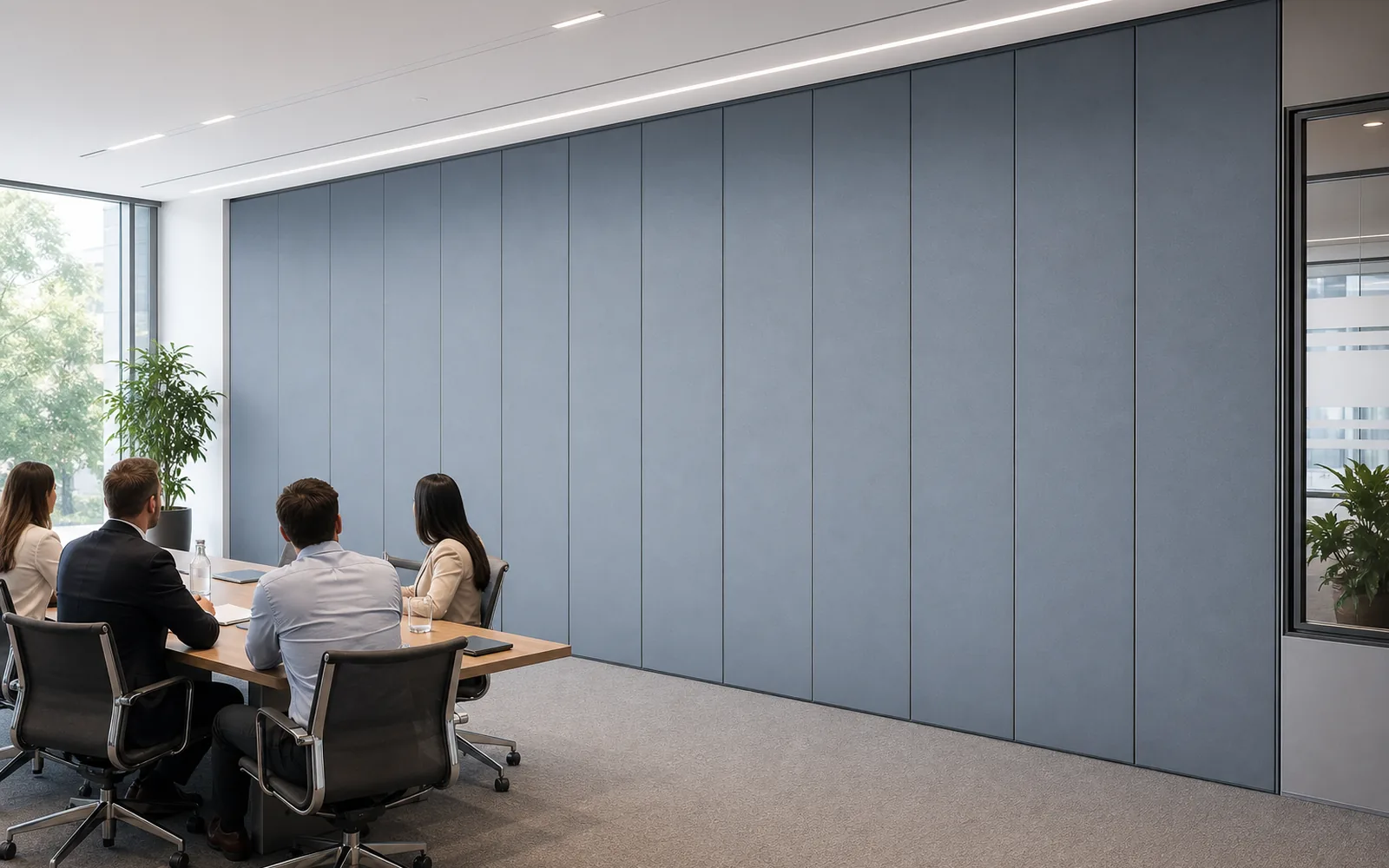
Contractor tender documents manual partition requirements should state that the track, support and panel layout are confirmed through coordinated project drawings. Approval of those drawings is a normal part of the process and should be named in the tender.
The sequence below shows how information typically moves from tender to coordinated design. It is a documentation flow, not an installation method.
- Tender documents state the top-hung principle and the uninterrupted floor condition.
- Bidders confirm their understanding and identify any information gaps.
- Coordinated drawings are developed to fix the overhead path and parking position.
- Finish selections are confirmed and care guidance is aligned with them.
- Approved drawings form the basis for the agreed scope.
The exact route, junction arrangement, continuous overhead path and parking position must be confirmed from the coordinated project drawings.
Comparison table for tender evaluation
The table below summarises how a tender response can be checked against the stated requirement. It is intended for evaluation notes rather than as a specification.
| Tender point | What to look for |
|---|---|
| Support principle | Proposal reflects a top-hung system. |
| Floor condition | No continuous floor running track along the partition line. |
| Parking arrangement | Parking style described and subject to coordinated drawings. |
| Finish and care | Finish treated as customizable with finish-specific care. |
| Drawing basis | Track, support and panel layout confirmed from coordinated drawings. |
Common tender wording pitfalls
Vague wording creates avoidable queries. The points below are frequent sources of clarification in contractor tender documents manual partition sections.
Describe the system by its support principle and its floor condition, then let the coordinated drawings fix the route and parking position.
Another pitfall is treating finishes as fixed when they are customizable. A third is describing parking as settled before the stacking area has been coordinated with the wider space design.
Keeping the wording factual helps bidders respond on a common basis and helps the evaluation team compare like with like.
Frequently asked questions
What should contractor tender documents manual partition clauses say about floor tracks?
They should state that the EBUNGE system is top-hung and has no continuous floor running track or operating hardware in the finished floor along the partition line, so the floor is not cut or damaged for a floor track.
Can the parking arrangement be fixed at tender stage?
Parking style can be customized to the customer layout and project requirements, subject to coordinated drawings. The exact track, support and panel layout still require project drawings.
Are finishes selected before the tender is issued?
Finish materials can be customized, and cleaning and maintenance methods vary with the selected finish. The tender can note that finishes are confirmed as the project develops.
Do movable partitions only suit hotel ballrooms?
No. Movable partitions can be used wherever flexible space division, combination or reconfiguration is required, and application examples are not limiting. EBUNGE has completed many types of hotel-related movable-partition projects.
What drawing information confirms the overhead path?
The exact route, junction arrangement, continuous overhead path and parking position must be confirmed from the coordinated project drawings. Approval of those drawings forms part of the documented scope.
Where can bidders see related partition work?
Bidders can review the products and projects pages for background on the system family and completed work.
Summary for tender authors
Finish selection and care follow the chosen material.
Keeping those points explicit gives bidders a consistent basis and gives the evaluation team a clear checklist. The exact route, junction arrangement, continuous overhead path and parking position must be confirmed from the coordinated project drawings.
Continue Exploring
More Cost and Planning Guides
- Newer guideHow to Coordinate Tender Handover for Partition Track Cleaning Access
- Earlier guideHow to Plan Tender Handover for Partition Finishes Touch-Up Kits
- Related guideReview a Movable Partition Tender for Ambiguous Stacking Pocket
- Related guideReading a Movable Partition Tender for Hidden Interface Assumptions