
Why the Scoreboard Controller Panel Changes Partition Seal Planning
In a sports hall, a movable partition often divides the space for training, events, or matches. When a wall-mounted scoreboard controller panel sits on the partition line, the seal between the panel and the wall becomes a coordination point. This article compares sports hall partition seals scoreboard controller panel approaches, focusing on what project teams must confirm before specifying.
EBUNGE movable partitions are top-hung and move without a floor track, which simplifies the floor surface. However, the wall interface—especially around a controller panel—requires careful review. The panel may protrude, have cables, or need access for operation. Each factor influences the seal design.
This guide is not a product manual. It is a comparison framework for architects, contractors, and facility owners. We will explain the role of seals, the types of interfaces, and the evidence needed to make informed decisions. The suitability of each route and parking arrangement depends on the approved layout, circulation, ceiling interfaces and operating sequence.
Understanding Partition Seals in Sports Hall Contexts
In a sports hall, seals also manage light, dust, and sometimes ball impact. But seals are not a single component; they are a system of perimeter and inter-panel closures.
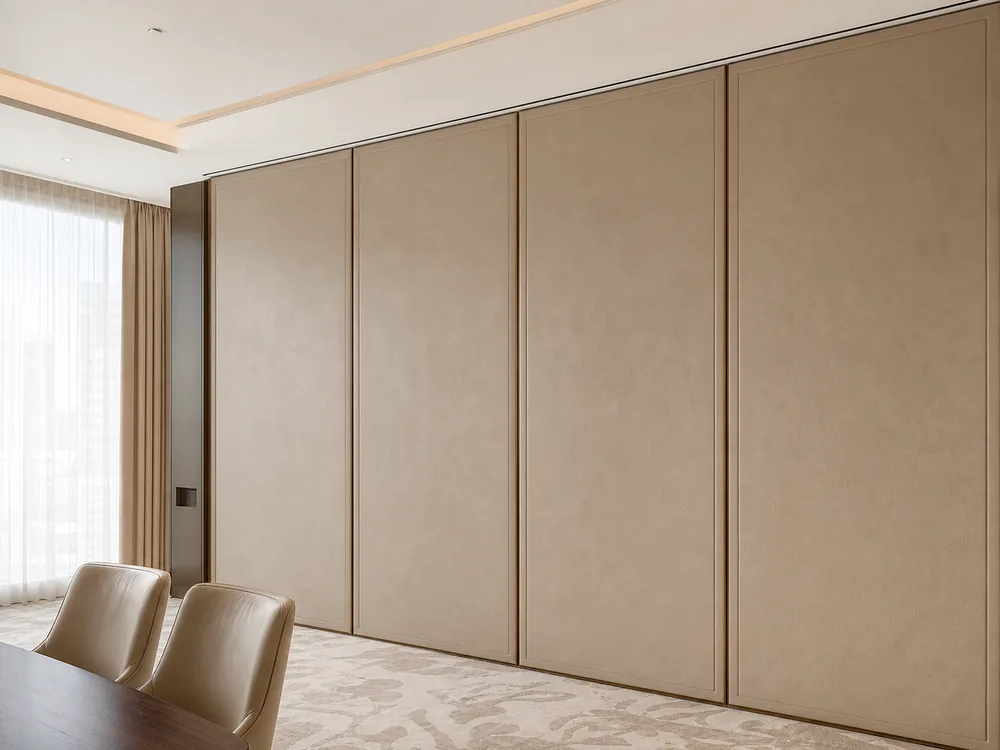
For a wall-mounted scoreboard controller panel, the seal must accommodate the panel’s presence without compromising the partition’s movement or parking. The controller may be flush or recessed, but often it protrudes slightly. This protrusion can create a gap that a standard vertical seal cannot bridge.
These are laboratory measurements of sound transmission loss. They do not directly translate to a decibel reduction in a real room. Many factors affect real-world performance, including flanking paths, installation quality, and the seal integrity. Instead, focus on the sealing strategy and its limitations.
Types of Seals at the Wall Interface
When a partition panel meets a wall, the vertical edge typically has a seal. This can be a compression seal, a drop seal, or a combination.
Compression Seals
Compression seals are common on the vertical edges of movable panels. They are often made of a flexible material that compresses against the wall when the panel is locked in place. They are effective for flat, even surfaces. However, a wall-mounted scoreboard controller panel may have an uneven surface, such as a raised bezel or a cable outlet. In such cases, a standard compression seal may not fully close the gap.
Share the opening dimensions, room layout and intended operating sequence for review.
Drop Seals
Drop seals are typically at the bottom of the panel, but they can also be used at the top or sides in special cases. They lower into place when the panel is deployed. For a wall interface, a drop seal might be used if the gap is larger or if the wall has an irregular profile. But drop seals require a clear path and may not be suitable if the controller panel is in the way.
Custom-Engineered Seals
For unique situations like a controller panel, a custom seal may be necessary. This could involve a gasket that wraps around the controller or a seal that is cut to fit. Custom seals require precise measurements and coordination. EBUNGE can review the layout and discuss options, but any custom solution must be confirmed with project-specific drawings.
Comparing Seal Approaches for Controller Panel Interfaces
When comparing seal approaches, consider the following criteria:
- Gap closure: How well does the seal close the gap around the controller?
- Accessibility: Can the controller still be operated and maintained?
- Movement: Does the seal interfere with the panel’s travel or parking?
- Acoustic contribution: Does the seal reduce sound leakage without overpromising?
- Durability: Will the seal withstand repeated use in a sports environment?
The comparison must be based on the specific controller panel dimensions, the wall construction, and the partition’s movement path. For example, a flush controller may allow a standard compression seal, while a protruding controller may require a custom block-out or a seal that is set back.
Coordination with Wall-Mounted Equipment
The scoreboard controller panel is not the only wall-mounted equipment in a sports hall. There may be sockets, switches, or speakers. Each item on the partition line requires coordination. The project team must provide detailed drawings showing the location and size of every wall-mounted element.
EBUNGE reviews straight, turning, and stacking routes from the layout. If a controller panel is in the stacking area, it may affect the parking depth. If it is on the travel path, it could obstruct the panel.
In some cases, it may be possible to relocate the controller panel to avoid the partition line. But if relocation is not feasible, the seal design must accommodate the panel. Discuss the options with EBUNGE and provide the controller’s technical specifications.
Acoustic Considerations and Flanking Paths
It is about the entire assembly, including the wall, the ceiling, and the floor. A wall-mounted scoreboard controller panel can create a flanking path if it penetrates the wall or if the seal is incomplete. Visible references can support layout discussion but do not verify hidden construction or performance.
STC and Rw are ratings that describe the sound transmission loss of a partition in a laboratory. They are useful for comparing products, but they do not predict real-world performance.
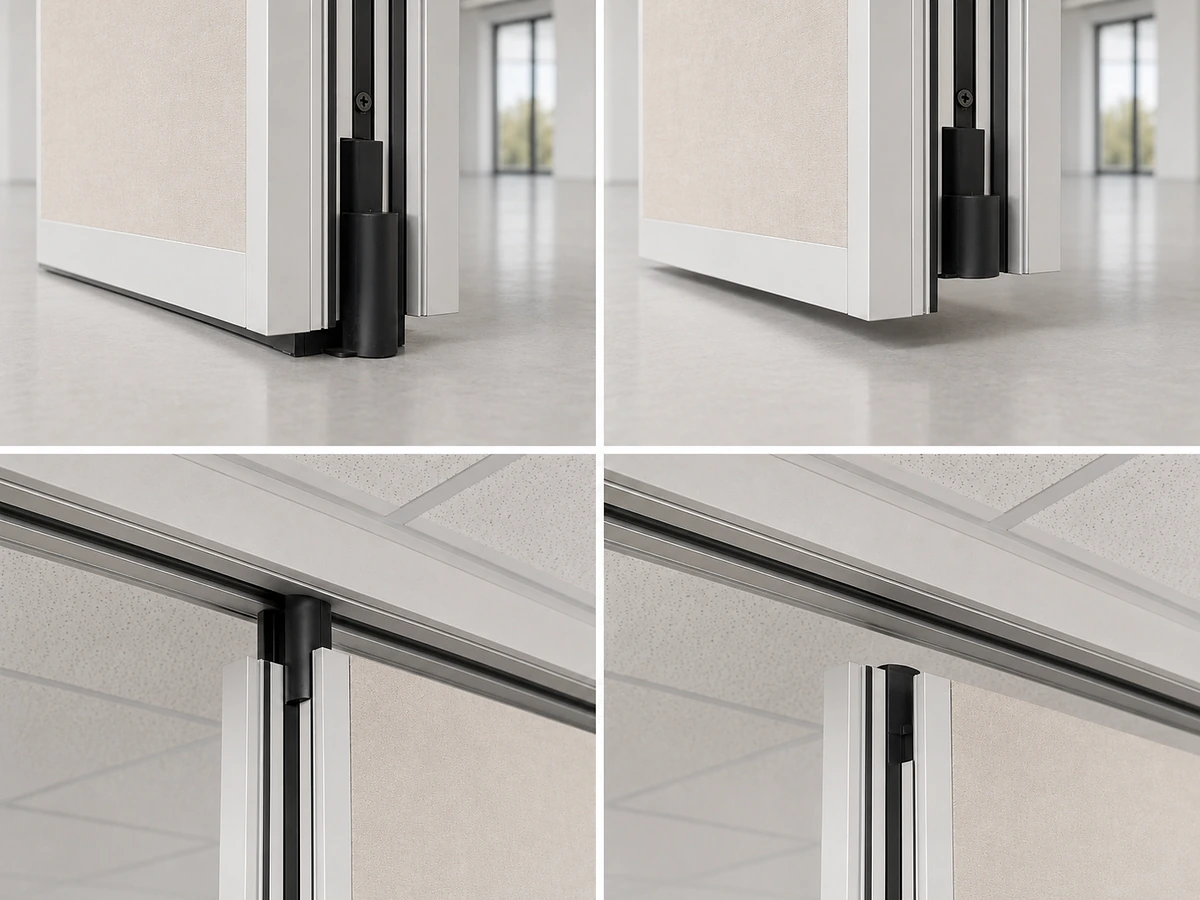
EBUNGE can explain seal concepts generically, but we do not invent test values.
Operational Access and Maintenance
The scoreboard controller panel must be accessible for operation and maintenance. If the partition seal covers the panel, it may be difficult to use. Some seals are fixed, while others are removable. The exact overhead route and support arrangement must be confirmed by the responsible project team from coordinated drawings.
Consider the frequency of access. If the controller is used daily, the seal must be easy to open and close. If it is rarely used, a more permanent seal might be acceptable. Also, consider the maintenance of the seal itself. Seals wear over time and may need replacement. Choose a design that allows for easy replacement without dismantling the partition.
EBUNGE panels are individually movable and can be parked at a planned stacking position. The stacking position should not interfere with the controller panel or its access. Review the layout to ensure that the controller remains accessible even when the partition is stacked.
Review the ceiling interface, panel route and stacking position together.
Project Documentation and Evidence
Every sports hall project is unique. The seal design for a scoreboard controller panel depends on the specific conditions. Provide EBUNGE with the following:
- Architectural drawings showing the partition line and the controller panel location.
- Technical specifications of the controller panel, including dimensions and mounting details.
- Operational requirements, such as access frequency.
EBUNGE will review the layout and discuss the sealing options. We can also discuss pass-door requirements if a door is needed in the partition. All configurations must be confirmed with project-specific support.
Do not assume that a standard seal will work. The controller panel may require a custom solution.
Finish Options and Their Impact on Seals
The partition finish can affect the seal design. EBUNGE offers laminate, melamine, fabric, leather, glass, and other approved surfaces. For example, fabric can be wrapped around a seal, while glass is rigid and may require a different seal profile.
In a sports hall, durability is important. A leather or laminate finish may be more resistant to impact. The seal is a separate component that must be chosen based on the gap and the movement.
When the partition is stacked, the finish may be visible. The stacking position should be planned to minimize wear and tear. EBUNGE can customize the parking style to the customer layout, but the design must be confirmed.
Frequently Asked Questions
What is the best seal for a wall-mounted scoreboard controller panel?
The optimal seal depends on the controller’s size, protrusion, and the partition’s movement. A compression seal may work for a flush panel, but a custom seal may be needed for a protruding one. EBUNGE can review your layout and recommend options.
Can a standard partition seal accommodate a controller panel?
Standard seals are designed for flat, even surfaces. A controller panel may have a raised bezel or cables that create an uneven surface. In such cases, a custom seal or a modified interface is required.
Does the controller panel affect the acoustic performance of the partition?
Yes, it can. Any gap or penetration in the partition line can create a flanking path for sound. The seal must be designed to minimize this.
How do I ensure the controller remains accessible with the partition in place?
Plan the partition layout so that the controller is not in the stacking area or the travel path. If the controller must be on the partition line, consider a removable seal or a design that allows access. Discuss the access frequency with EBUNGE.

What information does EBUNGE need to design a seal for a controller panel?
EBUNGE needs the controller’s dimensions, mounting details, and the wall construction. This information allows EBUNGE to review the sealing options and provide project-specific guidance.
Conclusion and Next Steps
Comparing sports hall partition seals for a wall-mounted scoreboard controller panel requires a systematic approach. The seal must close the gap, allow access, and not interfere with the partition’s movement. Every project requires a detailed review of the layout and the controller’s specifications.
EBUNGE movable partitions are top-hung and clear the floor, which is an advantage in sports halls. But the wall interface demands attention. Work with EBUNGE to review your project drawings and discuss the sealing options. We can also discuss pass-door requirements and other customizations.
To move forward, contact EBUNGE with your project details.
. You can also explore our project references to see how we have addressed similar challenges.
Continue Exploring
More Acoustic Partition Guides
- Newer guideHow to Plan Airport Conference Partition Seals Around Ceiling-Mounted PA Speaker Arrays
- Earlier guideWhy Community Hall Partition Seals Need Interface Detailing at Wall-Mounted Folding Table Racks
- Related guideHow to Coordinate Hotel Banquet Partition Seals with Ceiling-Mounted Rigging Point Access Panels
- Related guideWhat Pre-Installation Checks Matter for University Lecture Hall Partition Seals at Floor-Mounted Lectern Wells