
Quick answer: sports hall partition seals
Review the project drawings for sports hall partition seals.
Floor-mounted volleyball sleeves create a specific coordination problem for sports hall partition seals. The sleeves sit in the playing surface, while a top-hung movable partition crosses the opening without a continuous floor track. The suitability of each route and parking arrangement depends on the approved layout, circulation, ceiling interfaces and operating sequence. This guide sets out how project teams can approach sports hall partition seals volleyball sleeves as a drawing-review exercise rather than a product selection shortcut.
Start With the Sleeve Layout, Not the Seal Detail
Coordinate the current drawing set for sports hall partition seals.
The first useful drawing is the floor plan showing every sleeve, its cover or cap, and the intended partition line. Sleeves are usually installed for volleyball posts, so their positions are fixed by court geometry and playing requirements. The partition line must then be tested against those fixed points.

Ask whether any sleeve falls directly on the partition line, within the stacking zone, or close enough to affect the closing edge. A sleeve that sits under a panel when the room is open may be harmless. A sleeve that conflicts with the final closing panel or the park position is a layout issue that should be resolved before seals are discussed.
Information to collect before any seal review
- Dimensioned floor plan with sleeve centres, diameters and cover details.
- Partition line, opening width and required clear height.
- Intended stacking position and the space reserved for it.
- The exact route, junction arrangement, continuous overhead path and parking position must be confirmed from the coordinated project drawings.
- Court markings and any requirement to keep sleeves accessible when the hall is open.
Confirm the Overhead Route Before Detailing Seals
Record the drawing revision used for sports hall partition seals.
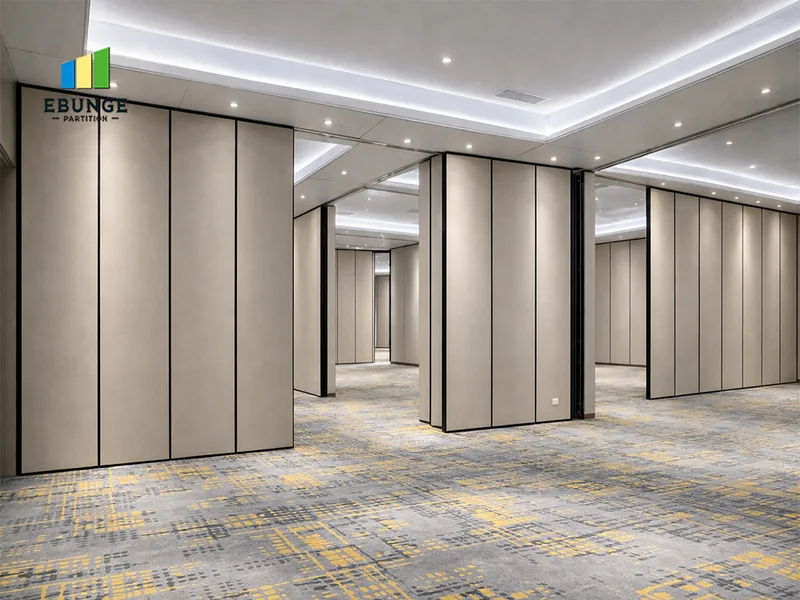
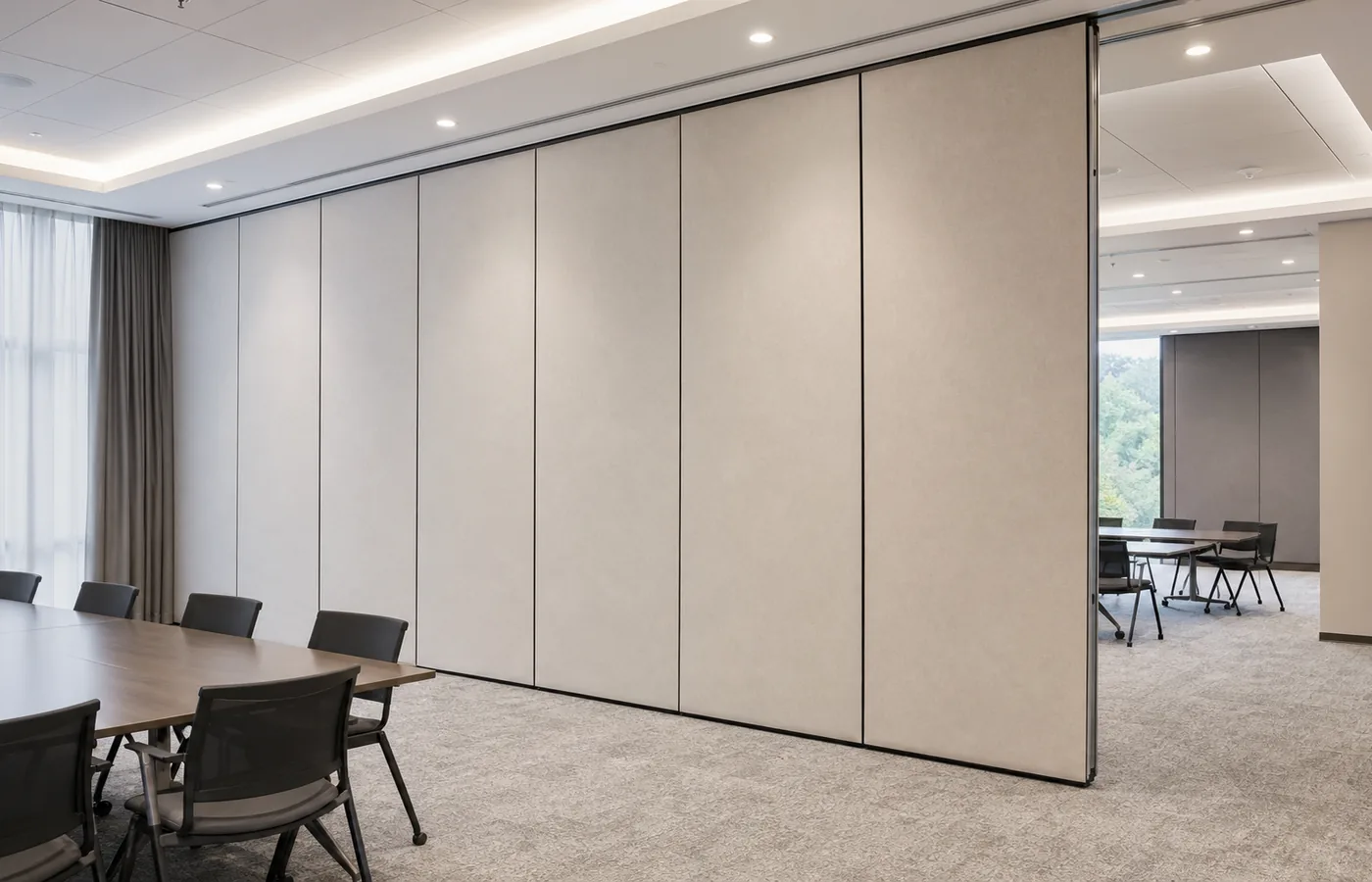
EBUNGE movable partition panels are individually movable and suspended from a top track. They cross the opening without a floor track and park at a planned stacking position. That principle matters here: the partition does not need a floor channel that would cross the volleyball sleeves, but it does need a continuous connected overhead route.
Straight, turning and stacking routes should be reviewed from the layout. If the partition must turn a corner or move into a recess, the route geometry affects where panels can travel and where they can rest. A gap in the overhead route is not something panels can cross, so any proposed path needs project-specific support review.
Evidence note: a visible track detail or finish sample does not confirm structural capacity, acoustic performance or suitability for a specific ceiling. Those items require coordinated project documentation and confirmation.
Treat Seals as Part of the Closing Interface
Keep project evidence attached to the sports hall partition seals review.
Seals are the components that address the interfaces around a closed partition: between panels, at the closing edge, at the head, and at the floor. In a sports hall, the floor interface is the one most affected by sleeves, because the partition must close across a surface that is not continuous in the usual sense.
STC and Rw are single-number ratings used to describe sound reduction in defined laboratory or field conditions.
Questions that belong in the seal review
- Where does the partition line meet the floor, and what is the floor finish at that point?
- Do any sleeves, covers or recesses interrupt that line?
- How is the closing edge intended to meet the adjacent wall or structure?
- What acoustic requirement applies to the room, and who is responsible for confirming it?
- Which drawings show the head, floor and closing interfaces together?
Coordinate Stacking So Sleeves Stay Usable
Parking style is customized to the customer layout and project requirements. In a sports hall, the stacking zone often competes with court run-off, seating, storage or equipment access. If panels park over or beside volleyball sleeves, the design should show how sleeves remain accessible and how covers are handled.
Compact stacking may be possible when the coordinated design permits it, but it should not be assumed. The stacking route, the number of panels and the available recess all interact. A plan that shows the open, closed and stacked conditions is more useful than a single partition elevation.
Choose Finishes With the Hall Environment in Mind
Confirmed finish options include laminate, melamine, fabric, leather, glass and other approved surfaces.
For a hall used for volleyball, consider how the partition looks when open and stacked, how it handles incidental contact, and whether the finish family suits the maintenance regime. Any cleaning compatibility or impact expectation should be confirmed for the specific project rather than inferred from a sample.
Use a Decision Checklist Before Issuing Drawings
| Decision | Drawing or document to check | Confirmation boundary |
|---|---|---|
| Sleeve positions | Dimensioned floor plan | Confirm no conflict with partition line or stacking zone |
| Overhead route | Reflected ceiling plan and structural coordination | Confirm continuous connected route and support |
| Stacking position | Open, closed and stacked plans | Confirm space, access and sleeve usability |
| Seal interfaces | Head, floor and closing-edge details | Confirm project-specific acoustic and dimensional requirements |
| Finish | Approved sample and schedule | Confirm suitability for the hall environment |
Pass-door requirements and project documentation can be discussed with the supplier. If a pass door is needed, its position should be shown on the same layout so it does not conflict with sleeves, court markings or the stacking zone.
Frequently Asked Questions
Can a top-hung partition cross floor-mounted volleyball sleeves?
Because the panels are suspended from a top track and cross the opening without a floor track, the partition line does not require a continuous floor channel. The exact overhead route and support arrangement must be confirmed by the responsible project team from coordinated drawings.
Do volleyball sleeves change the acoustic performance of the partition?
STC and Rw are conceptual ratings, not a direct decibel count.
Where should the partition stack if sleeves are near the wall?
The stacking position should be planned from the layout so sleeves remain accessible and covers can be managed. Parking style is customized to the project, and compact stacking may be possible when the coordinated design permits it.
What finish works best for a sports hall partition?
Laminate, melamine, fabric, leather, glass and other approved surfaces are confirmed options. The right choice depends on appearance, cleaning routines and the hall environment. Confirm suitability for the specific project before specifying.
Can a pass door be included in the partition?
Pass-door requirements can be discussed as part of the project documentation. The door position should be coordinated with the sleeve layout, court markings and the stacking zone.
What should be confirmed before fabrication?
Confirm the overhead route, support conditions, partition line, stacking position, seal interfaces, finish selection and any pass-door requirement.
Conclusion and Next Step
Planning partition seals around floor-mounted volleyball sleeves is mainly a coordination task. Fix the sleeve positions, prove the overhead route, show the stacking condition, and treat seals as part of the closing interface. Keep every performance claim tied to project-specific confirmation.
To review your layout, share the floor plan, ceiling coordination and intended stacking position through the contact page. .
Continue Exploring
More Acoustic Partition Guides
- Newer guideHealthcare Training Partition Seal Comparison: Utility Panel
- Earlier guideCommunity Hall Partition Seals at Wall Equipment Panels
- Related guideAcoustic Partition Ceiling Interface Zone Confirmation
- Related guideWho Confirms Ceiling Grid Line Before Acoustic Partition Track