
Quick answer: movable partition tender return
Review focus: movable partition tender return.
Movable partition tender return benchmarking is the discipline of comparing what each bidder offers against your own scope schedule, drawing set and coordination requirements. It is not a price-only exercise. A return may look complete while leaving route review, finish confirmation, pass-door coordination or documentation boundaries unresolved. This article sets out a structured way to read returns without inventing performance, cost or engineering conclusions that the evidence does not support.
Start With Your Own Scope Schedule, Not the Return
Project review term: movable partition tender return.
The baseline is your control document. Without it, every return is judged on its own narrative, and comparison becomes inconsistent. Confirm project-specific support, acoustic and dimensional requirements with qualified specialists before treating any schedule line as final.
What the Baseline Should Contain
- Room-by-room opening dimensions taken from the current drawing issue.
- Straight, turning and stacking routes shown as a reviewed path, not an assumption.
- Parking position and the space reserved for it.
- Finish direction: laminate, melamine, fabric, leather, glass or another approved surface.
- Pass-door needs and the documentation expected at each stage.
Read the Return Against Confirmed Product Facts
Coordination scope: movable partition tender return.
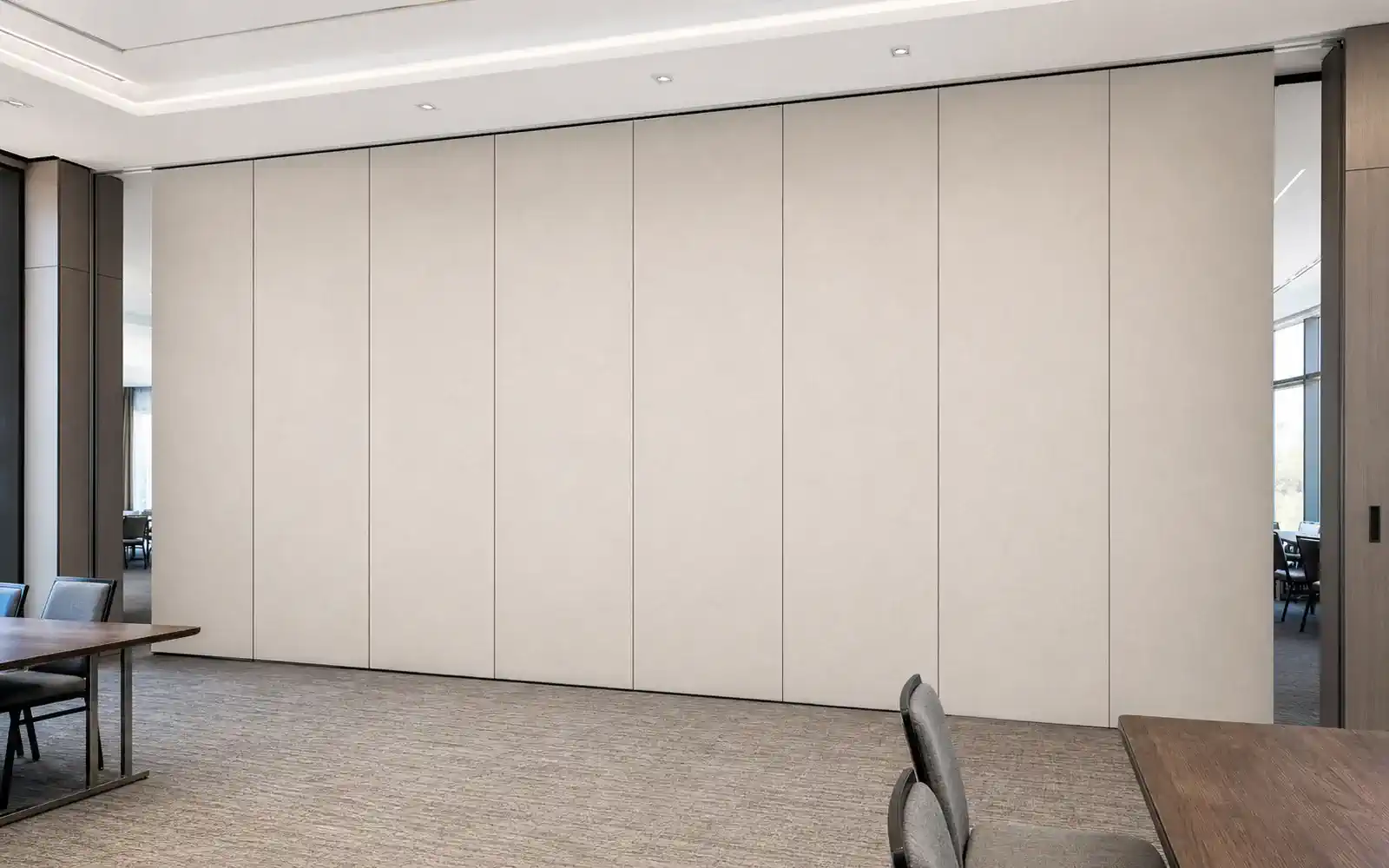
EBUNGE movable wall panels are individually movable, suspended from a top track, cross the opening without a floor track, and park at a planned stacking position. Those facts give you a stable reference for reading a return. The exact route, junction arrangement, continuous overhead path and parking position must be confirmed from the coordinated project drawings.
Straight, turning and stacking routes are reviewed from the layout. That means the return should connect its proposed route to your drawings, not simply assert that movement is possible. Where the route changes direction or the parking area is tight, ask how the layout was reviewed and what remains open.
Evidence Note
Do not derive acoustic, structural or durability performance from a visible finish, photograph or drawing. Comparative and absolute statements require matching evidence; otherwise they should be removed or replaced with an exact project-specific confirmation boundary.
Benchmark the Commercial and Technical Lines Separately
Checklist focus: movable partition tender return.

A common weakness in tender review is mixing commercial and technical evaluation into one score. Separate them. Technical lines cover route review, finish confirmation, pass-door coordination and documentation. Commercial lines cover what is included, what is excluded and what must be confirmed later. Keeping them apart prevents a low commercial line from hiding an unresolved technical question.
Where a return offers a finish, treat it as a finish option only. The suitability of each route and parking arrangement depends on the approved layout, circulation, ceiling interfaces and operating sequence. Those are separate project-specific questions.
Compact Comparison Table
| Benchmark Area | What to Look For | What Remains Project-Specific |
|---|---|---|
| Movement principle | Top-hung, individually movable panels, no floor track along the partition line | Support and overhead route review |
| Route | Straight, turning and stacking routes linked to the layout | Continuous connected overhead route and support |
| Parking | Planned stacking position identified | Space, layout and coordination |
| Finish | Named finish option from the approved list | Cleaning, durability and performance confirmation |
| Pass door | Requirement stated and discussed | Dimensional and coordination review |
| Documentation | Scope of documents offered | Project-specific content and issue status |
Use a Numbered Process for Each Return
Review focus: movable partition tender return.
- Check the return against your baseline schedule line by line.
- Mark every statement that needs project-specific evidence.
- Confirm the movement principle matches top-hung, floor-track-free operation.
- Review the proposed route against your drawings and parking position.
- Separate finish options from performance claims.
- List open questions on pass doors, documentation and dimensional coordination.
- Record what must be confirmed before any comparison is treated as complete.
This process keeps the review auditable.
Coordinate Procurement and Tender Review Across Disciplines
Architects can confirm the drawing issue and route logic. Contractors can confirm site constraints and the parking area. Owners can confirm the finish direction and the documentation they expect.
Where a return refers to acoustic concepts, keep the language conceptual. Confirm acoustic requirements with qualified specialists for the actual room, route and construction.
Questions to Send Back to Bidders
- Which drawing issue was used to review the straight, turning and stacking routes?
- How is the parking position coordinated with the surrounding layout?
- Which finish option is offered, and what remains to be confirmed?
- How is the pass-door requirement addressed in the return?
- Which documents are included, and which depend on later project information?
Common Benchmarking Mistakes to Avoid
One mistake is treating a polished return as a complete one. Another is assuming that a named venue or room type proves suitability elsewhere. Named venues are examples only; movable partitions can be considered wherever flexible spatial division, combination or reconfiguration is required.

A third mistake is allowing a finish sample to stand in for performance evidence. A fourth is accepting a route description without checking it against the layout. Each of these can leave a gap that only appears later, when coordination is harder to change.
Frequently Asked Questions
What is movable partition tender return benchmarking?
It is the structured comparison of tender returns against your own scope schedule, drawings and coordination requirements, rather than against price alone.
Which documents should I prepare before reviewing returns?
Prepare the current drawing issue, room-by-room opening dimensions, the intended parking position, the approved finish direction, pass-door requirements and the documentation you expect.
Can I compare acoustic performance from a tender return?
Treat acoustic descriptions conceptually. Confirm project-specific acoustic requirements with qualified specialists.
How should I handle finish options in a return?
Record the named finish option, such as laminate, melamine, fabric, leather or glass, and keep cleaning, durability and performance questions separate until confirmed.
What if a return does not show the movement route?
Ask for the route to be reviewed against your layout. Straight, turning and stacking routes should be checked from the drawings, and every proposed path requires a continuous connected overhead route and project-specific support review.
When is a return ready for comparison?
A return is ready when technical and commercial lines are separated, open questions are listed, and project-specific support, acoustic and dimensional requirements have been confirmed.
Conclusion and Next Step
Benchmarking movable partition tender returns is a coordination task. Build your baseline first, read each return against confirmed product facts, separate finish options from performance claims, and record what still needs project-specific confirmation. That approach keeps the comparison honest and the next steps clear.
To discuss pass-door requirements, project documentation or route review for your layout, contact EBUNGE. You can also review the movable partition wall range and see related project references before finalising your tender comparison.
Continue Exploring
More Cost and Planning Guides
- Newer guideRedline Movable Partition Tender Specs Before Pricing
- Earlier guideHow Facility Teams Budget Partition Downtime Across a Busy Event
- Related guideReview a Movable Partition Tender for Unclear Interface Ownership
- Related guideCompare Movable Partition Tender Returns When Bidders Bundle