
html body.single-post main#content.site-main{box-sizing:border-box!important;width:calc(100% – 32px)!important;max-width:900px!important;margin-left:auto!important;margin-right:auto!important;padding-left:0!important;padding-right:0!important}
Quick answer: movable partition tender
Review focus: movable partition tender.
A movable partition tender interface ownership review is the structured process of checking who is responsible for every physical and documentation boundary that touches the partition scope. When those boundaries stay vague, the risk does not disappear at award. It reappears as variation requests, delayed coordination and disputed responsibility between trades.
This guide is written for overseas contractors, architects, interior designers, owners and procurement teams who need to close tender ambiguities without inventing performance or engineering conclusions. It focuses on what can be reviewed from drawings, specifications and written clarifications, and it flags where project-specific confirmation is required.
Why Interface Ownership Becomes Unclear in Partition Tenders
Project review term: movable partition tender.
Movable partition systems are top-hung and move without a continuous floor running track along the partition line. That single fact already changes the interface map. The supporting overhead structure, the route the panels follow, the parking position and the adjacent finishes all sit at the edge of more than one trade package.
Tender documents often describe the partition as a product rather than a coordinated system. The suitability of each route and parking arrangement depends on the approved layout, circulation, ceiling interfaces and operating sequence.
Common boundary points that need a named owner
- Overhead supporting structure and the route that keeps the panels continuously supported.
- Parking area location, dimensions and the adjacent wall or recess condition.
- Opening preparation, head detail and any pass-door requirement.
- Finish interfaces where the partition meets ceilings, floors, columns and adjacent walls.
- Documentation responsibility for shop drawings, coordination drawings and approvals.
A Practical Review Sequence for Procurement Teams
Coordination scope: movable partition tender.
A repeatable sequence keeps the review evidence-based rather than opinion-based. The goal is not to solve the engineering in the tender meeting; it is to identify what must be confirmed, by whom, and with what drawing or document.
- List every interface touched by the partition scope, from structure to finishes.
- Mark each interface as supplier scope, main contractor scope, another trade scope or shared.
- Check whether the tender drawings show the movement route, turning points and parking position.
- Identify every item that depends on project-specific support, acoustic or dimensional confirmation.
- Convert each unresolved item into a written clarification request with a required response format.
- Record the agreed owner in the tender clarification log before award.
What to ask for in writing

Ask for a marked-up drawing that shows the proposed route and parking position. Ask for a written statement of which party provides the supporting structure and which party confirms its adequacy. Ask how pass-door requirements and finish selections will be documented. These requests are reasonable at tender stage because they define scope, not performance.
Evidence Boundaries Every Reviewer Should Respect
A tender review should separate visible information from conclusions that require separate evidence. A drawing can show a route. Those require matching project-specific documentation.
Evidence note: do not infer acoustic, structural, fire, durability or commercial performance from a visible shape, finish, photograph or drawing. If the tender needs a performance statement, request the corresponding project-specific evidence rather than deriving it from the layout.
Confirm the project-specific acoustic requirement with qualified specialists.
Checklist: Interface Ownership Questions for the Tender
| Interface area | Question to resolve | Evidence to request |
|---|---|---|
| Overhead support | Who provides and confirms the supporting structure? | Structural drawing and written scope statement |
| Movement route | Is the route continuously supported and shown on plan? | Marked-up layout drawing |
| Parking position | Where do panels stack, and who prepares that area? | Parking detail and adjacent finish specification |
| Pass door | Is a pass door required, and who owns its interface? | Written requirement and door schedule |
| Finishes | Which finish is specified, and who approves samples? | Finish schedule and approval route |
| Documentation | Who issues and coordinates shop drawings? | Drawing responsibility matrix |
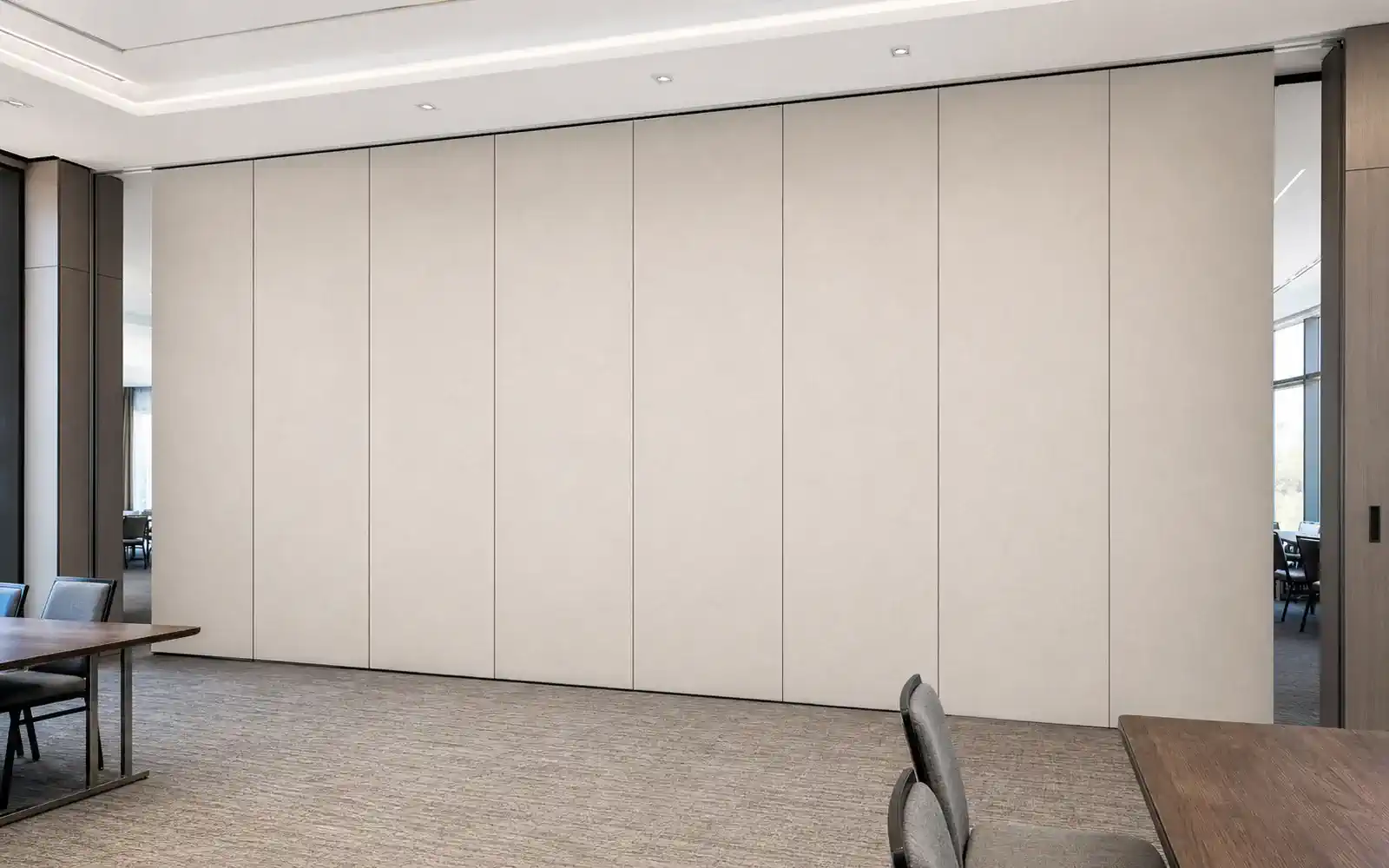
Use this table as a working document, not a final answer. Each row should end with a named owner and a dated clarification entry.
Finish and Documentation Interfaces
Confirmed finish options include laminate, melamine, fabric, leather, glass and other approved surfaces. In a tender review, the important question is not only which finish is selected, but who confirms compatibility with the adjacent design intent and who approves the sample.
Finish selection also affects coordination. A glass or fabric surface may require different protection, handling and junction details at the tender stage. None of those details should be assumed from a generic example. They should be listed as items requiring project-specific confirmation.
Documentation that reduces dispute risk
- A scope matrix naming the owner of each interface.
- A marked-up layout showing route, turning points and parking.
- A written record of pass-door requirements.
- A finish schedule with the approval route.
- A clarification log with dated responses.
How to Close the Review Before Award
Close the review by converting every unresolved interface into one of three outcomes: confirmed in the tender, confirmed by a dated clarification, or explicitly excluded with a named responsible party. Anything left as an assumption should be visible in the tender risk register.
This approach keeps the movable partition tender interface ownership review focused on coordination rather than speculation. It also gives the project team a defensible record if responsibilities are questioned later.
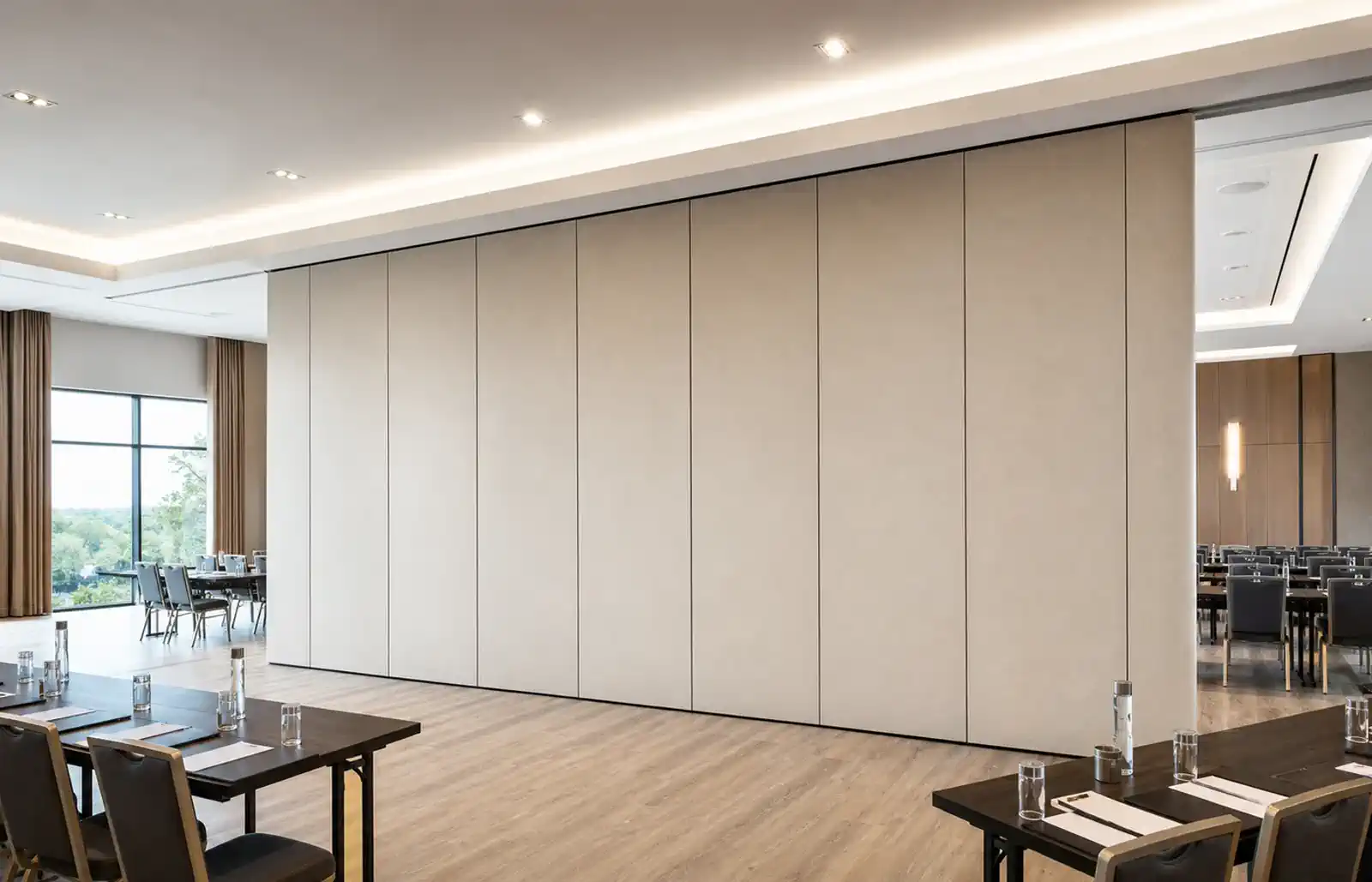
For product context and layout planning, review the movable partition wall overview. For examples of how flexible space is planned, see the project pages. When your team is ready to discuss pass-door requirements, finish options and project documentation, contact EBUNGE.
Frequently Asked Questions
What does interface ownership mean in a movable partition tender?
It means identifying which party is responsible for each boundary that touches the partition scope, including overhead support, movement route, parking area, finishes and documentation. Each boundary should have a named owner before award.
Can the tender review confirm acoustic performance from the drawings?
No.
Who should provide the overhead supporting structure?
That depends on the project. Do not assume it from a generic drawing.
How should parking position be handled in the tender?
Parking style is customized to the customer layout and project requirements. The tender should show the proposed parking position, identify who prepares that area, and confirm the adjacent finish condition.
What finish information should be requested?
Request the specified finish, the sample approval route and any junction details with adjacent surfaces. Confirmed options include laminate, melamine, fabric, leather, glass and other approved surfaces, but project-specific confirmation is still required.
When should pass-door requirements be clarified?
Pass-door requirements should be clarified during tender review so the interface owner, opening preparation and documentation responsibility are recorded before award.
Conclusion
A movable partition tender interface ownership review succeeds when every boundary has a named owner, every assumption is converted into a clarification, and every performance statement is supported by project-specific evidence. Keep the review grounded in drawings, written scope and confirmed product facts.
Confirm project-specific support, acoustic and dimensional requirements with qualified specialists before finalising the tender. For coordination questions and documentation discussion, contact EBUNGE.
Continue Exploring
More Cost and Planning Guides
- Earlier guideCompare Movable Partition Tender Returns When Bidders Bundle
- Related guideReview Movable Partition Wall Tender Addenda for Scope Creep
- Related guideMovable Partition Tender Omitted Interface Scope Audit
- Related guideMovable Partition Tender Unpriced Interface Scope