
Quick project answer
Office meeting suite partition maintenance begins with understanding how the partition system is supported. The EBUNGE movable partition system is top-hung and has no continuous floor running track or operating hardware in the finished floor along the partition line. This single fact shapes daily care, floor protection and long-term planning for conference rooms.
Why the top-hung principle changes maintenance priorities
Because the system is top-hung, the finished floor is not cut or damaged for a floor track. The floor remains physically uninterrupted by the maintained EBUNGE top-hung system. That means routine care can focus on the floor surface and the visible panel faces rather than on cleaning or protecting a floor-mounted track.
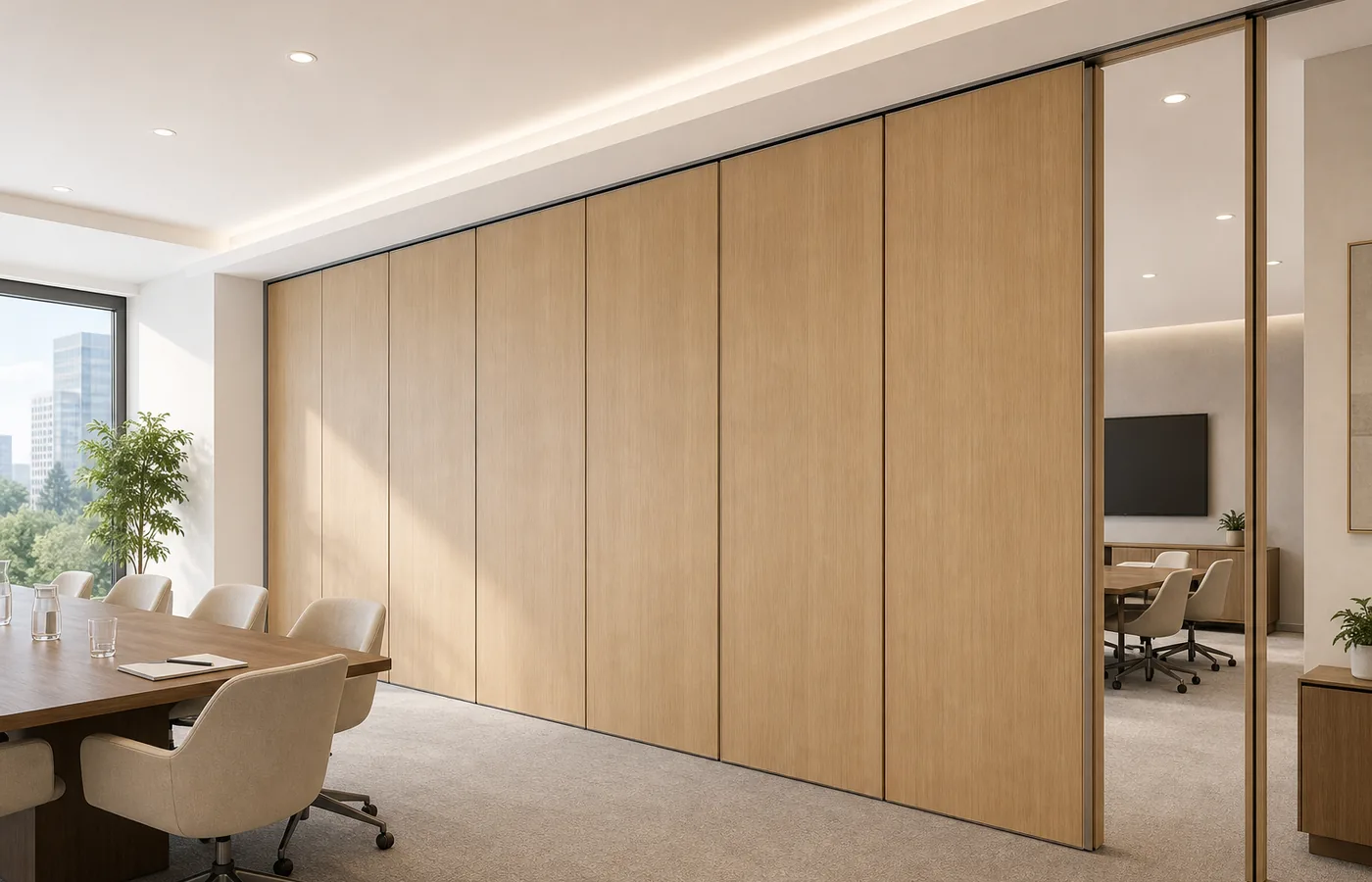
Office meeting suite partition maintenance still requires attention to the overhead path. The exact route, junction arrangement, continuous overhead path and parking position must be confirmed from the coordinated project drawings. Maintenance planning should therefore reference those drawings rather than assume a generic layout.
Keeping the floor physically uninterrupted
A physically uninterrupted floor is a practical advantage in conference rooms. There is no continuous floor track to collect debris or interrupt carpet transitions. The floor is not cut or damaged for a floor track, so the maintained EBUNGE top-hung system leaves the walking surface clear along the partition line.
Cleaning teams can treat the floor as a normal finished surface. They do not need to inspect or clear a floor running track. This supports straightforward office meeting suite partition maintenance because the floor itself is not part of the operating hardware.
Parking planning for office meeting suite partition maintenance
Panel parking style can be customized to the customer layout and project requirements, subject to coordinated drawings. A suitable approved parking arrangement can use the stacking area more compactly and coordinate with the space design. The exact track, support and panel layout still require project drawings.
For office meeting suite partition maintenance, parking planning affects how panels are stored when the room is open. A compact stacking area can reduce the floor space reserved for parked panels. However, the approved arrangement must come from the project drawings, not from a generic assumption.
Finish and care coordination
Finish materials can be customized, and cleaning and maintenance methods vary with the selected finish. This means office meeting suite partition maintenance should follow the care guidance for the chosen finish rather than a single universal method. Different finishes may need different cleaning products or techniques.
Buyers should confirm the finish selection early so that care planning matches the installed surface. The exact route, junction arrangement, continuous overhead path and parking position must be confirmed from the coordinated project drawings. Finish care and parking planning should be reviewed together during drawing approval.
Non-limiting applications for movable partitions
Movable partitions can be used wherever flexible space division, combination or reconfiguration is required. Application examples are not limiting. Office meeting suites are one context, but the same top-hung principle can apply in other spaces that need flexible room division.
EBUNGE has completed many types of hotel-related movable-partition projects. Ballrooms, wedding halls and multifunction halls are non-limiting examples. No customer names, locations, quantities, ratings, certifications or outcomes may be inferred from those project types.
Buyer inputs that support office meeting suite partition maintenance
Useful buyer inputs include the room layout, the desired parking position and the selected finish. These inputs help the project team coordinate drawings for the top-hung system. They also help define how office meeting suite partition maintenance will be handled after handover.
- Room layout and adjacent areas that affect panel parking.
- Preferred parking style, subject to coordinated drawings.
- Selected finish material and its care requirements.
- Any project-specific constraints that affect the overhead path.
These inputs do not replace the coordinated drawings. The exact route, junction arrangement, continuous overhead path and parking position must be confirmed from the coordinated project drawings.
Drawing approvals and project coordination
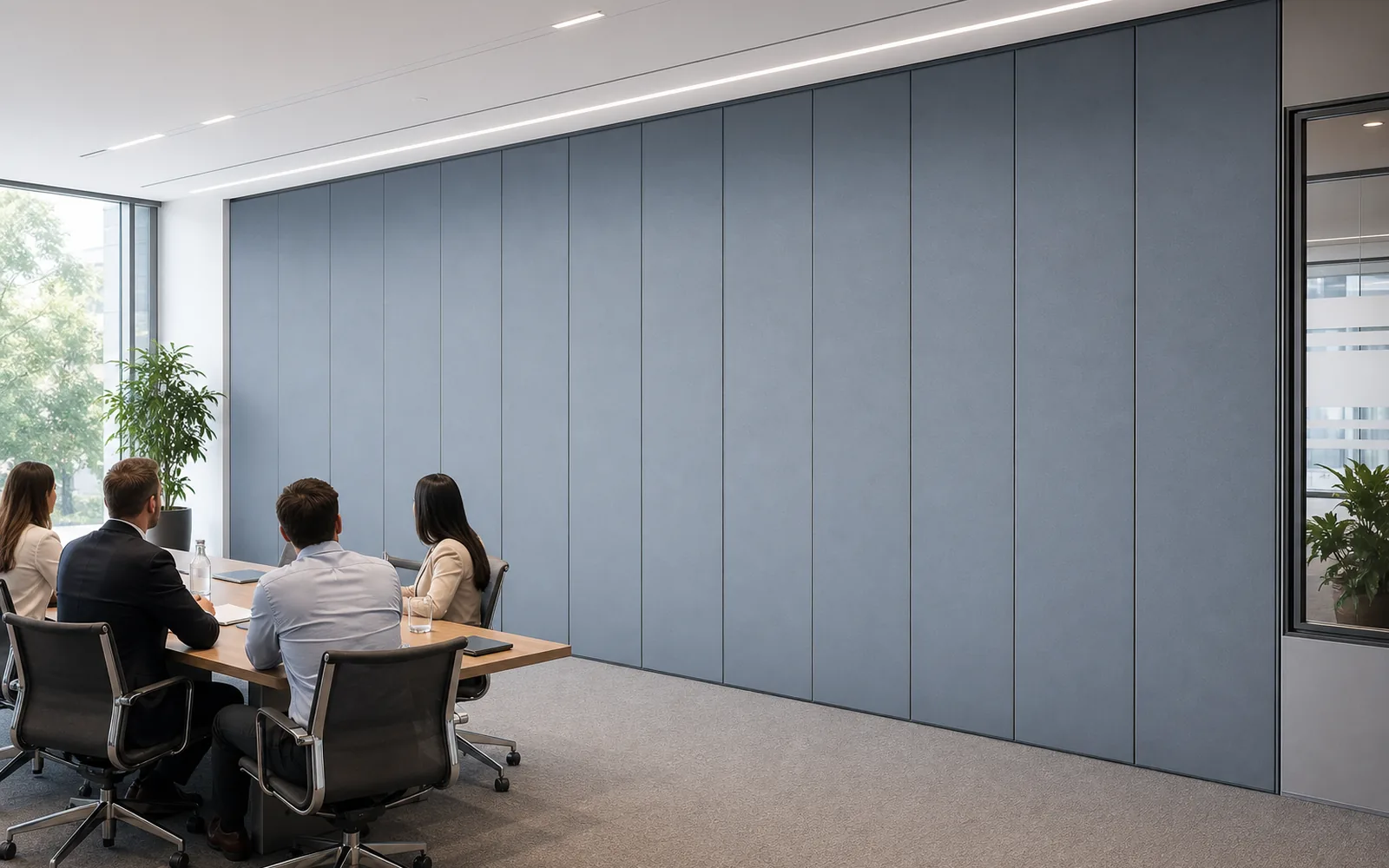
Drawing approval is a key step for office meeting suite partition maintenance planning. The approved drawings should show the overhead path, the parking position and the relationship between the partition line and the finished floor. Because the system is top-hung, the floor remains physically uninterrupted.
A suitable approved parking arrangement can use the stacking area more compactly and coordinate with the space design. The exact track, support and panel layout still require project drawings. Buyers should review those drawings before finalizing finish and care plans.
Maintenance planning without a floor track
The suitability of each route and parking arrangement depends on the approved layout, circulation, ceiling interfaces and operating sequence. The floor is not cut or damaged for a floor track, and the maintained EBUNGE top-hung system leaves the floor physically uninterrupted. Care teams can focus on the visible panel faces and the selected finish.
Finish materials can be customized, and cleaning and maintenance methods vary with the selected finish. This means the care routine should be matched to the actual finish rather than a default method. The exact route, junction arrangement, continuous overhead path and parking position must be confirmed from the coordinated project drawings.
Common questions about office meeting suite partition maintenance
Does a top-hung movable partition need a floor track?
No. The EBUNGE movable partition system is top-hung and has no continuous floor running track or operating hardware in the finished floor along the partition line. The floor is not cut or damaged for a floor track.
How does office meeting suite partition maintenance differ from a floor-track system?
Office meeting suite partition maintenance for a top-hung system does not involve cleaning or protecting a continuous floor track. The floor remains physically uninterrupted by the maintained EBUNGE top-hung system.
Can panel parking be customized for the room layout?
Panel parking style can be customized to the customer layout and project requirements, subject to coordinated drawings. A suitable approved parking arrangement can use the stacking area more compactly and coordinate with the space design.
Do cleaning methods depend on the chosen finish?
Yes. Finish materials can be customized, and cleaning and maintenance methods vary with the selected finish. The care routine should match the installed finish rather than a single universal method.
What must be confirmed from the coordinated project drawings?
The exact route, junction arrangement, continuous overhead path and parking position must be confirmed from the coordinated project drawings. The exact track, support and panel layout still require project drawings.
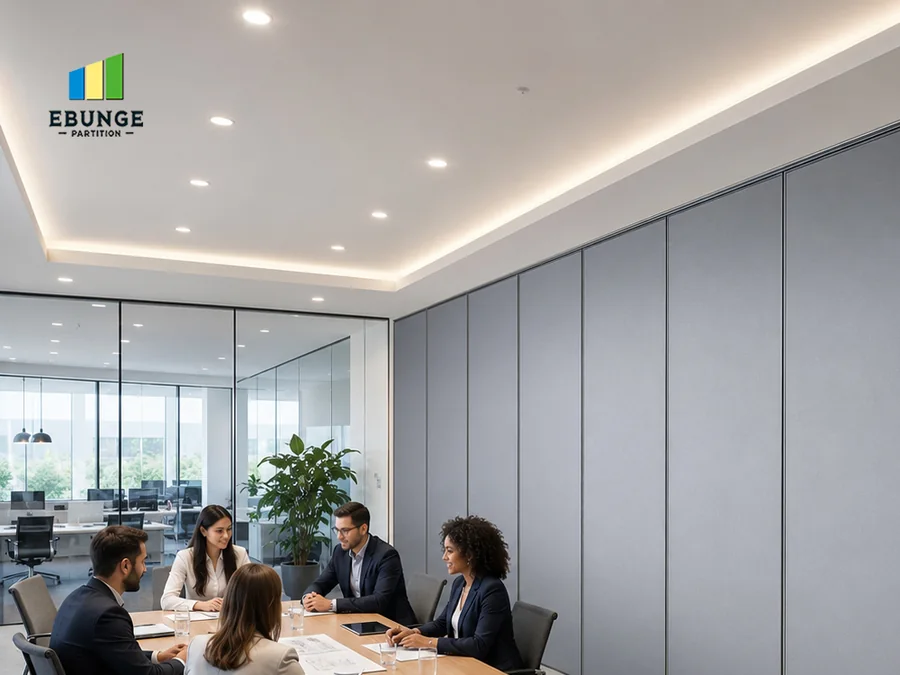
Planning next steps for office meeting suite partition maintenance
Office meeting suite partition maintenance planning should start with the top-hung principle and the physically uninterrupted floor. Buyers can then review parking style, finish selection and drawing approvals as a coordinated set. Movable partitions can be used wherever flexible space division, combination or reconfiguration is required.
For product context, see movable partition products. For project context, see completed movable partition projects. The exact route, junction arrangement, continuous overhead path and parking position must be confirmed from the coordinated project drawings.
Office meeting suite partition maintenance is easiest to plan when the top-hung support, the uninterrupted floor and the approved parking position are documented together.
Continue Exploring
More Maintenance Guides
- Newer guideRestaurant Partition Maintenance Inspection for Office Schedules
- Earlier guideWhy Convention Center Operable Wall Track Maintenance Requires Plenum
- Related guidePlan Service Access to Operable Wall Tracks When Ceiling Hatches
- Related guideAcoustic Movable Partition Track Servicing Access