
Why Stage Pin Connectors Matter in Community Hall Partitions
When planning a movable partition for a community hall, the area around floor-mounted stage pin connectors often raises detailed coordination questions. These connectors are part of the building’s electrical or audiovisual infrastructure, and their position can affect how a partition seals at the floor line. This article explains what drawings specify community hall partition seals at stage pin connectors and how to approach procurement without relying on unsupported assumptions.
EBUNGE movable partitions are top-hung systems: each panel is individually movable, suspended from an overhead track, and crosses the opening without a continuous floor track. Visible references can support layout discussion but do not verify hidden construction or performance. However, the exact sealing solution depends on project-specific conditions that must be confirmed through drawings and coordination.
Understanding the Role of Drawings in Partition Sealing
Drawings are the primary communication tool between architects, engineers, partition suppliers, and contractors. For community hall partition seals at stage pin connectors, several drawing types are involved:
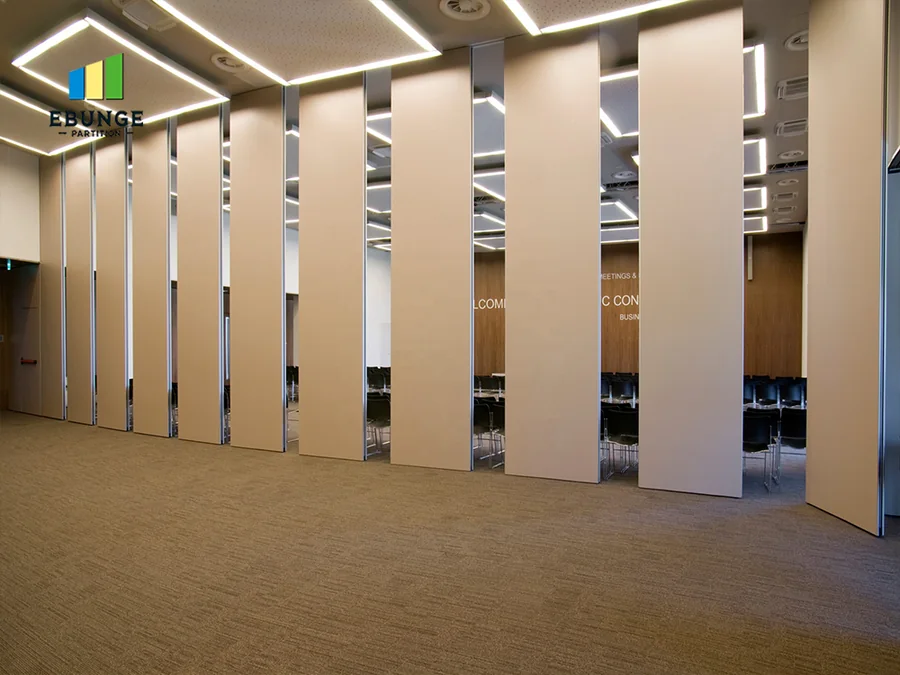
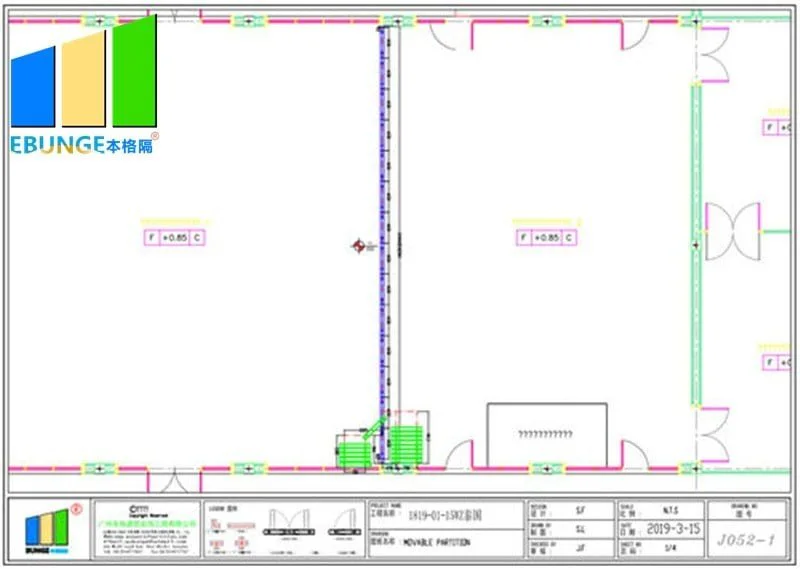
Architectural Floor Plans
Floor plans show the partition’s location, the stacking area, and the position of floor-mounted devices such as stage pin connectors. These plans must be reviewed to ensure the partition’s travel path and parking position do not conflict with the connectors. EBUNGE reviews straight, turning, and stacking routes from the layout to confirm feasibility.
Reflected Ceiling Plans
Since EBUNGE partitions are top-hung, the overhead track route is critical. Reflected ceiling plans indicate the track path, support points, and any obstructions. Coordination with stage pin connectors is necessary to ensure the partition can be parked without interfering with the connectors or their access.
Section Details
Sections through the partition and floor reveal how the bottom of the panel interacts with the floor surface. Where a floor-mounted stage pin connector protrudes, a special seal detail may be required. These details are often developed in coordination with the partition supplier and must be reviewed for dimensional accuracy.
Share the opening dimensions, room layout and intended operating sequence for review.
What the Drawings Need to Specify for Sealing at Stage Pin Connectors
To avoid ambiguity, the drawings should clearly indicate:
- The exact location and dimensions of each stage pin connector relative to the partition line.
- The type of floor surface and any recesses or raised boxes around the connectors.
- The required seal performance, expressed as a target such as STC or Rw, but only as a conceptual goal—not a guaranteed decibel reduction.
- Access requirements for the connectors, such as hinged or removable sections in the partition or seal.
- Coordination with electrical and low-voltage drawings to avoid conflicts.
The suitability of each route and parking arrangement depends on the approved layout, circulation, ceiling interfaces and operating sequence.
Acoustic Sealing Concepts Without Performance Promises
In a movable partition, the perimeter seal—at the floor, walls, and ceiling—is critical. At a floor-mounted stage pin connector, the seal must accommodate the connector’s protrusion while maintaining contact with the floor.
However, these ratings are not a simple decibel count and cannot be guaranteed without testing.
Coordination Steps for Procurement Teams
When procuring a movable partition for a community hall with stage pin connectors, follow these steps:
1. Review the Layout with the Supplier
Share the architectural and MEP drawings with EBUNGE early. The supplier will review straight, turning, and stacking routes to ensure the partition can move and park as intended.
2. Identify All Floor-Mounted Devices
List every floor-mounted device along the partition line, including stage pin connectors, floor boxes, and outlets. Provide their exact positions and dimensions. This information is necessary for designing the bottom seal and any cutouts.
3. Discuss Seal Options Generically
Seals can be made of various materials, but EBUNGE does not specify seal materials without project confirmation. The supplier can propose a seal design that accommodates the connectors, but the final solution must be confirmed through testing or reference to similar installations.
4. Confirm Finish and Integration
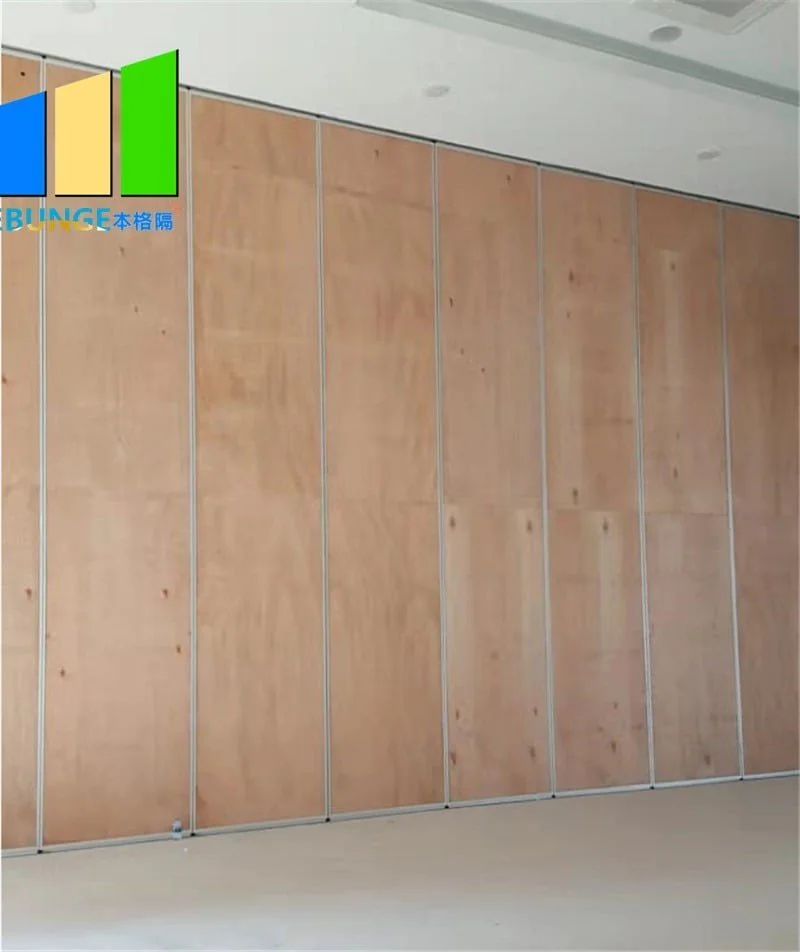
The partition finish—laminate, melamine, fabric, leather, glass, or other approved surfaces—can affect the seal detail. For example, a glass panel may require a different bottom seal than a solid panel. Ensure the finish is specified in the drawings and that the seal integrates cleanly.
5. Plan for Access and Maintenance
Stage pin connectors may need periodic access. The drawings should indicate whether the partition includes a pass door or a removable section near the connectors. EBUNGE can discuss pass-door requirements, but the decision must be based on the project’s operational needs.
Common Pitfalls in Specifying Seals at Stage Pin Connectors
Avoid these mistakes when coordinating community hall partition seals at stage pin connectors:
- Assuming a standard seal works everywhere: Each connector’s height and shape vary.
- Ignoring the floor surface: Carpet, tile, or concrete each interact differently with the seal. The drawings must specify the floor finish.
- Overlooking the track route: The partition must travel to its stacking position without hitting the connectors. The stacking route must be reviewed.
- Use conceptual terms and confirm with the supplier.
Review the ceiling interface, panel route and stacking position together.
How EBUNGE Supports Project-Specific Coordination
EBUNGE provides movable partition systems that are individually movable and top-hung. The company reviews each project’s layout to confirm that straight, turning, and stacking routes are feasible. For projects with floor-mounted stage pin connectors, EBUNGE can discuss how the partition seals at the floor and what documentation is needed.
However, EBUNGE does not publish generic performance data for seals or connectors. The supplier’s role is to provide a system that meets the project’s needs when properly coordinated.
Case Example: A Community Hall with Stage Pin Connectors
Consider a community hall that hosts performances and meetings. The floor has several stage pin connectors for temporary lighting and audio. The movable partition divides the hall into two rooms. The drawings show the partition line crossing two connectors.
During the layout review, EBUNGE identifies that the partition’s stacking position is near one connector. The project team decides to relocate the connector slightly to allow for a cleaner seal. Alternatively, a special bottom seal with a cutout is designed.
This example illustrates why drawings must be precise and why early coordination is essential. Without accurate drawings, the seal may not perform as intended.
Frequently Asked Questions
What are stage pin connectors and why do they affect partition seals?
Stage pin connectors are electrical connectors used for stage lighting and audio. They are often mounted in the floor. When a movable partition crosses their location, the bottom seal must accommodate the connector’s protrusion to maintain a continuous seal.
Do EBUNGE partitions require a floor track?
No, EBUNGE movable partitions are top-hung and do not require a continuous floor track. This design allows for a clear floor surface, but floor-mounted devices like stage pin connectors still need to be coordinated with the bottom seal.
Can the partition seal around a floor-mounted connector without gaps?
Yes, with proper detailing, the seal can be designed to fit around the connector. However, the exact method depends on the connector’s size, shape, and location. A project-specific review is necessary to ensure a proper fit.
What information do I need to provide to EBUNGE for a quote?
Provide architectural and MEP drawings showing the partition layout, track route, stacking area, and the location of all floor-mounted devices. EBUNGE will review the layout and discuss options.
How is acoustic performance measured for partitions with floor-mounted connectors?
These ratings are determined through laboratory testing. The presence of a floor-mounted connector can affect the overall performance, so it is important to confirm the target with the supplier and test if necessary.
Conclusion and Next Steps
Specifying community hall partition seals at stage pin connectors requires careful review of drawings and early coordination with the partition supplier. EBUNGE’s top-hung, clear-floor system offers flexibility, but every project must confirm its specific requirements.
. Our team can review your drawings and provide guidance on how to achieve a well-sealed partition around floor-mounted stage pin connectors. Visit our products page for more information, and see project examples for inspiration.
Continue Exploring
More Acoustic Partition Guides
- Newer guideWhat Pre-Installation Checks Matter for Sports Hall Partition Seals at Floor-Mounted Gymnastics Anchor Points
- Earlier guideHow to Compare Restaurant Partition Seals for Floor-Mounted Utility Well Junctures
- Related guideHow to Coordinate Hotel Banquet Partition Seals with Ceiling-Mounted Rigging Point Access Panels
- Related guideWhat Pre-Installation Checks Matter for University Lecture Hall Partition Seals at Floor-Mounted Lectern Wells