
Understanding the Role of Seals in Movable Partition Acoustics
For project teams, manual partition seals school auditorium acoustics should be reviewed against the opening, ceiling interface, operating sequence and approved finish requirements. When planning a school auditorium with movable partitions, the discussion often centers on the panel itself. However, the performance of the entire system—especially for speech and music—is heavily influenced by the seals. Manual partition seals are the components that close the gaps between panels, and between the panel and the building structure. They are critical for reducing flanking paths, which are indirect sound leaks that can undermine the acoustic separation between spaces.
For school auditoriums, the acoustic requirements differ significantly between speech and music. Speech intelligibility requires controlling mid-frequency reverberation and blocking background noise. Music, on the other hand, often involves lower frequencies and higher sound pressure levels, especially for orchestral or band performances. Therefore, when comparing manual partition seals for school auditorium acoustics, you must consider how each seal type addresses these distinct needs.
EBUNGE movable partitions are designed as individually movable panels suspended from a top track, crossing the opening without a floor track, and parking at a planned stacking position. This design allows flexibility in layout and operation. The seals are an integral part of the system, and their configuration can be reviewed based on your specific layout and acoustic goals.
Speech vs Music: Acoustic Priorities in a School Auditorium
Before diving into seal comparison, it is essential to understand the acoustic priorities for speech and music. Speech requires clarity and intelligibility. The human voice primarily occupies frequencies between 250 Hz and 4 kHz. In this range, reverberation time (RT60) should be relatively short to prevent syllables from blurring together. Music, particularly classical or choral, benefits from a longer reverberation time to enrich the sound. However, for amplified music or contemporary performances, a shorter RT may be preferred.
The partition and its seals must help achieve the desired acoustic environment. For speech, the focus is on reducing mid-frequency flanking. For music, low-frequency isolation becomes crucial, as low frequencies are more challenging to contain and can cause structural vibrations.
Key Acoustic Concepts: STC and Rw
You may encounter terms like STC (Sound Transmission Class) and Rw (Weighted Sound Reduction Index). These are single-number ratings that summarize a partition’s ability to reduce airborne sound. They are not a direct count of decibels; they are derived from measurements across a range of frequencies, weighted to reflect human hearing. While they provide a convenient comparison, they do not tell the whole story. For music, you may also need to consider low-frequency performance, which is not fully captured by STC or Rw.
Share the room layout, operating schedule and stacking position.
Flanking Paths: The Hidden Gaps
Flanking paths are any indirect routes sound can take around the partition. Common flanking paths include gaps at the top, bottom, and sides, as well as through adjacent structures like ceilings or ductwork. Seals are designed to close these gaps. A partition with excellent panel construction but poor seals will underperform. Therefore, when comparing manual partition seals, pay attention to how thoroughly they address potential flanking paths.
Types of Manual Partition Seals: A General Overview
Manual partition seals come in various designs, each with its own operating mechanism and effectiveness. While we do not specify materials or tools, we can discuss general categories:
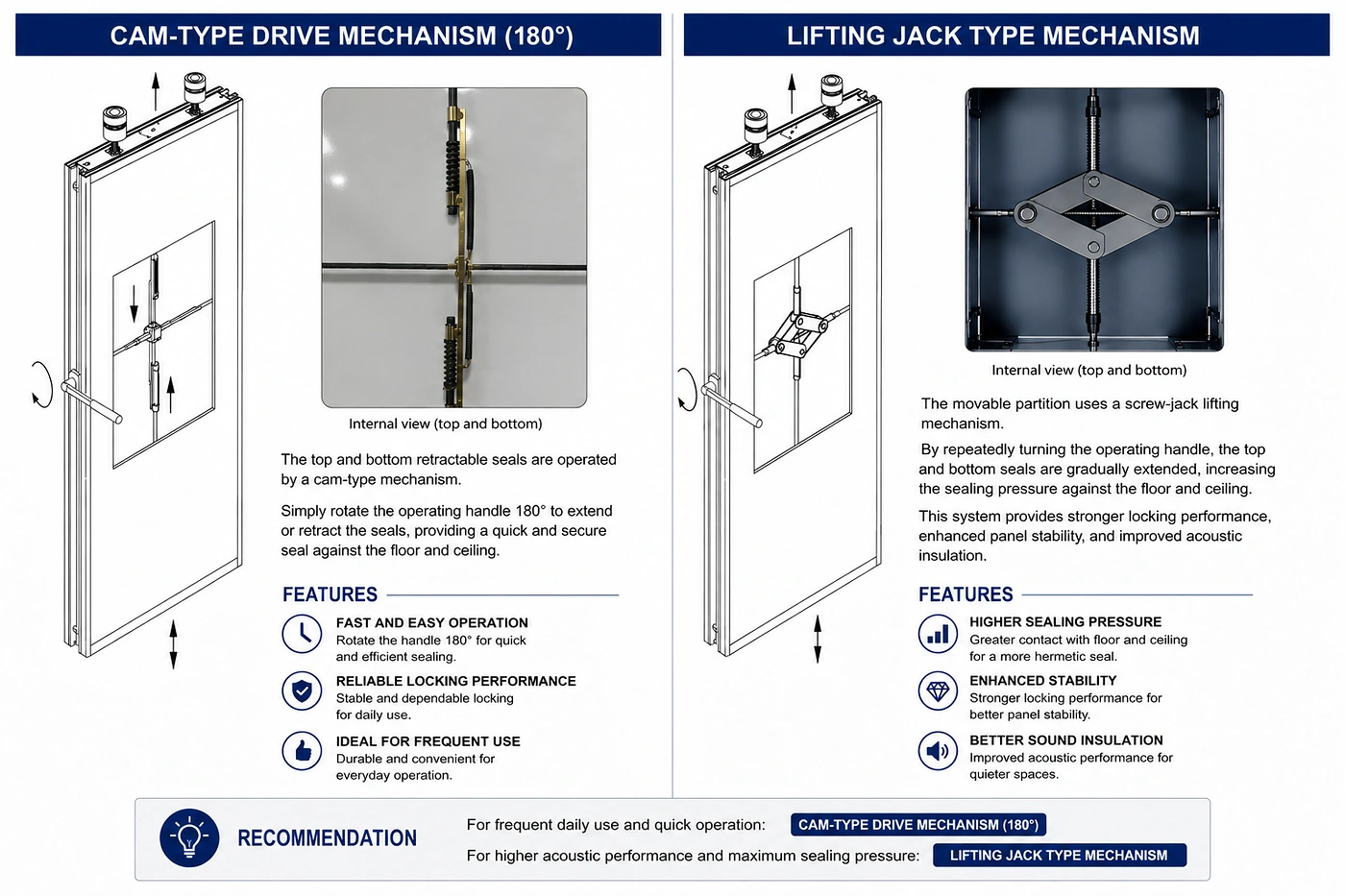
- Perimeter Seals: These run along the top, bottom, and vertical edges of the partition. They are often activated by a lever or crank that pushes a gasket against the adjacent surface.
- Panel-to-Panel Seals: These seal the gap between adjacent panels. They may be integrated into the panel edge and engage when the panels are pushed together.
- Bottom Seals: Because EBUNGE partitions do not use a floor track, the bottom seal is particularly important. It must drop down to contact the floor, creating a tight seal across the entire width.
Operating Mechanisms: Manual vs Automatic
Manual seals require physical operation, such as turning a handle or pulling a lever. This is a deliberate action that ensures the seal is fully engaged. Automatic seals may deploy when the panel is moved into position, but they can be less predictable and may require maintenance. For a school environment, manual seals offer simplicity and control, but they rely on staff to operate them correctly.
Seal Configuration and Layout
The effectiveness of seals also depends on the partition layout. EBUNGE reviews straight, turning, and stacking routes from the layout to ensure the seals can be properly aligned at every junction. For example, at a turn, the seal must accommodate the change in direction without leaving a gap. The stacking position also affects seal design, as panels that park together must have seals that do not interfere with stacking.
Comparing Seals for Speech: Focus on Mid-Frequency Integrity
For speech, the primary goal is to maintain clear communication. In an auditorium divided into two spaces, you want to prevent one class from hearing the other. The seals must effectively block mid-frequency sounds, which are where speech energy is concentrated.
Vertical Seals: Edge-to-Edge Contact
Vertical seals between panels must provide continuous contact. Any gap, however small, can create a path for sound. When comparing manual seals, look for designs that apply even pressure along the entire edge. Some seals use a compression gasket that deforms to fill irregularities in the panel edge.
Top and Bottom Seals: Perimeter Closure
Top seals must close the gap between the panel and the overhead structure. Bottom seals are equally critical. Since EBUNGE partitions have no floor track, the bottom seal must be robust. For speech, a simple drop seal that contacts the floor may suffice, but it must be consistent in its deployment.
Operational Consistency
Manual seals require proper operation every time. In a school, staff may vary in their diligence. A seal that is easy to operate and has clear indicators of engagement is more likely to be used correctly. Consider this when comparing options.
Comparing Seals for Music: Addressing Low Frequencies
Music, especially with bass instruments or percussion, produces low-frequency sounds that are more difficult to isolate. Low frequencies have longer wavelengths, meaning they can bend around obstacles and cause vibrations in structures. Seals alone cannot solve low-frequency isolation, but they are part of the solution.
Heavier and More Compliant Seals
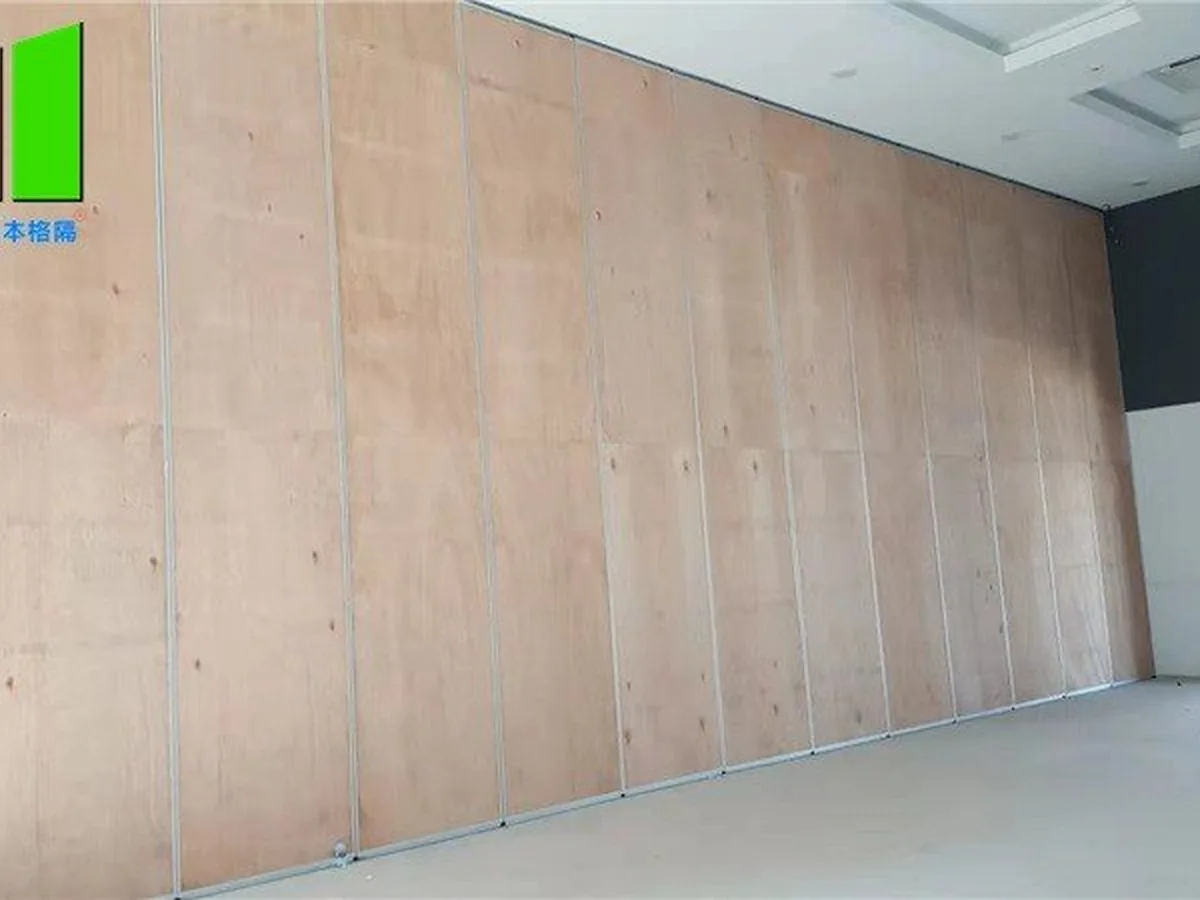
For music, seals may need to be heavier or more compliant to absorb low-frequency energy. However, we do not specify materials. The key is that the seal must maintain contact under pressure. A seal that is too stiff may not conform to the floor or wall irregularities, leaving gaps. A seal that is too soft may not provide enough resistance.
Bottom Seals for Music
The bottom seal is particularly important for music because the floor is a common flanking path. A robust bottom seal that creates a tight contact with the floor is essential. In some cases, a double seal or a more complex mechanism may be needed, but this must be evaluated based on the specific acoustical requirements.
Review the operator route for each room mode.
Seal Around Pass Doors
If the partition includes a pass door, the seals around the door must be carefully designed. The door itself can be a weak point. For music, the door seals must be as effective as the rest of the partition. EBUNGE can discuss pass-door requirements to ensure they meet your acoustic goals.
Evaluating Seals: What to Look For in a School Auditorium
When comparing manual partition seals, consider the following factors:
- Acoustic Performance: Ask for acoustic data, but remember that STC/Rw is a guideline. Request details on low-frequency performance if music is a priority.
- Durability and Maintenance: Seals wear over time. Look for designs that are easy to replace and maintain. However, we do not provide service-life promises.
- Ease of Operation: Manual seals should be intuitive. Consider training needs for school staff.
- Compatibility with Layout: Ensure the seals work with your straight, turning, and stacking routes. EBUNGE reviews the layout to confirm this.
Project Documentation and Support
EBUNGE can provide project documentation to help you compare options. This may include technical drawings, installation guides, and acoustic reports. It is essential to review these documents with your acoustic consultant to ensure the seals meet your specific requirements.
Real-World Considerations for School Auditoriums
In a school, the partition may be used daily, sometimes multiple times. The seals will face wear and tear. Manual seals are often preferred because they are less complex and easier to repair. However, they depend on human operation. A school should establish a protocol for engaging seals after each move.
Budget and Long-Term Value
While we do not discuss financial returns, it is important to consider the total cost of ownership. A cheaper seal may require more frequent replacement, while a more robust seal may offer better long-term value. Discuss your budget with EBUNGE to find a solution that balances performance and cost.
Making the Right Choice: Speech, Music, or Both
Many school auditoriums use partitions for both speech and music events. In such cases, you need a seal that performs well across a broad frequency range. This may require a compromise, but with the right design, it is possible to achieve satisfactory acoustics for both.
Consulting with EBUNGE
EBUNGE offers movable partitions that are individually movable, suspended from a top track, and can cross the opening without a floor track. We can review your layout to ensure the seals are optimized for your specific needs. Whether you prioritize speech intelligibility or music richness, we can discuss the sealing options available.
FAQ: Manual Partition Seals for School Auditoriums
What is the difference between STC and Rw?
STC (Sound Transmission Class) and Rw (Weighted Sound Reduction Index) are both single-number ratings that indicate how well a partition reduces airborne sound. They are calculated from measurements across a range of frequencies and are not direct decibel counts. STC is more common in North America, while Rw is used internationally. Both have limitations, especially for low-frequency sounds.
How do seals affect acoustic performance?
Seals close gaps around and between panels, preventing sound from leaking through flanking paths. Even a small gap can significantly reduce the overall acoustic performance. Effective seals are essential for achieving the rated performance of the partition.
Can manual seals be used for both speech and music?
Yes, but the requirements differ. Speech needs effective mid-frequency sealing, while music requires attention to low frequencies. A well-designed seal can handle both, but you should discuss your specific needs with EBUNGE to ensure the seals are appropriate.
What should I consider when operating manual seals?
Manual seals require consistent operation. Staff should be trained to engage all seals fully each time the partition is used. Look for seals with clear indicators of engagement to minimize errors.
Does EBUNGE provide support for seal selection?
Yes, EBUNGE can discuss project-specific support, acoustic requirements, and dimensional considerations. We review the layout, including straight, turning, and stacking routes, to ensure the seals are suitable. Contact us to discuss your project.
Conclusion
Comparing manual partition seals for a school auditorium requires a clear understanding of your acoustic priorities. Speech and music demand different considerations, but both rely on effective sealing to minimize flanking paths. By focusing on the seal design, operation, and compatibility with your layout, you can make an informed decision.
At EBUNGE, we are ready to help you evaluate your options. We encourage you to contact us to discuss your project specifics. Our team can provide guidance on acoustic, dimensional, and operational requirements. Explore our acoustic movable partition solutions and see how they can be tailored to your school auditorium. For more insights, visit our projects page to see how we approach similar challenges.

Ready to enhance your school auditorium acoustics? Contact EBUNGE today to discuss your manual partition seal needs.
Continue Exploring
More Acoustic Partition Guides
- Newer guideWhy Restaurant Function Room Partition Seals Need Grease-Particle Air Path Planning
- Earlier guideHow to Coordinate Hotel Banquet Partition Seals with Ceiling-Mounted Sprinkler Head Escutcheons
- Related guideWhat Drawings Specify School Auditorium Partition Seals at Ceiling-Mounted Speaker Cluster Zones
- Related guideHow to Coordinate Office Meeting Suite Partition Seals with Wall-Mounted Video Bar Swing Paths