
Quick project answer
Restaurant function rooms often need to shift between dining, private events and prep support. A movable partition can support that flexibility when the planning addresses restaurant partition seals grease particle control and the finished floor condition. This article explains how a top-hung EBUNGE system keeps the floor physically uninterrupted and how to coordinate parking, finishes and drawings.
Top-Hung Principle for Restaurant Partition Seals Grease Particle Planning
The EBUNGE movable partition system is top-hung and has no continuous floor running track or operating hardware in the finished floor along the partition line. This matters in restaurant spaces where grease and food particles can collect in floor gaps. With no floor track, the floor is not cut or damaged for a floor track and remains physically uninterrupted by the maintained EBUNGE top-hung system.
For restaurant partition seals grease particle planning, the overhead path carries the panels. The exact route, junction arrangement, continuous overhead path and parking position must be confirmed from the coordinated project drawings. This boundary keeps expectations aligned with the confirmed system behavior.
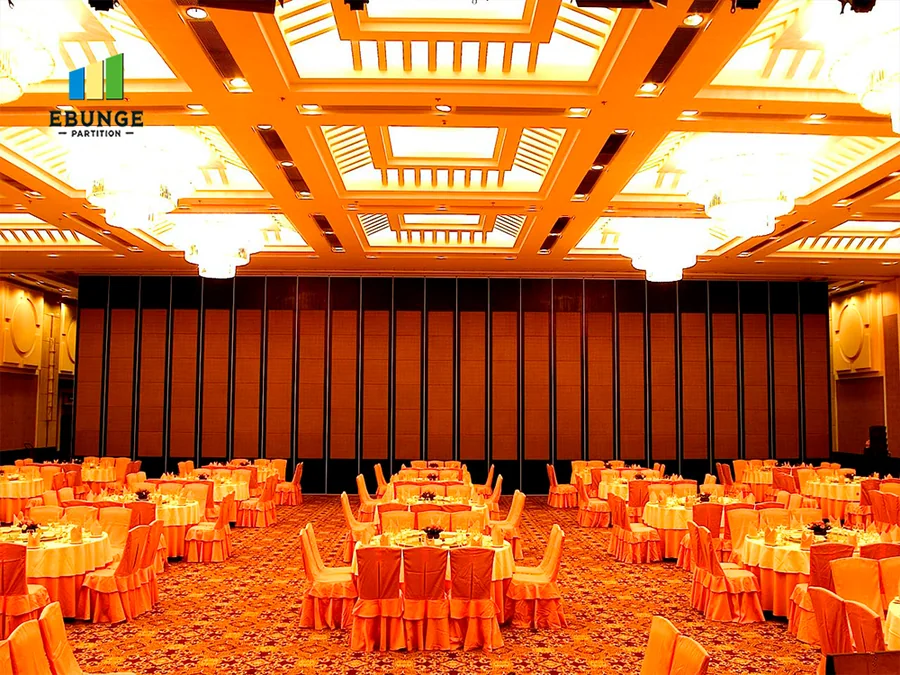
Restaurant teams should treat the partition line as a planning zone. The zone includes the overhead path, the parking area and the finish transitions. Because the floor is not interrupted, cleaning routines around the partition line can focus on the floor surface rather than a recessed track. Cleaning methods still vary with the selected finish.
Physically Uninterrupted Floor and Grease Particle Control
A physically uninterrupted floor is a practical advantage in food service areas. Grease and small particles can lodge in floor channels, and a floor track would create a continuous line to manage. The EBUNGE top-hung approach removes that continuous floor track from the partition line. The floor remains physically uninterrupted by the maintained system.
This does not mean the floor is immune to spills or routine soiling. It means the partition system does not introduce a continuous floor track along the partition line. Restaurant partition seals grease particle planning should still include daily floor care, spill response and finish-specific cleaning. The selected finish determines the appropriate cleaning method.
When the floor is not cut or damaged for a floor track, the floor finish can run through the function room without a track interruption. The suitability of each route and parking arrangement depends on the approved layout, circulation, ceiling interfaces and operating sequence. Any floor work should still be coordinated with the partition drawings.
Parking Planning for Movable Partitions
Panel parking style can be customized to the customer layout and project requirements, subject to coordinated drawings. A suitable approved parking arrangement can use the stacking area more compactly and coordinate with the space design. For restaurant function rooms, parking may sit near a service wall, a storage zone or another coordinated location.
The exact track, support and panel layout still require project drawings. Restaurant partition seals grease particle planning should identify the parking zone early so that grease-producing activities and cleaning routes do not conflict with stored panels. The parking position must be confirmed from the coordinated project drawings.
Buyers should share layout priorities, including how the room is used during service and events. Parking style can then be matched to the layout. The goal is a coordinated arrangement that supports the space design without assuming a universal solution.
Finish and Care Coordination
Finish materials can be customized, and cleaning and maintenance methods vary with the selected finish. In a restaurant setting, the chosen finish should be discussed with the cleaning team. Grease and food particles may require specific care routines depending on the finish. The confirmed fact is that care methods vary by finish.
Restaurant partition seals grease particle planning should connect finish selection with daily cleaning. A finish that suits a dining room may need a different care approach than a finish near a prep area. The project team should review cleaning products and methods for the selected finish.
Because finish materials can be customized, the buyer can align the partition appearance with the restaurant interior. The care plan should be documented for the selected finish.
Non-Limiting Applications in Hospitality
Movable partitions can be used wherever flexible space division, combination or reconfiguration is required; application examples are not limiting. EBUNGE has completed many types of hotel-related movable-partition projects. Ballrooms, wedding halls and multifunction halls are non-limiting examples.
Restaurant function rooms are another context where flexible division may be useful. The same top-hung principle applies when the project drawings confirm the overhead path and parking. Restaurant partition seals grease particle planning can be adapted to different hospitality layouts without claiming a universal configuration.
No customer names, locations, quantities, ratings, certifications or outcomes may be inferred from these examples. The examples only show that the system type has been used in hotel-related contexts. Each restaurant project still requires its own coordinated drawings.
Buyer Inputs and Drawing Approvals
Buyers should provide layout goals, parking preferences and finish direction. They should also identify cleaning routines and any areas where grease or particles are expected. This input supports restaurant partition seals grease particle planning and helps the project team coordinate the top-hung system.
The exact route, junction arrangement, continuous overhead path and parking position must be confirmed from the coordinated project drawings. Approval should follow the drawings rather than assumptions. The floor is not cut or damaged for a floor track, and the floor remains physically uninterrupted by the maintained EBUNGE top-hung system.

Review the coordinated drawings for the overhead path, parking zone and finish transitions. Confirm that the parking style matches the layout and project requirements. Keep the approved drawings as the reference for the installed configuration.
Scannable Planning Checklist
- Confirm the function room uses that require flexible division.
- Review the top-hung principle and the physically uninterrupted floor.
- Identify a parking zone that coordinates with the space design.
- Select a finish and document the finish-specific care method.
- Verify the exact route, junction arrangement, continuous overhead path and parking position from the coordinated project drawings.
Comparison of Planning Topics
| Topic | Confirmed planning point |
|---|---|
| System type | EBUNGE movable partition system is top-hung. |
| Floor condition | No continuous floor running track or operating hardware in the finished floor along the partition line. |
| Parking | Panel parking style can be customized to the customer layout and project requirements, subject to coordinated drawings. |
| Finish | Finish materials can be customized; cleaning and maintenance methods vary with the selected finish. |
Frequently Asked Questions
Does a top-hung partition require a floor track?
No. The EBUNGE movable partition system is top-hung and has no continuous floor running track or operating hardware in the finished floor along the partition line. The floor is not cut or damaged for a floor track and remains physically uninterrupted by the maintained EBUNGE top-hung system.
How does restaurant partition seals grease particle planning affect parking?
Parking should be coordinated with the layout so stored panels do not conflict with cleaning or service routes. Panel parking style can be customized to the customer layout and project requirements, subject to coordinated drawings. The exact track, support and panel layout still require project drawings.
Can finish materials be customized for a restaurant?
Yes. Finish materials can be customized, and cleaning and maintenance methods vary with the selected finish. The project team should review care methods for the chosen finish with the cleaning staff.
Where can movable partitions be used?
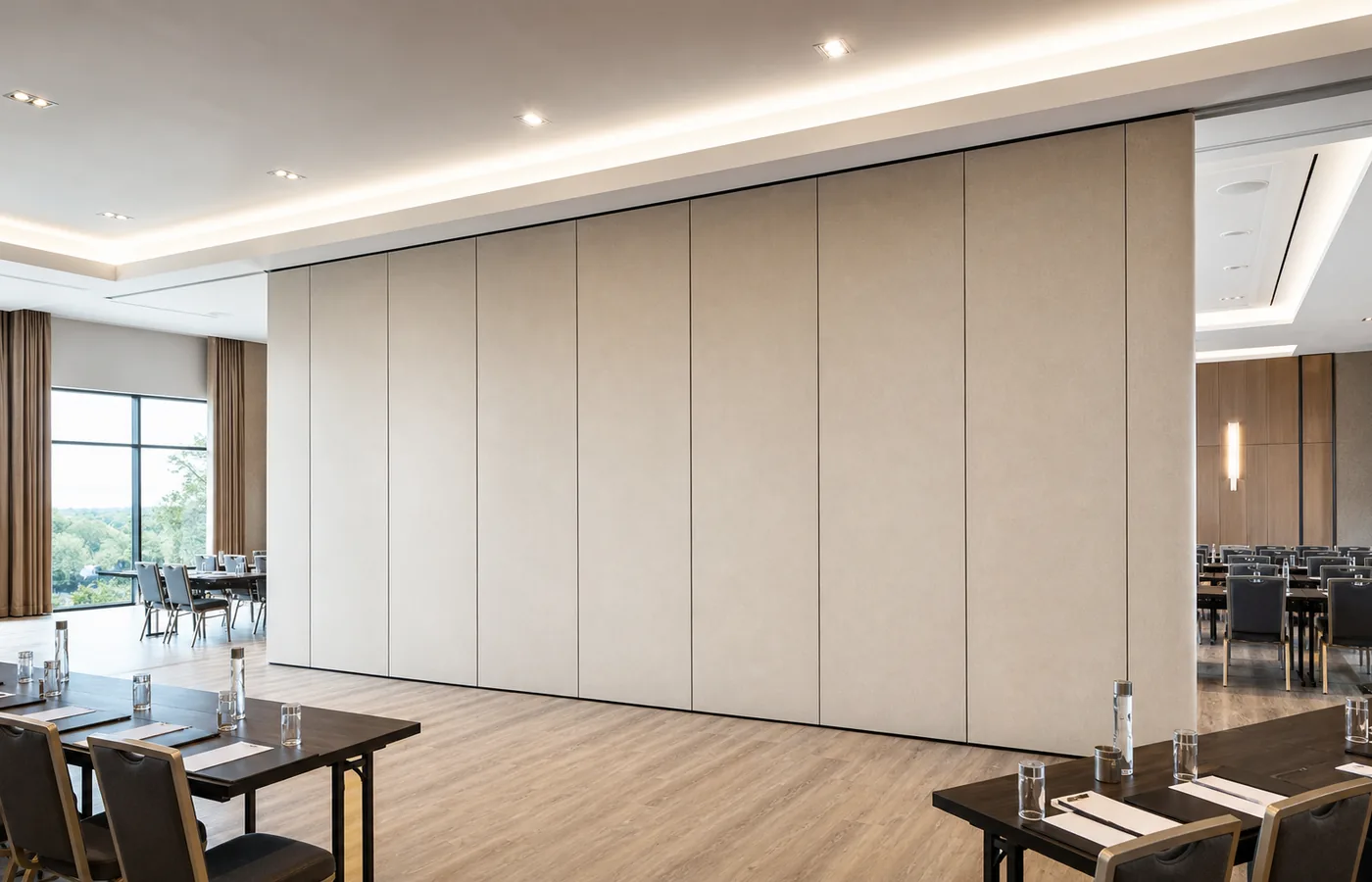
Movable partitions can be used wherever flexible space division, combination or reconfiguration is required; application examples are not limiting. EBUNGE has completed many types of hotel-related movable-partition projects, with ballrooms, wedding halls and multifunction halls as non-limiting examples.
What must be confirmed from the coordinated project drawings?
The exact route, junction arrangement, continuous overhead path and parking position must be confirmed from the coordinated project drawings. Buyers should approve those drawings before treating the layout as final.
Related Pages
Review completed project contexts and movable partition product information for more planning background. Restaurant partition seals grease particle planning should remain tied to the confirmed top-hung facts and the coordinated drawings.
Continue Exploring
More Acoustic Partition Guides
- Newer guideRestaurant Partition Seals: Ceiling Grease Filter Edges Drawings
- Earlier guideManual Partition Seals: School Auditorium Speech vs Music
- Related guideAcoustic Partition Ceiling Interface Zone Confirmation
- Related guideWho Confirms Ceiling Grid Line Before Acoustic Partition Track