
Why Finish Selection Matters in Medical Lecture Halls
When planning a medical lecture hall that will use wall-mounted projector screens, the finish of your movable partition is more than a visual choice. A medical lecture hall partition finishes comparison should consider how the surface interacts with projected light, how it will be cleaned, and how it coordinates with the room’s layout. EBUNGE movable partitions are top-hung and move without a continuous floor track, which gives design flexibility, but the finish you choose must be reviewed against your specific projector screen placement and room usage.
This guide provides a structured approach for comparing finishes, based on maintained product facts and clear evidence boundaries. The suitability of each route and parking arrangement depends on the approved layout, circulation, ceiling interfaces and operating sequence.
Understanding the Role of the Partition in a Projector Screen Setup
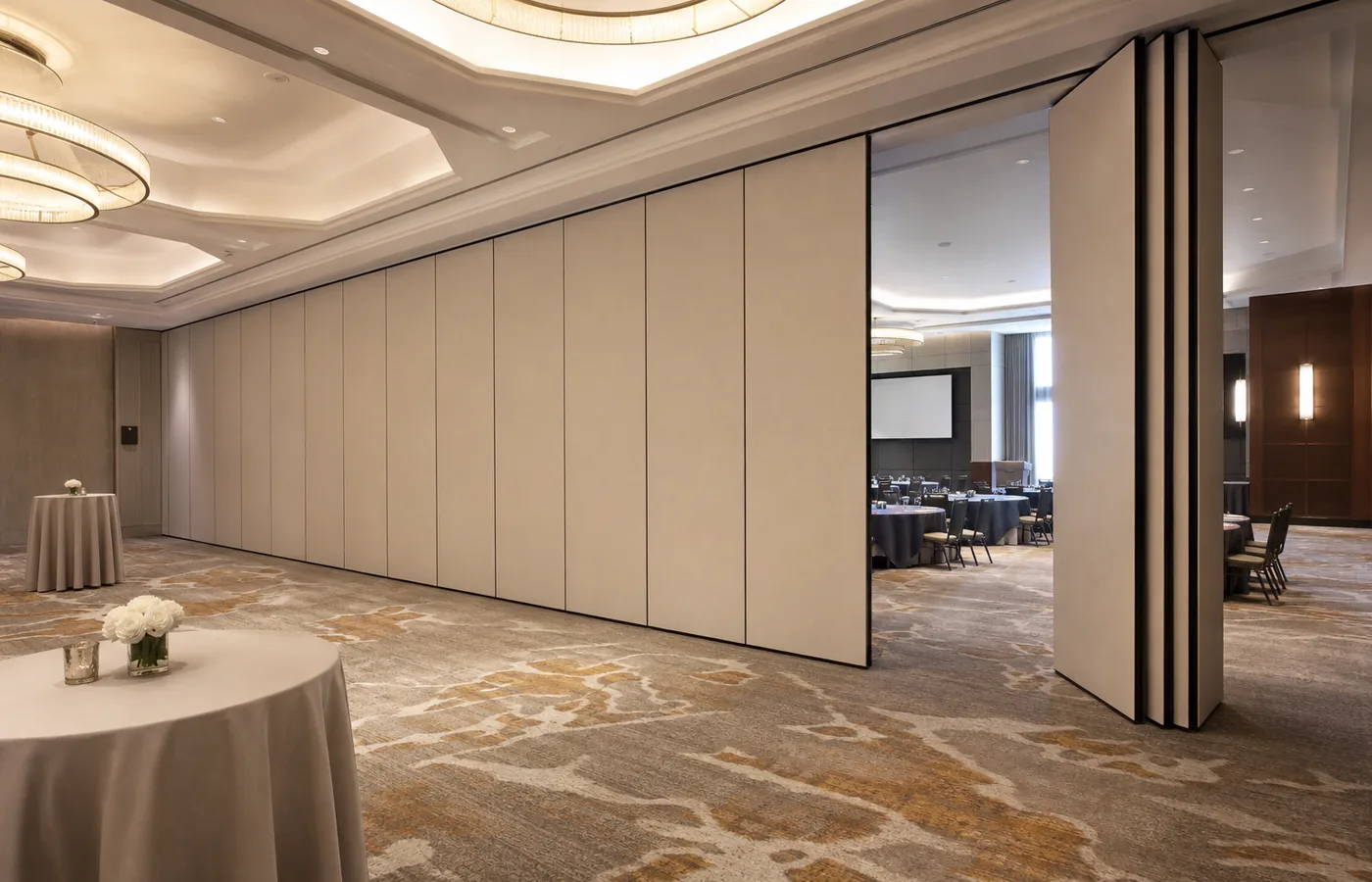
In a medical lecture hall, a movable partition often divides a large space into smaller teaching rooms. When a wall-mounted projector screen is planned, the partition surface may become part of the visual environment around the screen. The finish affects how light reflects, how the wall looks during presentations, and how easy it is to maintain.
Key Considerations for Projector Screen Visibility
A partition finish that is highly reflective may cause glare or wash out the projected image. Conversely, a very dark finish may absorb light and make the room feel smaller.
Your project team should review the partition finish in relation to the screen’s viewing angle and the position of any ceiling lights. This is a coordination task that requires input from the architect, interior designer, and audiovisual consultant.
Comparing EBUNGE Finish Options: What Is Available
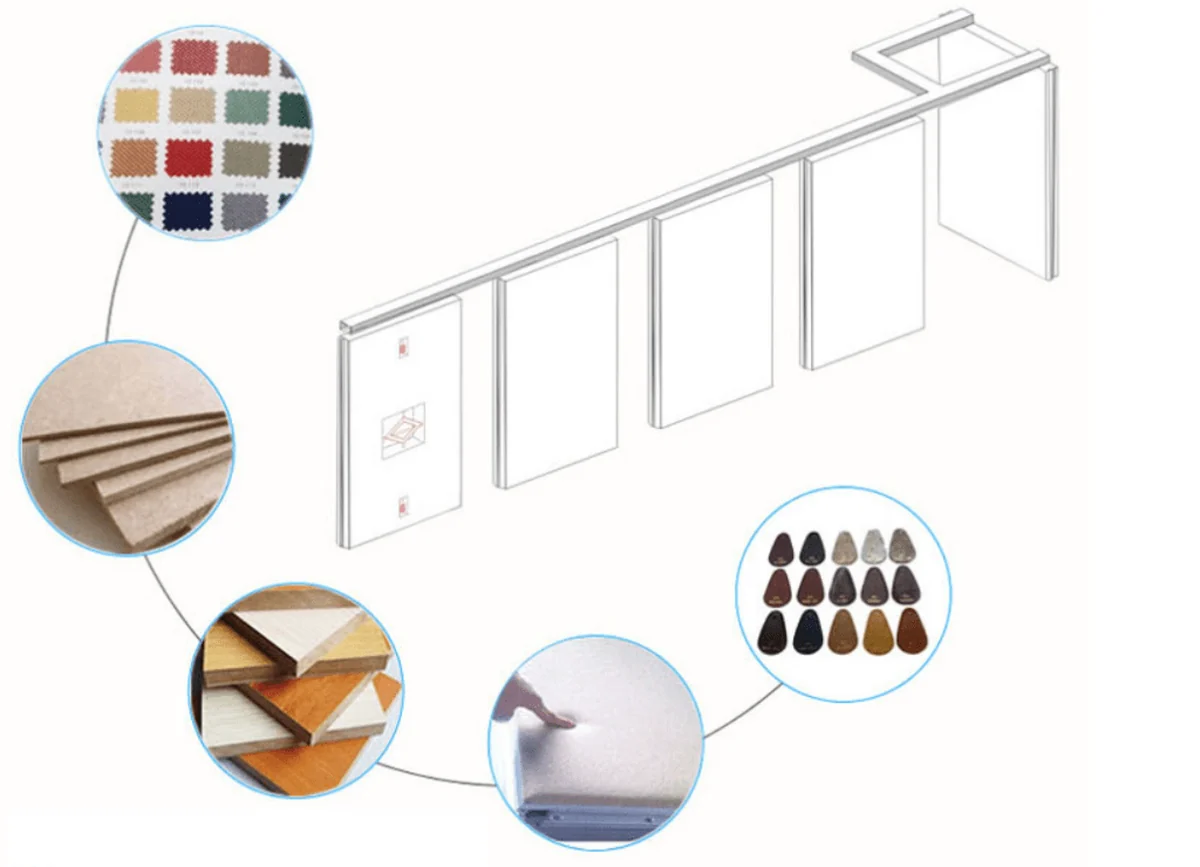
EBUNGE offers a range of finish options for movable partitions, including laminate, melamine, fabric, leather, glass, and other approved surfaces. Each has distinct visual and tactile characteristics. When comparing finishes for a medical lecture hall, you should evaluate them against your specific needs.
Laminate and Melamine Finishes
Share the opening dimensions, room layout and intended operating sequence for review.
Laminate and melamine are common choices for high-use areas. They are available in many colors and patterns, allowing you to match the room’s interior. These finishes are generally smooth and easy to wipe down, which is important in medical settings where hygiene is a priority.
However, the gloss level of laminate or melamine can vary. A high-gloss finish may reflect projector light, while a matte finish reduces glare. Your comparison should include the exact gloss level and how it performs under the room’s lighting conditions.
Fabric and Leather Finishes
In a medical lecture hall, consider the frequency of cleaning and the potential for contact with disinfectants. Not all finishes are compatible with all cleaning agents, so confirm the maintenance protocol with your supplier.
Glass and Other Approved Surfaces
Glass may also create reflections that interfere with projector visibility. Other approved surfaces might include specialty materials that meet specific design or functional requirements.
Each finish option has implications for weight, maintenance, and light behavior. Your comparison should be based on the actual product specifications and project requirements, not on assumptions.
Light Reflection and Glare: A Practical Comparison
One of the most important factors in a medical lecture hall partition finishes comparison is how the finish interacts with light. Projector screens rely on a dark, controlled environment to produce a clear image. A partition with a glossy finish can act like a mirror, reflecting ceiling lights or windows and creating distracting hot spots.
Matte finishes diffuse light, reducing glare, but they may also absorb some light, making the room feel darker.
To compare finishes effectively, request samples and view them under the actual lighting conditions of the lecture hall. Move a light source across the sample to see how it reflects. This simple test can reveal differences that are not obvious from a small swatch.
Coordination with Wall-Mounted Projector Screens
When a projector screen is wall-mounted, the partition may be adjacent to the screen. If the partition is not flush with the screen wall, there may be a gap that allows light leakage. The finish of the partition can also affect the perceived contrast of the screen.
Your project team should review the partition layout and the screen position to ensure there is no conflict. For example, if the partition stacks in front of the screen area, the finish should be durable enough to withstand frequent movement without visible wear.
Maintenance and Hygiene in Medical Environments
Medical lecture halls require surfaces that can be cleaned regularly with hospital-grade disinfectants. The finish must withstand repeated wiping without fading, staining, or degrading.
Fabric finishes are not recommended for high-touch areas unless they are treated with a stain-resistant coating. Leather finishes may be more resistant to liquids but can be damaged by abrasive cleaners.
Durability and Wear Over Time
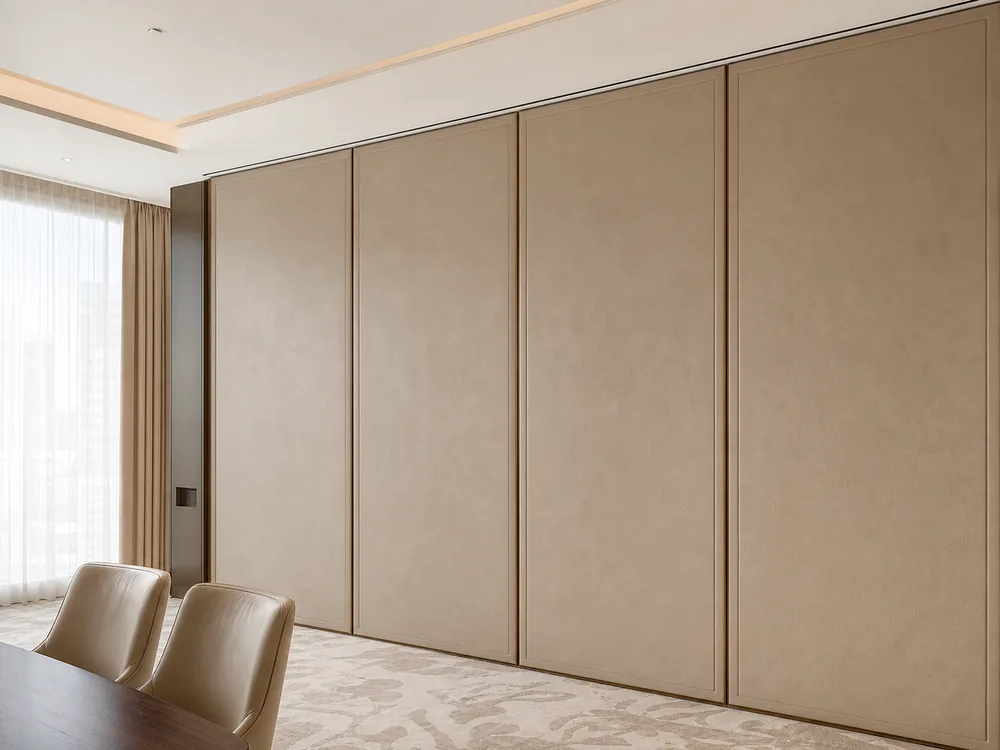
Movable partitions are moved frequently, so the finish must resist scratches, dents, and abrasion. The edges of panels are particularly vulnerable. A finish that looks good in a sample may not perform well after years of use. Ask for references or case studies, but remember that each project is unique.
EBUNGE partitions are designed for flexibility, but the finish’s durability is a separate consideration. Your comparison should include the finish’s resistance to impact and wear, based on documented test data from the finish supplier.
Acoustic Considerations: Conceptual Only
In a medical lecture hall, sound control is often as important as visual control.
Review the ceiling interface, panel route and stacking position together.
While fabric may absorb sound on the surface, the overall sound insulation depends on the mass and construction of the panel.
Project Documentation and Layout Review
Before finalizing a finish, your project team must review the partition layout, including straight, turning, and stacking routes. EBUNGE panels are top-hung and move without a floor track, but they require a continuous overhead track system. The stacking position must be planned to avoid conflicts with projector screens, lighting, or other ceiling-mounted equipment.
All project-specific requirements, including finish selection, must be documented and confirmed with EBUNGE. This includes the exact dimensions, weight of the panels, and the interface with the ceiling structure. The documentation should also specify the type of pass-door, if required, and any other access needs.
Why You Need a Professional Survey
A professional survey of the site is essential to ensure that the partition system can be installed as designed. The survey should check the ceiling structure, the available headroom, and the condition of the walls. It should also identify any obstructions that might affect the track route.
Only after a thorough survey can the project team confirm that the chosen finish and partition system will meet the project’s needs.
Frequently Asked Questions
What finish is best for a medical lecture hall with a projector screen?
Can a fabric finish be used in a medical setting?
Fabric finishes can be used, but they require more maintenance and may not be compatible with harsh disinfectants. Confirm the cleaning protocol with the supplier.
How does the partition finish affect acoustic performance?
Do not rely on the finish alone to achieve a specific STC or Rw rating.
Do EBUNGE partitions require a floor track?
No, EBUNGE movable partitions are top-hung and move without a continuous floor track or floor hardware along the partition line.
What project information is needed to compare finishes?
You need the room layout, ceiling height, lighting design, projector screen specifications, and the intended use of the space. You also need to know the cleaning and maintenance requirements. This information allows you to evaluate finishes against real conditions.
Can I see samples of the finishes before deciding?
Yes, requesting physical samples is recommended. View them under the actual lighting of the lecture hall and test their cleanability with the products you intend to use. This hands-on comparison is essential for making an informed decision.
Conclusion: Make an Informed Finish Choice
Comparing finishes for a medical lecture hall partition is a multi-step process that involves visual, functional, and maintenance considerations. By focusing on light reflection, cleanability, and coordination with your projector screen, you can narrow down the options.
EBUNGE offers a variety of finish options, but the final selection must be based on your project’s specific requirements. Contact EBUNGE to discuss your project and request a professional survey. Our team can help you review the layout, confirm the finish options, and ensure that your partition system meets all your needs. Visit our products page for more information, or explore our project references to see how movable partitions have been used in similar settings.
Continue Exploring
More Materials and Finishes Guides
- Newer guideWhy Conference Venue Partition Finishes Need Abrasion Mapping for Mobile Stage Risers
- Earlier guideWhy Sports Hall Partition Finishes Need Coordination with Wall-Mounted Tactic Board Marker Trays
- Related guideComparing Healthcare Training Room Partition Finishes for Wall-Mounted Whiteboard vs Tackable Zones
- Related guideWhy Sports Hall Partition Finishes Need Abrasion Mapping for Wall-Mounted Hurdle Storage Racks