
Quick answer: convention center partition seal maintenance floor av wells
Review the project drawings for convention center partition seal maintenance.
The suitability of each route and parking arrangement depends on the approved layout, circulation, ceiling interfaces and operating sequence. In flexible halls, AV wells, floor boxes and cable pits interrupt the floor plane, while the partition itself remains top-hung and moves without a continuous floor track. That combination is manageable, but it rewards a disciplined inspection routine and clear project documentation.
This article offers an evidence-bounded checklist. Instead, it helps contractors, venue teams and designers ask the right questions, record what they see and confirm project-specific requirements before work proceeds.
Why Floor-Mounted AV Wells Deserve Their Own Maintenance Focus
Coordinate the current drawing set for convention center partition seal maintenance.
In a convention center, the floor is rarely a clean, uninterrupted surface. AV wells, power access points and data pits appear where exhibitors and production teams need them. A movable partition may cross or pass near these features when the hall is reconfigured.

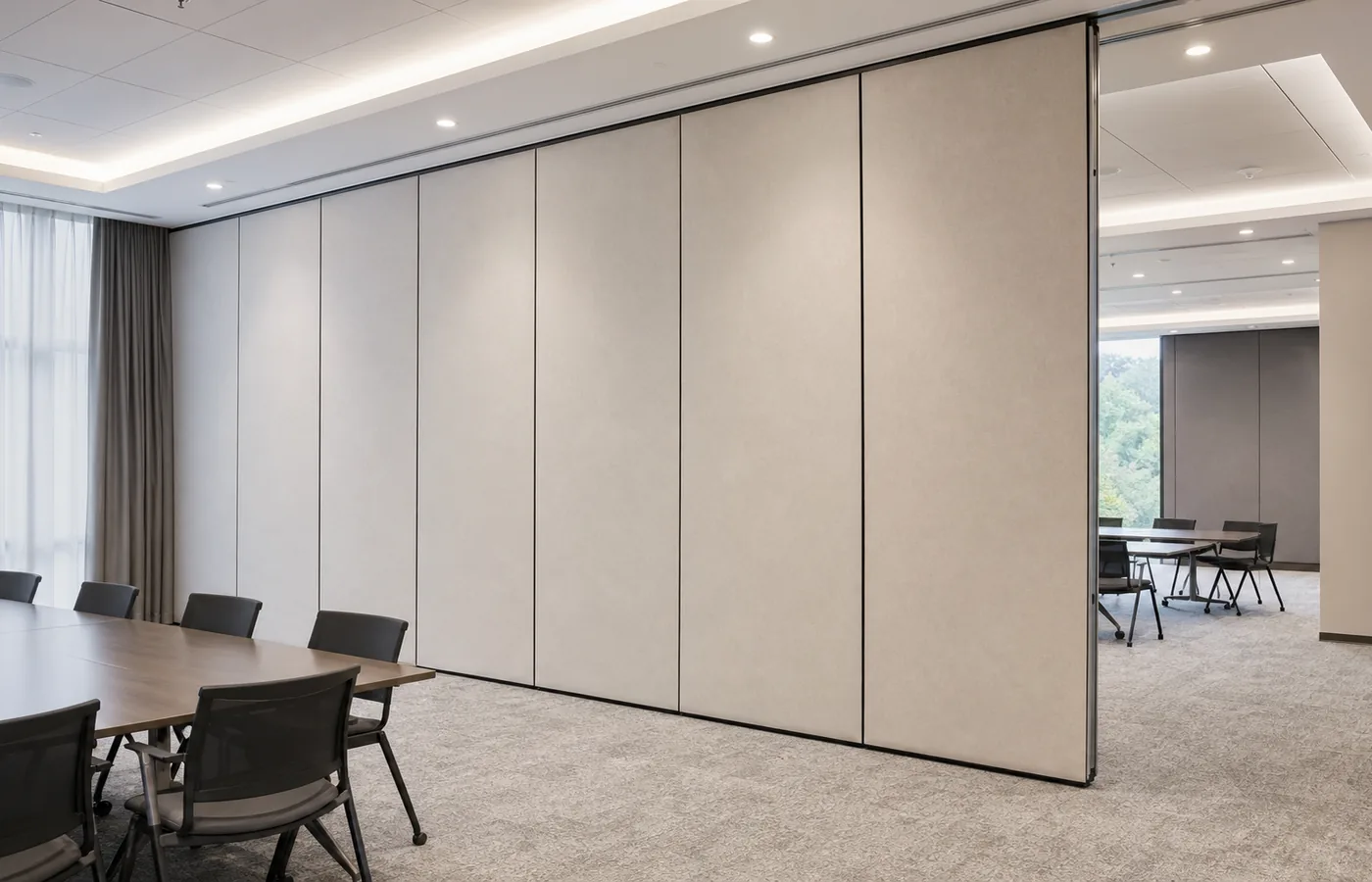
Because EBUNGE movable partitions are individually movable and suspended from a top track, the panels do not rely on a floor running track along the partition line. The exact route, junction arrangement, continuous overhead path and parking position must be confirmed from the coordinated project drawings.
Seals are the interface between panel edges, adjacent panels and the surrounding building condition. A floor well near the partition line can collect dust, cable debris or temporary event materials, so it deserves a defined inspection point rather than an occasional glance.
Pre-Maintenance Information Checklist
Record the drawing revision used for convention center partition seal maintenance.
Before any inspection or adjustment, gather the project documents that describe the partition, the ceiling interface and the floor features. The goal is to avoid inferring performance from a drawing or a photograph.
- Current partition layout drawings showing straight, turning and stacking routes.
- Approved finish schedule for laminate, melamine, fabric, leather, glass or other approved surfaces.
- Floor plans identifying AV wells, floor boxes, cable routes and any removable covers.
- Ceiling and support documentation for the top track and its continuous connected route.
- Pass-door requirements and any agreed project documentation for access points.
- Venue event schedules that show when the hall will be reconfigured.
If any item is missing, mark it as an open question.
Routine Seal Inspection Around AV Wells
Keep project evidence attached to the convention center partition seal maintenance review.
A routine inspection is mostly visual and tactile.
When the partition is closed
Walk the partition line and look at the vertical joints between panels. Check whether seals appear compressed, misaligned, damaged or obstructed. Around an AV well, confirm that no cable, cover or temporary fixing prevents the panel edge from reaching its intended closed position.
When the partition is open or parked
Inspect the stacking area and the route the panels travel. Confirm that the overhead route remains continuous and that no floor well cover has been left raised in a way that interferes with panel movement.
What to record
Record the date, panel position, location relative to the AV well, observed condition and any action taken.
Coordination With AV, Electrical and Event Teams
Review the project drawings for convention center partition seal maintenance.
Floor wells are shared infrastructure. AV teams may open them for cable access, electrical teams may service them, and event teams may cover them with temporary plates or carpet. Each activity can affect the partition line.
A simple coordination routine prevents most conflicts. Before a major reconfiguration, confirm who is responsible for closing well covers, securing cables and clearing the partition route. After the event, inspect the same locations again. This is not a performance guarantee; it is a practical way to keep the partition interface visible and maintained.
| Checkpoint | Who confirms | Evidence to keep |
|---|---|---|
| AV well cover is closed and flush | AV or venue operations | Pre-event inspection note |
| Partition route is clear | Partition operator or venue team | Route drawing with date |
| Seal condition at panel joints | Maintenance team | Photo and written observation |
| Stacking area is unobstructed | Venue operations | Parking position confirmation |

Acoustic Concepts Without Overclaiming
STC and Rw are rating concepts used to describe sound transmission performance in defined laboratory or field conditions. They are not a simple count of decibels, and a single number does not describe how a room will perform in every event layout.
For this reason, this checklist does not state a target rating or promise soundproofing.
Documentation and Handover for Ongoing Maintenance
A maintenance checklist is only useful if it survives staff changes and event cycles. Keep a simple log that links each inspection to the relevant drawing, panel position and floor feature.
- Assign a document owner for the partition layout and finish schedule.
- Store inspection records with the venue operations file.
- Note any change to AV wells, floor covers or ceiling interfaces.
- Review open questions with the project team before the next reconfiguration.
- Confirm pass-door and access requirements remain documented.
Generic guidance cannot replace it.
Frequently Asked Questions
Does a floor-mounted AV well require a floor track for the partition?
No. EBUNGE movable partitions are top-hung and move without a continuous floor running track or floor hardware along the partition line. The AV well is a floor feature to coordinate, not a reason to add a floor track.
How often should partition seals be inspected around AV wells?
Inspection frequency depends on event intensity, cleaning routines and how often the hall is reconfigured. A practical approach is to inspect before and after major events, and to record any change in seal condition or floor-well status.
Can a partition cross an open AV well?
Every proposed movement path requires a continuous connected overhead route and project-specific support review. The floor well itself should be covered or managed so it does not obstruct the partition line.
Do seals guarantee a specific acoustic rating?
No. This article does not promise soundproofing or a specific rating.
Which finishes are available for panels near AV wells?
Confirmed finish options include laminate, melamine, fabric, leather, glass and other approved surfaces. Cleaning compatibility and durability should be confirmed for the specific finish and project condition rather than assumed from a generic example.
What should be documented for handover?
Keep the partition layout, finish schedule, floor-well locations, inspection records and any agreed pass-door requirements together. This helps future teams understand the maintenance context without relying on memory or informal notes.
Conclusion and Next Step
Convention center partition seal maintenance around floor-mounted AV wells is a coordination task as much as a cleaning task. Keep the overhead route continuous, keep floor wells managed, inspect seals in open, closed and parked positions, and document what you find.
To discuss your layout, finishes or pass-door requirements, contact EBUNGE.
Continue Exploring
More Acoustic Partition Guides
- Newer guideUniversity Classroom Partition Seals Need Detailing at Floor-Mounted
- Earlier guideAirport Convention Partition Seal Coordination with Floor-Mounted Power
- Related guideAcoustic Partition Ceiling Interface Zone Confirmation
- Related guideWho Confirms Ceiling Grid Line Before Acoustic Partition Track