
Quick project answer
A hotel banquet partition ceiling track supports panels from above, so the finished floor along the partition line remains physically uninterrupted. That single principle shapes how maintenance should be planned for a hotel banquet partition ceiling track. The exact overhead route and support arrangement must be confirmed by the responsible project team from coordinated drawings.
Start with the top-hung principle
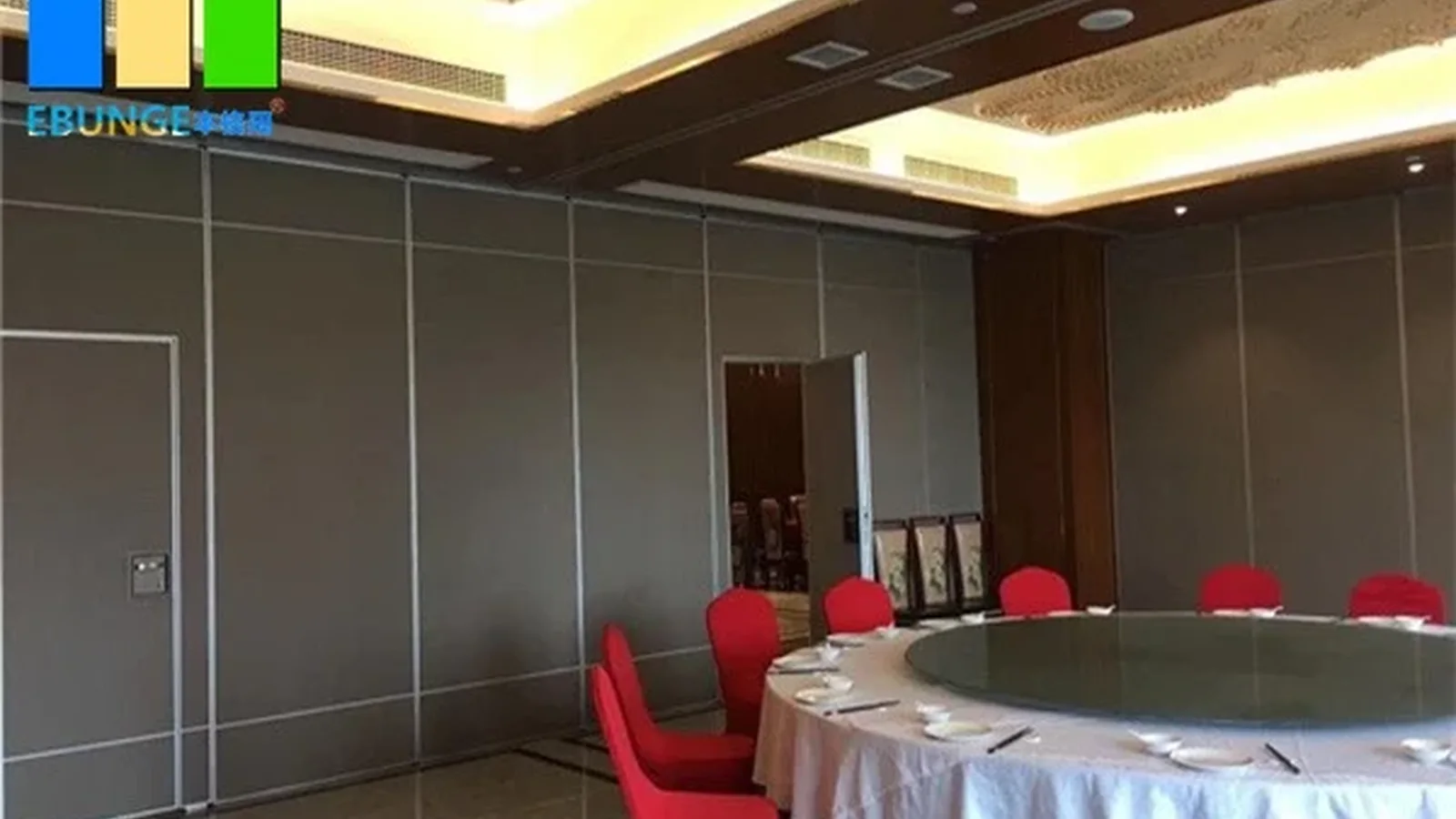
The EBUNGE movable partition system is top-hung and has no continuous floor running track or operating hardware in the finished floor along the partition line. Maintenance attention therefore belongs to the overhead support and the panel parking arrangement rather than to a floor-mounted guide. The floor is not cut or damaged for a floor track and remains physically uninterrupted by the maintained EBUNGE top-hung system.

Because the system is top-hung, the hotel banquet partition ceiling track should be reviewed as part of the coordinated project drawings. Those drawings define the exact route, junction arrangement, continuous overhead path and parking position. A checklist can organize observations, but it cannot replace the approved documentation for a specific ballroom, wedding hall or multifunction hall.
Keep the finished floor physically uninterrupted
One practical benefit of a top-hung arrangement is that the finished floor along the partition line is not cut for a floor track. That means floor finishes, carpet transitions and adjacent flooring can remain continuous across the opening. During maintenance reviews, confirm that no temporary fixings, wedges or loose objects have been placed along the partition line in a way that conflicts with the approved layout.
The floor itself is not part of the operating hardware for the maintained EBUNGE top-hung system. Cleaning and maintenance methods vary with the selected finish, so floor care should follow the finish manufacturer’s guidance rather than a generic partition procedure. Record observations against the coordinated drawings instead of assuming a universal condition.
Plan parking and stacking with the project layout
Panel parking style can be customized to the customer layout and project requirements, subject to coordinated drawings. A suitable approved parking arrangement can use the stacking area more compactly and coordinate with the space design. The exact track, support and panel layout still require project drawings.
During maintenance planning, review whether the parking zone remains clear of stored furniture, service equipment and temporary event items. The goal is to preserve the approved parking position rather than to invent a new one. Any proposed change to parking should be checked against the coordinated drawings before it is implemented.
Coordinate finish selection and care
Finish materials can be customized, and cleaning and maintenance methods vary with the selected finish. A hotel banquet partition ceiling track checklist should therefore include a finish-specific care reference for each panel face and edge condition that is actually installed. Do not assume one cleaning method applies across every finish in a property.
When finishes differ between ballrooms, wedding halls or multifunction halls, keep separate care notes for each space. Confirm the approved finish schedule with the project drawings, and avoid introducing unconfirmed materials or cleaning agents. The suitability of each route and parking arrangement depends on the approved layout, circulation, ceiling interfaces and operating sequence.
Review non-limiting application examples
Movable partitions can be used wherever flexible space division, combination or reconfiguration is required; application examples are not limiting. EBUNGE has completed many types of hotel-related movable-partition projects; ballrooms, wedding halls and multifunction halls are non-limiting examples. No customer names, locations, quantities, ratings, certifications or outcomes may be inferred from those examples.
For maintenance planning, the application type helps determine how often the space is reconfigured and which finishes are present. It does not change the need to follow the coordinated drawings for the hotel banquet partition ceiling track. Use the drawings as the reference point for every inspection and care activity.
Use a scannable maintenance checklist
The following checklist organizes routine observations without prescribing a universal operating sequence. It focuses on visible conditions, approved documentation and finish-specific care. Any item that cannot be confirmed from the drawings should be referred to the project team.
- Confirm the approved hotel banquet partition ceiling track route against the coordinated drawings.
- Check that the finished floor along the partition line remains physically uninterrupted.
- Verify that the parking zone matches the approved parking arrangement.
- Review finish-specific care notes for each installed panel finish.
- Record any visible change in the overhead path for project-team review.
- Confirm that no temporary fixings or stored items obstruct the approved layout.
This list is a planning aid, not a substitute for project documentation. The exact route, junction arrangement, continuous overhead path and parking position must be confirmed from the coordinated project drawings.
Gather buyer inputs before drawing approval
Before drawings are approved, buyers can gather room dimensions, reconfiguration goals, finish preferences and parking expectations. These inputs help the project team prepare coordinated drawings for the hotel banquet partition ceiling track. Application examples are not limiting, so the input list should reflect the actual space rather than a standard template.
Parking style can be customized to the customer layout and project requirements, subject to coordinated drawings. Finish materials can be customized as well. Buyers should confirm which finishes are proposed and how each will be cared for, because cleaning and maintenance methods vary with the selected finish.
Confirm drawing approvals before maintenance planning
Maintenance planning should follow drawing approval, not precede it. The coordinated drawings define the exact route, junction arrangement, continuous overhead path and parking position. Without that confirmation, a checklist may describe conditions that do not match the installed hotel banquet partition ceiling track.
Once drawings are approved, align the checklist with the approved layout and the selected finishes. Keep the checklist focused on visible conditions and finish-specific care. Refer any engineering detail outside the confirmed facts to the project team for clarification.
Frequently asked questions
Does a top-hung system require a floor track?
The EBUNGE movable partition system is top-hung and has no continuous floor running track or operating hardware in the finished floor along the partition line. The floor is not cut or damaged for a floor track and remains physically uninterrupted by the maintained EBUNGE top-hung system.
Can parking style be customized for a hotel layout?
Panel parking style can be customized to the customer layout and project requirements, subject to coordinated drawings. A suitable approved parking arrangement can use the stacking area more compactly and coordinate with the space design. The exact track, support and panel layout still require project drawings.
How should finishes affect maintenance planning?
Finish materials can be customized, and cleaning and maintenance methods vary with the selected finish. Keep finish-specific care notes for each installed finish and confirm the approved finish schedule against the coordinated drawings before planning routine care.
Which hotel spaces can use movable partitions?
Movable partitions can be used wherever flexible space division, combination or reconfiguration is required; application examples are not limiting. EBUNGE has completed many types of hotel-related movable-partition projects; ballrooms, wedding halls and multifunction halls are non-limiting examples.
What should be confirmed before maintenance planning?
The exact route, junction arrangement, continuous overhead path and parking position must be confirmed from the coordinated project drawings. Maintenance planning should align with those approved drawings and with the selected finishes rather than with a generic checklist.
Where can buyers review related project information?
Buyers can review the movable partition wall page and the projects page for general context. Specific hotel banquet partition ceiling track details still require coordinated project drawings and approved documentation.
Keep the checklist tied to approved drawings
A maintenance checklist for a hotel banquet partition ceiling track is most useful when it reflects the approved layout, the selected finishes and the confirmed parking arrangement. The top-hung principle keeps the finished floor physically uninterrupted, while the coordinated drawings define the exact route and parking position. Use the checklist to organize observations, and refer engineering details to the project team.
Continue Exploring
More Maintenance Guides
- Newer guideSchool Auditorium Partition Track: Ceiling Lighting Grid Inspection
- Earlier guideCommunity Hall Partition Track: Ceiling Banner Hooks Inspection
- Related guidePlan Service Access to Operable Wall Tracks When Ceiling Hatches
- Related guideAcoustic Movable Partition Track Servicing Access