
html body.single-post main#content.site-main{box-sizing:border-box!important;width:calc(100% – 32px)!important;max-width:900px!important;margin-left:auto!important;margin-right:auto!important;padding-left:0!important;padding-right:0!important}
Quick answer: movable partition tender interface risk
Review focus: movable partition tender interface risk.
Movable partition tender interface risk weighting is the discipline of scoring how well a bid manages the boundaries between the partition system and everything around it. The suitability of each route and parking arrangement depends on the approved layout, circulation, ceiling interfaces and operating sequence. A low price can hide unresolved interfaces. A high price does not automatically resolve them. The goal is a scoring model that rewards clarity, coordination and evidence rather than optimistic wording.
This article offers an evidence-bounded framework for contractors, architects, interior designers, owners and procurement teams. It does not replace project-specific engineering, acoustic or dimensional confirmation.
Why Interface Risk Deserves Its Own Score
Project review term: movable partition tender interface risk.
Movable partitions are top-hung and move without a continuous floor running track along the partition line. That single fact shifts attention upward. The overhead route, support conditions and parking zone become central to whether the system works as drawn. If those items sit inside a general ‘partition works’ line, bidders may interpret them differently.
Interface risk also affects comparability. One bidder may assume a straight route and a simple stack. The exact overhead route and support arrangement must be confirmed by the responsible project team from coordinated drawings. Without a separate score, the tender may compare unlike offers.
What interface risk is not
Interface risk is not a hidden performance rating. It is a way to score how completely a bid addresses coordination items that the project must confirm anyway.
Build a Weighting Model Before You Read Bids
Coordination scope: movable partition tender interface risk.
Set weights before opening submissions. This reduces the chance that a polished narrative or a low number drives the outcome. A simple model can separate technical clarity from commercial terms and from documentation quality.

| Scoring area | What to look for | Suggested weight band |
|---|---|---|
| Route and parking clarity | Straight, turning and stacking routes shown and described consistently | High |
| Overhead support coordination | Support locations and interface responsibilities identified for project review | High |
| Finish and pass-door alignment | Finish options and pass-door requirements matched to the layout | Medium |
| Documentation completeness | Drawings, schedules and clarification log maintained | Medium |
| Commercial transparency | Inclusions, exclusions and assumptions stated plainly | Medium |
Weight bands are a planning device, not a performance claim. Adjust them to the project’s tolerance for coordination uncertainty.
Score the Movement Route and Parking Plan
Checklist focus: movable partition tender interface risk.
The movement route is where interface risk becomes visible. A bid should show how panels travel from the closed position to the planned stacking position. Straight, turning and stacking routes should be reviewed from the layout, not inferred from a single elevation.
The exact route, junction arrangement, continuous overhead path and parking position must be confirmed from the coordinated project drawings. Every proposed movement path requires a continuous connected overhead route and project-specific support review. If a drawing shows a break, ask how the route remains connected.
Questions that reveal route risk
- Does the bid show the full route from opening to parking position?
- Are turning points and stacking zones drawn to the same scale as the room layout?
- Does the parking arrangement conflict with doors, services or adjacent finishes?
- Is the route described consistently across drawings, schedules and text?
Score clarity, not optimism. A bid that flags a coordination item for confirmation is often stronger than one that silently assumes a solution.
Treat Overhead Support as a Shared Responsibility
Review focus: movable partition tender interface risk.
Top-hung systems depend on overhead support. The tender should identify who confirms support conditions, who reviews the route, and what information is still outstanding. This is not a place for vague statements such as ‘support by others’ without a coordination path.
Project teams should confirm support, acoustic and dimensional requirements with qualified specialists. The tender score can reward bidders who state exactly what they need and when they need it.
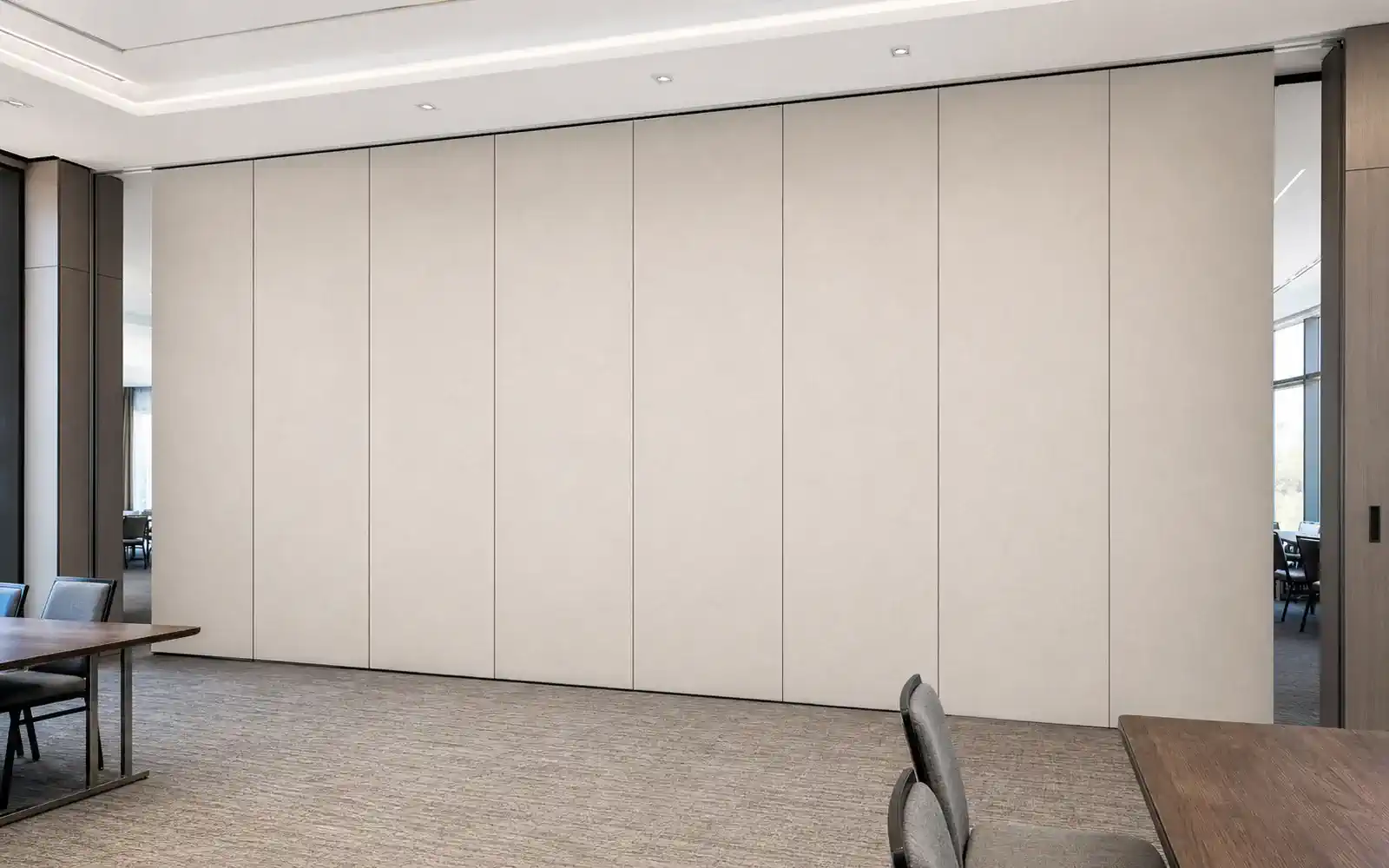
Evidence note
Visible shapes, finishes and photographs do not prove structural capacity, acoustic performance or installation outcomes. Those items require project-specific confirmation and matching evidence.
Weight Finishes, Pass Doors and Documentation
Project review term: movable partition tender interface risk.
Finish choices affect interface risk because they touch adjacent walls, ceilings and door frames. Confirmed finish options include laminate, melamine, fabric, leather, glass and other approved surfaces. The tender should show how selected finishes meet surrounding conditions without inventing compatibility claims.
Pass-door requirements and project documentation can be discussed as part of the bid. A pass door changes the panel layout, the route and the parking plan, so it belongs in the interface score rather than in a late variation.
Documentation checklist
- Layout drawings showing the closed, open and parked positions.
- A route description covering straight, turning and stacking movements.
- A finish schedule aligned with the approved options.
- A pass-door requirement stated with its location and swing.
- A clarification log naming open items and responsible parties.
Score the completeness of this package. Missing items are future coordination cost, even when the commercial number looks attractive.
Use Acoustic Concepts Carefully in Scoring
A tender may describe seals and acoustic concepts generically, but project-specific acoustic requirements need their own confirmation.
Do not award interface points for acoustic claims that lack supporting project evidence. Instead, score whether the bid identifies the acoustic interface items that must be reviewed, such as junctions, seals and adjacent construction.
Run a Pre-Award Interface Review
Before award, bring the leading bids through a short review. The aim is to convert assumptions into confirmed items or explicit exclusions. This protects both the buyer and the bidder.

- Walk the route on the layout and mark every change of direction.
- Confirm the parking position does not block required circulation.
- List every interface that another trade must resolve.
- Record finish and pass-door decisions in the tender record.
- Ask each bidder to restate open items in writing.
This review does not guarantee outcomes. It improves the quality of the comparison and reduces the chance that interface risk is discovered after contract signature.
Frequently Asked Questions
What is movable partition tender interface risk weighting?
It is a scoring approach that gives explicit weight to how well a bid manages the boundaries between the partition system and the surrounding building, including route, parking, support, finishes and documentation.
Should interface risk be scored separately from price?
Yes. Separating interface risk from commercial terms helps teams compare bids on coordination clarity rather than price alone. The weights should be set before bids are opened.
Does a top-hung partition need a floor track?
EBUNGE movable partition panels are top-hung and move without a continuous floor running track or floor hardware along the partition line.
Can acoustic ratings decide the interface score?
No. Acoustic interface items should be identified for project-specific confirmation rather than scored from generic claims.
What documents should a bidder provide?
Useful documents include layout drawings, route descriptions, finish schedules, pass-door requirements and a clarification log. The exact package depends on the project and should be stated in the tender.
When should the interface review happen?
A pre-award review lets the team convert assumptions into confirmed items or explicit exclusions while there is still time to compare bids fairly.
Conclusion and Next Step
Interface risk weighting is not about predicting performance. Teams that set weights early and review drawings consistently will make more defensible comparisons.
Review the movable partition wall product context, look at relevant project references, and then contact EBUNGE to discuss pass-door requirements, documentation and project-specific confirmation for your tender.
Continue Exploring
More Cost and Planning Guides
- Earlier guideBenchmark a Movable Partition Tender Against Prior Award Data
- Related guideRead a Movable Partition Tender Pricing Schedule for Hidden
- Related guideReview a Movable Partition Tender for Ambiguous Stacking Pocket
- Related guideReading a Movable Partition Tender for Hidden Interface Assumptions