
html body.single-post main#content.site-main{box-sizing:border-box!important;width:calc(100% – 32px)!important;max-width:900px!important;margin-left:auto!important;margin-right:auto!important;padding-left:0!important;padding-right:0!important}
Quick answer: tender evaluation matrix
Review focus: tender evaluation matrix.
A partition tender evaluation matrix scoring criteria set works only when every score can be traced to something a bidder actually submitted. Movable partition bids are easy to compare on headline price and hard to compare on substance, because the same opening can be described in several ways. A matrix that rewards verifiable evidence, and flags unsupported statements for clarification, protects the client and keeps bidders on equal footing.
This guide sets out a scoring structure for overseas contractors, architects, designers, owners and procurement teams. It stays within confirmed product facts and treats performance, engineering and commercial outcomes as items to confirm per project rather than assume.
Start With the Opening, Not the Brochure
Project review term: tender evaluation matrix.
Before any weighting is agreed, the tender pack should fix the physical problem. Record the clear opening, the intended parking position, and whether the panels must travel in a straight line, turn a corner, or stack away from the opening. These are layout questions, and they belong in the technical envelope of the matrix.
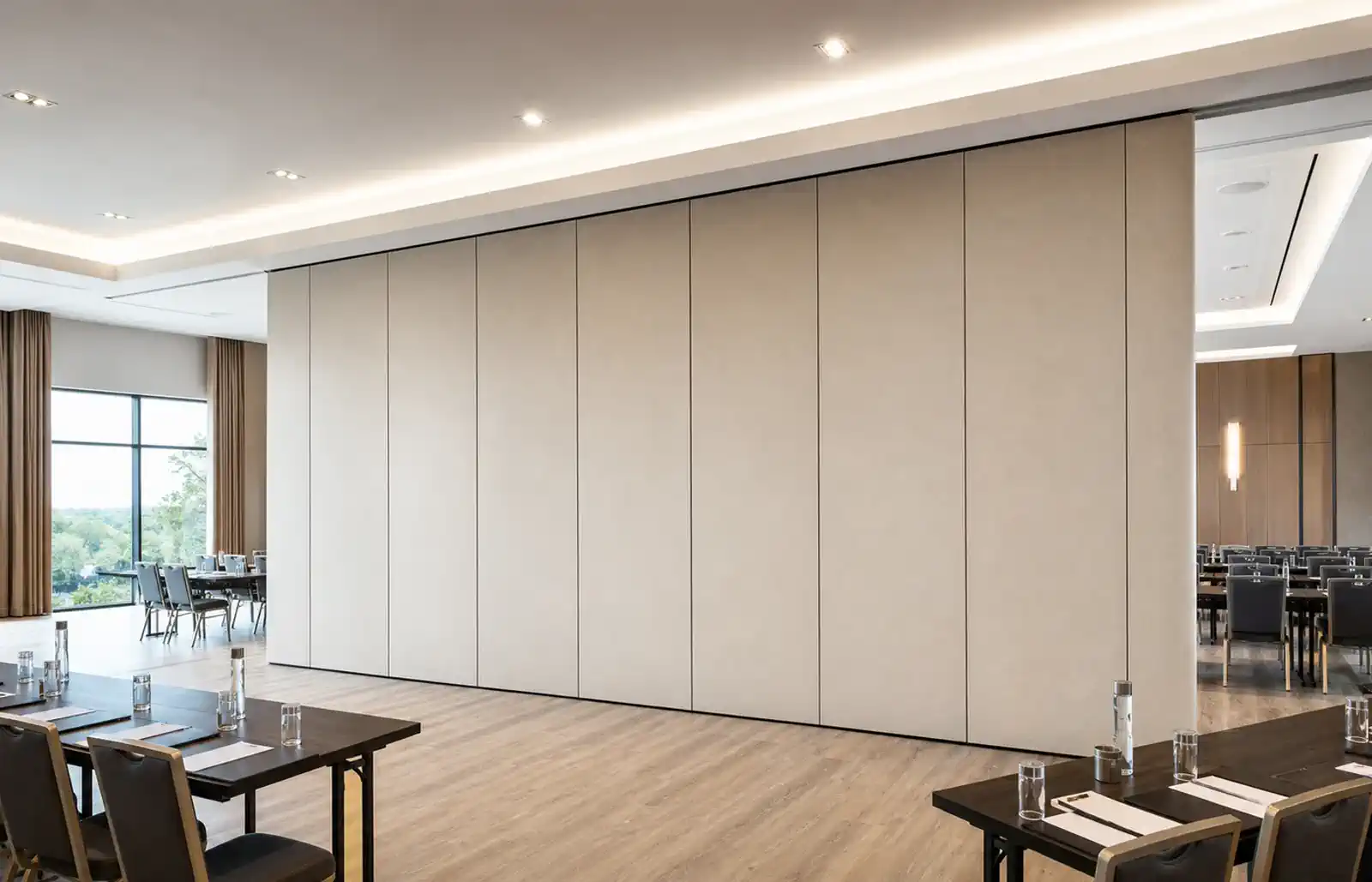
Movable partition panels are individually movable and suspended from a top track. They cross the opening without a floor track and park at a planned stacking position. That clear-floor behaviour is a genuine evaluation point, but it depends on a continuous connected overhead route and project-specific support review. A bidder who describes panels crossing a gap without a supported route has not answered the question.
Route evidence to request
- A marked-up plan showing the straight, turning and stacking routes.
- The suitability of each route and parking arrangement depends on the approved layout, circulation, ceiling interfaces and operating sequence.
- The proposed parking position and how it relates to adjacent doors, circulation and finishes.
- Any pass-door requirement, since this affects daily use of the room.
Score the Technical Envelope Separately
Coordination scope: tender evaluation matrix.
Keep technical compliance in its own block so that a strong price cannot mask a weak route proposal. Each line should be scored against a submitted drawing or written statement, not against a marketing page. Where a bidder is silent, score zero and raise a clarification rather than inferring capability.

| Matrix line | What is being scored | Evidence expected |
|---|---|---|
| Route and layout | Straight, turning and stacking paths reviewed against the layout | Marked-up plan and written route description |
| Top-hung principle | Clear floor along the partition line, with parking at a planned position | System description and elevation |
| Support coordination | Interface with the structure above the track | Coordination note or drawing reference |
| Finish selection | Laminate, melamine, fabric, leather, glass or other approved surfaces | Finish schedule and sample references |
| Pass doors | Whether a pass door is required and where | Written confirmation and detail drawing |
If acoustic criteria are included, define the required rating, the test context and the evidence format, and require project-specific confirmation.
Weight Finishes and Interfaces Fairly
Checklist focus: tender evaluation matrix.
Finish scoring is often where matrices drift into taste. Convert it into a compliance question: does the bidder offer the specified surface family, and can they show a sample or approved reference? Confirmed options include laminate, melamine, fabric, leather, glass and other approved surfaces. Score the offer against the specification, not against a photograph.
Consider ceiling condition, adjacent wall junctions, floor finish transitions at the parking zone, and how the stacked panels sit relative to circulation. None of these can be settled from a brochure; they need drawing review.
A short evidence note for evaluators
Score only what is written or drawn in the submission. If a claim about support, acoustics, dimensions or finishes cannot be traced to a document, mark it as an open clarification and do not award the points.
Build the Scoring Structure in Five Steps
Review focus: tender evaluation matrix.
- Fix the scope. Publish the opening dimensions, route intent, parking position and finish schedule in the tender documents.
- Separate the blocks. Use distinct sections for technical compliance, documentation quality, finish and interface coordination, and commercial terms.
- Define evidence per line. State what a bidder must submit for each line, such as a drawing, schedule or written confirmation.
- Set pass and fail gates. Treat route feasibility and support coordination as gates rather than tradeable points.
- Reserve a clarification round. Allow bidders to answer open items in writing so the final comparison rests on the same information.
Score Documentation Quality, Not Volume
A thick submission is not automatically a compliant one. Score whether the documents answer the questions asked: drawings at a usable scale, a finish schedule that matches the specification, and clear statements about what is included and excluded. Project documentation requirements can be discussed with the supplier during tender clarification, and the matrix should record what was agreed.
Keep commercial scoring simple and auditable. Compare like with like, note exclusions, and avoid converting unclear offers into assumed totals. Where a bidder offers alternatives, require them to be priced and described separately so the base offer remains comparable.
Handle Clarifications and Risk Openly
Clarification is not a weakness in the process; it is how a matrix stays honest. Log every question, the answer received, and the effect on the score. This protects the evaluation if a decision is later challenged and gives unsuccessful bidders a clear reason for the outcome.

Do not accept verbal assurances about support, acoustics or dimensional fit. Ask for them in writing and attach them to the bid record. Review the movable partition wall product context to frame technical questions, and look at project references for application examples only, not as proof of performance on your site.
Frequently Asked Questions
What should carry the highest weight in the matrix?
Route feasibility and support coordination should usually be gates, because a bid that cannot work in the layout is not comparable on price. Weight the remaining lines to reflect project priorities.
How should acoustic criteria be scored?
Define the required rating, the test context and the evidence format in the tender. Score the submitted evidence, and confirm project-specific acoustic requirements with the supplier rather than assuming a rating guarantees a result.
Can finish options be scored objectively?
Yes, by scoring compliance with the specified surface family and the quality of the sample or reference provided. Confirmed options include laminate, melamine, fabric, leather, glass and other approved surfaces.
Do bidders need to show a floor track?
No. The confirmed system is top-hung and crosses the opening without a floor track, parking at a planned stacking position. The overhead route must still be continuous and supported, which is a drawing review item.
When should a clarification round happen?
After initial scoring and before final comparison. It lets every bidder answer the same open items in writing, so the matrix reflects documented responses rather than assumptions.
What if a bidder offers a pass door?
Record it as a scope item and score the detail drawing. Pass-door requirements can be discussed during tender clarification so the offer matches how the room will be used.
Conclusion and Next Step
A defensible partition tender evaluation matrix scoring criteria set does three things: it fixes the layout problem, it demands traceable evidence for every scored line, and it keeps performance and engineering claims open until project-specific confirmation. Build the matrix around the opening and the route first, then score finishes, documentation and commercial terms on equal terms.
To discuss pass doors, finish schedules or documentation expectations for your tender, contact the EBUNGE team and share your layout drawings for review.
Continue Exploring
More Cost and Planning Guides
- Earlier guidePlan a Partition Reconfiguration Calendar Around Facility Budget Cycles
- Related guideCheck a Movable Partition Tender for Inconsistent Unit Rates
- Related guideBuild a Tender Clarification Question Bank for Partition Packages
- Related guideSet Bid Clarification Deadlines That Protect Your Partition