
Quick project answer
Stacked chairs in a school auditorium move along the same paths before and after events. Those paths often cross the partition line. The school auditorium partition finishes impact becomes visible where chair frames, casters, and legs contact wall surfaces. This article explains how a top-hung movable partition system and finish planning can address that wear.
Why Stacked Chairs Affect Partition Finishes
Stacked chairs are dense, heavy, and frequently repositioned. When they are pushed or carried along a partition line, their edges can abrade the lower portion of partition panels. The school auditorium partition finishes impact is concentrated at heights where chair parts make contact.
This wear is not a product defect. It is a use pattern. Planning should begin with how chairs are stored, moved, and returned. The finish selection and parking layout can then respond to that pattern.
The Top-Hung Principle and the Physically Uninterrupted Floor
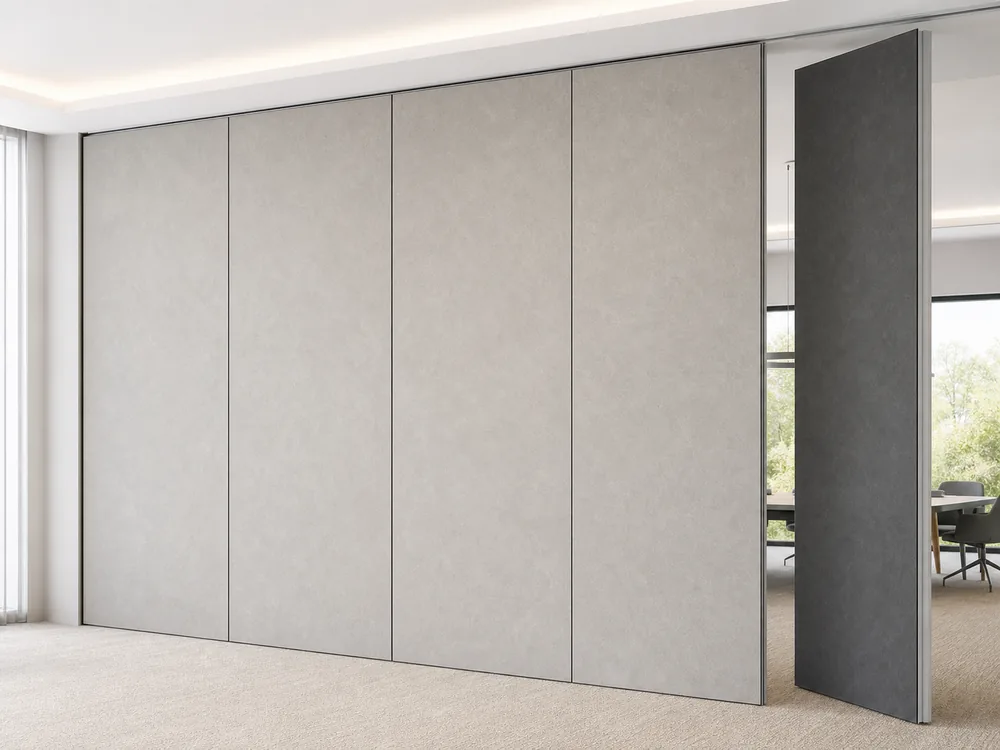
The EBUNGE movable partition system is top-hung. It has no continuous floor running track or operating hardware in the finished floor along the partition line. The floor is not cut or damaged for a floor track and remains physically uninterrupted by the maintained EBUNGE top-hung system.
Because the floor is uninterrupted, stacked chairs can move across the partition line without encountering a floor track. This reduces one source of finish abrasion at floor level. It also means the school auditorium partition finishes impact is managed primarily at panel surfaces rather than at a floor track.
The exact route, junction arrangement, continuous overhead path and parking position must be confirmed from the coordinated project drawings.
Parking Planning for Stacked Chairs
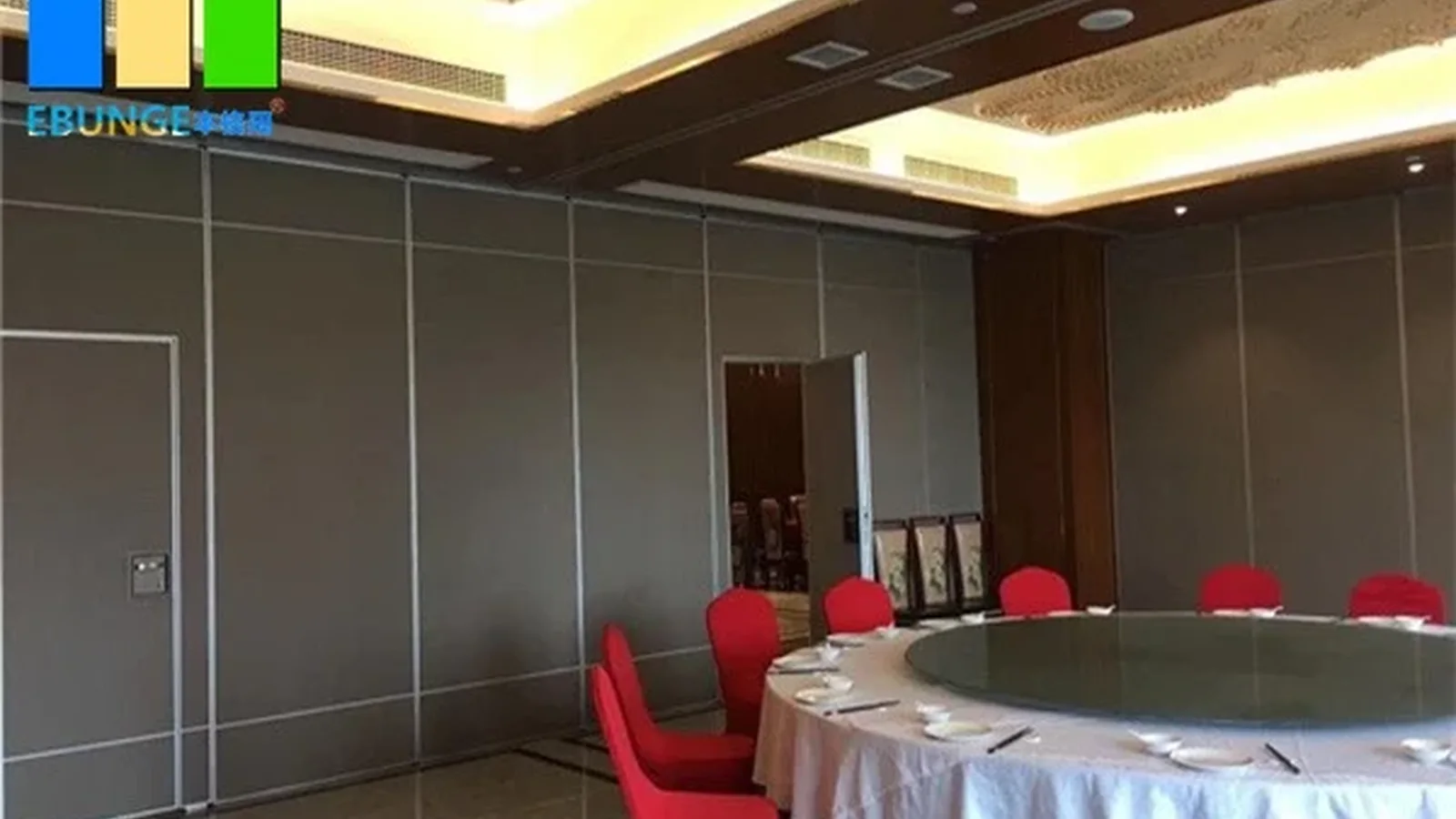
Panel parking style can be customized to the customer layout and project requirements, subject to coordinated drawings. A suitable approved parking arrangement can use the stacking area more compactly and coordinate with the space design. The exact track, support and panel layout still require project drawings.
When chairs are stacked near the partition line, the parking position affects how often panels and chairs share space. A compact parking arrangement may reduce the distance chairs travel along finished panel faces. This can lower the school auditorium partition finishes impact over time.
Parking planning should consider the chair storage zone, the partition line, and the path between them. These elements are confirmed through coordinated drawings, not assumed.
Finish Selection and Care Coordination
Finish materials can be customized, and cleaning and maintenance methods vary with the selected finish. This means the school auditorium partition finishes impact should be discussed with the finish supplier and the project team.
Different finishes respond differently to repeated contact. Some may show marks more readily; others may require specific care methods. The confirmed fact is that care methods vary with the finish. No universal cleaning outcome should be assumed.
Coordination should include the chair type, storage method, and expected frequency of use. These inputs help the project team select a finish that aligns with the school auditorium partition finishes impact profile.
Non-Limiting Applications and Use Cases
Movable partitions can be used wherever flexible space division, combination or reconfiguration is required. Application examples are not limiting. EBUNGE has completed many types of hotel-related movable-partition projects; ballrooms, wedding halls and multifunction halls are non-limiting examples.
School auditoriums are another context where flexible division may be useful. The school auditorium partition finishes impact is one planning consideration among many. No customer names, locations, quantities, ratings, certifications or outcomes may be inferred from past projects.
Buyer Inputs for Abrasion Planning
Buyers should gather information about chair handling, storage, and event frequency. This information supports finish and parking decisions. The suitability of each route and parking arrangement depends on the approved layout, circulation, ceiling interfaces and operating sequence.
Useful inputs include the number of chairs, typical stacking method, and the route chairs take. Also note whether chairs are pushed or carried. These details help the project team understand contact patterns.
Buyers should also confirm the partition line location and the available parking area. The exact route, junction arrangement, continuous overhead path and parking position must be confirmed from the coordinated project drawings.
Drawing Approvals and Project Coordination
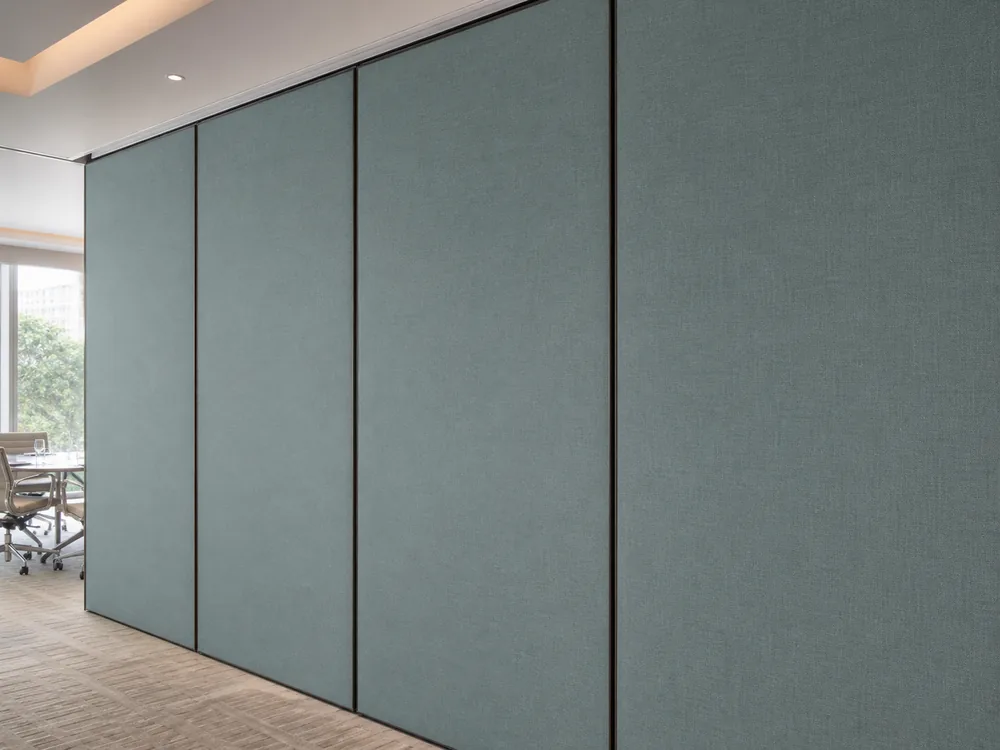
Coordinated drawings are the basis for confirming track, support, and panel layout. The school auditorium partition finishes impact should be reviewed alongside these drawings. Approvals should address parking style, finish selection, and chair movement paths.
Finish customization and care methods should be documented. The project team should confirm that the selected finish aligns with the intended use. The school auditorium partition finishes impact is then managed through coordinated design rather than assumption.
For related project examples, see projects. For general product information, see movable partition wall.
Frequently Asked Questions
What causes finish abrasion on school auditorium partitions?
Stacked chairs and other movable items can contact partition surfaces during handling and storage. The school auditorium partition finishes impact is often concentrated where chair frames, casters, or legs repeatedly touch the panels.
Does a top-hung system eliminate floor tracks?
The EBUNGE movable partition system is top-hung and has no continuous floor running track or operating hardware in the finished floor along the partition line. The floor remains physically uninterrupted by the maintained EBUNGE top-hung system.
Can parking style be customized for stacked chairs?
Panel parking style can be customized to the customer layout and project requirements, subject to coordinated drawings. A suitable approved parking arrangement can use the stacking area more compactly and coordinate with the space design.
How do finish materials affect abrasion planning?
Finish materials can be customized, and cleaning and maintenance methods vary with the selected finish. The school auditorium partition finishes impact should be reviewed with the finish supplier and project team.
What drawings are needed for approval?
The exact route, junction arrangement, continuous overhead path and parking position must be confirmed from the coordinated project drawings. Track, support and panel layout also require project drawings.
Are school auditoriums the only application?
Movable partitions can be used wherever flexible space division, combination or reconfiguration is required. Application examples are not limiting, and school auditoriums are one possible context among many.
Key Takeaways for Abrasion Planning
- Stacked chairs create repeated contact that defines the school auditorium partition finishes impact.
- The EBUNGE top-hung system leaves the floor physically uninterrupted by a floor track.
- Parking style can be customized, subject to coordinated drawings.
- Finish materials can be customized, and care methods vary with the finish.
- Buyer inputs and drawing approvals should address chair movement and parking.
The exact route, junction arrangement, continuous overhead path and parking position must be confirmed from the coordinated project drawings.
Planning for the school auditorium partition finishes impact is a coordination task. It brings together chair handling, finish selection, parking layout, and drawing approvals. By focusing on the top-hung principle and the physically uninterrupted floor, project teams can address abrasion where it occurs and support a durable result.
Continue Exploring
More Materials and Finishes Guides
- Newer guideRestaurant Operable Wall Finishes: Cleaning-Protocol Mapping
- Earlier guideOffice Suites Partition Finish: Glass vs Solid Panels
- Related guideWho Verifies Partition Handover Records When Trades Finish at Different
- Related guideMovable Partition Finish Sample Coordination Guide for Interior