
Quick project answer
Sports halls often need to change between full-court use, training layouts and community events. A top-hung movable partition can support that flexibility because the operating system is carried overhead. For planners, the practical question is how sports hall partition stacking pockets work alongside fixed wall equipment such as a wall-mounted first aid cabinet that swings out from the wall.
What the top-hung principle means for a sports hall
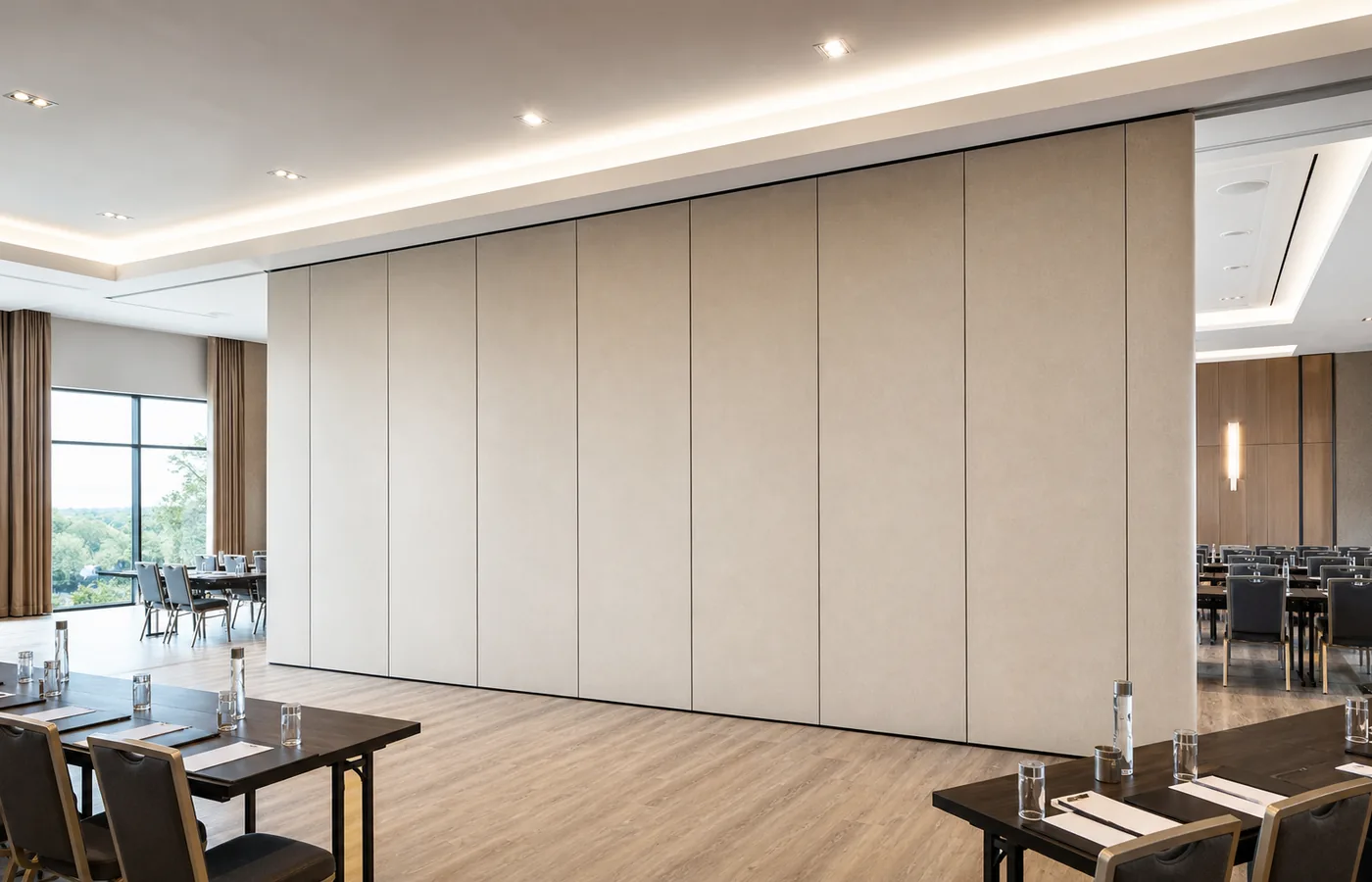
The EBUNGE movable partition system is top-hung. The panels are carried from an overhead structure rather than from a track set into the finished floor. This principle shapes how the room is planned, because the partition line does not require continuous floor hardware.
For a sports hall, that matters when the floor is used for play, training or equipment movement. The floor surface can remain physically uninterrupted by the maintained EBUNGE top-hung system. The floor is not cut or damaged for a floor track along the partition line.
This does not remove the need for coordinated design. The exact route, junction arrangement, continuous overhead path and parking position must be confirmed from the coordinated project drawings. Those drawings connect the partition layout with the rest of the hall.
Why a physically uninterrupted floor matters in sports halls
A sports hall floor is often a continuous playing surface with markings, impact areas and equipment zones. Introducing a floor track would change how that surface is planned and maintained. With a top-hung system, the finished floor along the partition line is not cut for a floor track.
That helps when the hall must switch between activities during the day. The floor remains physically uninterrupted by the maintained EBUNGE top-hung system, so the partition line does not become a permanent floor feature. The overhead path still needs engineering review.
Planners should treat the floor condition and the overhead condition as separate coordination topics. The floor can stay continuous, while the overhead route, support and parking position are resolved in drawings. The exact route, junction arrangement, continuous overhead path and parking position must be confirmed from the coordinated project drawings.
Planning sports hall partition stacking pockets
Sports hall partition stacking pockets are the areas where panels rest when the room is open. The panel parking style can be customized to the customer layout and project requirements, subject to coordinated drawings. A suitable approved parking arrangement can use the stacking area more compactly and coordinate with the space design.
In a sports hall, the stacking pocket may sit near a wall, a recess or a service zone. Its position affects how the hall is used when the partition is open. The pocket should be considered early, because it influences circulation, equipment storage and wall-mounted items.
Stacking pockets are not a universal product feature with fixed dimensions. The exact track, support and panel layout still require project drawings. That is why sports hall partition stacking pockets should be reviewed together with the overall hall plan rather than chosen from a catalogue alone.
Coordinating wall-mounted first aid cabinet swings
A wall-mounted first aid cabinet that swings out from the wall needs clearance in front of it. If a stacking pocket is planned nearby, the cabinet swing and the parked panels can compete for the same zone. This is a layout coordination issue, not a product limitation.
The cabinet swing should be shown on the coordinated drawings together with the parking position. The exact route, junction arrangement, continuous overhead path and parking position must be confirmed from the coordinated project drawings. That drawing review helps the design team see whether the swing path and the stacking pocket can coexist.
Where the cabinet swing and the pocket are close, the parking style may be adjusted to suit the layout. Because panel parking style can be customized to the customer layout and project requirements, subject to coordinated drawings, the design team can explore options before finalizing the hall plan.
Finish selection and care coordination
Finish materials can be customized, and cleaning and maintenance methods vary with the selected finish. In a sports hall, the finish choice may relate to the surrounding wall and floor palette, but the confirmed point is that finishes are customizable and care depends on the finish selected.
Cleaning and maintenance methods vary with the selected finish, so the project team should record the chosen finish and its care method. This is separate from the top-hung principle and from the stacking pocket layout. Each topic belongs in the project documentation.
Finish coordination should also consider how the stacking pocket is accessed and how the wall-mounted first aid cabinet swing is used. The exact route, junction arrangement, continuous overhead path and parking position must be confirmed from the coordinated project drawings.
Non-limiting application examples
Movable partitions can be used wherever flexible space division, combination or reconfiguration is required. Application examples are not limiting. A sports hall is one context, but the same top-hung principle can be considered in other spaces where a continuous floor is preferred.
EBUNGE has completed many types of hotel-related movable-partition projects. Ballrooms, wedding halls and multifunction halls are non-limiting examples. No customer names, locations, quantities, ratings, certifications or outcomes may be inferred from those examples.
For sports hall partition stacking pockets, the useful lesson is that parking and wall equipment should be coordinated early. The same coordination approach applies when a wall-mounted first aid cabinet swings into a zone near a stacking pocket.
Buyer inputs and drawing approvals
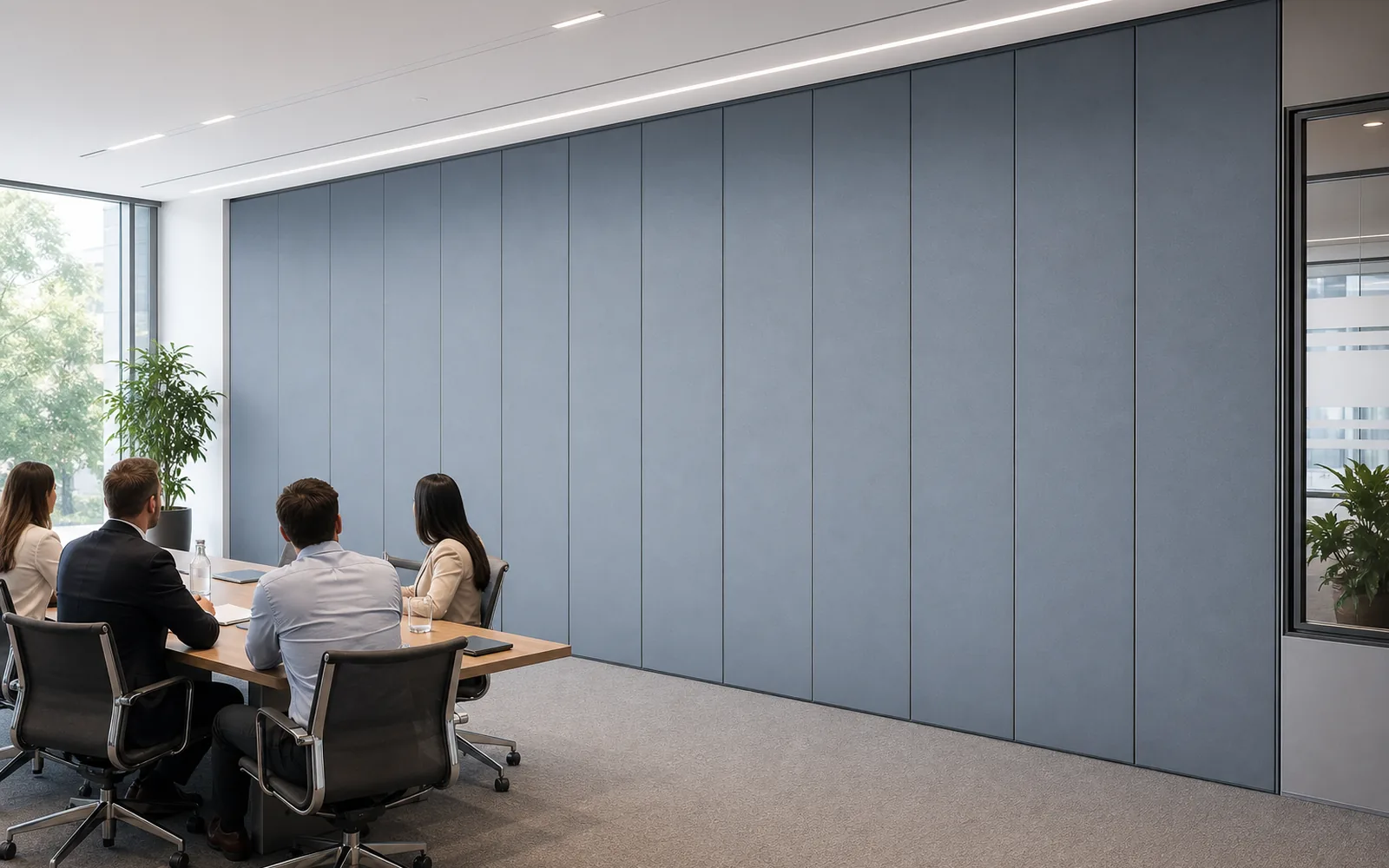
Buyers can prepare a short list of inputs before drawings are developed. These inputs help the project team review sports hall partition stacking pockets and nearby wall equipment. The list below is a starting point, not a substitute for coordinated drawings.
- Hall layout showing the partition line and the open-room condition.
- Proposed stacking pocket zone and any adjacent wall-mounted equipment.
- Swing clearance for a wall-mounted first aid cabinet where applicable.
- Preferred finish direction for the project team to review.
- Any known constraints on the overhead path that require engineering review.
Approval should be based on coordinated drawings rather than on assumptions. The exact route, junction arrangement, continuous overhead path and parking position must be confirmed from the coordinated project drawings. This boundary applies to every project, including sports hall partition stacking pockets.
Reviewing the stacking pocket with the cabinet swing
A simple review table can help the project team compare the two zones. It does not replace drawings, but it can organize the discussion before approval.
| Review item | What to confirm |
|---|---|
| Stacking pocket zone | Parking style and position relative to the hall layout |
| Cabinet swing | Clearance in front of the wall-mounted first aid cabinet |
| Overhead path | Route and support as shown on coordinated drawings |
| Finish | Selected finish and its finish-specific care method |
When these items are reviewed together, sports hall partition stacking pockets can be planned with more confidence. The exact track, support and panel layout still require project drawings. Project teams should also use the allowed internal links to review related products and projects.
See /products/ for product information and /projects/ for project context. These pages support early coordination but do not replace the coordinated drawings required for a specific hall.
FAQ
What are sports hall partition stacking pockets?
Sports hall partition stacking pockets are the areas where top-hung movable partition panels rest when the hall is open. The panel parking style can be customized to the customer layout and project requirements, subject to coordinated drawings.
Does a top-hung partition require a floor track?
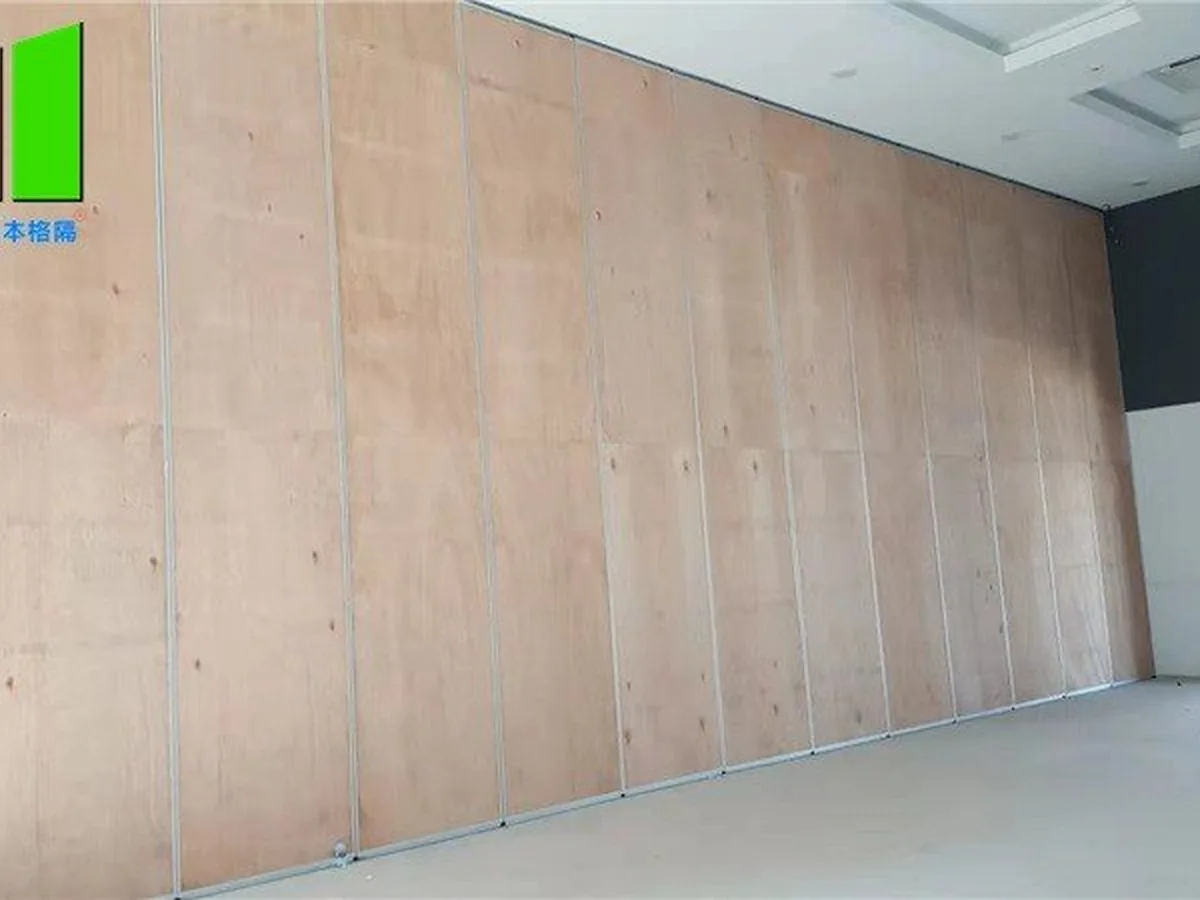
No continuous floor running track or operating hardware is required in the finished floor along the partition line for the maintained EBUNGE top-hung system. The floor is not cut or damaged for a floor track.
Can a wall-mounted first aid cabinet swing near a stacking pocket?
It can be considered during coordination. The cabinet swing and the parking position should be shown together on the coordinated drawings so the design team can review clearance and layout.
Can the stacking pocket layout be customized?
Panel parking style can be customized to the customer layout and project requirements, subject to coordinated drawings. The exact track, support and panel layout still require project drawings.
Are finishes and cleaning methods fixed?
Finish materials can be customized, and cleaning and maintenance methods vary with the selected finish. The project team should record the chosen finish and its care method.
Where can movable partitions be used?
Movable partitions can be used wherever flexible space division, combination or reconfiguration is required. Application examples are not limiting, and sports halls are one possible context.
Continue Exploring
More Operable Wall System Guides
- Newer guideAirport Holdroom Partition Stacking: Ceiling Boarding Signs Clearance
- Earlier guideCommunity Hall Partition Stacking and Projector Screen Housing Clearance
- Related guideEvacuation Chair Routes Where Operable Walls Cross Accessible Paths
- Related guidePhase Operable Wall Work When a Renovation Adds a New Wing